For 35 years, Washington State’s Growth Management Act (GMA) has been a success at reducing sprawl and preserving rural character. It has experienced less sprawl than similarly fast-growing Colorado over those 35 years.
But 35 years later, state development patterns are changing as development shifts away from cities towards unincorporated Urban Growth Areas (UGA). Lower density growth of UGAs isn’t inherently bad, but does increase negative externalities like traffic congestion, longer routes for school buses and first responders, and long-term infrastructure liabilities that can eventually devastate the budgets of local governments. Washington must defend the gains of the GMA’s first 35 years.
Good GMA
Original supporters of the GMA sought to prevent the ‘Californication’ of Washington via unchecked suburban sprawl as well as saving ‘rural character,’ protecting the environment and creating a predictable set of development rules.
The core of the GMA is land use. The GMA requires counties to create UGA borders around cities, with intensive development permitted within and restricted outside the UGA boundaries.
Washington versus Colorado
To understand Washington’s land use and growth, it’s useful to contrast with Colorado. Both states are fast growing, each seeing 40% population growth since 2000, but Colorado has used much more land than Washington to accommodate that growth.
The U.S. Department of Agriculture’s National Resources Inventory measures the changes in land use, measuring, for instance, when a farm becomes a subdivision. USDA reports changes in five-year increments, allowing one to track the growth of urban areas over time. Between 2000 and 2025, Washington State’s population increased by 2.2 million, half a million more than Colorado’s 1.7 million. But Washington used much less land – 263,000 acres – to accommodate that growth, compared with 310,000 acres for Colorado. Washington's growth was about 50% denser on a per acre basis.
The increased density in Washington wasn’t an accident. It’s a result of the state’s rules-based development regime compared with Colorado’s fragmented, hyper-local and competitive regime. Washington allows for local decision-making, but only within strict frameworks that dictate limits and requirements.
In contrast, Colorado is a ‘local control’ state with no such top-down control. Most Coloradans live in ‘home-rule’ cities with absolute control over local affairs, such as zoning maps and building codes, independent tax authority, and right to expand via annexation as far as their (strained) water resources allow.
In a fast-growing state, combined tax and zoning authority lead to perverse incentives, Colorado cities compete fiercely for retail commerce and housing, gobbling up and annexing adjacent farms and forests to collect tax revenue. The result is 150 miles of sprawl, north and south of Denver and tiny towns that mushroom into sizable suburbs seemingly overnight.
Washington’s GMA has hemmed in sprawl but not prevented it. Low density suburban growth cannot leapfrog rural areas, cities can’t endlessly sprawl and annexation is difficult – requiring agreement of both city and county leaders.
The GMA also has a quasi-judicial body, the Growth Management Hearings Board (GMHB), with the authority to resolve land-use disputes and enforce state laws against municipal or county scofflaws. The GMHB has repeatedly reversed or overruled local attempts to sprawl, reversing land use decisions in Spokane County in 2015, Clark County in 2004, overturning King County’s Bear Creek sprawl in 1990 and Kitsap County’s Keyport in 2007.
GMA loses its mojo
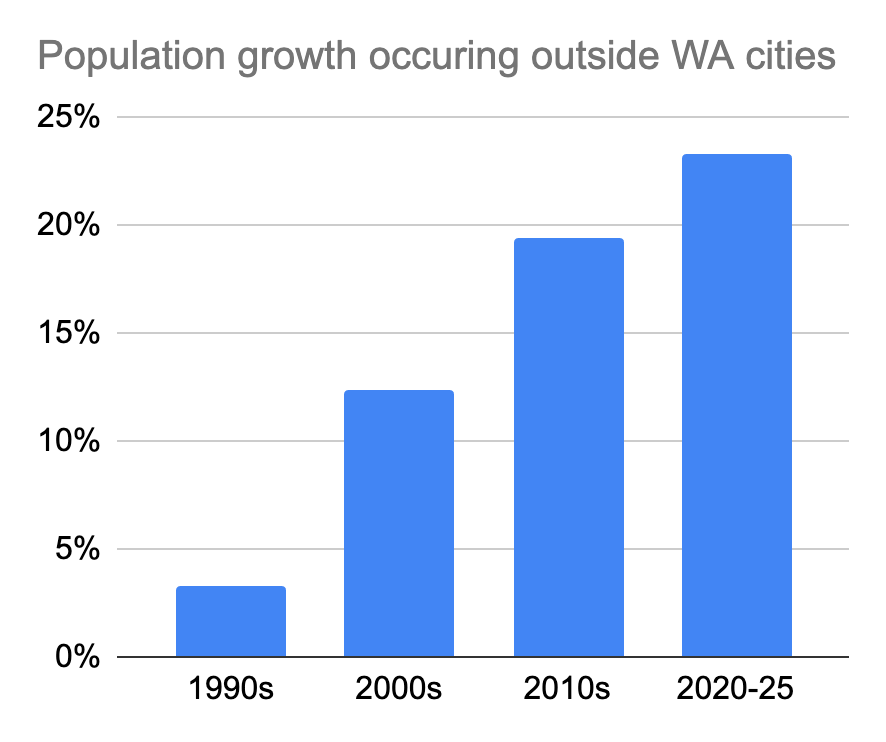
But the GMA may be losing its ability to restrict the ever-expanding sprawl. Washington’s Office of Financial Management (OFM) measures annual population growth according to jurisdiction type, distinguishing between incorporated cities and unincorporated counties. In the 1990s, the vast majority of population growth occurred within cities, but each decade since 1990, an ever higher proportion of growth occurred outside of incorporated cities.
That trend is particularly notable in Washington’s largest counties. Between 2010 and 2025, 51% of new residents to Tacoma’s Pierce County moved into homes outside of incorporated cities. In Snohomish the figure was 48%, Kitsap 41%, Clark 39% and Spokane 36%.
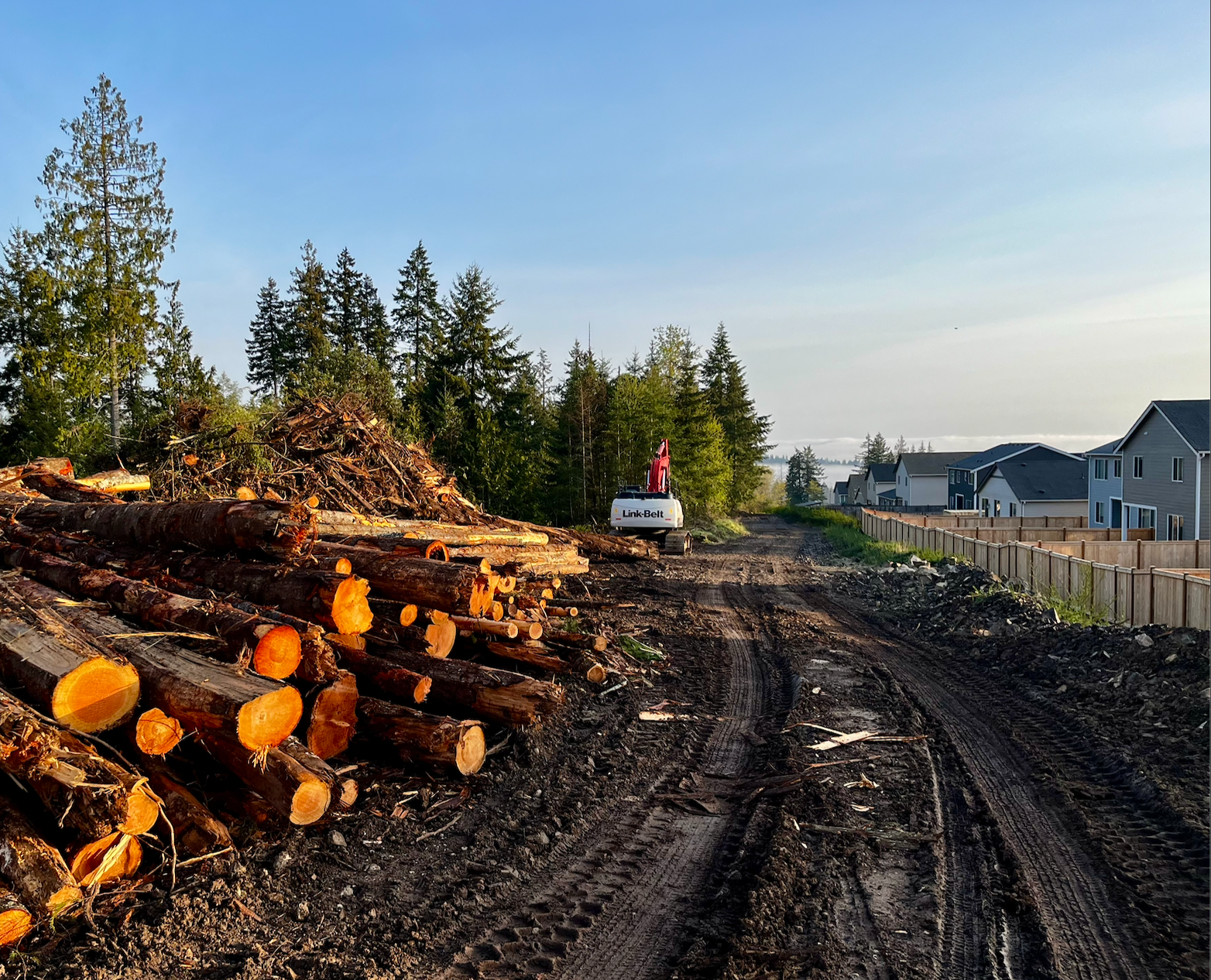
Of these counties, Snohomish has the more enlightened local development patterns, creating relatively small unincorporated areas, tucked beside and between incorporated cities. Pierce chose giant sprawling tracts of ever receding forest east of Tacoma.
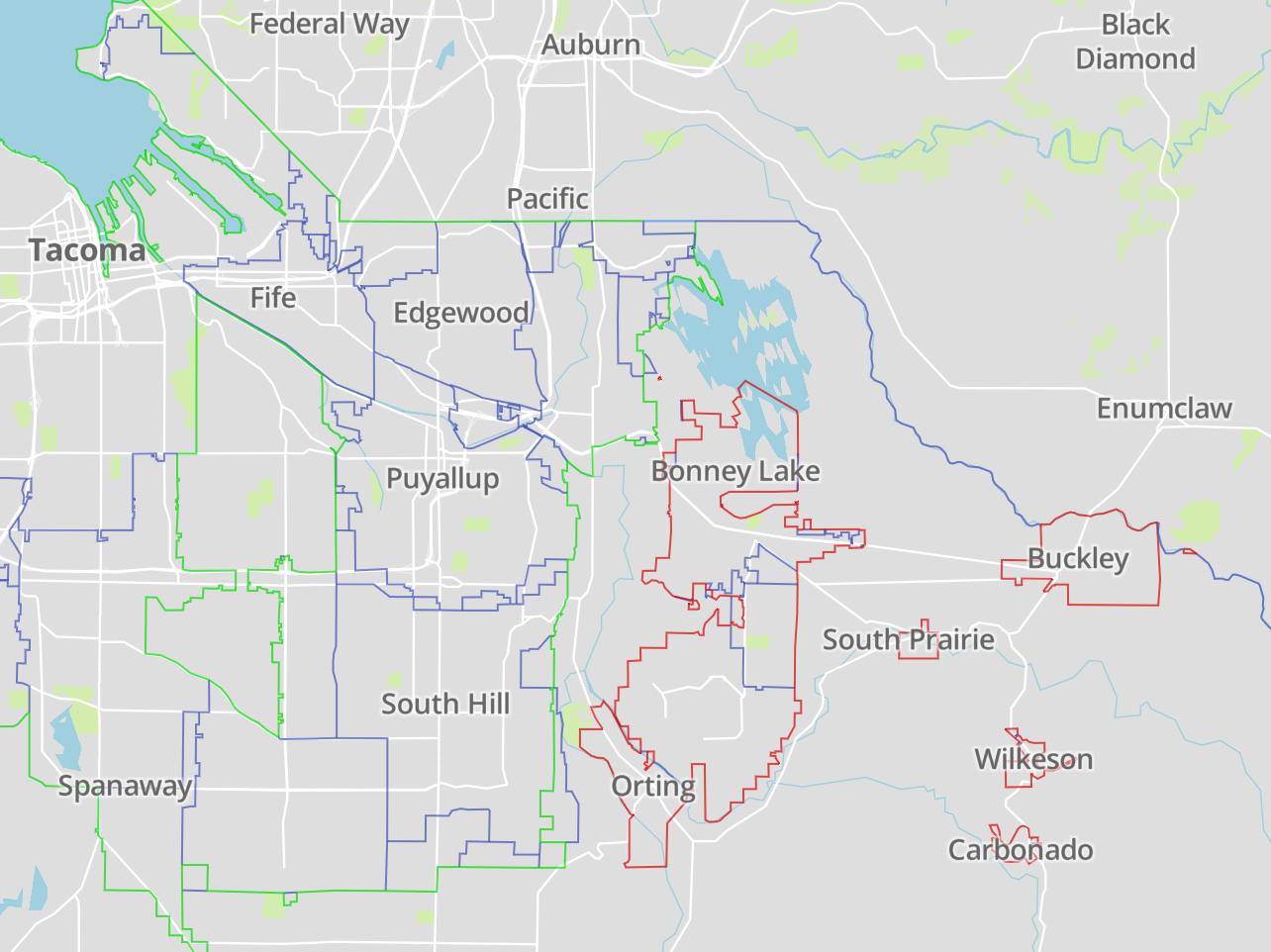
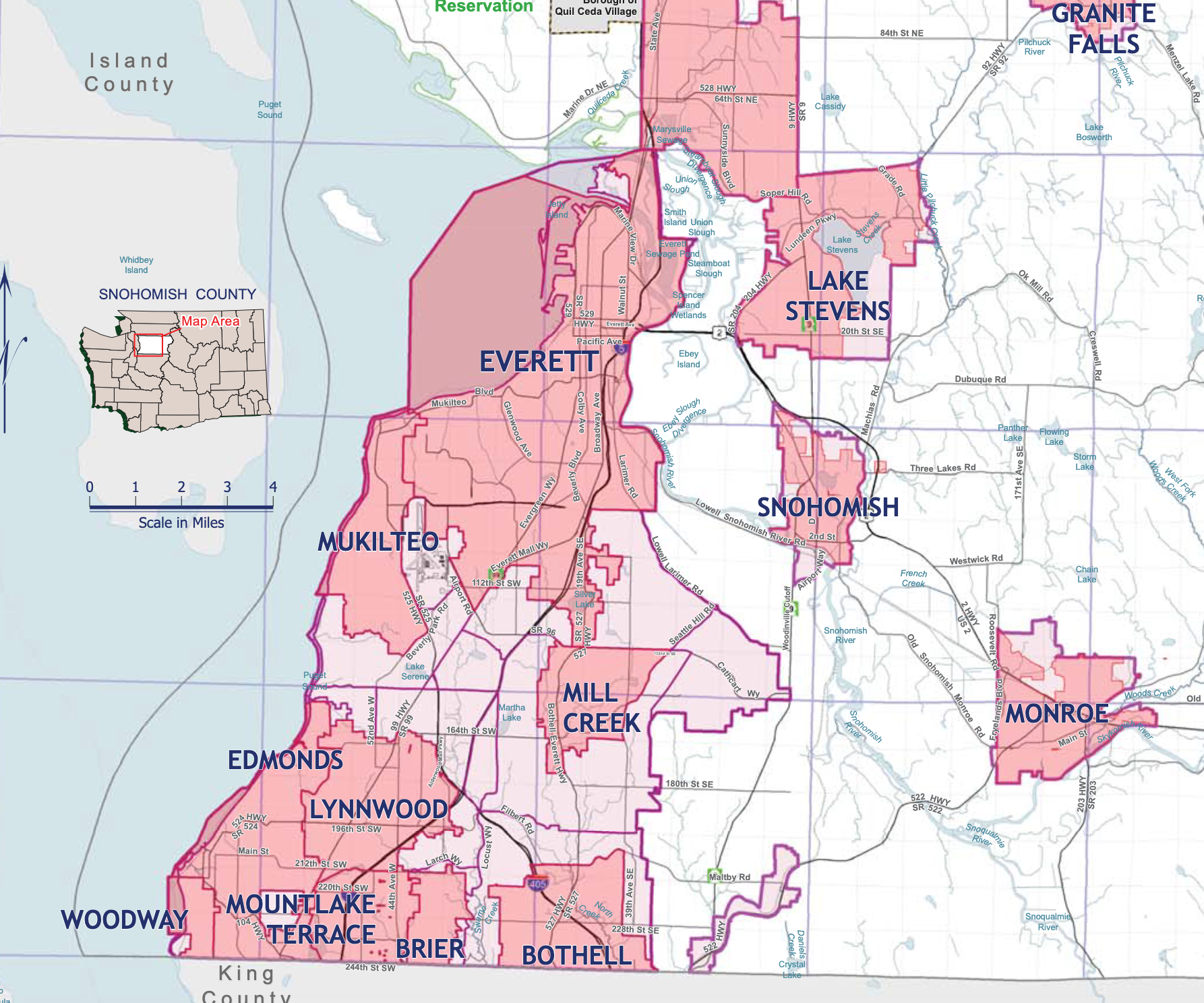
Pierce and Snohomish Counties divergent growth patterns - vast sprawl in East Pierce County vs. tight UGAs placed between cities in Snohomish. (Pierce County & Snohomish County)
Bad UGA
Ironically, the largest source of sprawl is the exact same mechanism the GMA designed to limit sprawl: the unincorporated UGA. The GMA requires that counties and cities “shall include areas and densities sufficient to permit the urban growth that is projected to occur in the county or city for the succeeding twenty-year period.”
In other words, Washington’s counties are legally required and financially incentivized to create ample space for housing development, most of which is located in undeveloped forests and fields. The promise of sales and property taxes encourages counties to compete with cities for new growth, often offering tax incentives, pre-approval for environmental impact and fresh, ample tarmac and stoplights to handle traffic.
The GMA’s definition of “areas and densities sufficient to permit” clause allows counties to create zoning maps as dense or sprawling as they choose. King County anticipates 650,000 new residents and sets aside 24,500 acres of ‘buildable land’ – 26 people per acre. Olympia’s Thurston County UGA is only expected to accommodate 11 new residents per acre, Bremerton’s Kitsap 12, Tacoma’s Pierce 16. Fewer people per acre means more acres of sprawl.
Another factor increasing sprawl is that developers often build at lower densities (housing units per acre) than counties or cities supposedly require, because land used for streets, parking lots, natural areas, water catchment basins and playgrounds is excluded from unit per acre calculations. A recent development within the City of Bremerton was zoned for a minimum of 8-10 homes per acre, but ended up containing just 365 homes across a sprawling 130 acres – less than three homes per acre.
In greenfield developments, developers usually pay for new streets, street lights and sewers, but counties are stuck with the maintenance costs for thousands of new linear feet. Counties struggle to provide sidewalks and parks. New suburbs add new miles to school bus routes, snow plowing and county sheriff patrols.
The distant, dispersed developments become transit and active transportation deserts, too far from bus stops, too far to bike from job and cultural centers. Even where transit does exist, the low population densities force infrequent service that push most residents to continue to rely on cars.
And lastly is the dastardly problem of coordination. Cities and counties simply fail to cooperate, particularly on transportation projects that cross city/county boundaries. Kitsap County won a state grant for a much-needed Safe Routes to School project near a middle school. But the project stops 300 feet short of the school’s main entrance, because the school is located within the City of Bremerton. Bremerton has no plans to complete the one-block gap.
GMA in the next 35 years
Washington has a lot of work to limit the growth of sprawl.
Cities carry much of the burden and opportunity. Cities should encourage new development by reducing red tape around permitting, in order to reduce the power of neighborhood councils and eliminating costly parking mandates. And cities should reduce traffic congestion by locating denser housing near transit and building active transportation facilities, like sidewalks and bike lanes.
Counties should update their growth plans to encourage more infill development, less horizontal sprawl. They should rezone commercial land for mixed use and increase required densities on existing undeveloped land to minimize horizontal growth. And they should look to partner with their local cities to encourage smart growth and transportation.
Washington State must strengthen the GMHB to compel cities to allow housing development, and lawmakers should outlaw parking minimums statewide. The state should encourage its designated ‘Regional Transportation Planning Organizations,’ like the Puget Sound Regional Council (PSRC), to encourage cooperation between cities and counties and fund collaboration on active transportation projects.
Washington’s Growth Management Act has served the state well for 35 years. The next 35 will be harder. Let’s get to work.
 Ryan Packer