But... new untested affordability requirements could jeopardize state compliance.
The City of Bainbridge Island will pursue interim development regulations that increase capacity for new housing throughout its downtown core of Winslow, a move that should finally bring the city in compliance with the Growth Management Act (GMA) more than 19 months after a state-imposed deadline. The change in course was prompted by the refusal of the Washington State Commerce Department to offer the City a deadline extension last week that would have postponed activation of a new accountability tool known as the Builder's Remedy.
Without state pressure, Bainbridge Island looked to be heading for several more months of deliberations around how exactly to add density to accommodate state laws like House Bill 1220, a 2021 update to the GMA that requires cities to plan for expected population growth across income levels.
Those state requirements have been vexing Bainbridge officials for years now, particularly a bloc of councilmembers opposed to adding additional capacity for new market-rate units in Winslow. Those councilmembers have argued that the city should be solely focused on delivering units for lower-income residents, despite a limited ability for developers to provide affordable units at scale without subsidy, which Bainbridge generally does not offer.
Bainbridge Island housing advocates, on the other hand, argue that the city should be focusing growth into Winslow rather than continuing the island's longstanding trend of adding more single-family homes in the so-called "conservation area" outside of growth centers.
As it stands, base zoning caps building heights at 35 feet, even in the core of Winslow, with modest increases for including affordable housing or "tucked under" parking.
If the City doesn't adopt interim regulations by the state's August 26 deadline – importantly, ones that have already been reviewed by the state under the 2025 Housing Accountability Act – Bainbridge is on track to the first Washington city to see the Builder's Remedy triggered. Under remedy provisions, the City would be required to approve any building permit application that meets the state's affordability requirements, regardless of existing zoning and development standards.
In other words, a permit for an eight- or 10-story building would have to be approved regardless of existing height limits, as long as a certain number of units are set aside for households at specific income levels, including the option of building all units for households making 120% of Kitsap County's area median income (AMI) for a period of 25 years – a threshold that translates to a monthly rent that is close to market rate, or around $2,900 per month for a one-bedroom apartment.
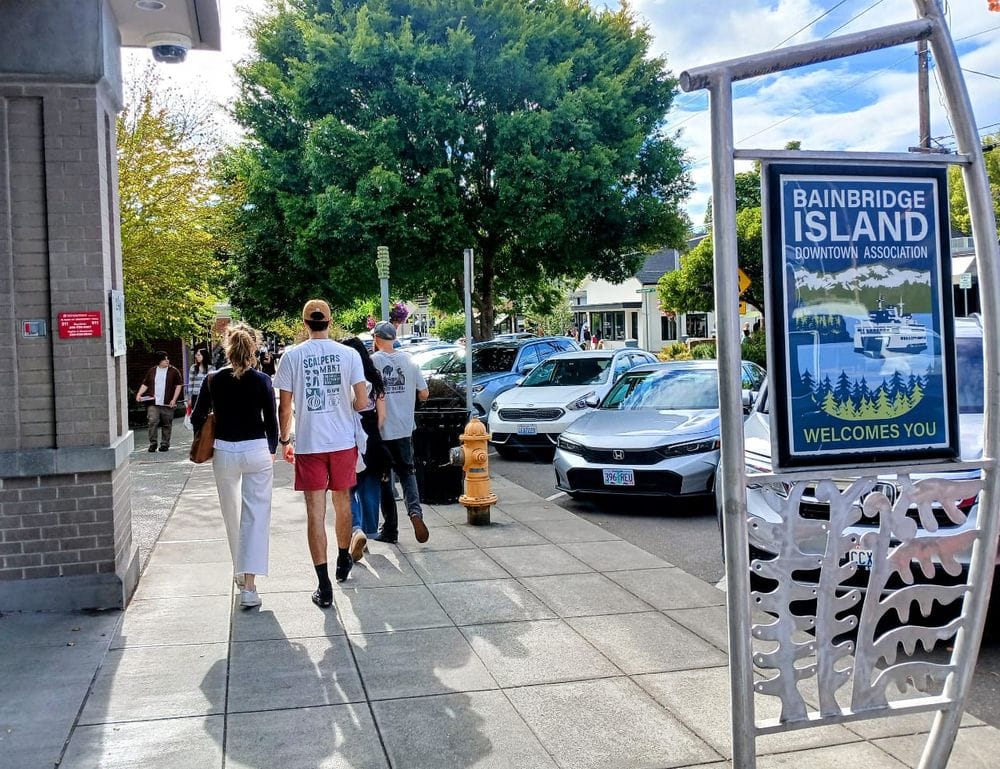
In denying the request for another 120-day extension, Commerce held firm and instead told City leaders that an interim ordinance, which would expire after a certain amount of time if not renewed, is the best path toward compliance with the Housing Accountability Act. Bainbridge Island is one of eight cities whose growth plans are currently being scrutinized this year under that law's "targeted review" provisions. Of the eight, it's the largest in population by far. Much of this is uncharted territory for both the City and the state.
"Although the city has pursued a subarea plan and comprehensive plan concurrently, the city has already had an additional 18 months past its periodic update due date to complete this additional work," an August 5 letter signed by Commerce Housing Planning and Data Manager Laura Hodgson stated. "[T]he updates to state law requirements since the periodic update due date are minimal and have been sufficiently drafted by the city."
The interim development standards set to be adopted at an August 25 meeting would modestly increase base floor area ratio (FAR) in the Ferry Terminal and High School Road districts within Winslow to 1.0, as well allowing additional density with affordable units wrapped into the project. That means a two story building could take up 50% of a lot by-right, not an earth-shattering level of density, but a far cry from the restrictive 0.3 and 0.5 FAR in place now.
Those regulations would stay in place until the City adopts a permanent ordinance that could potentially walk back density allowances, with four councilmembers previously approving a motion to advance a less ambitious version of the framework last month.
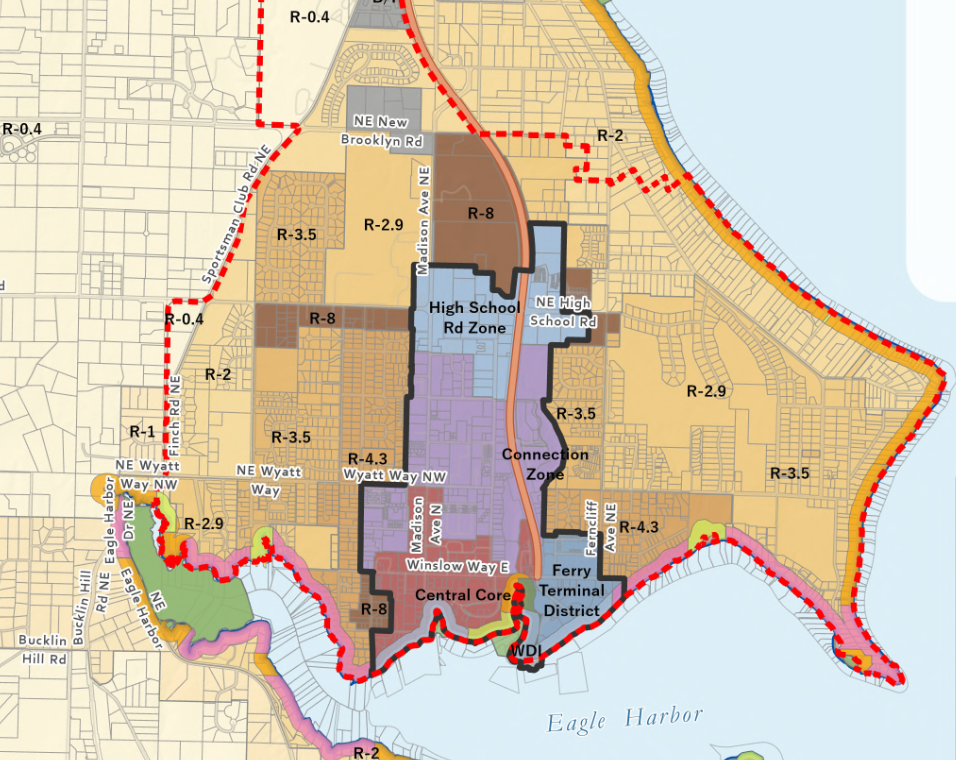
There is one potential catch. With its 6-1 vote Tuesday, the Bainbridge Council also voted to include a new mandatory inclusionary zoning (MIZ) program on top of the regulations that Commerce had already said are up to snuff. That program would require builders advancing projects with 10 or more units to set aside 10% of their units at 80% of AMI or below and 10% of unit at 110% of AMI or below, a concept that was only advanced last month by Bainbridge's Planning Commission.
With no clear picture yet of MIZ's impact on the city's new land capacity analysis, that issue could throw a wrench into the entire plan to get into compliance within two weeks. Exacting affordability requirements could end up killing the feasibility of the new housing that the interim regulations were intended to unlock, and the fact Bainbridge didn't conduct an economic analysis before adopting them could be a cause for concern for Commerce.
Voting against the idea of an interim ordinance altogether was Councilmember Mike Nelson, who suggested that the City could pursue legal recourse against the state instead of complying. Although Commerce has affirmed its view that the Builder's Remedy provisions in the Housing Accountability Act do apply to Bainbridge Island, many city residents disagree with that position, and have asserted that the entire city is exempt because it is considered a Critical Aquifer Recharge Area. That recharge status previously led to the city being exempted from the state's landmark Middle Housing Law, HB 1110.
"I actually think we should go a different way, and I really wouldn't mind a court weighing in as to the extent to which the Builder's Remedy applies to Bainbridge Island, because I'm quite certain that we're exempt, because the entire island is a critical area," Nelson said. "I will be voting no primarily because I don't support the market-rate upzoning that's included in this interim development regulations."
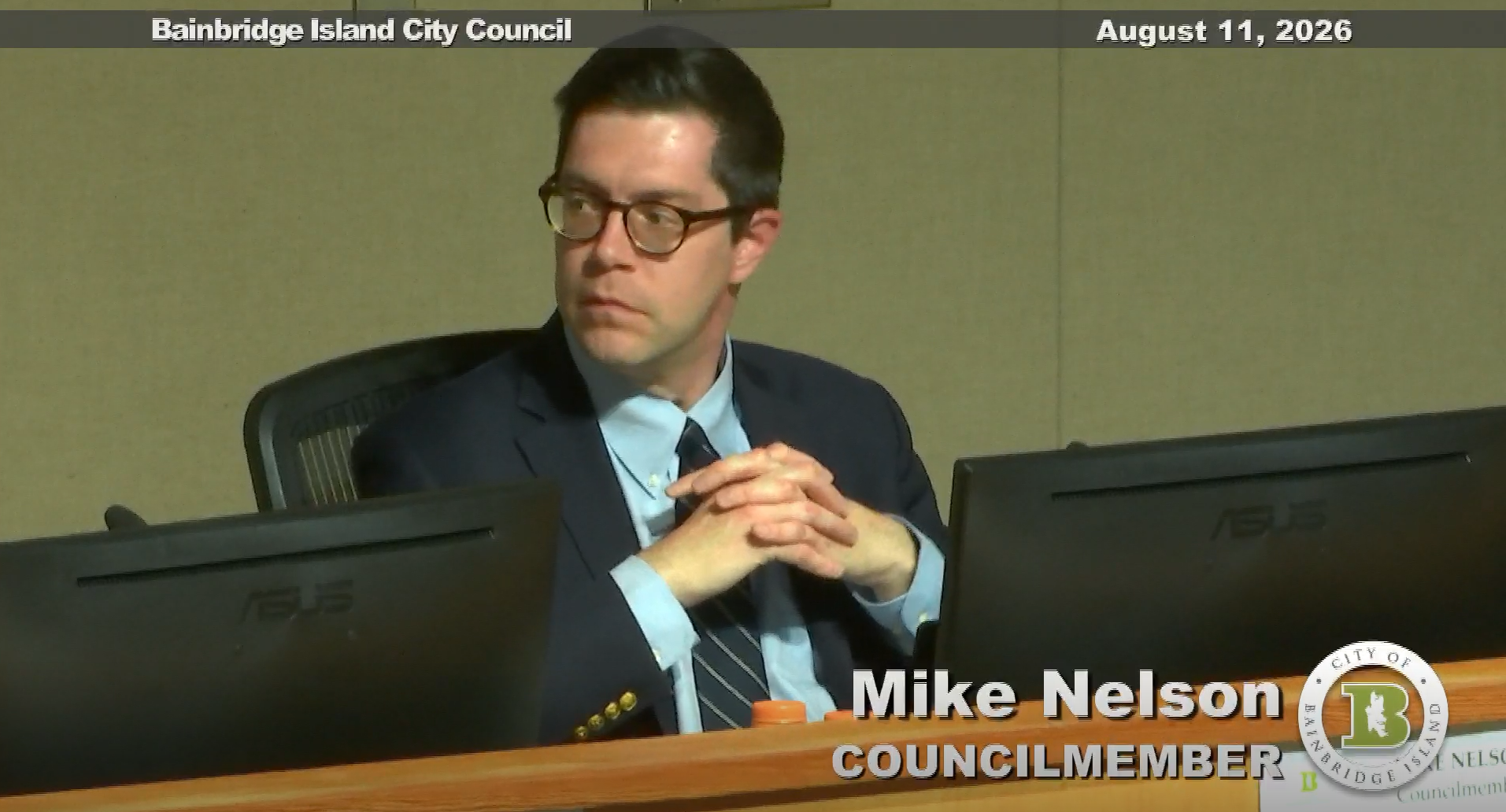
But Nelson was not joined by either Lara Lant or Kirsten Hytopoulos, two councilmembers who usually side with him in pushing back against the idea of increasing density within Winslow. Hytopoulos noted that layering on affordability requirements was the main reason she got to yes.
"Essential to this, to endorsing this approach, is layering on the inclusionary zoning, the mandatory inclusionary zoning, so that if anything comes through during this period, that there will be that component," Hytopoulos said. "I gave a lot of thought to whether the Builder's Remedy would be good enough because, I mean, none of us up here have a problem with what it says, other than we don't understand, ultimately – we're not going to know what these barriers [to developing a Builder's Remedy project] are. It's not clear we can use it. The goals, I think, we would all agree with."
Ultimately, if Commerce does give the greenlight, the interim ordinance will pave the way for yet more debate over the final version of Bainbridge's growth plan, something that could stretch for many more months. The whole saga will illustrate the role of state accountability infrastructure when it comes to getting cities to accept more housing.
 Ryan Packer
 Ryan Packer