Kettle floats deeper housing cuts to pay for it.
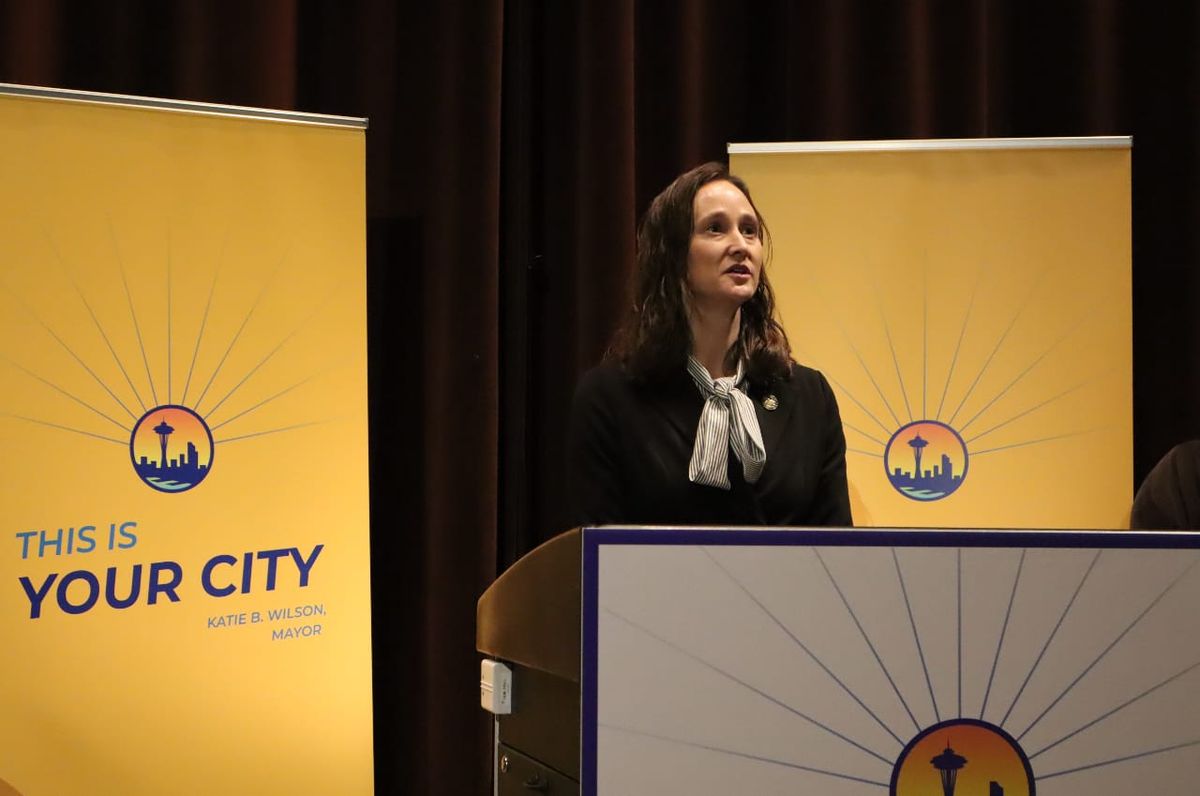
After Seattle Mayor Katie Wilson’s 2027 proposed budget was released last week, the focus shifted to the Seattle City Council, some members of whom have made it clear during several days of meetings with City department heads that they are not happy with the proposal in front of them.
Councilmembers’ ire stands in stark contrast to the response of Seattle’s business community, who have been cautiously supportive of Wilson’s budget plan. Wilson deftly sidestepped a large amount of potential criticism from business interests with her focus on addressing the City’s structural budget deficit while not raising significant new taxes and increasing investment in the Seattle Police Department (SPD). Indeed, some might say she came out looking like the adult in the room, which was clearly a deliberate strategy on her part.
But Wilson’s fiscal responsibility has left less room for the Seattle City Council to maneuver in the last budget season before the majority of councilmembers (six, since Councilmember Debora Juarez will be stepping down before the end of the year) are up for reelection.
In an effort to close the $175 million budget deficit as well as to keep the budget deficit-clear through 2030, Wilson chose to discontinue the majority of one-time spending that was pervasive in 2026’s budget. This strategy marks a departure from the budget ethos practiced by her predecessor, Bruce Harrell, as well as upsetting the councilmembers who added most of those one-time investments without finding ongoing funds to continue them past this year.
City Budget Office Director Aly Pennucci told the council in one of their budget meetings this week that across the General and Jumpstart payroll tax funds, the 2026 budget spent $78 million in these one-time budget adds. Wilson’s proposal only continued $10-15 million of these investments, converting them into ongoing expenses for the City.
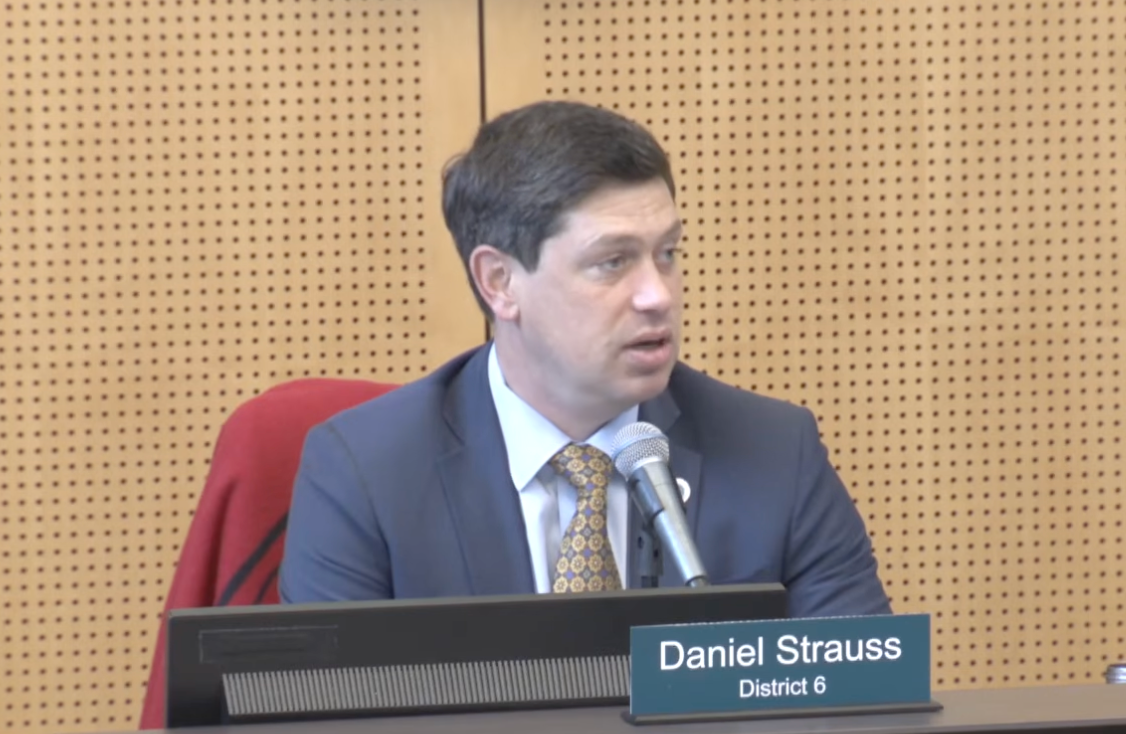
That being said, councilmembers weren’t even always happy about the investments that were maintained from last year, with Budget Chair Dan Strauss expressing displeasure that Wilson had made $4 million in one-time food bank and meal delivery investments from 2026 ongoing. Strauss said the Mayor’s Office should have consulted privately with councilmembers first. These investments were prioritized last year in anticipation of federal SNAP cuts contained in H.R. 1 – cuts that remain in place today.
“We provide as much food, money for food security as possible with the understanding that providing food is not a chartered responsibility,” Strauss said.
Councilmember ire aside, presenting this more sustainable budget was not without its pain points for Wilson. Most notably, her budget proposal transfers $65 million of 2026 dollars from the Seattle Office of Housing (OH). This money has already been allocated to housing projects, but Mayor’s Office told The Urbanist the impacted projects will still receive their awarded funding on the same timeline.
While this budget move has been sold as a way to allow the OH’s base budget to continue “substantially unchanged” in 2027-2028, it does ultimately amount to $65 million fewer dollars invested in housing, as the Mayor’s Office has told The Urbanist they don’t anticipate restoring the funds in the 2027-2028 biennium.
“This action does mean that there will be $65 [million] less overall invested in affordable housing in the long term, but we do not anticipate this action will have an impact on the availability of funding for new construction or the pace of construction in the near term,” said Alex Hudson, a spokesperson for the Mayor’s Office.
$65 million bears a striking resemblance to a few other investments in the 2027 proposed budget: namely, the $65 million of Jumpstart funds being allocated to homelessness response for the first time and the $68 million total increase to SPD’s budget. When choosing which investment to cut to balance the budget, Wilson chose affordable housing.
“This is a strategy that the Mayor's Office and the Budget Office put forward, and working in partnership with the Office of Housing, and they're being very thoughtful in thinking through how to actually implement this change,” Pennucci said during the OH’s presentation to the council. “What we see this as is an opportunity to both maintain the ongoing investments in affordable housing and frankly preserve many other investments across the budget in key areas.”
One of these investments is clearly SPD, although at least a few councilmembers still aren’t satisfied.
A closer look at SPD’s budget
Wilson’s proposed budget increases SPD’s budget by a total of $68 million.
The Seattle Police Officers Guild (SPOG) contract that passed last December, in addition to the SPOG contract before that, gave huge raises to SPD’s rank and file, in addition to event overtime bonuses and additional salary premiums for education and language proficiency. This contract, along with new contracts with the Seattle Police Management Association (SPMA) and the Seattle Parking Enforcement Officers' Guild (SPEOG), are by far the greatest driver of the increased SPD budget, costing the City an additional $57.8 million in 2027.
Public safety chair Bob Kettle acknowledged this cost driver while failing to take any accountability for it, even though he voted for the new SPOG contracts in 2024 and 2025. Instead, he blamed the previous council.
“From a budget perspective, the SPOG agreement hurts from budgeting, just like when the Trump administration does different things that impact inflation. That hurts from a budget perspective,” Kettle said. “We were not set up for success in those agreements because of the bad decisions and the legacy of decisions made a half decade ago plus in this chamber.”
Kettle quickly added that he didn’t blame Councilmembers Debora Juarez and Strauss, who both served on that previous council.
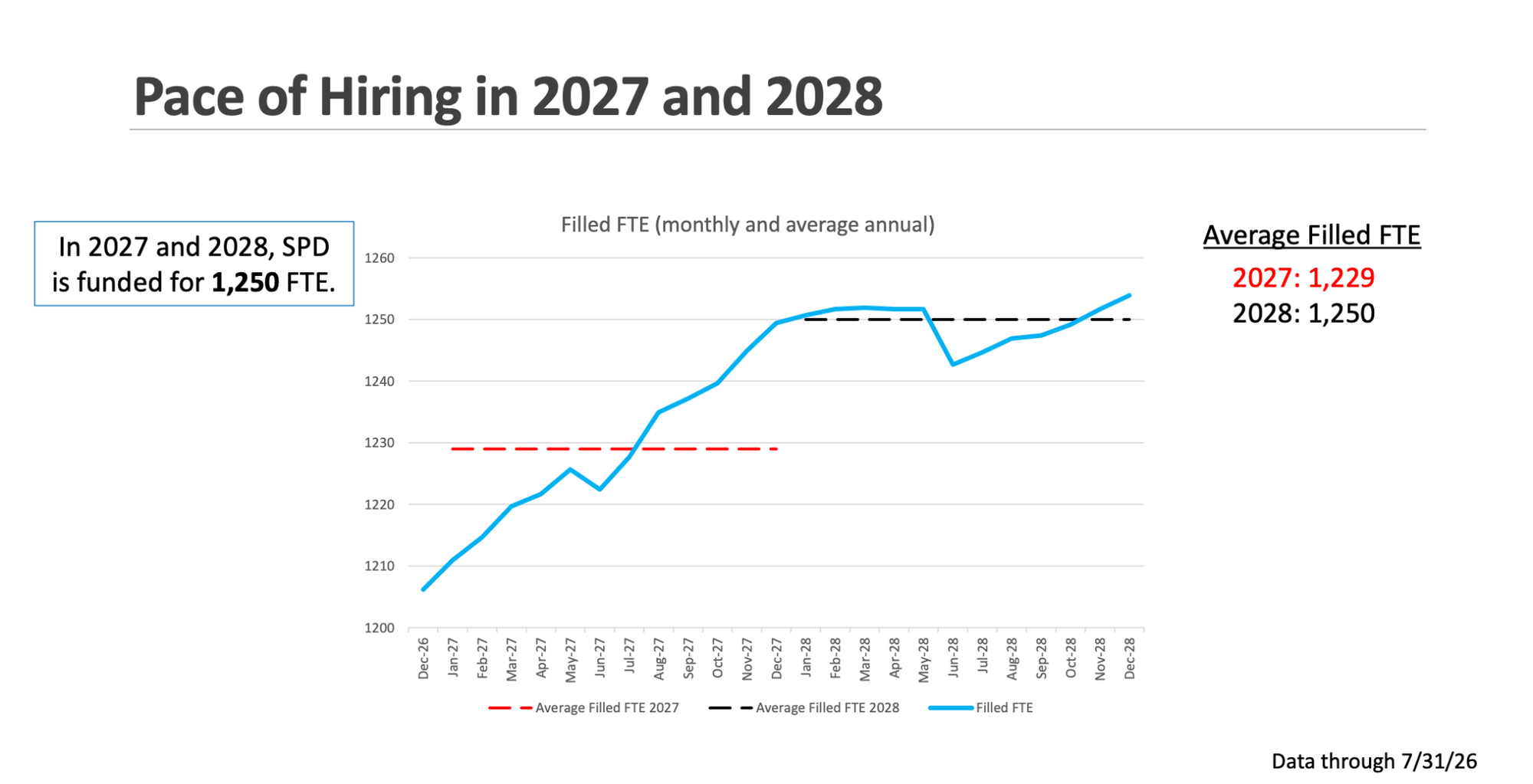
Wilson also added $12.6 million to pay for staffing SPD up to 1,250 officers, a number that is then maintained through 2030. While SPD will receive the money for this full number in 2027, according to their own chart, they aren’t expected to actually reach 1,250 until November, meaning there might be some salary savings available for the department to try to reallocate elsewhere.
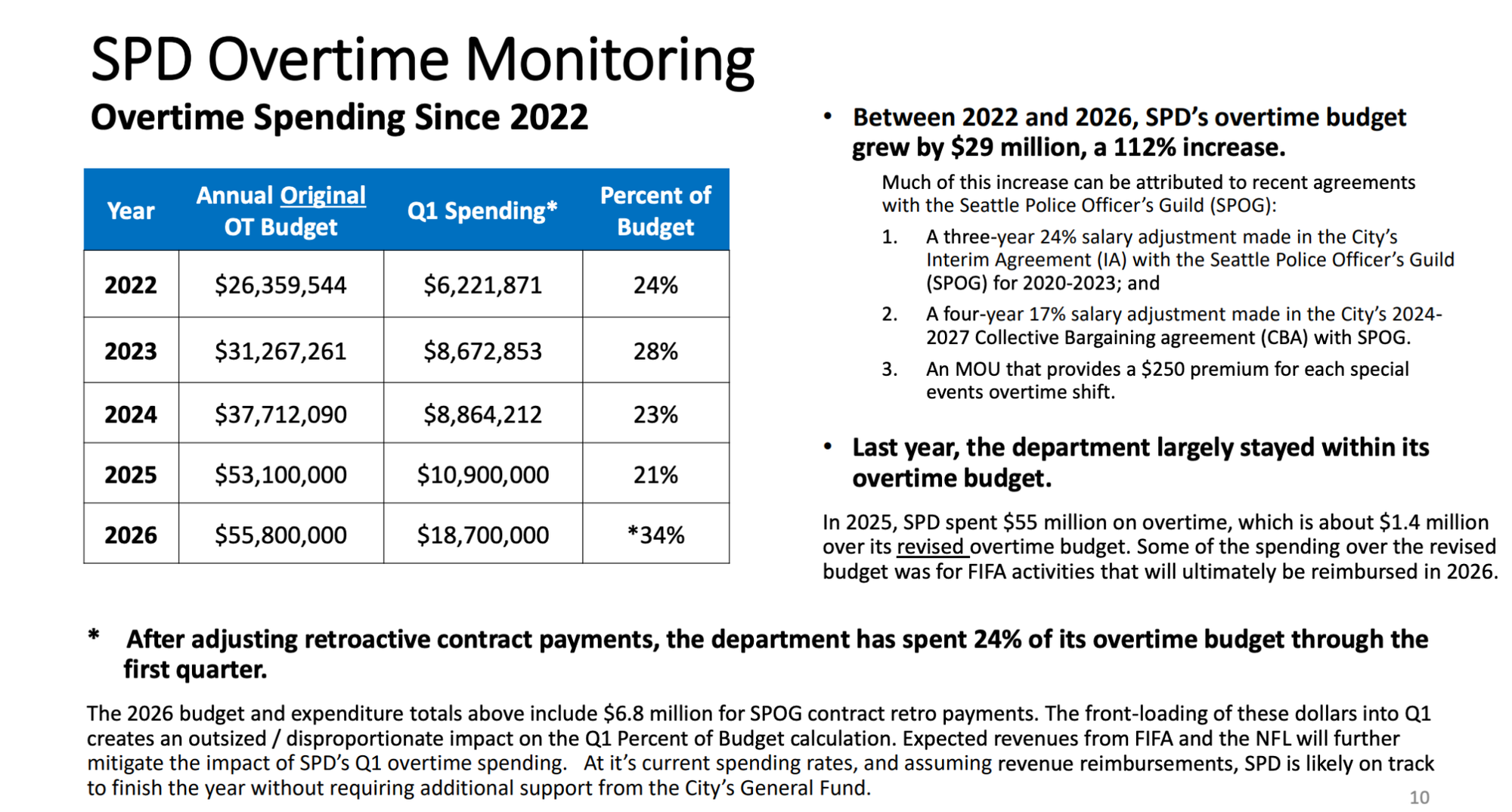
Due to the SPOG contract, SPD’s overtime budget will continue to grow with an additional $12.6 million being added compared to the 2026 budget. SPD’s overtime has ballooned in recent years, as is illustrated from this SPD chart from June. A new 2027 line added to the chart would read $62,000,000, about a 135% increase from 2022.
SPD is taking a few cuts in 2027 as well: namely, around $2.4 million to its media marketing budget, $467,000 to its hiring incentives budget, and the loss of many vacant positions (and two filled ones) for a savings of at least $5.7 million. However, none of the position cuts impacted command staff.
“The proposed budget does not include any abrogation or un-funding of command staff positions in SPD,” Hudson told The Urbanist.
Certain councilmembers were upset by almost all of these cuts.
Kettle was unhappy with the staffing numbers, saying he’d been told by “an expert in the area” that by 2050, Seattle will need 1,800 officers.
“It seems like we've given up on the goal of reaching 1,400 plus [officers], which is really the minimum that we need to have for officers,” Kettle said. “In fact, the proposed budget for 2028 is a sustainment budget that has zero new net hires. And should we, as a council, interpret this to mean that the Mayor's Office no longer wishes to grow the size of the deployment long term?”
Pennucci said that goal wasn’t grounded in financial reality.
“If there is a different choice, you need to reduce spending in other places to continue to grow beyond that number,” Pennucci said.
Interim SPD budget director Dan Eder said that right now, it costs a little over $200,000 to fund one officer position for a year, meaning that reaching the 1,450 officer number Kettle wants would cost more than $40 million in additional salary spendings every year…at least until another SPOG contract is negotiated, which will almost certainly push that number even higher.
Kettle was also upset that hiring bonuses for lateral officer hires from other police departments are being discontinued.
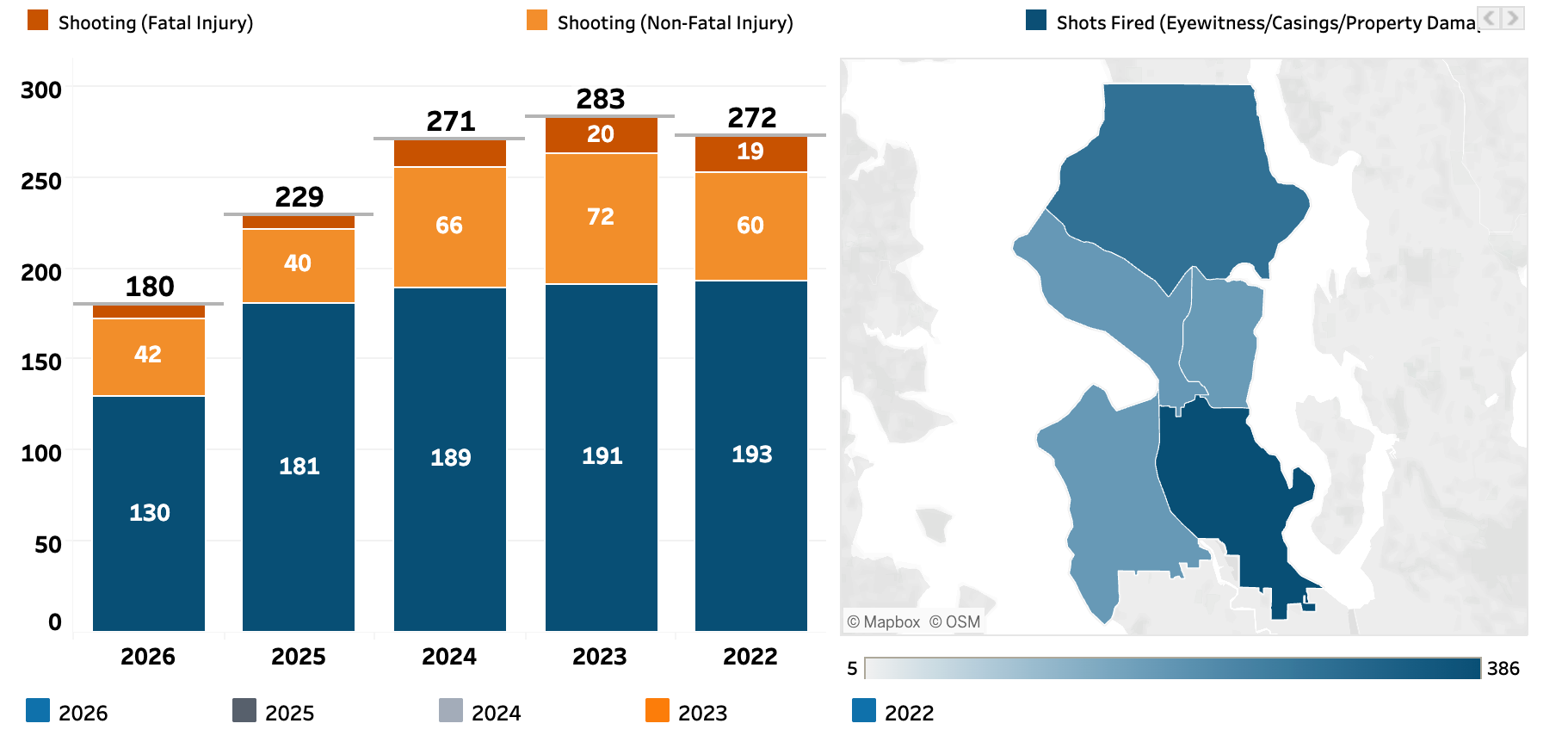
Councilmembers Juarez and Joy Hollingsworth both recited numbers of recent shooting fatalities and injuries in Seattle. Meanwhile, the SPD crime dashboard shows that citywide shootings and shots fired are down 28% year-to-date. Looking at the summer months (June-September) from the last several years, shootings and shots fired are down 103 incidents, around 36%, from their peak in the summer of 2023.
Councilmember Rob Saka led the charge on being upset about the lack of funding for surveillance cameras at the Seattle Center, which he expressed by standing up, taking a printed copy of the entire budget book, and dropping it on the dais.
“After the tragedy at the Bite, I expected this proposed budget to include funding for CCTV cameras at the Seattle Center,” Saka said. “As currently proposed, it does not. I find that omission extraordinarily difficult to understand, and incredibly disappointing.”
The facts of the shooting at the Bite of Seattle clearly illustrate that CCTV cameras at the site operated by SPD wouldn’t have done anything to prevent the outbreak of gun violence. SPD officers were within 100 feet of the shooting when it happened, and they had one shooter in custody within 30 seconds.
Councilmember Maritza Rivera was unhappy because she said the budget doesn’t contain funding for a focused deterrence strategy, a strategy that she spoke about at length during both the SPD and Community Assisted Response and Engagement (CARE) department presentations to council.
Pennucci corrected Rivera, saying there is about $300,000 in the budget each year for ongoing program evaluation, focused deterrence programs, and direct investments related to gun violence prevention.
SFD’s overtime
Meanwhile, the Seattle Fire Department (SFD) is taking a 17% cut ($7.1 million) to its overtime budget, which will continue the unit outages that the department has already been experiencing. Most of the councilmembers expressed concern about this cut, while Pennucci defended the decision.
“The percent of the general fund that goes to the fire department is the second highest investment that we have in the city, and there are challenges,” Pennucci said. “They are managing unit outages today due to staffing challenges. We started at a much higher number when we were facing a more difficult situation prior to the revenue forecasts and other things. We worked really hard to get this [cut] down as low as possible, and there have been years where there have been significant unit outages that have fluctuated over the years, so it is a challenge. We are very confident in the ability for our fire department to manage this reduction, and it is an area we will continue to be working on.”
As Pennucci stated, SFD has already been facing unit outages due to staffing issues, although the department is making progress in improving their staffing numbers after the Covid-19 vaccine mandate caused many firefighters to leave. SFD is used to using a large amount of overtime, as can be seen from an analysis of the department’s 2024 overtime performed by PubliCola, which found many fire employees working thousands of hours of unevenly distributed overtime.
SFD Chief Scoggins said this overtime change in the 2027 budget will mean daily staffing will drop from 222 to 209 per day, impacting response times.
Councilmember Eddie Lin pointed out that the department’s new hires should alleviate overtime use, and Scoggins agreed that they are helping. Plus, since SFD’s budget includes funded positions that aren’t yet filled, there should be some salary savings coming into play as well.
“The budget fully funds firefighter salaries; however, the department is currently operating below fully staffed levels, resulting in salary savings associated with vacant positions,” Hudson told The Urbanist. “These savings provide flexibility to address other personnel costs, including overtime needed to maintain emergency response coverage.”
Strauss suggested the idea of a fire district in the future.
“I'm not proposing a fire district today, but I am making the statement on the record that the best way to insulate the fire department from any of these budget challenges is if we give you a dedicated source of funding.”
However, the firefighters’ union didn’t support the idea of a fire district earlier this year.
Next steps
Beyond Strauss’s displeasure about the ongoing food bank investments, councilmembers didn’t say where they might be looking to cut in order to make the additional public safety investments in SPD and SFD that they expressed an interest in doing.
The closest thing to a hint was a line of questioning from Kettle during the OH’s presentation, in which he suggested the new Seattle Social Housing Developer (SSHD) might be interested in buying distressed affordable housing properties in the city. SSHD has different priorities, however, and the public developer – and its enticing funding stream – are independent from City operations.
With affordable housing already taking a $65 million hit in this budget proposal, any further cuts could significantly curtail what the City is able to do in that space, especially since some JumpStart dollars are already being used to ensure the City can deliver on its 2023 Housing Levy commitments. In addition, the OH’s two largest funding sources are the Housing Levy and the JumpStart tax, which means any cuts made to its budget to fund more police officers would be directly and unambiguously handing JumpStart dollars to SPD. This move might be seen as more of a betrayal of the original intent behind the JumpStart tax than simply moving money to plug unspecified gaps in the General Fund.
Next up, the public will get a chance to weigh in on the budget during a public hearing on Tuesday, October 6, with remote public comment beginning at 1pm and in-person public comment starting at 5pm.
The following week, the council will participate in a series of meetings with their central staff to talk about identified issues in the budget, with the most recent City revenue forecast being released on October 16. Unless that forecast contains some really good news, councilmembers will be forced to consider what they are willing to cut in order to propose funding their own priorities.
 Amy Sundberg