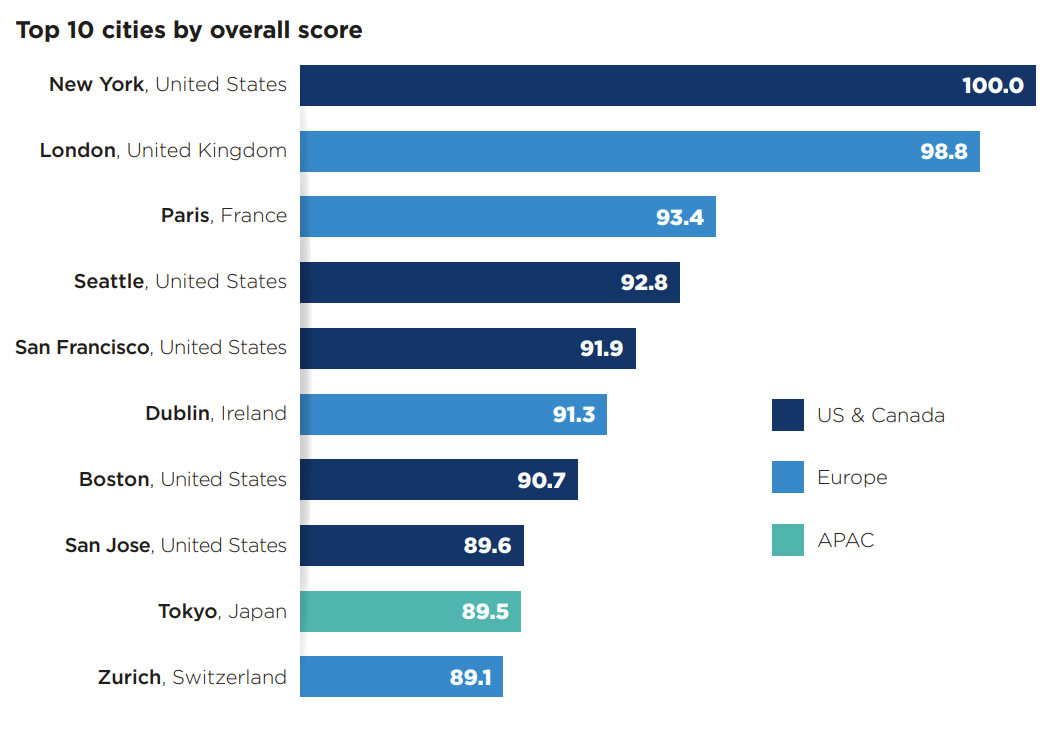
It was the best times; it was the worst of times. Depending whom you ask, Seattle's economy is one of the most elite in the world, or it's on death's doorsteps and in the midst of a corporate exodus. Oxford Economics weighed in this week on the positive side of the ledger, ranking Seattle as the fourth best city in the world on its 2026 Global Cities Index, trailing only New York, London and Paris.
The Urbanist's Fall Member Drive is in the home stretch! Support our work, read ad-free, and help us exceed our goal!
"Seattle’s economic strength propels it to the fourth spot of our 2026 Global Cities Index," the report noted. "This is largely thanks to the city’s major tech sector—home to both Microsoft and Amazon—which rivals those of any other city in the world. The metro also boasts major players in other industries such as aerospace (Boeing) and is home to major retail headquarters (Starbucks, Costco, and Nordstrom). This range of large employers gives the city one of the highest levels of GDP per person in our index and a healthy economic diversity measure."
The report was a good reminder that much is relative in economic analysis. Case in point: Mayor Katie Wilson's administration recently released a report that stressed that Seattle's economy (and the governmental revenue streams that rely on it) is not currently diversified enough, relying too heavily on a tech sector that could pull up stakes, or convert to an AI robot workforce that leaves many locals out of a job. Wilson launched a Resilient Seattle Economy Task Force to work on the issue and craft a strategy to grow and diversify the local economy.
At a recent public appearance, Wilson noted it is tough to manage the tension of wanting to decrease income inequality and rein in big tech's power while not killing the golden goose that is paying a big chunk of the City of Seattle's bills. The campaign that swept Wilson into office was focused on affordability and the idea that Seattle's economic boom should be more broadly shared. That campaign touched on improving governance, quality life, and environmental stewardship.
While the global index seems geared toward indicating business opportunities to corporate leaders, Oxford Economics – a commercial advisory firm based in Oxford, England – notes the analysis goes beyond solely looking at economic output: "We score cities based on a range of metrics across five categories: Economics, Human Capital, Quality of Life, Environment, and Governance."
Oxford's authors pointed out that very high incomes can be a double-edged sword contributing to climbing housing prices, especially as housing supply lags – with Seattle's slow pace to easing zoning restrictions and other development hurdles partially to blame for that lag.
"The city scores favourably in the Quality of Life category as a concentration of high-value sectors results in Seattle residents having a very high income per person (fourth in the world). However, this can be a double-edged sword, as income inequality is also considerably high in the city. This is especially concerning as Seattle’s consistent population growth and limited housing supply are set to contribute to increasingly unaffordable house prices and rents."
Seattle had the second highest quality of life ranking in the United States (22nd globally), behind San Jose, California, which (perhaps bizarrely) ranked 13th in the globe.
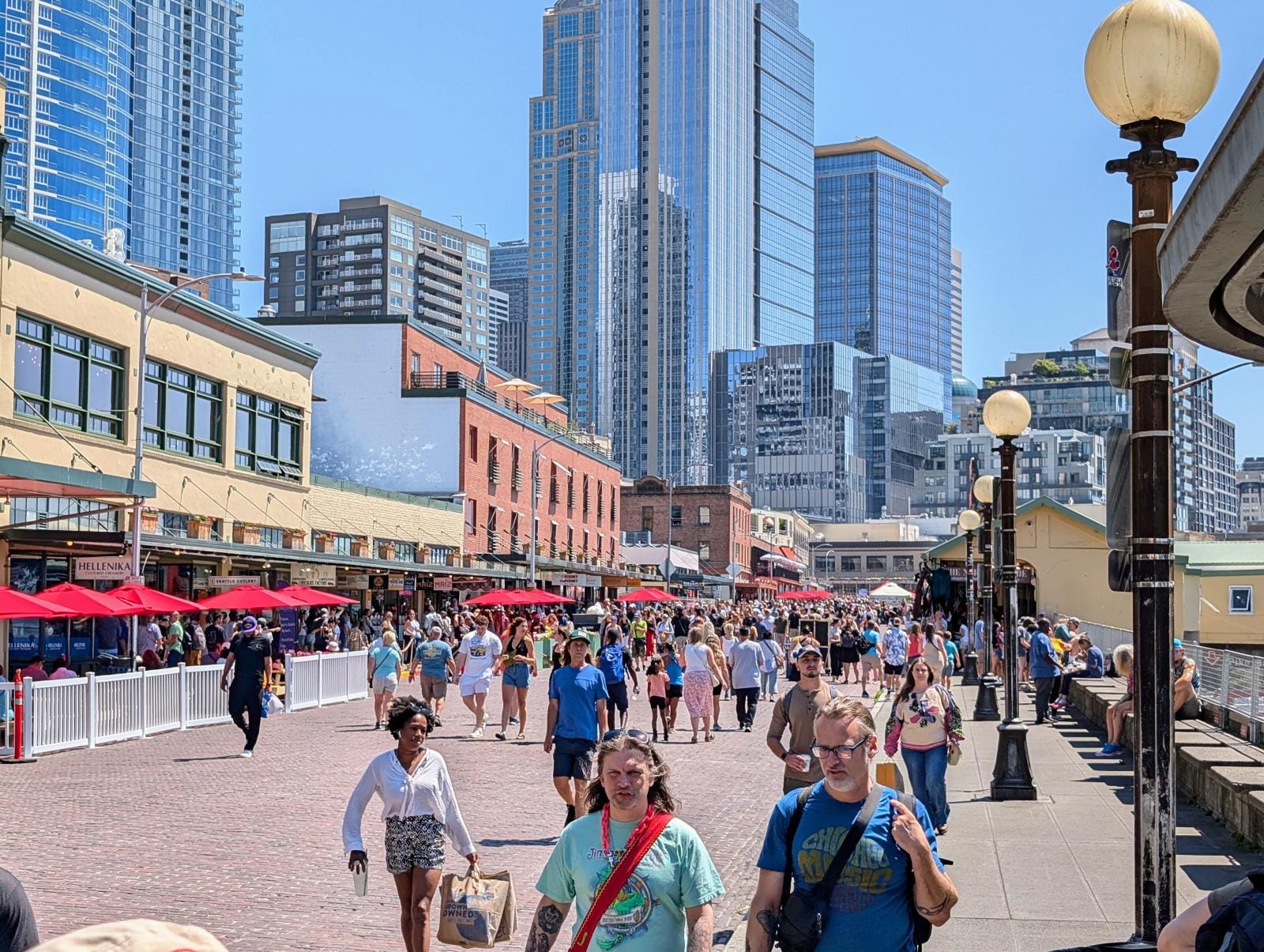
Seattle's qualify of life was on full display on the international stage this summer as the city's downtown hosted six FIFA Men's World Cup matches and earned the city a distinction as a top host with a booming transit system, bustling pedestrian zone, and beautiful waterfront park. The Bay Area, meanwhile, trucked fans to distant Santa Clara to watch matches in suburban recluse mode. How's that for quality of life?
Seattle also generally outperforms the U.S. field when it comes to environmental footprint and climate pollution per capita, with a big credit going to policies limiting suburban sprawl and promoting housing growth in transit-rich areas. Plus, with perhaps the most ambitious transit expansion plans in the country, the Seattle metropolitan area is adding more transit-rich areas – albeit with some snags and delays along the way.
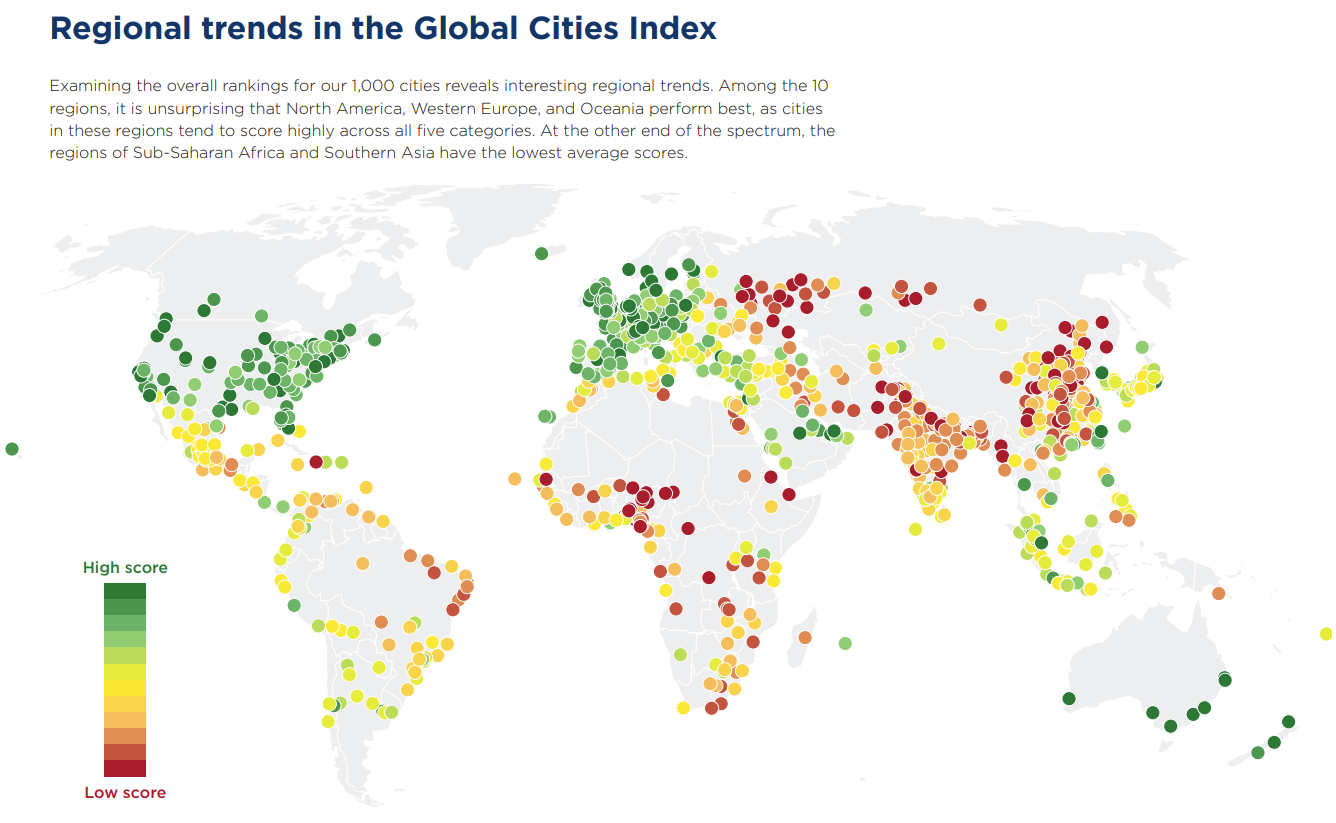
While Oxford Economics top 100 list is heavily weighted toward the Anglo world and Europe, authors do note that Asia is seeing some of fastest economic growth and is climbing the ranks. While pure GDP per capita (on which Seattle ranks 4th in the world at $152,000) seems the largest weight in the index, some cities climb the rankings due to quality of life, governance, and environmental factors, with European standouts often taking that route.
"Cities across North America and Europe dominate the top reaches of our index, with the US alone accounting for 30 of the top 100 cities," the report states. "Yet the drivers of this dominance between the two regions differs. In the US, it is strong scores across the Economics and Human Capital categories that drive their elevated position. In Europe, however, it is outperformance across the Quality of Life, Environmental, and Governance categories. These differences are emblematic of current trends and policy priorities, as the US continues to post strong economic gains, while Europe retains its advantage in resident amenities and liveability."
Another trend the report highlights is how Trump's erratic policymaking impacts the governance of American cities and the how its anti-immigrant policies could starve American cities of their lifeblood of talented immigrants that propel their economic engines. The authors ranked all U.S. cities 198th on governance, a swipe at the Trump administration, and they highlighted the threat that Trumpism posed to Seattle in particular.
"[T]he downside risk of the Trump administration’s immigration policies will likely limit international immigration to the city, reducing population growth and the share of foreign-born residents," the report said. "This may hold Seattle back from making gains in the Human Capital category in the next few years."
Beyond federal chaos, part of Seattle's governance challenge is high mayoral turnover. Wilson will likely seek to break the run of one-term mayors, but several members of the local mainstream media appear to have already turned against her, concocting negative headlines to the detriment of more positive stories that are out there, as this recent Oxford Economics report illustrates.
 Doug Trumm
 Maggie Block