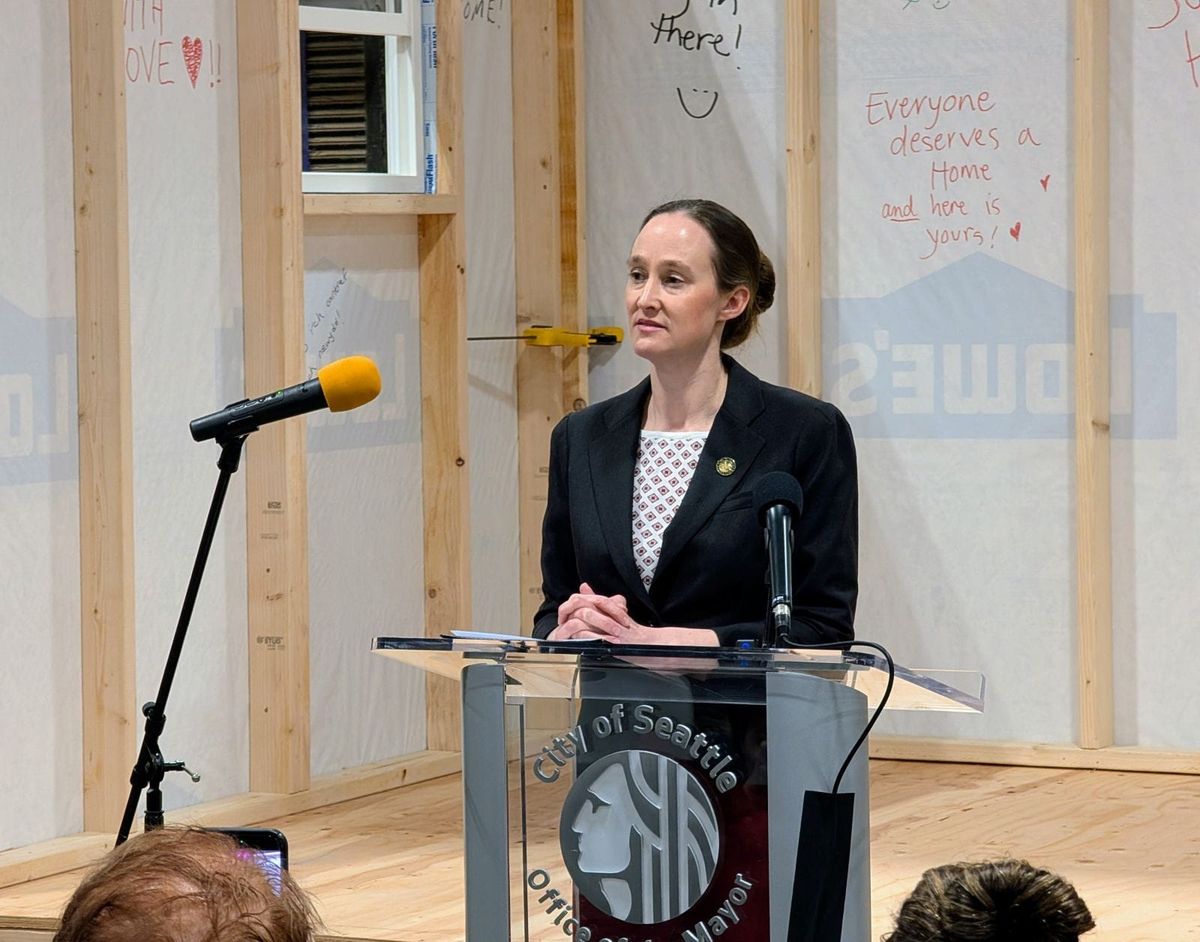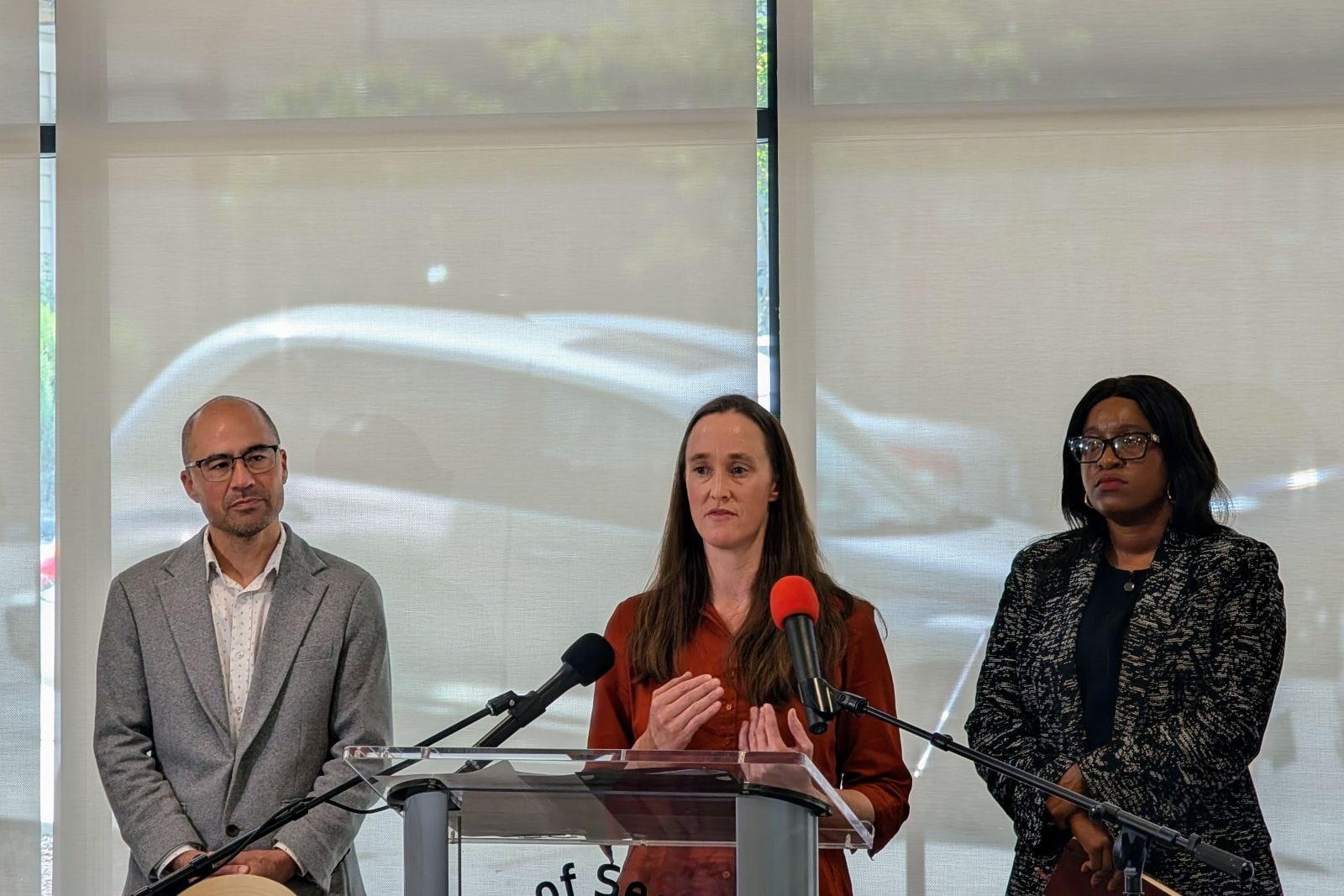
Mayor Katie Wilson rolled out an executive order pledging to streamline Seattle's building permitting process on Wednesday. In addition to two immediate actions aimed at reducing permit times, the order launched a Housing Production Task Force to advise the city's future housing agenda.
"We're taking two immediate actions," Wilson said. "One of those is the interdepartmental team on permitting, which is going to better coordinate our City departments to shorten permit timelines, and then proposing funding in the budget for next year for the affordable housing ombuds that can help our developers navigate those processes."
The mayor's housing task force "will bring together communities most impacted by City policy to craft recommendations to build needed housing, support affordable and community‑based developers, prevent displacement, and attract development to Seattle," according to a press release timed with the roll out.
Housing starts have been in a nosedive in Seattle after a boom period that lasted more than a decade, allowing Seattle's population to grow beyond 820,000 residents. The Emerald City's housing starts collapsed to a decade-long low of fewer than 2,000 units permitted in 2025 – down 88% from the 2020 peak of 17,400 units permitted.
Builders have pointed to a number of factors that create a drag on homebuilding, including high interest rates, high construction costs, and waning interest from financers – some of which are beyond the City's control. Permitting delays and fees are something the City does control, however, leading to calls for streamlining.
“Housing that people can afford is critical to a city that works for everyone," Wilson said. "We can't control every force that drives up the cost of building homes, but we can act where it counts. This Executive Order is about clearing the path, cutting the delays, and building the housing Seattle needs — now.”
The task force is expected to be a large one and cut across sectors, likely encompassing more than 60 members. Three of the four co-chairs appeared at the press conference alongside the mayor.
The four co-chairs are Carter Nelson, Director of Government Affairs with the Commercial Real Estate Development Association, Joel Ing, principal of Edge Developers, and Tiffany Kelly-Gray, Director of Strategic Initiatives at Byrd Barr Place, and Seattle Councilmember Eddie Lin, who chairs Council's Land Use Committee.
"This task force is going to be providing rolling recommendations," Wilson said. "There will be initial recommendations provided in February of 2027 that we will be able to act on next year. I also want to emphasize: This is not 'instead of.' This is in addition to the many other housing-related processes and activities that our departments are already doing."
The first question during the press scrum pressed the mayor on what announcing a task force not set to deliver recommendations until next year does to build more housing immediately. The mayor responded by pointing to the housing actions she has already taken, including her recent ordinance banning rental junk fees and her "Taller Faster Denser" housing plan, which aims to expand the city's housing capacity well beyond the growth plan her predecessor, Bruce Harrell, laid out.
"I just want to emphasize that we have not waited until this point to take action on housing affordability," Wilson said. "The city council just unanimously passed our ordinance banning rental junk fees, which will improve stability and affordability for renters, and we're also working on a larger scoping for the next phase of the Comprehensive Plan, so that we have more options for increasing housing production across the city. So this is additive, and we are not waiting for September 2027 to take action."
Wilson also recently signed State Environmental Policy Act reform in law, and in March she signed an executive order expediting permitting for tiny house villages as part of her push to accelerate production of emergency housing for homeless residents.
One Wilson initiative that did not make it out of the gates in her first eight months in office is the "Housing Accelerator" pilot program, which had similarly been touted as a measure to spur housing production. The idea was that a temporary two-year break in Mandatory Housing Affordability (MHA) fees, floated as an 80% reduction, would convince builders sitting on permits to break ground, encompassing several thousand homes.
However, the deal fell apart after the Housing Development Consortium, which represents a wide range of nonprofit builders and their partners, pulled their support and backing from key city councilmembers also appeared in jeopardy. This led Wilson to pull the legislation, pledging to bring it back next year. That MHA break proposal now appears to ride on making it into the consensus recommendations of the Housing Production Task Force.
At the task force roll out, The Urbanist asked if reducing MHA fees and curbing rising utility fees that the City is heaping on builders would be on the agenda. Wilson seemed to suggest it would be a discussion point, but stopped short of promising any particular outcome or making it a focal point.
"I think that's something that the task force will be able to discuss," Wilson said.
The mayor's executive order seeks to reduce delays stemming from City departments, but it's unclear if the effort will tackle utility infrastructure costs, which industry professionals have flagged as a growing issue stunting building.
As it stands, the Mayor’s Office says it is launching a "Residential Permitting Interdepartmental Team to make permit timelines shorter and more predictable across all regulatory departments involved in most housing construction projects." Additionally, the mayor has directed Seattle City Light, the Seattle Department of Transportation (SDOT), the Seattle Fire Department, and Seattle Public Utilities to each designate a primary point of contact for interdepartmental coordination to quickly resolve permitting issues for applicants.
Patience Malaba, the Housing Development Consortium's Executive Director, also spoke at the event, and noted the boost the effort could provide for nonprofit builders.
“For affordable housing, delays have real consequences," Malaba said. "When permits stall, costs rise. The Affordable Housing Ombudsperson and Interdepartmental Team can help create the coordination and accountability needed to keep projects moving. Clear points of contact across SDCI, Seattle City Light, SDOT, Seattle Fire, and Seattle Public Utilities can help resolve problems earlier and give housing providers greater certainty.”
The press conference was well attended, but the TV newscasters who dominated the Q&A session quickly pivoted to their preferred topic of pressing the mayor about the pushback and fledgling recall effort she is facing following the Bite of Seattle shooting. In contrast, their interest in diving into housing issues appeared pretty thin.
Builders from both the private and nonprofit sectors invited to take part in Wednesday's event were bullish that the task force could achieve the mayor's lofty aims.
"We appreciate Mayor Wilson and her team's leadership in convening this group," Nelson said. "Bringing together community leaders, nonprofits, housing advocates, and industry professionals is exactly the kind of collaboration we need to approach a challenge as complex as housing affordability. We're grateful to have a seat at the table and look forward to working with this group to identify the key barriers that make housing more difficult. We're excited to help advance practical solutions that make it easier to deliver housing for current and future Seattleites."
Ing noted the new task force will be building on the work of a previous task force former Mayor Ed Murray set to work in 2014.
"Following upon the efforts 10 years ago of the Housing Affordability and Livability Agenda task force to increase housing production, also known as HALA," Ing said. "Now is the time to refine many of those strategies while developing new initiatives. The housing shortage continues to worsen in our city, as we all know, and the region. So, the opportunity to improve many development requirements that prevent and challenge this housing production is both welcome and needed."
The HALA committee helped engineer the MHA inclusionary zoning program, which traded upzones for requirements for affordable housing contributions from builders. That cleared the way for the associated upzones in urban centers across Seattle, which started in 2017 and were completed in 2019. However, the HALA committee and Mayor Murray abandoned a plan to phase out single family zoning citywide after the draft proposal was leaked to the Seattle Times, whose columnists savaged the idea, kicking up a homeowner backlash.
As a result, it took a state mandate contained within Rep. Jess Bateman's Middle Housing Law to bring about an end to single family zoning – in Seattle's case, right before the state deadline in June 2025.
Whether Wilson's new task force, more than a decade later, can operate with fewer untimely leaks and policy setbacks remains to be seen. Whether market-rate builders, nonprofit leaders, and tenant advocates will see eye to eye on housing policy is a dicey proposition as well.
Regardless of the outcome, a task force has been birthed into existence, summoning the powers of the Seattle Process, whether creative or dilatory, and bringing them to bear on a problem widely agreed to be pressing and crucial to Seattle's ability to thrive over coming decades.
 Doug Trumm
 Parker Dawson
 Doug Trumm