A fledgling proposal for a two-year break on builder fees to spur Seattle housing starts amidst a permit drought hit a big snag on Thursday, as a key stakeholder rescinded support and Mayor Katie Wilson delayed plans to introduce the legislation. The mayor still appears intent on bringing the proposal back later this year, potentially after budget season this fall.
At its 2021 height, the Mandatory Housing Affordability (MHA) program pulled in $74 million in funding for affordable housing, but as housing starts have plummeted, that figure has trended below $20 million. This has led a coalition of 30 builders called the Seattle Housing Roundtable to propose a temporary break on MHA fees to spur builders to break ground. After negotiations with nonprofit builders and other stakeholders, they arrived at a two-year pilot program with an 80% fee reduction for multifamily builders.
"To meet the Mayor’s goal, the temporary reduction in MHA fees for new housing is laser-focused on spurring thousands of ‘shovel-ready’ Seattle housing units, which are already deep into permitting," the Seattle Housing Roundtable wrote. "By the City’s own data, more than 200 projects are stuck in the City’s pipeline. The City saw more than 50,000 permitted housing units stalled or canceled in just the last two years, and new applications are down a staggering 94% from the peak in 2020."
Housing Development Consortium of Seattle-King County (HDC), a coalition of nonprofit builders and industry partners, had been a key supporter for the MHA break proposal and a negotiator of the compromise to shorten the span of the pilot and the scale of the reduction. HDC Executive Director Patience Malaba even wrote an Urbanist op-ed in favor of the proposal last month. However, Malaba pulled HDC's support on Thursday in an email to consortium members, catching supporters of the MHA accelerator off guard.
"After careful consideration, I informed the Mayor's Office that HDC was withdrawing its support for advancing the proposal at this time," Malaba wrote Thursday. "Following that decision, the Mayor's Office chose not to move the legislation forward on a summer, pre-budget timeline and instead will convene a stakeholder workgroup to continue refining the proposal and related policy considerations."
Some housing advocates criticized the decision to delay the proposal.
"Tech 4 Housing is disappointed to see this worthwhile proposal fed to the insatiable maw of the Seattle Process," Scott Berkley, an organizer with Tech 4 Housing, said in a statement. "We encourage the mayor and city council to move beyond a revenue source that demands middle and working class renters fund affordability, while expecting nothing of our city's wealthiest homeowners and corporations."
Seattle YIMBY questioned the need for more process, with Seattle famous for drowning policy changes in lengthy processes that sometimes go nowhere.
"Seattle YIMBY and our members urge the mayor to show true leadership on housing by making hard choices to prioritize the homes that can be built right now," Seattle YIMBY Leadership Team wrote in a statement. "Our housing crisis was not caused by having too little process. Seattle has a critical window to show the region we are ready to act, ready to deliver thousands of new homes, millions in new tax revenue, and millions more for affordable housing as we start building again."
Seattle YIMBY has put together an online petition pushing the mayor to promptly advance the MHA accelerator.
In contrast, HDC sought to frame the delay as an opportunity.
"I believe this creates an important opportunity; not simply to revisit the policy, but to strengthen how we work together," Malaba continued. "It gives us the time and space to engage more broadly across our membership, incorporate the perspectives of our diverse constituencies, and emerge with a stronger proposal and an even stronger coalition."
Huh. This is a big about face after HDC had brokered a deal for a two-year pilot program with reduced MHA fees on builders.
— Doug Trumm (@metropolitanglide.bsky.social) July 2, 2026 at 8:54 PM
[image or embed]
In the email, Malaba called an HDC member meeting on July 7 to hear the perspectives of the various groups within the consortium and lay out a workgroup process. Habitat for Humanity Seattle-King & Kittitas Counties was among the early groups to break from the consortium, opposing the MHA reduction pilot program in May, but it appears some other HDC members followed suit more recently, including El Centro de la Raza and DESC, both influential, well-connected organizations.
"HDC’s June op-ed in support of the MHA Accelerator program was right then, and it is right today. MHA needs urgent recalibration to accelerate Seattle’s stalled housing pipeline," Seattle Housing Roundtable said in a statement. "That’s why it is disappointing and surprising to learn that HDC favors more Seattle-style 'process' over the only viable solution to catalyze Seattle housing production in the near-term."
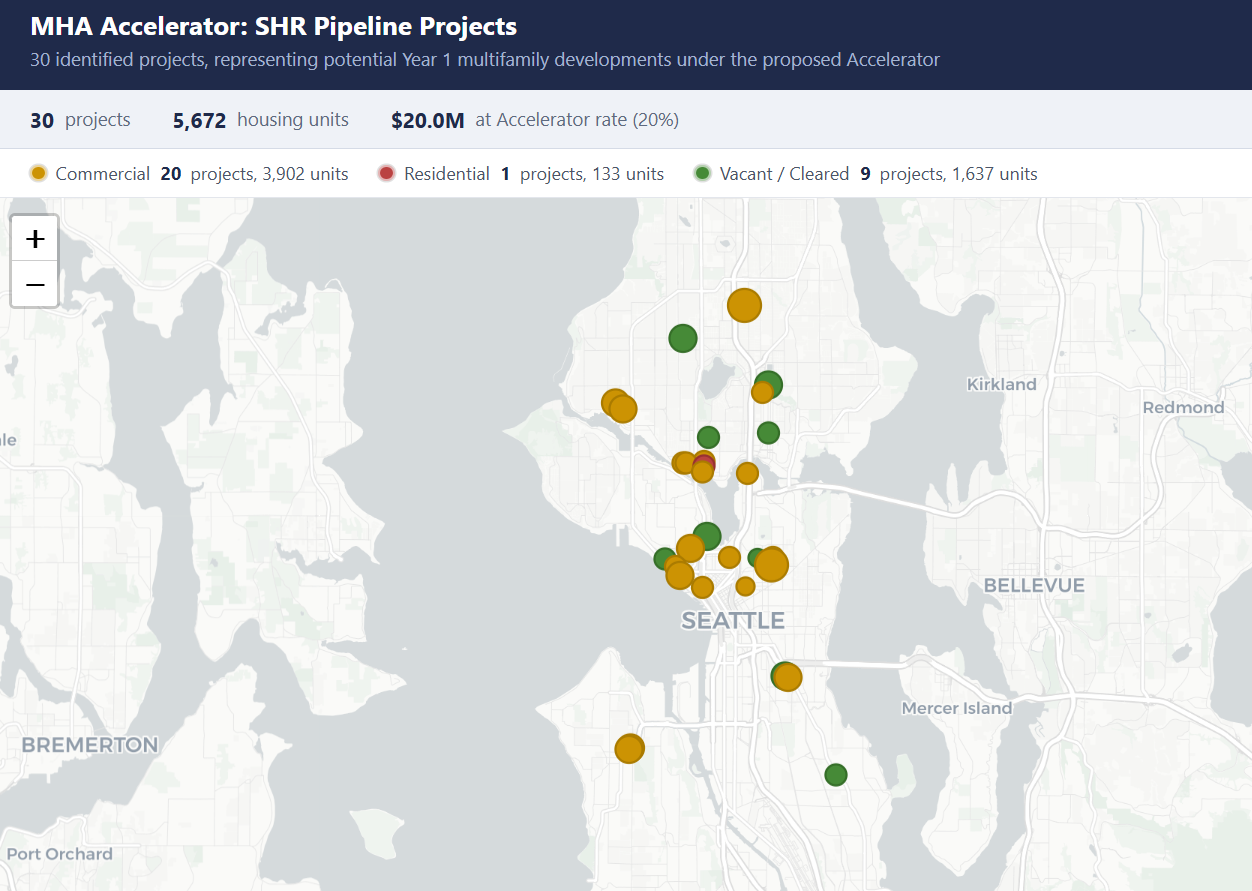
The roundtable noted most of the stalled projects are in the downtown core, Capitol Hill, and North Seattle, with the group open to carveouts for specific high displacement risk neighborhoods, such as the Chinatown-International District or the Central District, where some groups have raised concerns. Builders have identified 30 stalled projects encompassing nearly 6,000 homes (mapped above) that they say could move forward quickly if fees are cut by 80%, enticing banks and other investors to back projects that otherwise do not pencil out as financially feasible.
How MHA came into being
The Mandatory Housing Affordability program came into existence in 2017, after protracted negotiations between builders, advocates, and City officials, under the auspices of Mayor Ed Murray's Housing Affordability and Livability Agenda committee. Initially, MHA applied only downtown and in the U District, but the program went "citywide" in 2019 after the City enacted upzones in urban-center neighborhoods.
As a form of "inclusionary zoning," MHA imposed affordability requirements on builders when adding apartments, condominiums, or commercial space, but in exchange the City granted upzones that enabled more units in taller buildings. Builders could either set aside low-income homes within their new buildings for 75 years, or pay an "in-lieu" fee that went into the City's affordable housing trust fund, supporting nonprofit homebuilding elsewhere.
Most builders ended up paying the fee.
MHA fees range from $8 to $50 per square foot, depending on the zoning type and location. An inflation rider in the legislation means fees have been rising steadily since 2019. To take the on-site performance option, developers typically need to set aside 5%-7% of new units as affordable, although requirements can be as high as 10% or as low as 3% in certain rare circumstances.
Dubbed a "grand bargain," proponents considered the MHA program a win-win allowing more housing while ensuring a new stream of affordable homes would come online across the city. Critics argued MHA amounted to a tax on new housing, kneecapping homebuilding, but the staunchest supporters contended builders would barely feel the tax, positing that a "value capture" mechanism would offset costs by lessening the spike in land values that upzones would otherwise cause.
Housing starts fall off a cliff, along with MHA returns
Initially, MHA proponents appeared to be correct, as housing production continued to hum along and the City accrued more than $300 million in MHA fees to fund affordable housing from 2017 to 2023. Over the last decade, Seattle was one of the fast-growing big cities in America, and also led the nation in affordable housing production.
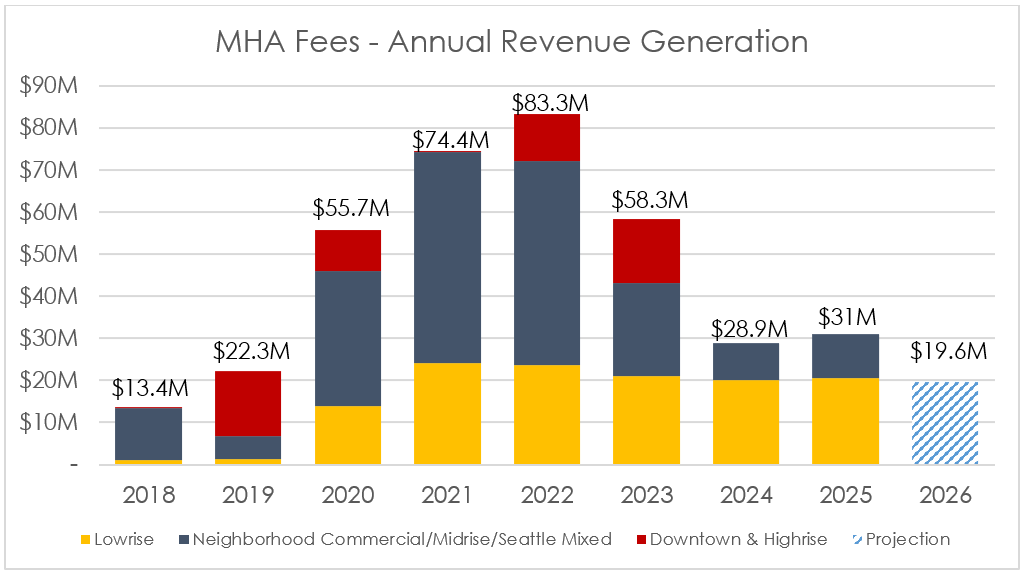
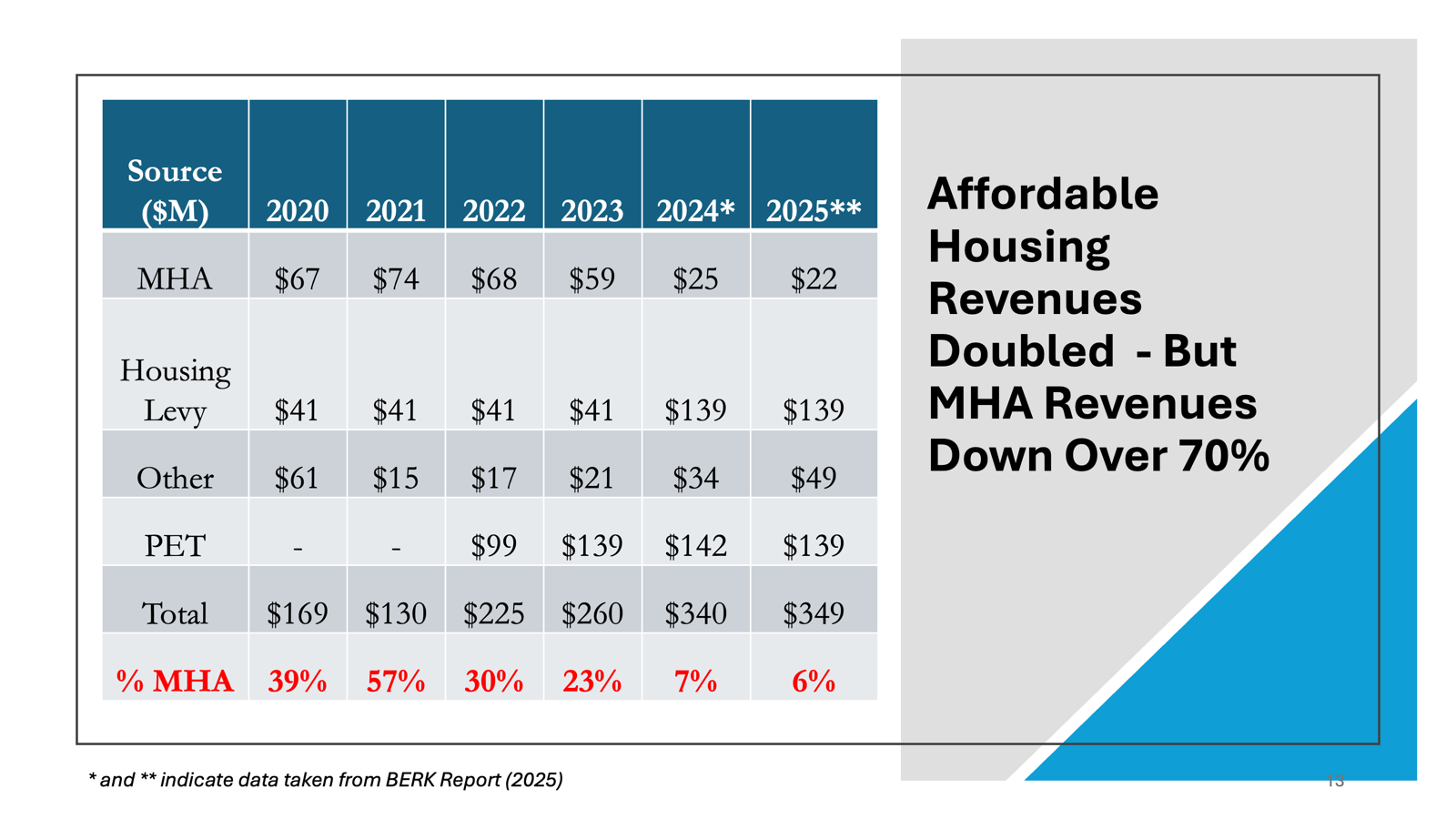
After a hot start, though, MHA fees are down sharply in the last few years, and housing starts are plummeting in Seattle. Permitting activity collapsed to a decade-long low of fewer than 2,000 units permitted in 2025. Through the first four months of 2026, Seattle has permitted just 594 multifamily units, an even slower pace than in 2025. Population growth is down, and interest rates and construction costs are up, which is leading to a financial pinch for builders.
Seattle's 2025 total was down 88% from the 2020 peak of 17,400 units permitted. In 2025, builders paid an estimated $25 million in MHA fees, down from a peak of $74 million in 2021, and the City projects collections will be even lower in 2026.
Permitting for housing has really fallen off the cliff in Seattle since 2021, but the slide has continued deeper into 2024 and 2025.
— The Urbanist (@theurbanist.org) July 2, 2026 at 8:53 PM
[image or embed]
The Seattle Housing Roundtable expects the downward trend to continue unless the City takes action to reduce building costs. Even with lower fees, the City could net more money from the greater volume of projects going forward, said Ian Morrison, a land-use attorney with McCullough Hill, a law firm whose founder, Jack McCullough, helped negotiate the original grand bargain agreement.
Builders have also argued it helps the mayor meet her campaign pledges around affordability, setting up her Taller Denser Faster housing plan for success.
"Mayor Wilson has made it clear from her election campaign that she’s a champion of building more housing and helping renters." the roundtable wrote. "We applaud her vision. But championing a ‘taller, denser, faster’ new phase of the Comprehensive Plan does not build housing now. It is a long-term solution for future housing capacity. We are in a housing crisis now, and only urgent action will help build more housing in the next three years."
Lowering MHA fees is one of the very few levers Seattle can pull quickly to move the needle, Alex Lofton, co-founder of pro-housing advocacy group For Seattle, contended.
"Seattle has to do two things at once: keep investing in the deeply affordable housing that market-rate builders will never build, and build as much housing of every type as we can, without making either one harder," Lofton said. "Adjusting the MHA fee is one of the few short-term levers the city has to get homes built again. We urge the Mayor and Council to move forward with the Housing Accelerator now and pair it with a permanent fix so we're not back here in a couple of years. More process shouldn't become one more reason we delay results."
 Doug Trumm
 Patience Malaba