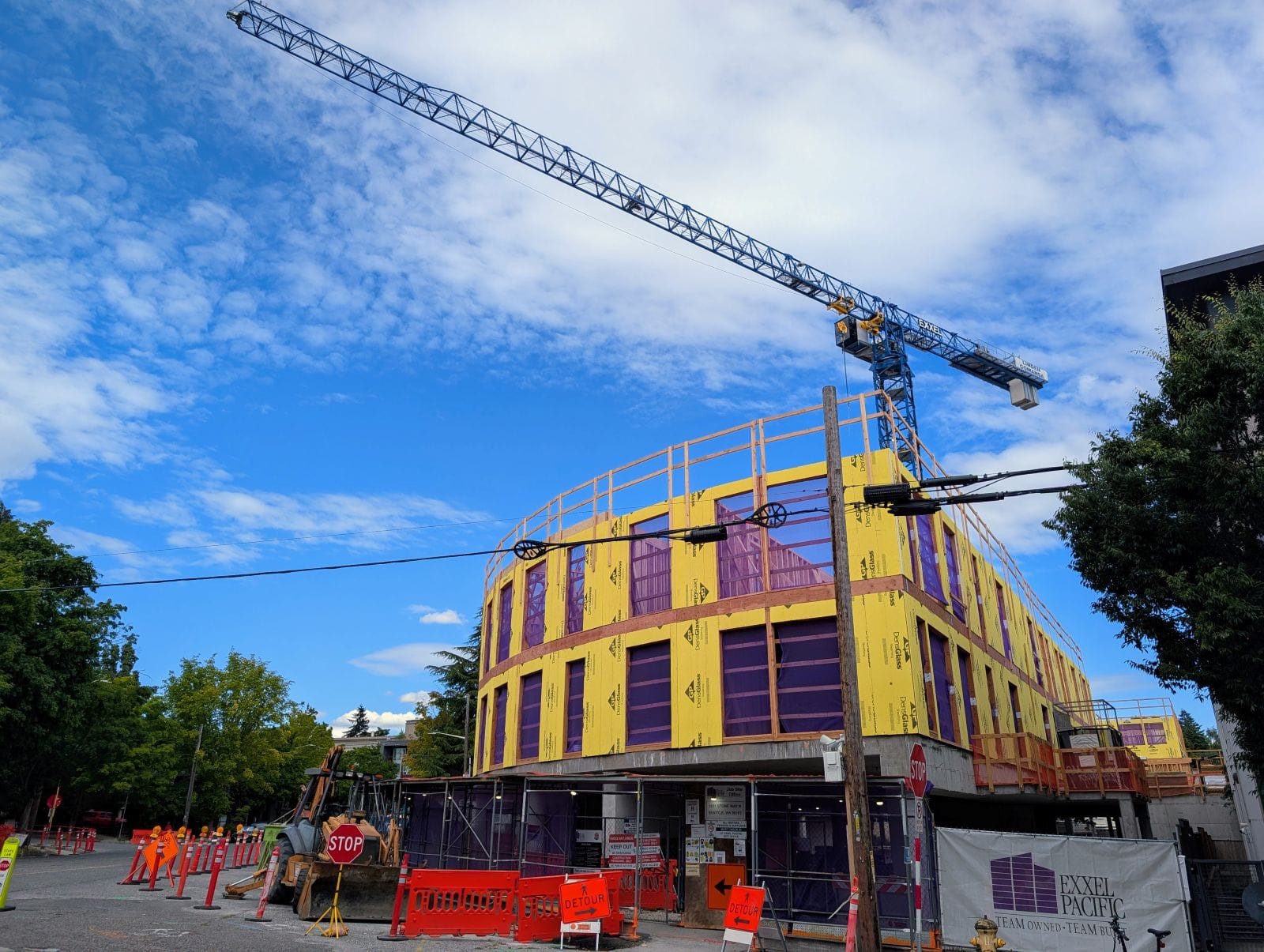
Seattle's proposed “Housing Accelerator" pilot would cut Mandatory Housing Affordability (MHA) fees by 80% for two years. The deal fell apart this July when a key nonprofit partner pulled its support and Mayor Katie Wilson tabled the legislation, hoping to bring it back next year.
I'm glad the deal felt apart. Not because MHA reform doesn't matter – it does. Rather, because this particular deal was shortsighted in design, proposing to expend the City's limited political capital on a policy with poor prospects to deliver meaningful results on its own. That’s because it left the looming problem of skyrocketing utility costs unaddressed.
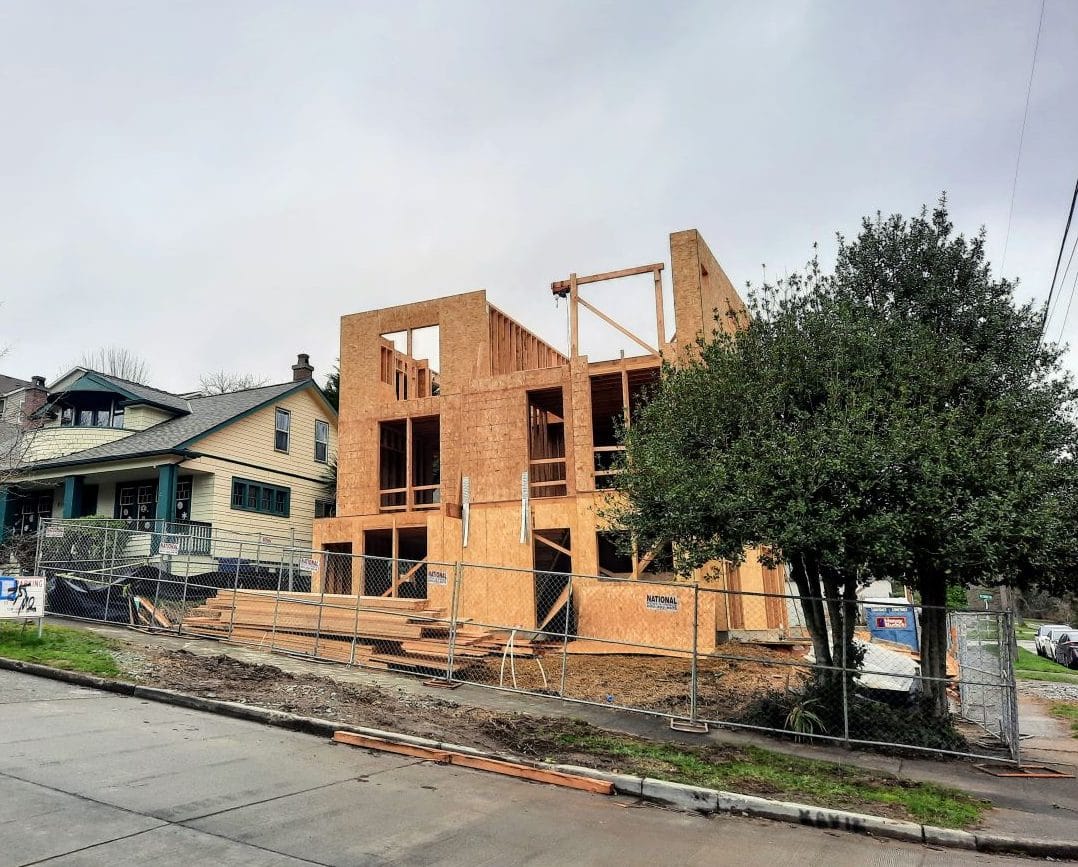
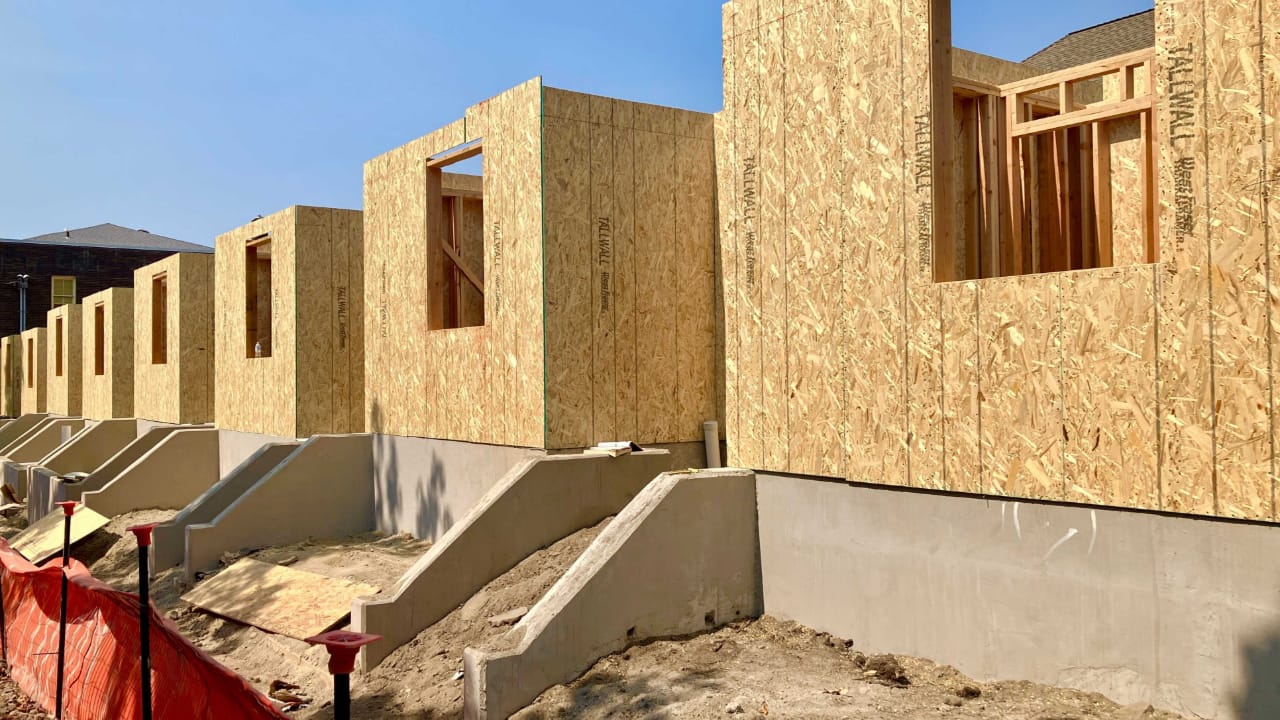
MHA reform is work worth doing, particularly because fees are not assessed equitably by project size or housing type. They fall hardest on small developments of three to ten units, which are typically built for sale and homeownership. For those projects, City data shows per-unit MHA costs reaching nearly $30,000 compared to Seattle’s nearly $15,000 per-unit average.
A $30,000 MHA fee is a significant financial contributor within 2025’s peak median sale price of $670,000. By contrast, large apartment buildings often see MHA costs as low as $6,000-$8,000 per unit, which can more easily be absorbed into long term rental costs.
But whether or not MHA fees can be reasonably absorbed, they are still only a fraction of what's actually strangling housing production in this city. Even extending the proposed 80% fee cut to a wholesale exemption wouldn't put cranes back on the Seattle skyline or ease pressure on the rental market.
If Seattle actually wants to reduce costs for developers, homebuyers, and renters alike, the bigger fight – albeit less glamorous – is in utility reform. Our infrastructure is old and overstretched: Seattle's water mains average 71 years in age, our utility poles are over-encumbered, and roughly a quarter of city streets still have no sidewalks at all. The upzones in our latest Comprehensive Plan will only add more pressure to a network that's already behind.
For most of the last two decades, City policy sheltered property owners and ratepayers from the true cost of maintaining and modernizing that network. That's now changing, as evidenced by Seattle Public Utilities (SPU) and Seattle City Light (SCL) each issuing rate hikes to fund overdue system maintenance. But the burden of modernizing and expanding the network still falls almost entirely on new housing.
"Housing pays for housing" has been Seattle's housing doctrine. It's largely a defensible principle: new development should account for its own impact on the infrastructure network. However, administrative policy changes at SPU, SCL, and the Seattle Department of Transportation (SDOT) since the early 2000s have pushed well past that principle, and the dollar figures show it. Where MHA might add anywhere from $6,000 to $30,000 per housing unit to a project, the costs of utility and street requirements routinely reach into seven figures.
Consider some examples: SCL's undergrounding requirements alone can add upwards of $100,000 to a multiplex project with four or more units – adding $25,000 per unit. SPU's Director's Rule WTR-440 similarly imposed a requirement for a 3-unit project to replace nearly 500 feet of water distribution main, complete with seismic resistant features, at a $750,000 sticker price. Today, SPU’s new System Development Charges would have increased SPU’s cost contribution by a further $31,350, reaching over $260,000 per unit.
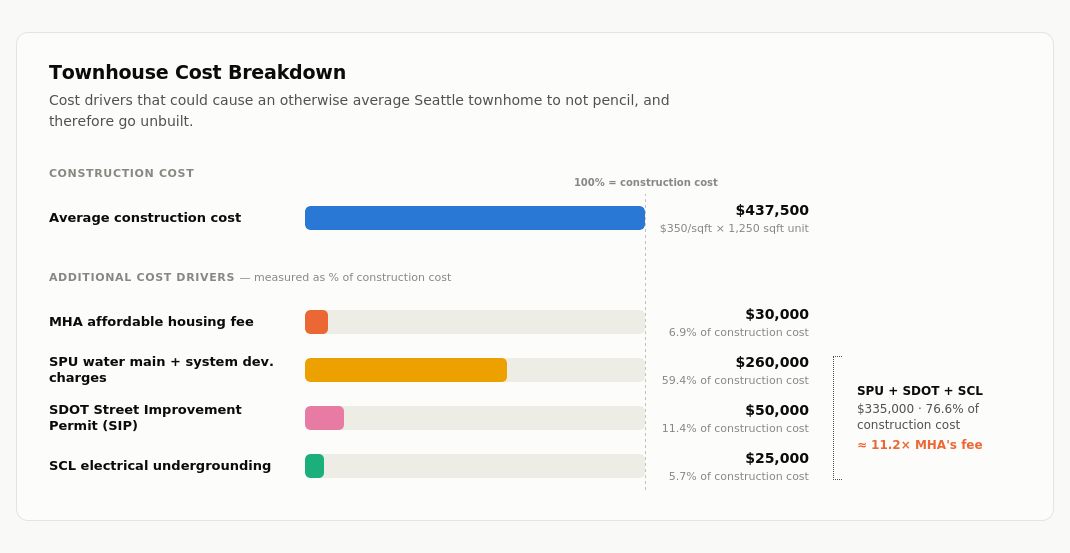
And because these utility improvements require subsurface street work, they typically trigger SDOT's Street Improvement Permit (SIP) process. SIPs place the cost and a multi-year timeline on the developer along the entire affected streetscape, not just their property's own frontage. Between holding and construction costs, a SIP might incur a further $150,000 on that small, 2-3 unit project. MHA fees begin to pale in comparison to the sum total of these cost drivers.
All up, the collective utility cost to replace one home with three or four will reach well above $1 million – over a quarter million dollars per unit. Since scale invites more requirements at every step, these costs are only exacerbated for large projects.
The effect: no developer wants to be first on a block or even in a neighborhood, since going first means absorbing the cost of upgrading infrastructure that will benefit every future project nearby. Latecomer agreements are a tool invented by SPU to help an early-moving developer recoup some of that cost from future developments, but SPU charges developers to simply apply for eligibility, they don’t meaningfully enforce collection, and still charge developers a portion of all funds that are eventually recouped.
These challenges are complex, and there's no silver bullet to cure Seattle's affordability challenges. WTR-440, SIP timelines, and undergrounding requirements can be reformed collectively, yes. Even so, there's still no single utility reform package on which we could rest our laurels and let the results pour in.
An equitable deal on MHA is also possible: one that sustains a funding source for affordable homeownership while redistributing costs where it will be equitably absorbed across the full spectrum of development. However, if Seattle passes a narrow MHA deal now with a commitment to reassess in two years, I'd wager we won't see floodgates of housing production open, and the verdict will read that we didn't go far enough. At that point, a return of higher or redistributed MHA fees would be flatly unpalatable, and MHA would be phased out entirely.
If the City avoids the harder, more consequential conversation about utility and permitting costs, we will miss an opportunity to assess the nuances of a sustainable MHA fee structure.
 Doug Trumm
 Donna Breske (Guest Contributor)