Fees for building and land use permits in Seattle are set to see double-digit increases for the second year in a row, as the city grapples with lower permit volumes amid a bleak development environment. The 10.7% bump in Mayor Katie Wilson's proposed budget for the Seattle Department of Construction and Inspections (SDCI) comes on top of an 18% increase just last year, adding costs to development right at a time when city leaders are hoping to spur construction.
With 91% of SDCI's budget coming from permit fees, the hike is a budget reality needed to maintain core staff, even as the department prepares to cut 34 fee-funded positions – including seven layoffs. But those added fees simply pile costs onto a dwindling constellation of projects that are able to move forward right now in the face of higher interest rates, increased construction costs, and an uncertain economic climate.
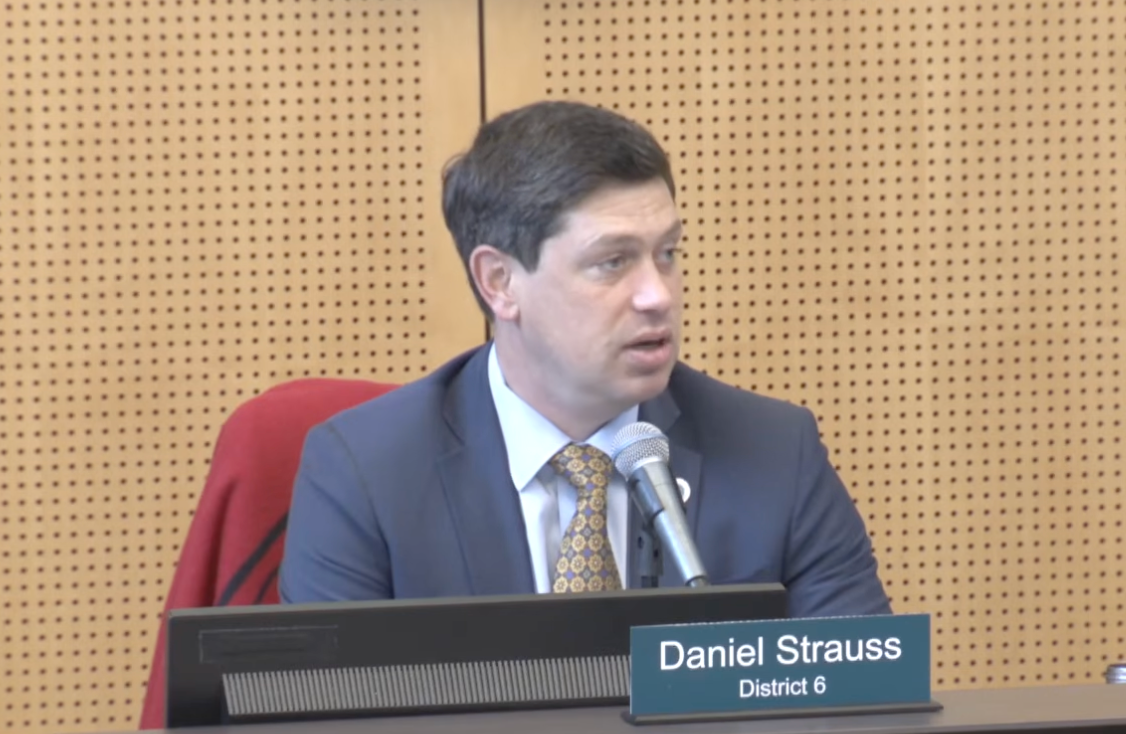
"These additional revenues help improve cost recovery, reduce the need for further staff reductions, and slow the use of fund balance while we continue to adjust to changing development activity," SDCI Finance Director Shane Muchow told city councilmembers Tuesday in breaking down the proposed budget.
SDCI expects Seattle to wrap up 2026 with 60% fewer applications for master-use permits (MUPs) than it saw in 2019, lower even than the depths of the Great Recession in 2010. Construction permit volumes are only expected to be 15% lower, but those permits have taken a dramatic shift toward smaller projects, a fact that impacts the amount of revenue that SDCI receives from them. All of these figures are spelling out a gloomy picture of the future of development activity in Seattle.
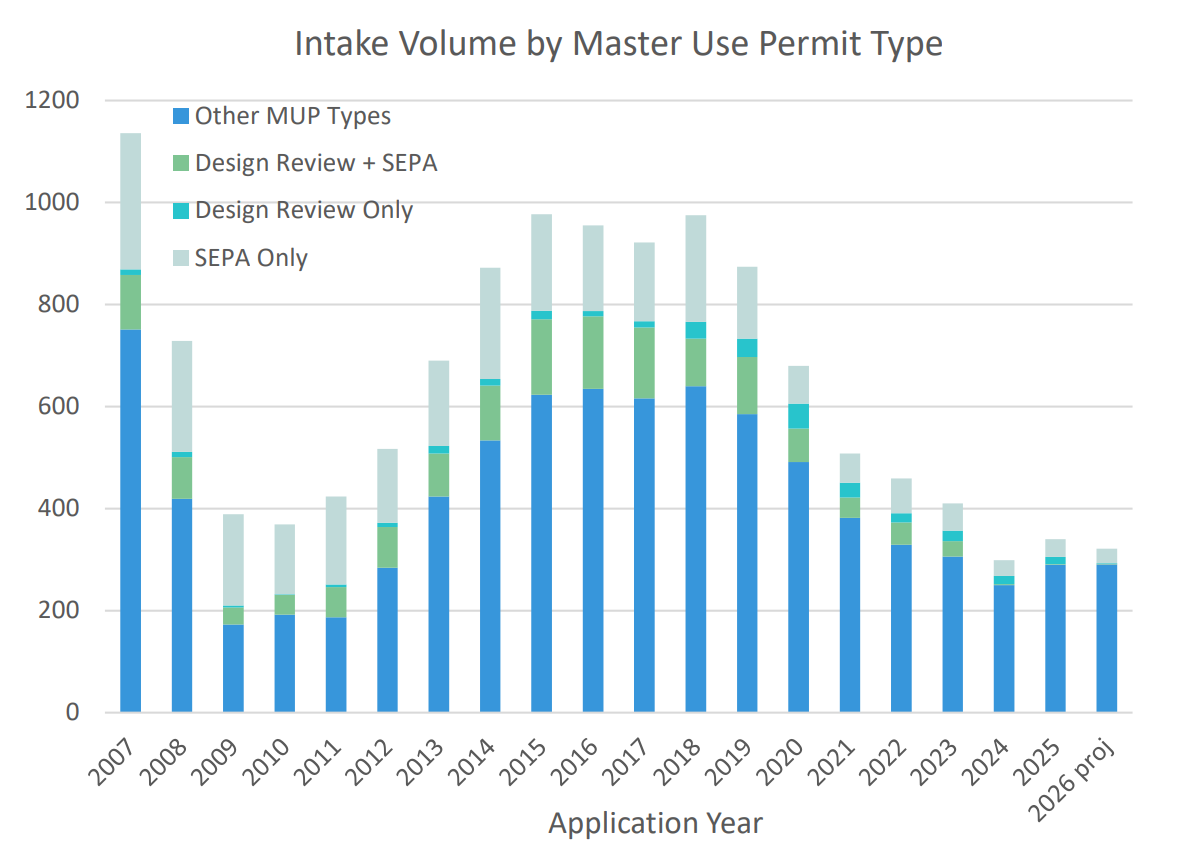
"That is very concerning to us in the department, when we see the scope and the valuation of the projects do not meet what they were in the the boom years, and the types of projects are smaller, less complex," Samuel Steele, SDCI's interim director, said.
Wilson put Steele in charge of the city's permitting department early this year after a prior string of temporary leaders for SDCI under former Mayor Bruce Harrell. Nathan Torgelson had led the department for nine years but left his post last March after Harrell requested his resignation. Steele previously led SDCI's construction inspection division.
Council land use committee chair Eddie Lin shared Steele's worries about the current development environment and what it portends for Seattle's housing goals.
"It's pretty alarming and concerning on many different levels," Lin said of the permit trends and the transition away from higher-value projects. Lin has been trying to advance the city toward its next major zoning update, delayed by legal challenges, but those upzones aren't likely to do the city much good if the economic climate – and Seattle's costly permit framework – mean projects aren't happening.
When these fee hikes are implemented, plan review and permit fees on a hypothetical 230-unit apartment building will have jumped from $274,486 in 2025 to $347,935 in 2027, a 26% increase. Costs to permit a four-unit townhouse development in Seattle will have jumped from $12,214 to $15,953 in just two years.
While those charges are far from the priciest line item on a developer's balance sheet, it's one more cost that could push a project on the edge of financial viability away from actually getting built.
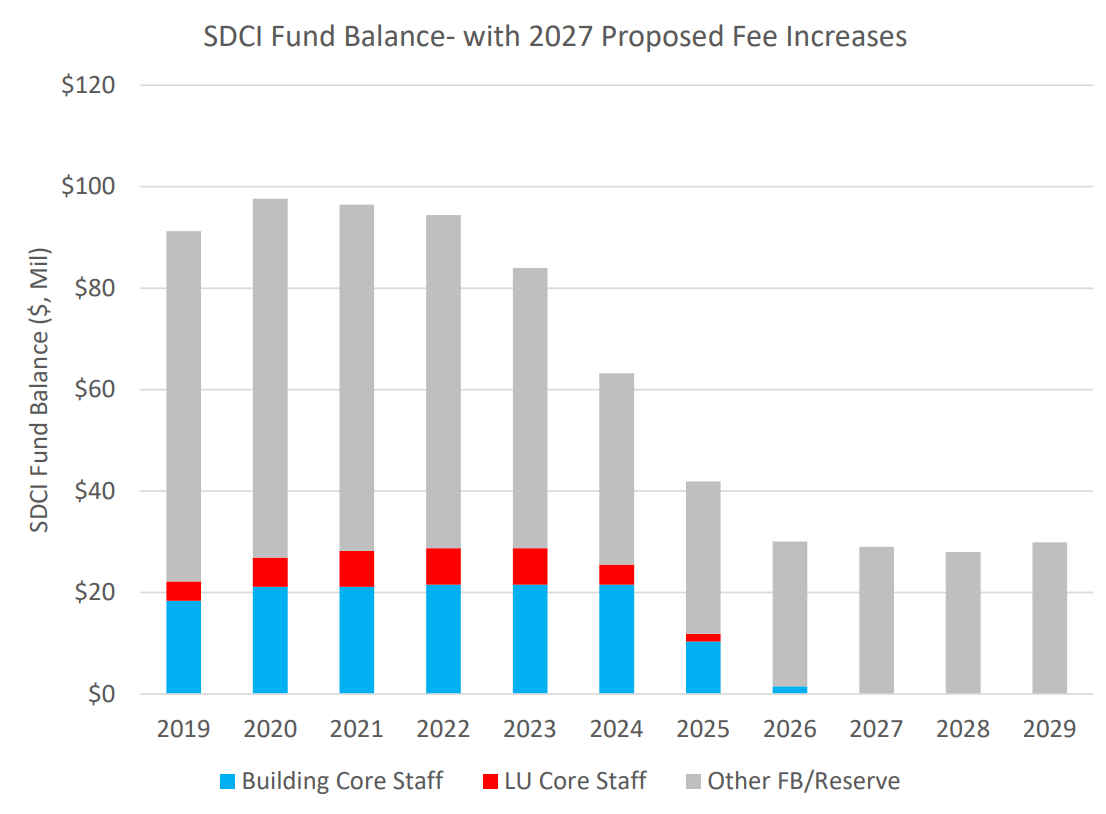
The hope is that by raising fees, SDCI can stave off further erosion of its cash reserves long enough to make it to the next major uptick in the development cycle. Those reserves have taken significant hits in recent years. By the end of the year, the department expects to have fully exhausted the reserve devoted to maintaining core building and land use staff.
"We were generally between $80 million to $100 million through 2023, but since then we've gone down those balances significantly as permit revenues have declined," Muchow said. "By the end of 2026, we're projecting an overall fund balance of roughly $30 million dollars. The fee increases proposed for 2027, along with the expenditure reductions we discussed earlier, are expected to stabilize the fund balance and slow further erosion."
A jolt to the development pipeline could come as early as next year, with a proposal to temporarily reduce the hefty Mandatory Housing Affordability (MHA) fees, which are charged to builders in Seattle's densest zones to fund the City's affordable housing trust fund. The impact of the proposal could be limited, given its emphasis on reviving stalled projects that have already had their permits vested via an 80% discount on MHA fees, while new projects would only qualify for a 60% discount and need to break ground within two years of passage to claim the discount.
Meanwhile, around a half dozen neighborhoods mostly in the South End would be excluded from the program unless projects clear the additional hurdle of keeping ownership in the hands of a "legacy homeowner."
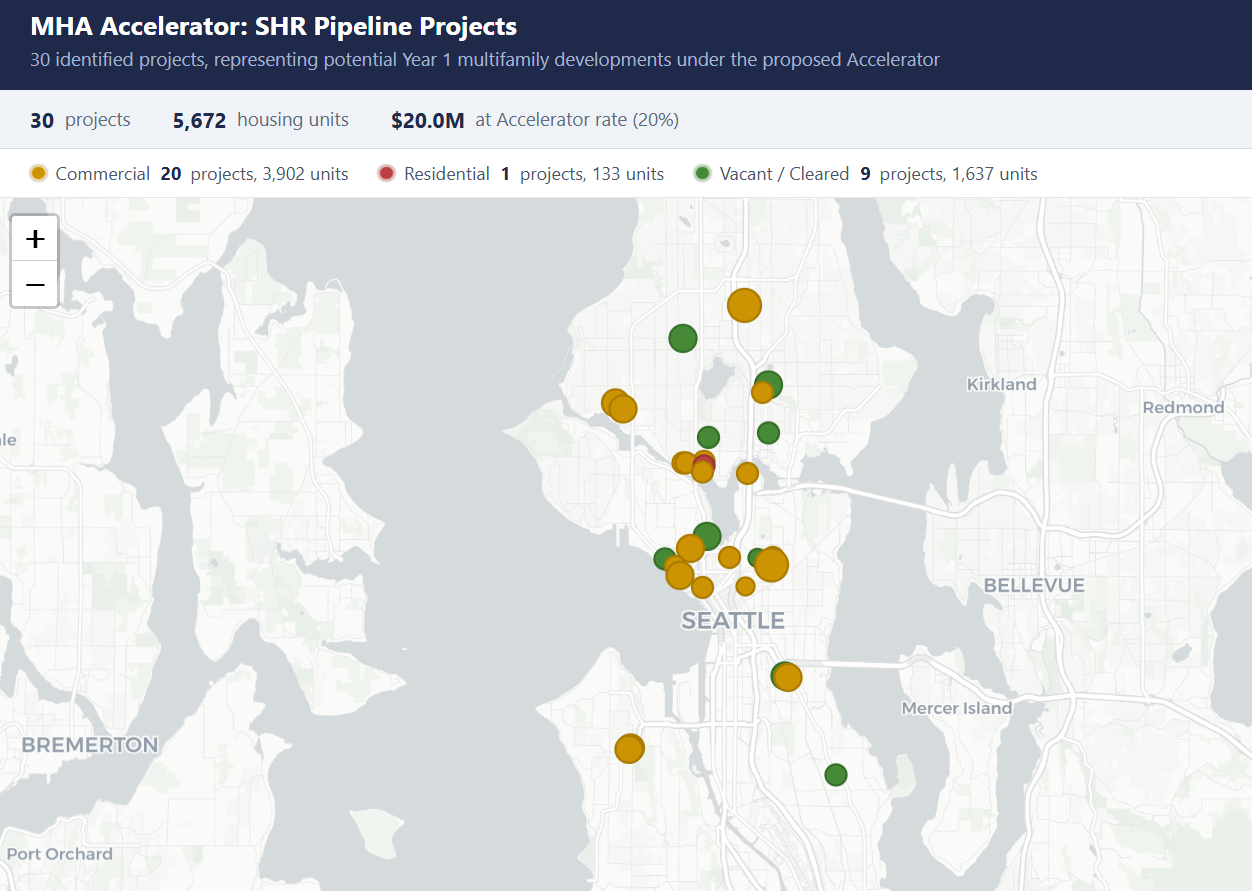
The Seattle Housing Roundtable, which represents around 30 developers and advocated for the fee reduction, has tallied more than 30 vested projects that they say would likely break ground with the 80% MHA break, leading to 6,000 new homes or more. The permit fees those projects would bring would be a nice bump for SDCI, but not enough to fix the department's long-term financial trajectory. The outlook for the next wave of projects looking to take advantage of the 60% discount is less certain, in part because the financial incentive is smaller.
MHA fees are a magnitude larger in scale that SDCI's permit fees. For example, on a hypothetical 230-unit apartment building, MHA fees may be $3 million or more, roughly 10 times greater than permit fees. Even after the proposed MHA break goes through, they would still exceed permit fees several times over.
Longer term reforms for Seattle's byzantine land use approval process could come about as a result of a new executive order that Wilson issued in August, which created a housing production task force charged with "developing and advancing policies and actions that accelerate housing production." In advance of that group's reports, due next year, Wilson has also set up an internal working group that is attempting to break down some of the siloes between different departments that all issue building permits.
"The Mayor's Office is leading a[n] interdepartmental team to really focus on some of these things. They have all the big departments involved: SDCI, of course, Department of Transportation, City Light, Public Utilities, the fire department, and one of the goals of this is to create end-to-end visibility," City Budget Director Aly Pennucci said Tuesday.
Even if reforms within SDCI are able to reduce costs for developers, the costs imposed by other regulations outside the department are significant as well, with rising utility costs coming under greater scrutiny. Wilson's budget for SDOT also includes increased fees for street use permits, with a 30% hike on deck for permit issuance, renewal, and modification.
"This was surprising to me to learn that currently, applicants need 30-plus permits from eight different departments to build housing in the city," Pennucci said. "So, that is one of the areas that are really being looked at, including really focusing on streamlining the speed of right-of-way and utility permitting, as those are kind of the longest duration [permits]."
While those reforms may ultimately bear fruit down the line, they aren't much help right now, and in the meantime the burden of keeping the city's permit infrastructure solvent will keep falling on exactly the type of projects that Seattle needs more of and is looking to boost.
 Amy Sundberg
 Ryan Packer