Seattle is taking another stab at a "Housing Accelerator" pilot program that would offer a temporary reduction on builder fees to stimulate housing starts. Councilmember Dionne Foster dropped the proposal today, which will be formally introduced Friday in the housing committee, which she chairs.
The housing accelerator idea surfaced earlier this year, with a coalition of builders called the Seattle Housing Roundtable forming to advocate for the idea. Behind the scenes, Mayor Katie Wilson backed the proposal and was preparing to release legislation when a key coalition representing nonprofit affordable housing developers pulled their support, leading the mayor to table the proposal for more stakeholder work.
The Urbanist's Fall Member Drive is in full swing! Support our work, read ad-free, and help us hit our goal for the member drive!
That process snag led some observers to worry the proposal would be trapped in the Seattle Process never to be seen again, or to be watered down past the point of usefulness. Foster's proposal seems to prove those doubts unfounded, though the delay will have an impact on how quickly the proposal can get signed into law. Due to the council budget process, which kicks off next week, the bill isn't expected to see a final vote until January.
"I'm expecting a lot of support for this proposal when we discuss it in committee on Friday," Foster told The Urbanist. "I think that we've had some really fantastic conversations with stakeholders over the last several weeks, and talked through the proposal and continue to develop the proposal in a way that I feel confident that there will be a broad support for it."
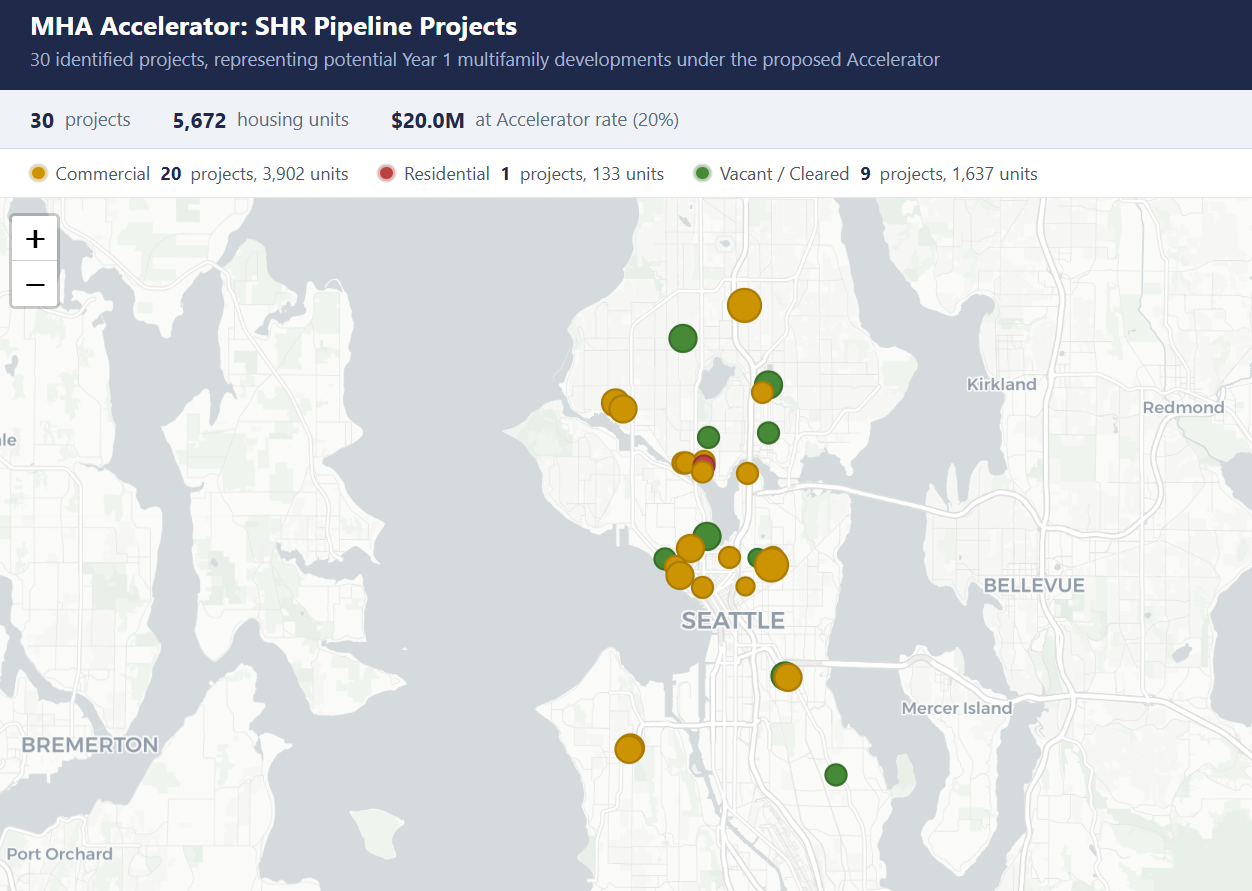
One key policy attribute remains: a 80% reduction in Mandatory Housing Affordability (MHA) fees for projects that have vested permits but are stuck in financing limbo. The Seattle Housing Roundtable has identified 35 projects encompassing more than 6,000 housing units that have vested permits, but are stuck and apparently unable to secure financing without a jolt the accelerator program could offer.
"This is really a key approach for jumpstarting housing production here in Seattle," Foster said. "We are taking this on with the goal of ensuring that housing can realistically get started in construction. So I expect to see shovels in the ground and apartment buildings opening up for our residents."
One key change: proposals that are not yet vested will be able to unlock a 60% reduction, rather than the full 80% proposed earlier. They will also need to provide 25% of units as multi-bedroom units in order to qualify for the reduction, a new requirement that could force significant designs of projects that previously would have been ready to go straight into the development pipeline.
The two-year break on fees could be a bridge to a more permanent recalibration of the MHA program. Mayor Wilson's new housing production task force is chartered with tackling that question, among others. The hope is that the group will have policy recommendations next year with plenty of time to put together the permanent program before the temporary break expires.
Promoting family-sized housing construction
In a Tuesday interview with The Urbanist, Foster said the two-bedroom stipulation was intended to address the dearth of family-sized rental housing in Seattle.
"We wanted to take that approach because it feels really important to strike a strong balance between accelerating production and also accelerating the kind of production we're hoping to see in the city," Foster said. "I'm also excited for the non-vested projects. We've heard a lot around the need for family-sized units here in Seattle. I certainly hear that a lot from friends of mine who are having families. And so, for those projects that are not yet vested, those will have a requirement that at least 25% of their units are two-bedroom units."
The vast majority of new multifamily housing built in Seattle consist of one-bedrooms and studios, since those types of units allow builders to achieve higher returns per square foot. But even one-bedroom-heavy projects are drying up in the pipeline. Overall, permit applications are down 94% from their 2020 peak, and permit completions are also down, which means less MHA revenue for the City's affordable housing trust fund.
At its 2021 height, the Mandatory Housing Affordability (MHA) program pulled in $74 million in funding for affordable housing, but as housing starts have plummeted, that figure has trended below $20 million. Seattle has only pulled in about $7 million though the first eight months of 2026, said Peter Nitze, a roundtable member and workforce housing developer with the firm Nitze-Stagen, said.
Nitze is in the permitting process for an 203-unit eight-story workforce housing project in Othello that could benefit from the MHA accelerator via the 60% break. It's not yet vested, but he said the firm already has a large number of multi-bedrooms in mind given their mission and Multifamily Tax Exemption (MFTE) incentives, which already encourage builders to include at least 12% two-bedroom units.
While his firm is poised to use the temporary break, lowering the break from 80% to 60% of the fee while adding the multi-bedroom requirement could nudge some others out of the market, Nitze said.
"I'm not a fan of it," Nitze said of the change. "I would have been much happier with an 80%. The theory here is that because unvested projects haven't even submitted the package for permit approval, that they can tweak the planning to make up for that lost 20%, and it could still make a difference. So, in theory, I think that's correct, but obviously, I would prefer... you know, the original plan was doing a 90% reduction in the first year."
Generally, though, Nitze and the housing roundtable writ large is welcoming the revised proposal as a significant improvement over the status quo, which is trending toward fewer and fewer housing starts.
"The problem is we're running out of time, and it takes years for these projects, even once they're permitted, to get out of the ground," Nitze said. "And so we're going to have a pretty significant trough in terms of delivering new rental units. So there is urgency here, and so I appreciate the council moving quickly to do it."
Potential MHA expansions into historically single family areas
Alongside the temporary MHA recalibration, Foster also introduced a resolution that requests a proposal to expand MHA to Neighborhood Residential (NR) zones, formerly known as single family zones), which are currently exempt. That idea had previously been considered under former Mayor Bruce Harrell, but ultimately it did not move forward, despite significant advocacy from councilmembers like Cathy Moore, who resigned last year.
"The Council requests that Central Staff: Develop legislation implementing an inclusionary requirement for new market rate residential development in Neighborhood Residential zones for referral to the Housing, Arts and Civil Rights Committee," the resolution states.
The move appears geared to win some support from stakeholders on the nonprofit side, some of whom see the lack of MHA in NR zones as an oversight sapping revenue.
Townhome builders have criticized efforts to expand MHA into NR zones, noting the margins are smaller on their project and their access to capital is more limited than builders of large apartment buildings and condominiums.
"It's certainly not going to help with making single-family homes more affordable," Nitze said. "Expanding MHA to include single family, I don't see how that's helpful. It sort of dilutes the main intent here. The main intent is to get 35 projects out of the ground by getting them over the line on the return profile, and build 6,700 units. And [if] you start tacking on a bunch of other stuff, that has unintended consequences.
Since Seattle levies MHA fees at the point of permit completion, that becomes a large burden for builders to carry before the project begins bringing in revenue. This timing challenge has led some builders to call for the reform of making the MHA fee due at the point the building receives an occupancy permit, rather before construction has even started.
Without the lifeboat that the housing accelerator could offer over the next two years, Nitze expects the development pipeline to dry up and rents to spike.
Foster seemed to agree the status quo is trending badly. While housing permit applications are plummeting in Seattle, the region is expected to continue to see significant population growth.
"Seattle is a majority renter city, and we need to make sure that we have new housing production to accommodate the growth that we're going to have here," Foster said. "And we're going to continue to grow as a city. We're a place that people want to live in. We're a place that is going to be a more climate resilient region. And it's really important that we are supporting the housing production to accommodate our population."
 Doug Trumm
 Doug Trumm