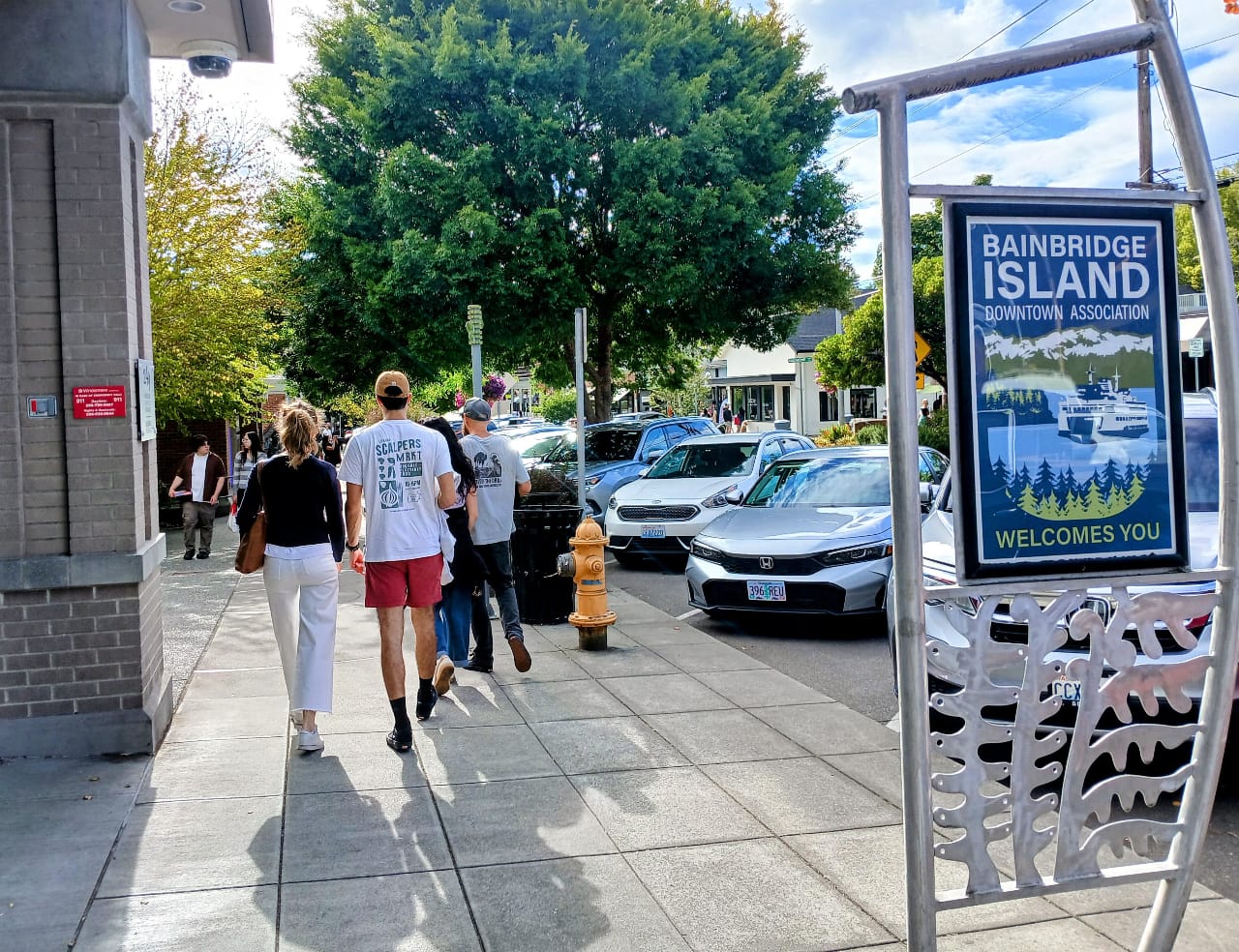
The City of Bainbridge Island could soon be forced to open the door to a much broader range of housing projects than the city's current zoning standards allow, thanks to a new accountability tool embedded in state law that's never been utilized before.
Earlier this week, the Washington State Department of Commerce confirmed that Bainbridge is on track to trigger what's known as the Builder's Remedy on August 22, if the city doesn't adopt an updated housing growth plan. The City is not currently on track to meet the deadline.
The declaration came at the first public hearing ever held under the 2025 Housing Accountability Act, with Bainbridge Island one of eight cities and towns subject to extra state scrutiny over their housing regulations. Under the Builder's Remedy, any housing project that meets certain affordability requirements for future residents has to be approved regardless of existing zoning or development standards, with projects able to be submitted until the city is found to have a compliant plan.
Bainbridge Island is now more than a year and a half late in getting its 20-year growth plan across the finish line, after the city's planning commission spent the entirety of 2025 pouring over details, often trying to come to unanimous consensus around zoning standards and development regulations. For a brief time, it looked like the Bainbridge City Council was on track to meet its deadline, which was communicated to the city back in April. But on July 15, the Council voted 4-3 to scale back zoning capacity in the island's main growth center of Winslow that it had voted to increase just a few weeks earlier, sending the regulations back to the planning commission for another review that will stretch into August if not further.
A day before the hearing, Bainbridge officially requested an extension on its deadline from Commerce, a request that is still being considered with an answer expected by next week. If no extension is granted, starting on August 22 the city would have to accept complete permit applications for projects that include: at least 20% of units affordable to households at 60% of Kitsap County's area median income (around $52,000 for a family of two), 50% of units at 80% of median income, or 100% of units at 120% of median income.

"The Builder's Remedy would allow an applicant to come in and submit a development proposal application for a project and ask for waivers of certain regulations that it felt were preventing it from being able to build the affordability levels that were required to be affordable projects under the law," Commerce planning and data manager Laura Hodgson told councilmembers Tuesday.
The Builder's Remedy provisions in the Housing Accountability Act are modeled on similar regulations in California, dating back to a 1990 law that mainly sat unused until recently — after law professor Chris Elmendorf wrote a paper on the topic that increased its salience in the development community. California’s Builder's Remedy has primarily served as a bargaining chip for housing developers. Virtually no Builder’s Remedy projects have actually been permitted as initially submitted, but the applications have often forced local governments to reckon with their own land use regulations and have helped to get more modest projects approved.
Thanks to not yet having a compliant Comprehensive Plan, Bainbridge Island has already lost nearly $800,000 in state funding for stormwater infrastructure, Councilmember Ashley Matthews confirmed at Tuesday's meeting, with the city discouraged from even applying for other state grant programs until they've been able to get their growth plan across the finish line.
Why can't City officials come to agreement on a plan? The heart of the back-and-forth in council deliberations has been how much zoning capacity to offer market-rate development in Winslow, and how much capacity to reserve as a bonus for developers willing to include affordable units. In June, the council had voted to increase the base floor area ratio (FAR) in the ferry terminal and High School Road districts to 1.0, a fairly modest increase that has nonetheless proved contentious. Currently, the base FAR is just 0.3 for a mixed-use building in High School Road and 0.5 in the Ferry District, where the Low Income Housing Institute's stalled affordable housing project would be located.
A calculation that relates to how much space a building is able to take up on a lot, a 1.0 FAR does not represent dramatic density, and simply means a two story building is able to take up half a lot, or a three story building can take up one-third of a parcel.
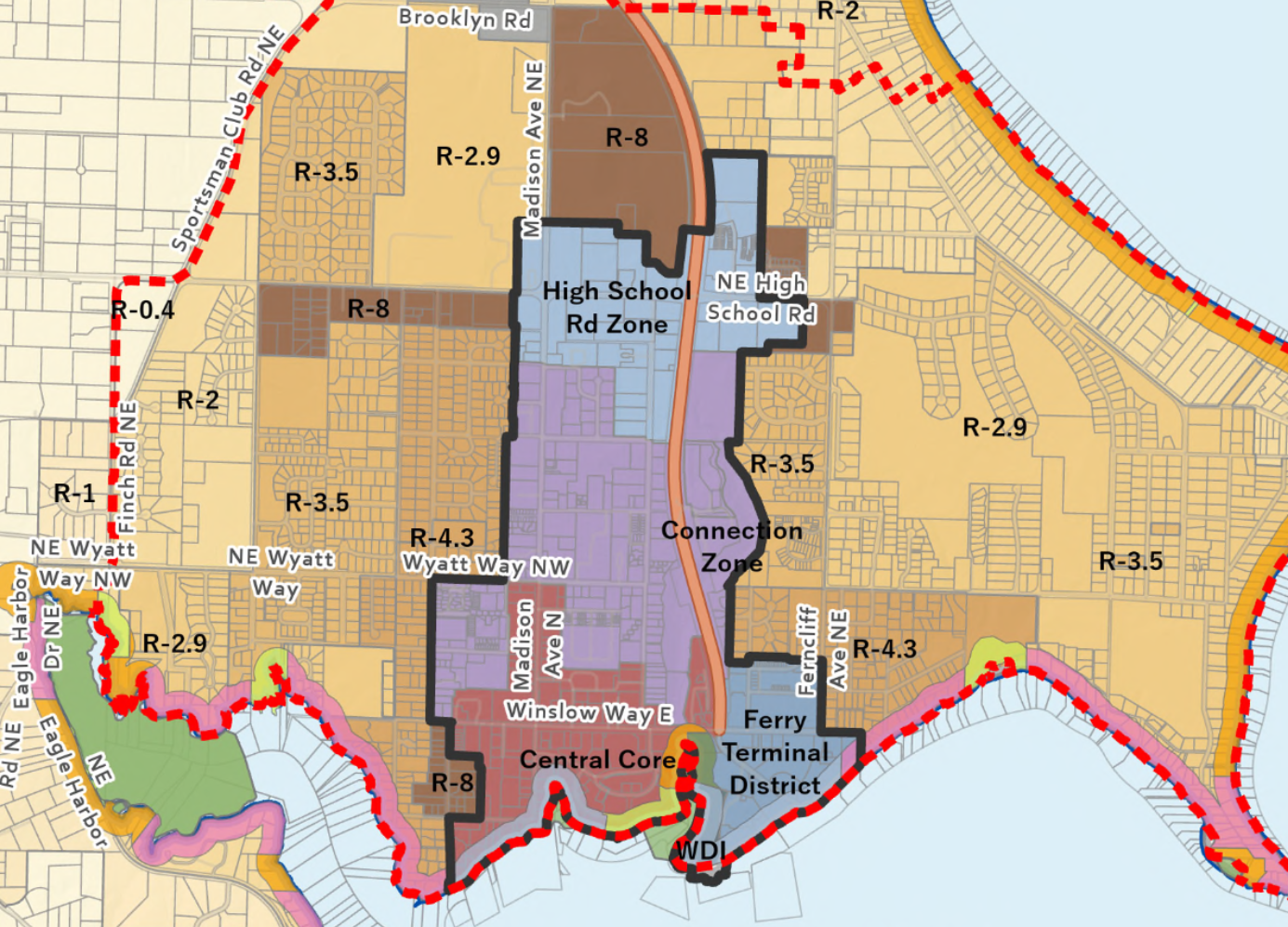
Stephen Hoskins, an urban economist who lives in Winslow, worries that with the reduction in base zoning capacity, the city won't be able to show that's it's fully compliant with a 2021 law requiring Bainbridge to plan for housing across all income levels, the same law that got the City of Mercer Island into hot water last year.
"I think that it was a not only a mistake insofar as I think that we now are still going to be below capacity, and I've been trying to raise alarm bells on it, and nobody has really noticed what I've been saying," Hoskins told The Urbanist. "I also think that it was an unnecessary decision that extended the timeline, and is what caused us to have to ask for an extension from Commerce. So we're asking for an extension that we didn't need because we had already made the bold decision to get ourselves into something that we knew was compliant, and we could have got implemented on time."
Bainbridge housing advocates have argued that the city needs to create capacity for housing projects of all types in Winslow, to create a pathway for units that could become available to more members of the city's workforce. Many workers endure long commutes from elsewhere to get to work on the island.
In Bainbridge, market-rate units are often pitted against subsidized affordable units, with the issue framed as zero-sum, and infrastructure limitations including water and sewer capacity are frequently cited as reasons the island's "carrying capacity" can't handle more residents.
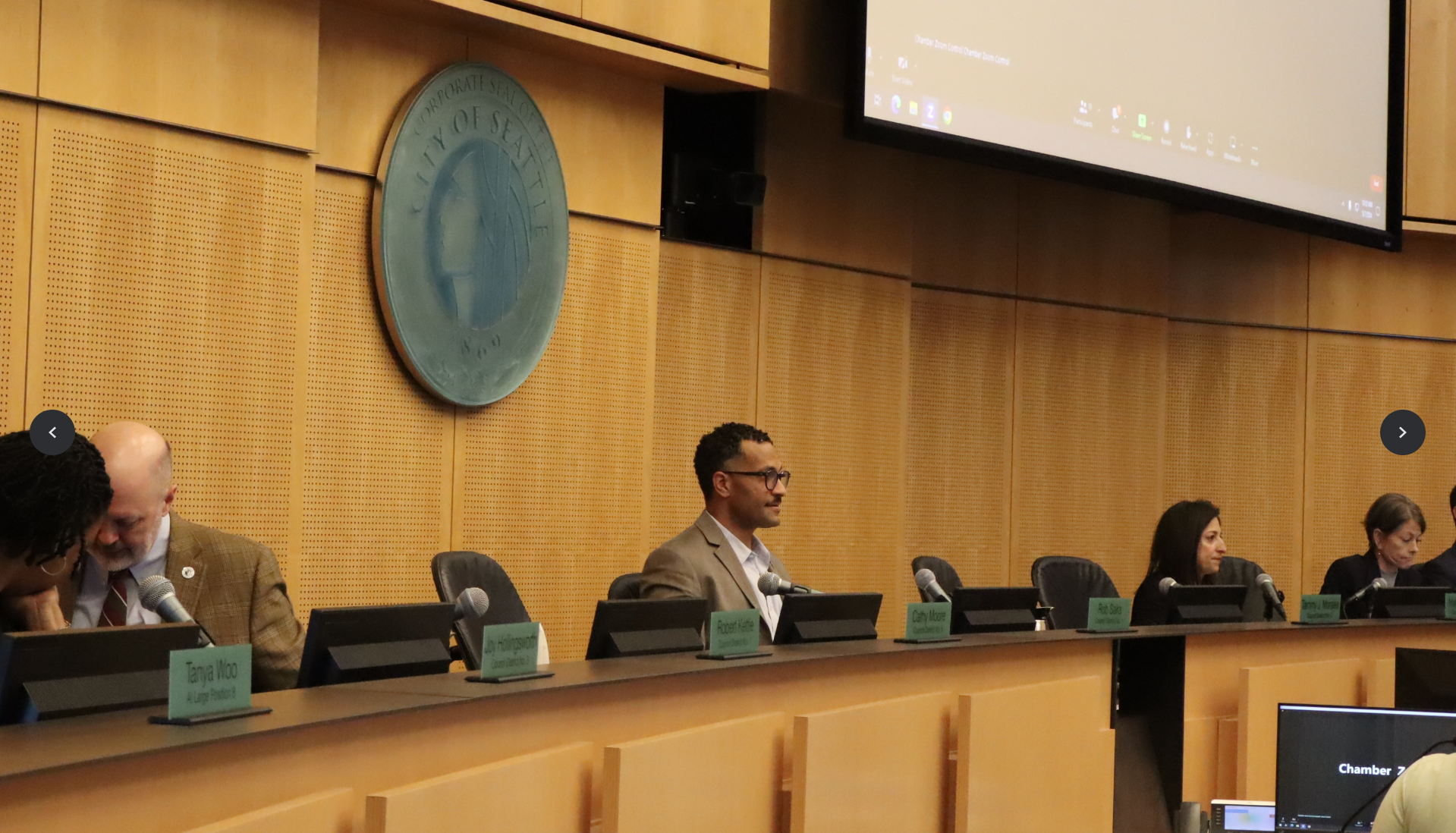
"We're being forced to upzone to create capacity that will be able to be used by market-rate development. And surely, since that's where the profits lie, that's where it'll go. So I'm very frustrated by that," Councilmember Kirsten Hytopoulos said at this week's hearing.
The issue of a mandatory inclusionary zoning (IZ) program, in which builders are required to set aside a certain percentage of units as affordable, has become something of a political football on Bainbridge. Late last month, when the Council voted to set aside a IZ program that would have only applied to projects encompassing more than two acres – a wholly unique way to manage such a program that no other Washington city has in place – Councilmember Mike Nelson took to social media to blast his colleagues. Nelson framed the four councilmembers who supported the move to shelve the idea, intended to keep the Comprehensive Plan on schedule, as being "pro-growth", begging the question of what word would apply to his faction of the council, which also includes Hytopoulos and Lara Lant.
"If you needed proof that the upzoning of Winslow is NOT about affordable housing and workforce housing but just market rate upzoning, look no further than last night’s City Council meeting. The City Council voted 4-3 to remove the mandatory inclusionary zoning program from the proposed development regulations," Nelson wrote in a Facebook post on July 1. "It was the Pro-Growth Majority that pushed through this change (i.e., Moriwaki, Mathews, Fantroy-Johnson, and Schneider). This is the same majority that professes to care about affordable housing and workforce housing for workers that can’t afford to live on the Island."
Now the City is poised to advance a revamped mandatory IZ program that is based on the number of units proposed in a development, but it's unclear if that program will demonstrate to the Department of Commerce that the city is creating enough capacity that will can be realistically counted on to translate into units on the ground. That math equation will be a major piece of the puzzle that Commerce is faced with when deciding whether Bainbridge's plan is compliant – if the City ever actually finalizes it.
Ultimately, the process intended to get Bainbridge Island to meet its housing capacity targets – with the threat of a loss of funding and the Builder's Remedy both acting as a powerful stick – is poised to prompt some of the biggest zoning updates that the city's seen in decades, even if they remain modest compared to other cities.
But Hoskins sees a focus on the targets themselves as a distraction when considered in the larger context of the island's housing needs.
"At the very least, we now have you know a community that has blocked housing through any means possible for a very long time, now at least being forced to do some tiny amount of upzoning, and that is great, and I'm sort of happy about this capacity target for that reason," Hoskins said. "But the reason why I think it is short-sighted is that all of the things that people are really worried about with respect to growth – such as the aquifers being drained, running out of infrastructure capacity with respect to sewer and water, and the roads and car parking, and also just our community mindset of wanting to be good for the environment and reducing our carbon emissions and protecting the conservation area – all of those things are helped by us directing as much of our future growth as possible into apartments, multifamily apartments in Winslow. That is our path to a sustainable and environmentally friendly and thriving and integrated community."
 Ryan Packer
 Ryan Packer