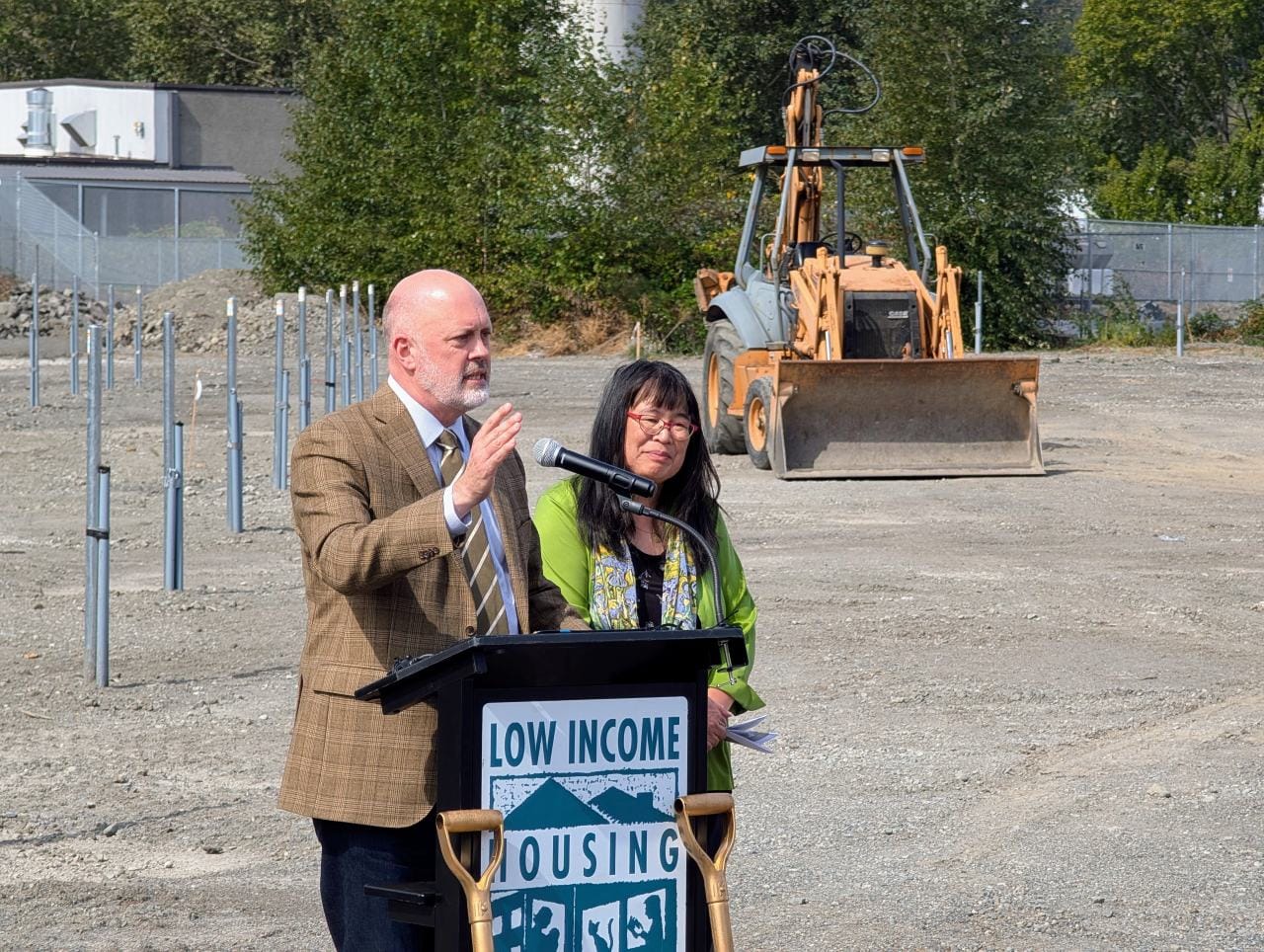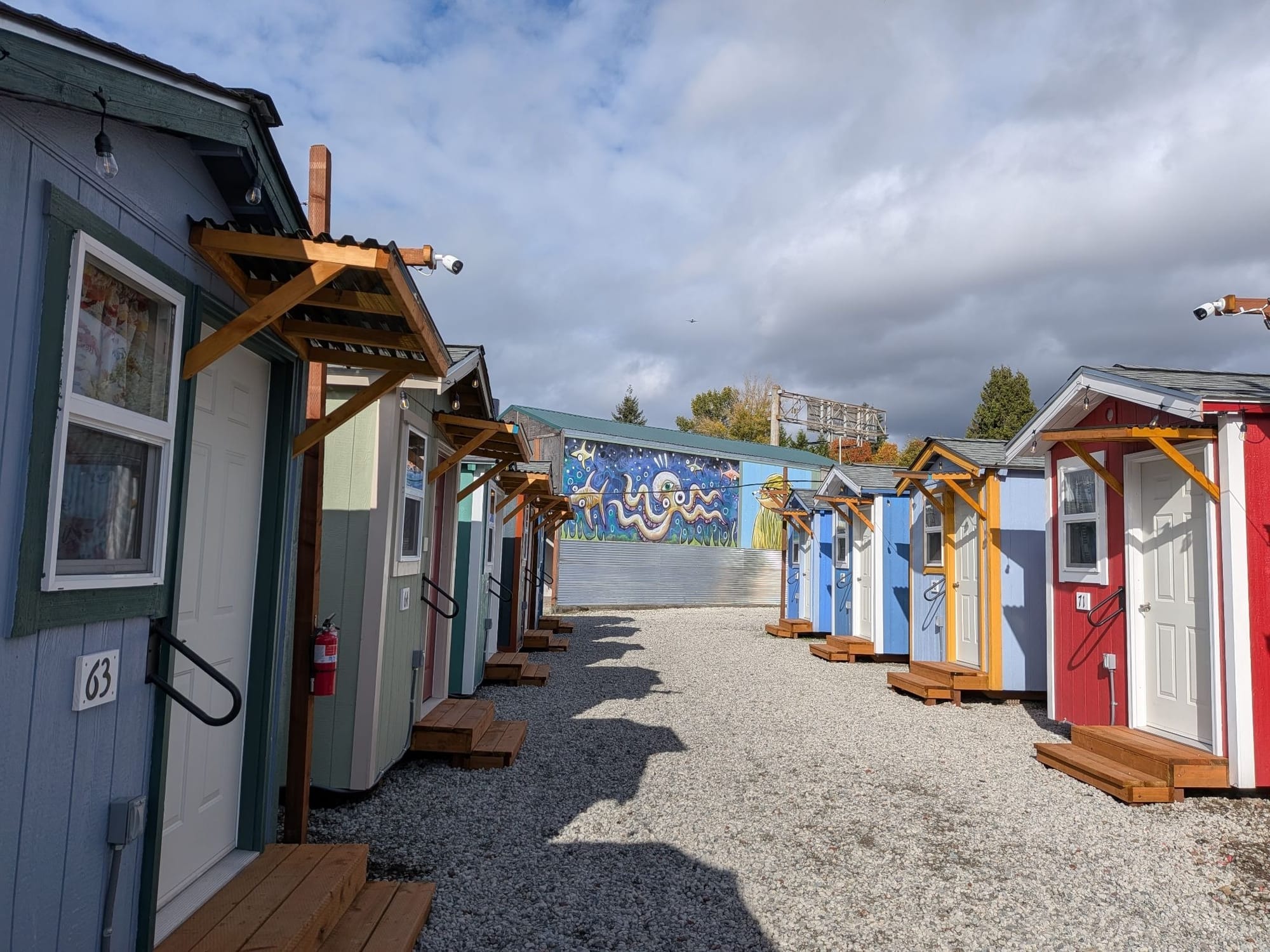
On Tuesday, the Low Income Housing Institute (LIHI) celebrated the opening of its new Cloverleaf Tiny House Village, its largest tiny house village to date. Located in an industrial neighborhood in South Park right off Highway 99, the new tiny house village has 90 tiny houses measuring in at 8 by 12 feet and will be able to house approximately 100 people.
“When I look around, I think this is what progress looks like,” Wilson said at the grand opening. “This is 90 tiny houses, 90 doors that lock, 90 chances for someone to come inside and catch their breath and find a new beginning. And of course, Cloverleaf Village is also a part of something bigger, a commitment that we as a city are finally ready to keep.”
Wilson was referring to Seattle’s long struggle with unsheltered homelessness, which led Mayor Ed Murray to declare a state of emergency on homelessness in 2015. More than a decade later, the problem persists. The 2026 Point in Time Count in King County, conducted by the King County Regional Homelessness Authority, recorded a 9% increase in the number of unhoused people since 2024’s count, with a larger percentage of those people being unsheltered.
Plus, service providers are bracing as federal policy changes, including at the U.S. Department of Housing and Urban Development and through cuts to health insurance subsidies, Apple Health, and SNAP, risk increasing that number further. Decisions from the Trump administration are weakening the social safety net, leaving more at risk of homelessness.
This new tiny house village is a product of Seattle Mayor Katie Wilson’s shelter accelerator plan and was funded by a public-private partnership with Challenge Seattle with support from the Seattle Foundation. The City of Seattle will continue to support the village’s operating costs in the future, assuming that the Seattle City Council passes that section of Wilson’s proposed 2027 budget as is.
“The mayor told us that addressing chronic homelessness was among her highest priorities,” said Christine Gregoire, former governor and CEO of Challenge Seattle. “We asked how the business community could be of help to her, and today we're here because our members stepped forward with $3 million to help make that priority a real reality. For years, Challenge Seattle has advocated for stronger, comprehensive, better coordinated public-private partners to address chronic homelessness. This is the vision that we've always had.”
Cloverleaf’s church sponsor is Reverend Lawrence Willis with the New Direction Missionary Baptist Church. Having a church sponsor expedites the process of standing up a new tiny house village, and the sponsor will often participate in a village’s community advisory committee.
Tyson, otherwise known as Turtle, a former resident of LIHI’s tiny house village Camp Second Chance, also spoke at the opening. Since his time at Camp Second Chance, he’s moved into his own apartment.
“Your support didn't just build tiny houses,” Tyson told the crowd. “You built a figurative scaffold that we all will be able to use to then build our own futures. With a safe place for people to land, they won't be so hesitant to test their wings and fly.”
In addition to the housing units, the village features a large kitchen tent, 10 bathroom stalls with toilet, sink, and shower, both outdoor and indoor community spaces, and a laundry room. The laundry machines will be free to use with soap provided, and residents of the village will be fed three meals a day by Operation Sack Lunch.
Both case management and behavioral health services will be provided on site. In the past, Sharon Lee, the executive director of LIHI, said their tiny house villages couldn’t afford to provide behavioral health services on site as part of their wrap-around services.
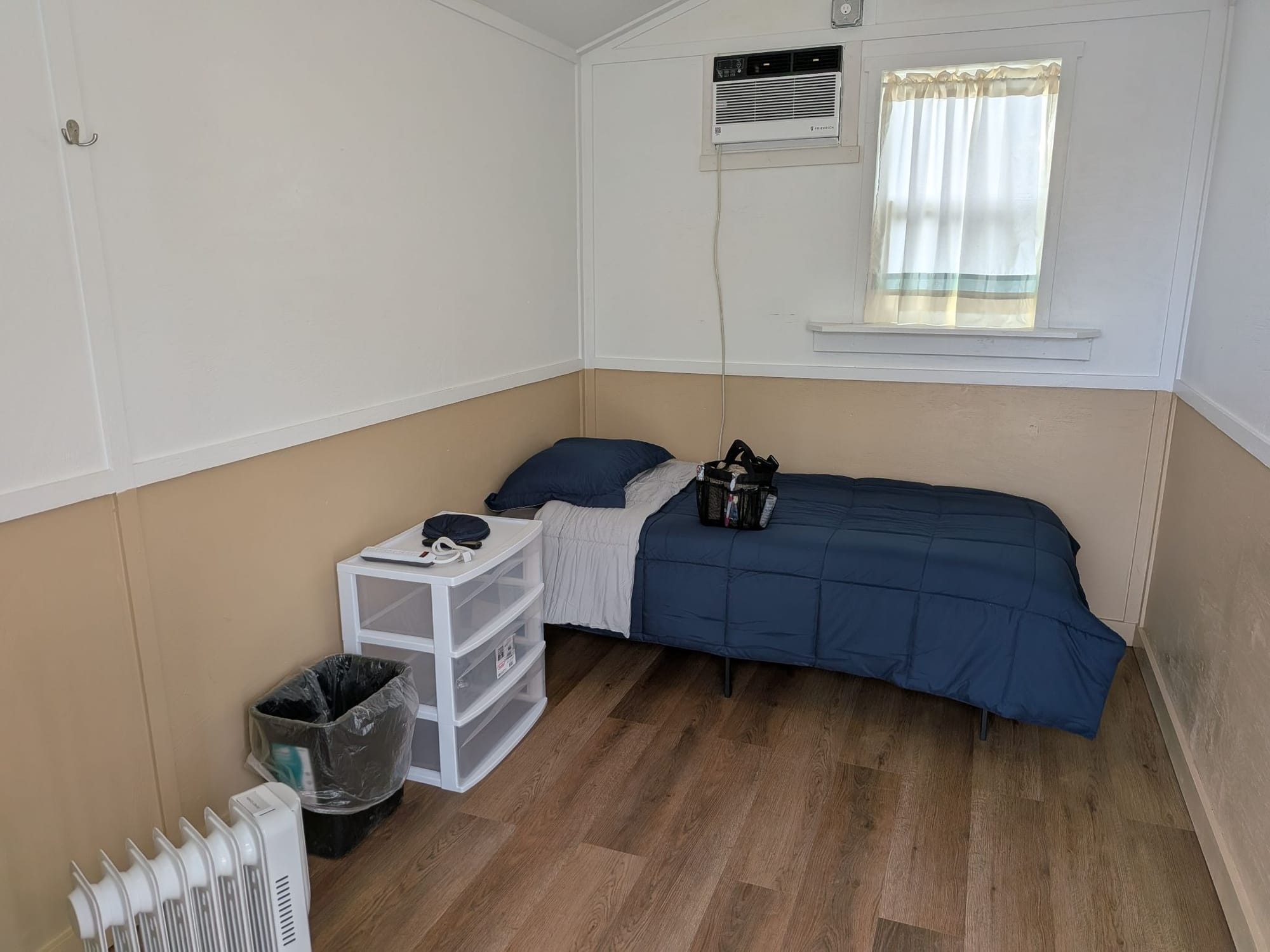
This particular village will be for adults only and will allow pets, with a dog run in the back and available dog waste bag dispensers. Some units have a double bed in order to be suitable for couples, and 12 of the units are ADA compliant. Each unit is also equipped with air conditioning and a space heater.
Security cameras are spaced at regular intervals throughout the village and monitored on-site. Staff will be present on site 24 hours a day, seven days a week.
The village is a bit of a trek from public transit – the nearest bus stop is more than half a mile away – with some of the surrounding streets lacking sidewalks. Those same streets handle significant truck traffic due to the businesses located there. LIHI plans to run a shuttle to help with accessibility, but the shuttle’s frequency and hours have not yet been determined.
“We are currently working to finalize the transportation plan for Cloverleaf,” LIHI senior manager of communications and resource development Alexis Diltz told The Urbanist. “We anticipate purchasing a shuttle van soon and will be developing the schedule and routes as we move forward with implementation. We want to ensure the transportation plan reflects program participants’ needs and priorities, so participant feedback and input will be an important part of that process.”
Diltz added that the shuttle will be providing transport to nearby grocery stores.
Expedited process
Soon after she assumed office, Wilson took steps to expedite the creation of new shelter spaces, including transmitting three pieces of legislation to the city council: one identifying additional spending for emergency shelter in 2026, one giving the city authority to sign leases for larger pieces of land at market rates, and one increasing the baseline and maximum number of people accepted at shelter sites.
All three ultimately passed, although not without friction between the council and the Mayor’s Office.
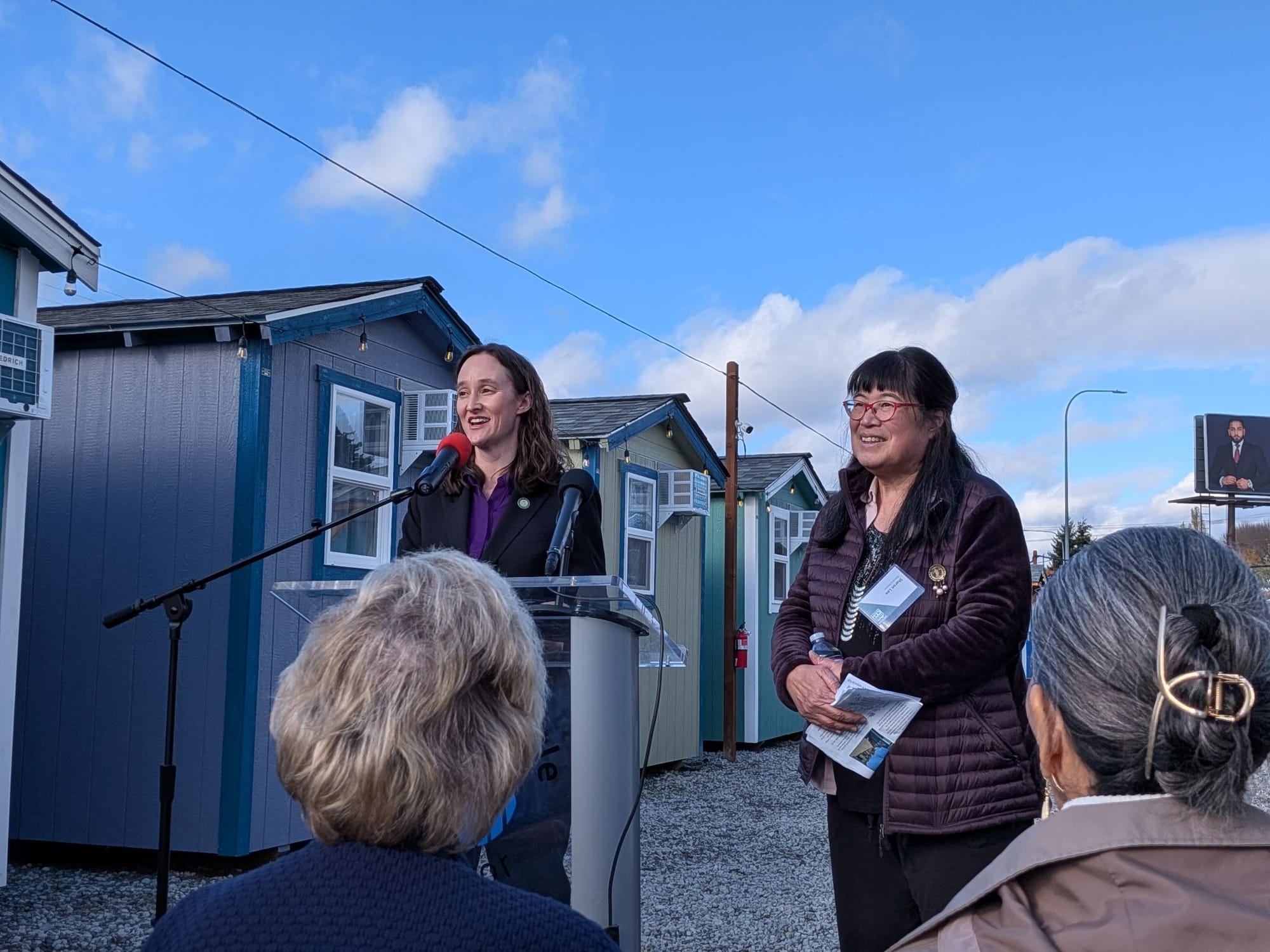
“When I stepped into office, it was my very highest priority to figure out how we could build a lot more shelter fast, and not just a roof over people's heads, but shelter that comes with services, the services that many people living unsheltered on our streets need in order to find that new beginning,” Wilson said.
Since her term began, Wilson has overseen the opening of Bayside Shelter in Interbay and Brighton Village in Rainier Valley.
Sharon Lee, the executive director of LIHI, credited Wilson with helping to expedite the opening of Cloverleaf.
“[Wilson] got every department head to get together in one room and look at our plans and permits and said, "Hey, anybody has any issues with this? You need to speak up now, and we're going to approve the permits. That had never happened before,” Lee told The Urbanist. “For a tiny house village, it was almost like the shortest period of time ever to get a permit.”
Lee said that without Wilson’s extra push, Cloverleaf wouldn’t have been able to open until next year.
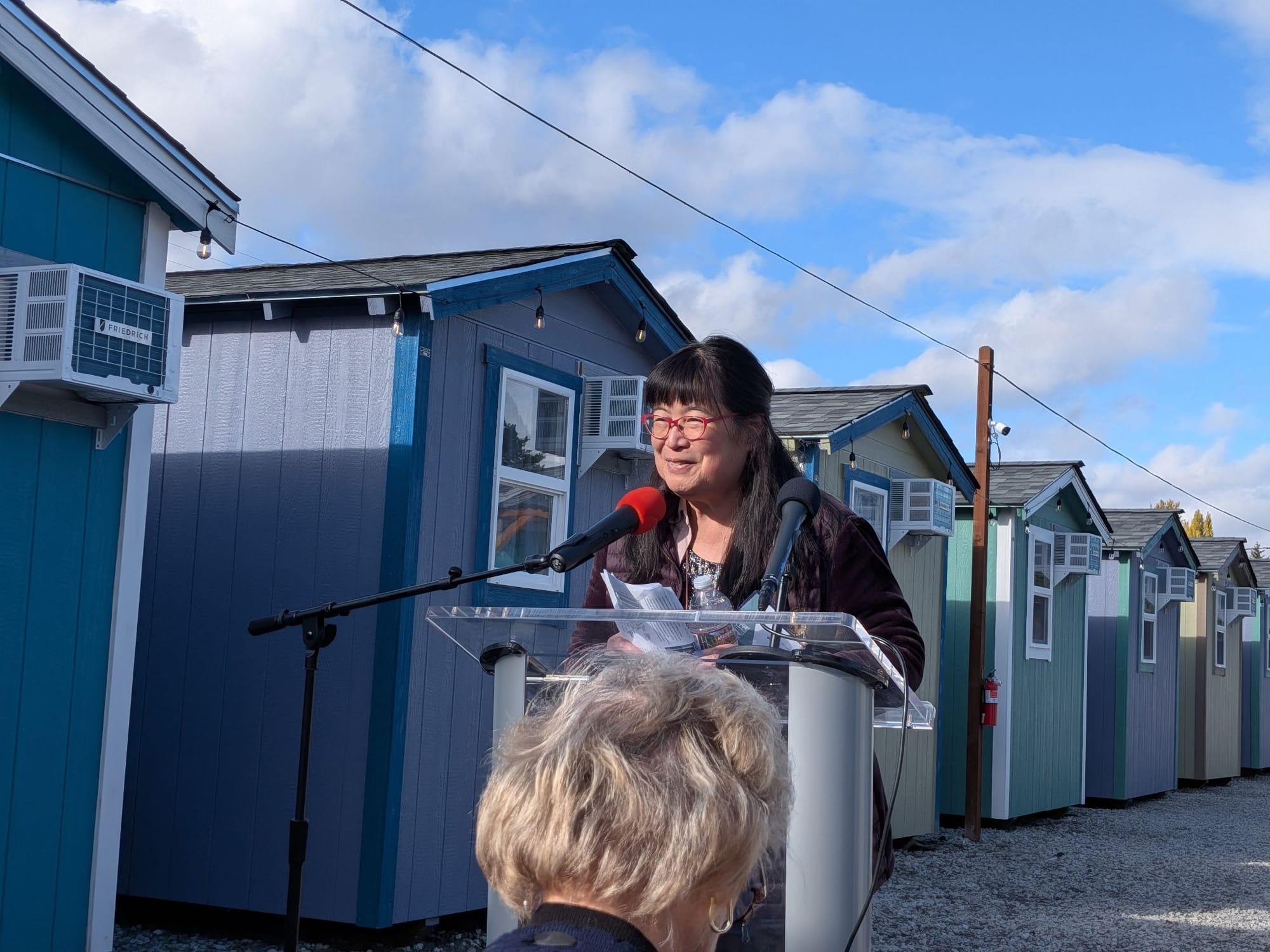
Donna Anderson, the regional operations manager for LIHI, shared the crucial role that living in a tiny house village played in her ability to overcome addiction and take the next steps in her life.
“I want to thank the mayor. This is the first time in a very long time that I've had hope that we can actually make things better, and there is one outstanding reason why,” Anderson said. “For a very long time, the administrations have not been listening to the folks who are doing the work on the ground, to us who are out here doing the work every day. And this administration is listening. They're listening to nonprofits, they're listening to what works and what doesn't work. So we're not just throwing money at something that's not going to work. We're evolving. We're funding more services. We're funding the services that are needed.”
Next steps
Last week, Wilson announced a new neighborhood-centered strategy to allocate the new shelter spaces the City is opening as effectively as possible. The new spots available at Cloverleaf will be key for executing that strategy, and on-site behavioral health specialists will mean the village can provide essential services for higher acuity residents.
Glassyards Commons, also being run by LIHI, is scheduled to open in November, providing parking for 72 recreational vehicles (RVs) and 20 tiny houses, which Lee said will serve upwards of 140 people because “just about every RV has more than one person.”
The reality that most RVs house multiple people calls into question Seattle Councilmember Dan Strauss’s new RV permitting program, which would only allow an individual person who could prove themselves to be the registered owner of an RV to receive a permit.
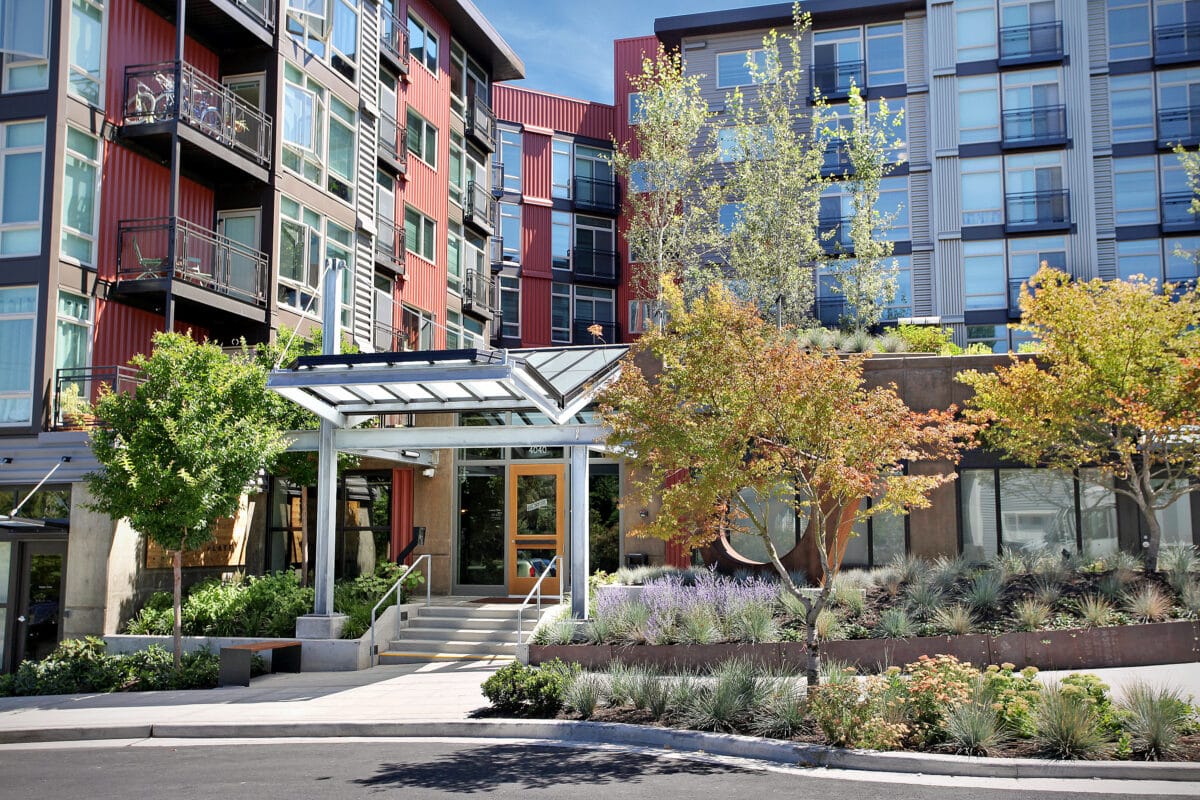
Early next year, LIHI is also scheduled to open a seven-story building on 125th and Aurora with 90 apartments for seniors aged 62 and above making up to 50% of the area median income.
Also on the schedule for the City is a Purpose Dignity Action (PDA) operated shelter and expansions at three existing shelters.
With Cloverleaf open and Glassyards Commons scheduled to open soon, the South Park neighborhood will be the location of three homeless shelters, with Camp Second Chance located there as well. KIRO 7 reported that Camp Second Chance is the leading candidate to expand to 250 units from its current 69, taking advantage of Wilson’s new legislation.
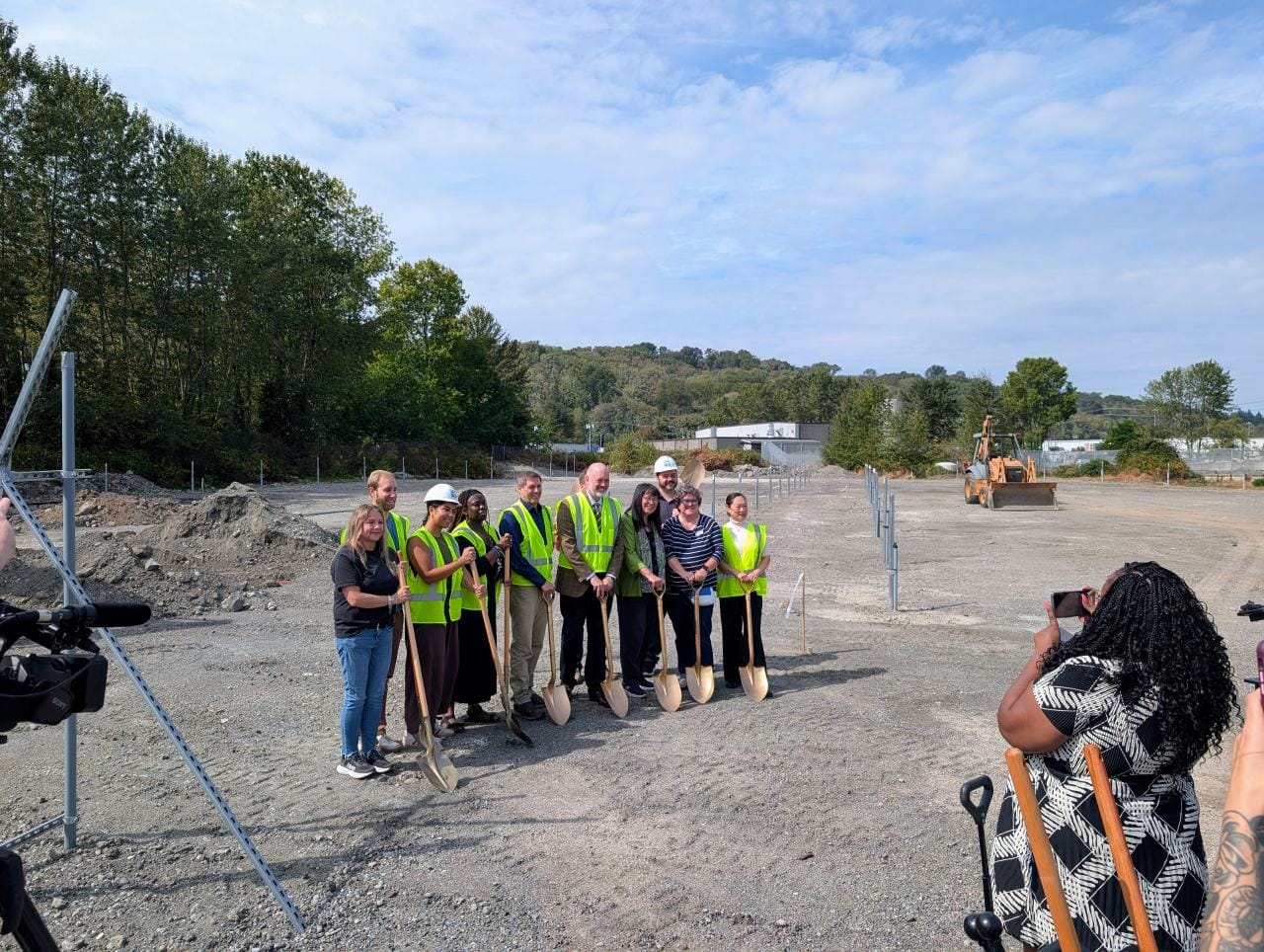
The Mayor’s Office didn’t respond to The Urbanist’s inquiry about the factors it considers in its homeless shelter siting decisions.
“Shelters like Cloverleaf are really how we welcome people indoors, how we can stop this pattern of just moving people from block to block, how we can actually get people what they need in order to start over, and this is also how we overcome the cynicism that takes root when people lose the faith that we can actually solve our our greatest challenges together,” Wilson said. “What this is going to take is partnerships and persistence. And what gives me hope is not just seeing the tangible signs of progress here behind me, these actual tiny homes that people are already moving into, but knowing that those partnerships are strong, and knowing that we are all feeling very persistent right now.”
 Amy Sundberg
 Doug Trumm