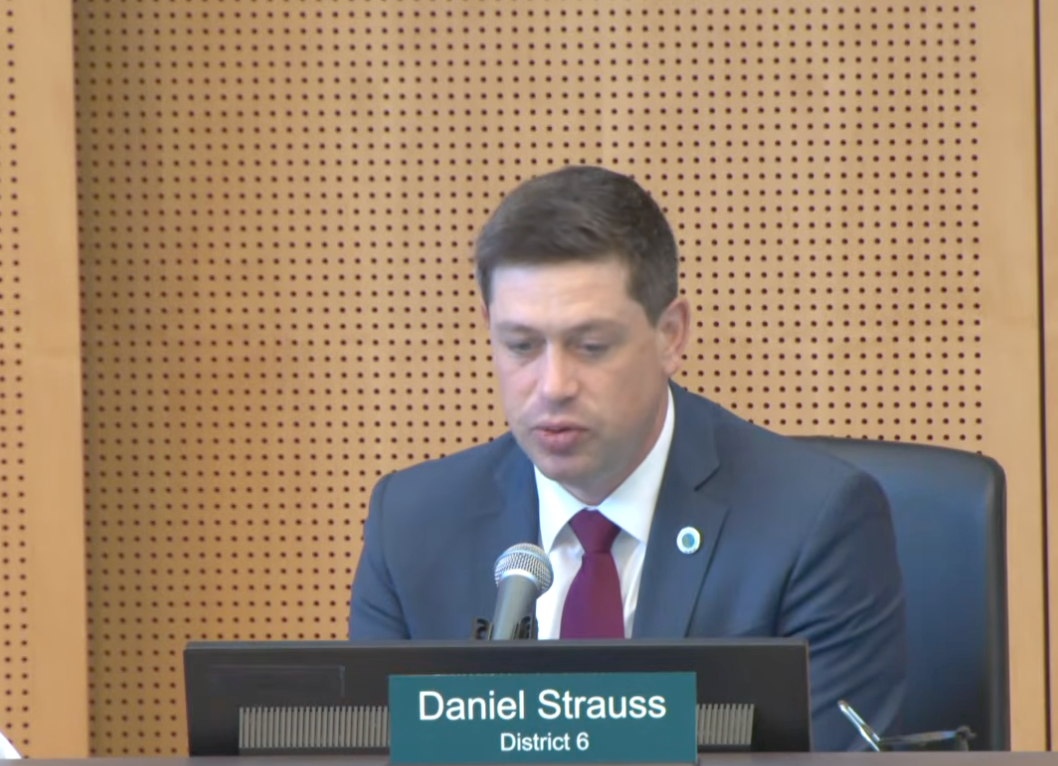
At the public safety committee meeting on August 11, Seattle Councilmember Dan Strauss introduced a legislation package that he said would help people who are currently living in their recreational vehicles (RVs). However, while the package includes funds for services such as safe lots and RV storage, it also introduces a RV permit program aimed at removing all RVs on Seattle’s streets – a move that advocates say could leave RV residents worse off.
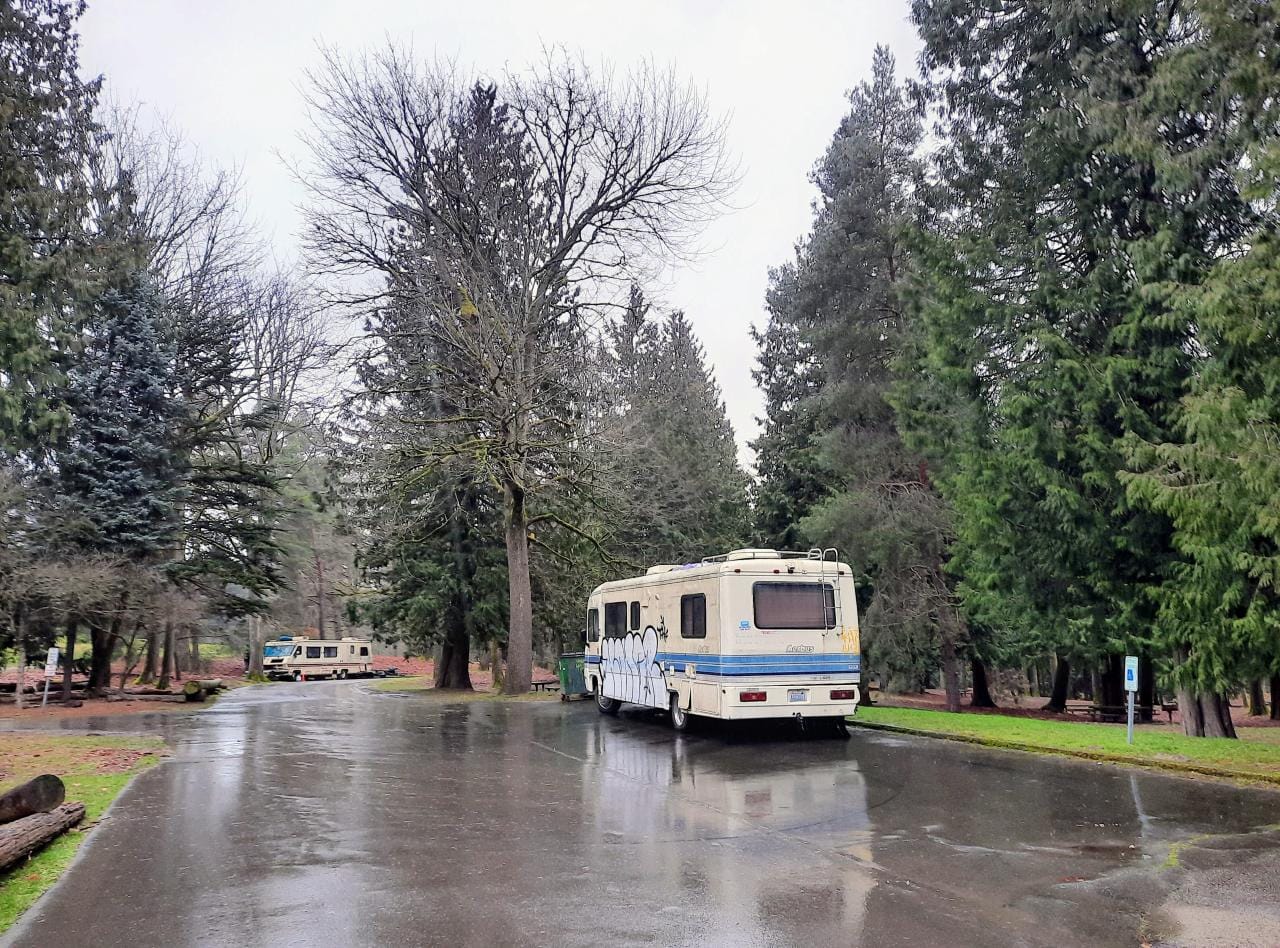
In Seattle, people can currently park their RVs overnight in industrial areas or, according to posted signage, up to 72 hours in one place, like other vehicles. However, the new legislation would change the law so that RVs could only park for two hours in one place, and would be forbidden from parking anywhere overnight (from midnight to 6am). Failure to follow these laws could result in towing without notice.
The only exception to this new rule would be for people living in RVs and “fifth wheel” trailers who succeeded in applying for a special permit during a one-time census. In order to receive a permit, residents would have to agree to receive services and ultimately move into other housing or shelter. There would be one permit per person who would have to prove they were the registered owner of the vehicle.
In order to retain a permit, residents would have to abide by a number of regulations, including having the vehicle display a license plate and vehicle identification number, not leaving trash around, not hosting a group of five or more people, not leaving a pet tied up unattended, etc.
Permit holders would be able to turn down up to six offers of shelter or housing, but after that, they would lose their permit.
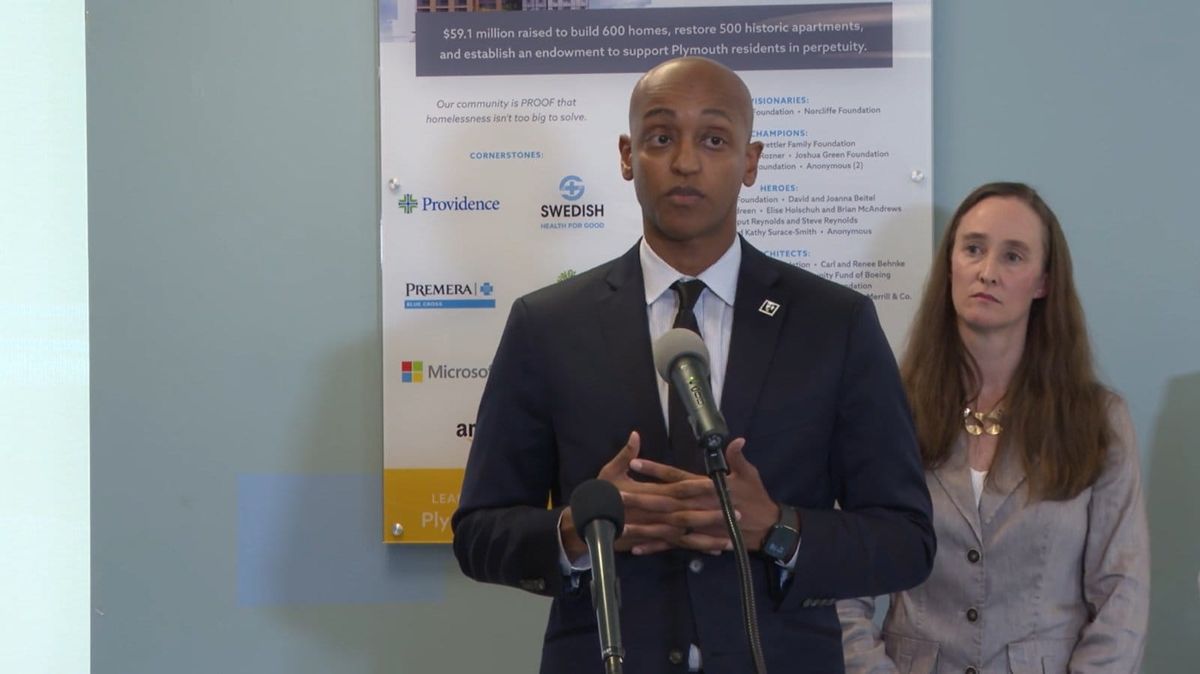
Strauss framed his plan as a way to help people who live in their vehicles.
“Today, we have zero places for people who live in their vehicles to come inside to. We have no city systems or city teams that are designed to help people that are experiencing homelessness with vehicles,” Strauss told The Urbanist. “We need to create those systems, and from there as well, RVs are a unique type of vehicle that are not built for year-round habitation.”
Plan details
The legislation package consists of five ordinances and a resolution. In addition to the permitting program, the ordinances would update outdoor storage land use codes, expand the Finance and Administrative Services (FAS) Director’s authority to execute various related leases, clarify and add two new criteria to the definition of a “junk vehicle,” and allocate $5 million of funding.
The resolution states the intent to move the ecoblocks that have multiplied in industrial areas popular for RV parking, such as Ballard, SODO, and West Seattle, within six months of implementation of the program. However, it doesn’t specify who holds responsibility for ensuring this removal takes place, which can be a costly endeavor and requires somewhere else to store the heavy blocks.
The proposed funding for Strauss’s program would consist of $1.5 million in one-time dollars and $3.5 million in ongoing funds. Part of the money would be used to pay for eight new positions: seven new outreach counselor positions within the Human Services Department (HSD) and one new permit technician within the Seattle Department of Transportation (SDOT). As written, the legislation gives SDOT the task of establishing program standards and administrative procedures for the permitting program.
Alison Eisinger, the executive director of the Seattle/King County Coalition on Homelessness, questioned the plan to hire new outreach workers as part of the overall strategy.
“Seven or eight full-time city employees suggests a disproportionate investment in coordination of inadequate resources, as opposed to an investment in adding good resources that will help get more people where they need to go,” Eisinger said.
The Unified Care Team – the interdepartmental team that performs the City’s homelessness outreach and sweeps – has tallied 145 vehicles that meet the permitting program’s definition, Strauss said, adding he believes this is an undercount.
In addition to the safe lot – Glassyard Commons – opening in West Seattle in November, Strauss’s plan calls for a second safe lot. Assuming the second lot is the same size, that could mean 150 parking spaces for RVs. But Strauss said he wants to collaborate with service providers to decide whether the second safe lot should prioritize RVs.
Seattle Public Utilities (SPU) already runs an RV Wastewater Program in order to mitigate RV wastewater spill incidents, in partnership with St. Vincent de Paul. Every quarter. the team performs an average of 300-400 wastewater pump-outs.
“Before the program was launched, spill incidents peaked at 117 in 2019,” an SPU spokesperson told The Urbanist. “In its first year, the program reduced spills by 60%, and incidents have continued to decline in both frequency and severity. Today, spill incidents average about 10 per year and our estimates show the program saved about $300,000 in cleanup costs in 2025 through this proactive spill reduction work.”
Strauss was clear with The Urbanist that he ultimately wants to remove RVs from Seattle’s streets.
“We want to create a program that serves humans, that centers humans, and we're at a point where RVs are not an appropriate type of vehicle to be on our streets anymore here in our city,” Strauss said. “I think of it like a boat. You know, people have boats, and they can either park them in their driveway, which is off of a city street or they can store it, in the same way that an RV can be parked in your driveway or it can be stored.”
The analogy is an interesting one since boats are generally considered to be luxury consumer goods while unhoused people living in their RVs often have few resources and fewer choices. Houseless RV owners rarely own land on which to store their RV, hence the dilemma.
Strauss also said the permitting program would only address people living in RVs and travel trailers.
“If they are in a place in their life where they're choosing living in a vehicle, [that] is a better option than anything else, there's nothing in this legislation that outlaws, bans, or penalizes living in a vehicle. We are saying we're not going to allow RVs on the street anymore, which means somebody could live in a 15-passenger van. They could live in their truck, a truck with a camper on it,” Strauss said. “If you want to own a different type of vehicle, you have that ability.”
Eisinger had a different perspective.
“The people I know who've lived in RVs, that's been the best option available. Period. It's not about choosing one RV over another or one vehicle over another,” Eisinger told The Urbanist.
Graham Pruss, the executive director of the National Vehicle Residency Coalition, used to be the only outreach worker for people living in vehicles in Seattle between 2013 and 2015, with a caseload of around 1,500 people. Pruss said people living in their vehicles saw it as a more stable option to the alternative, one that provided privacy, a place to store their belongings, and sometimes even a way to build a kind of property equity, all while maintaining a connection with their community.
“The folks that were living in vehicles often described a much deeper level of stability, a deeper level of connection,” Pruss said. “They often had bills that they had to pay, maintenance for their vehicle. They had to keep their driver's license, their insurance. They often keep it operable. At the very least, they saw this vehicle as an important piece of property.”
Advocates worry about potential harms of permit program
While advocates are pleased about the idea of more services, they are concerned at the punitive nature of the RV permitting program.
“How does this permit proposal fit into our landscape of housing and shelter? It doesn't. The permit, the way that it's currently constructed, it would be punitive and not helpful to move people into shelter or housing,” Hali Willis, the community policy manager of the Seattle/King County Coalition on Homelessness, told The Urbanist. “We like to support efforts that are based in evidence and facts and will accomplish the goals of helping people achieve stability and live well, and we don't believe that this permitting proposal will get us there.”
A similar program in San Francisco led to more than five times the number of RVs towed versus households placed into housing through their permit program.
“I think the biggest impact we would see almost immediately is you would see more people living outside and not in vehicles,” said G.B., a volunteer with Stop the Sweeps. “This doesn't solve anything.”
G.B. called out the difficulty people living in their vehicles would have trouble filling out the necessary paperwork to apply for a permit, how they might not have proof of ownership of the RV in which they’re living, and how they might be displaced from their communities in order to take a spot in a safe lot. G.B. also called out the high price the City would be paying for towing contracts to enforce the new parking laws.
“It could be very sensible to focus on the most positive and generally broadly agreed to proposals, namely a safe parking lot, the ability to understand more about people who are living in their RVs in the city of Seattle, and this idea of potentially storing people's vehicles if the fact that they don't have anywhere to park long term could be a barrier to them being able to accept shelter or housing,” Eisinger said. “But we have also told Councilmember Strauss that we believe that it is desirable and reasonable for him to defer this idea of a complex, hard to implement, bureaucratic, and expensive permitting process that is unlikely to actually improve upon people's living circumstances, and he has articulated a willingness to continue the conversation.”
Jay from Stop the Sweeps said that the services provided by the new legislative package might not be worth the punitive measures.
“It really feels like this is completely aligned with the standard thinking of the strategic approach to addressing homelessness, which is that every carrot must have a stick,” Jay said. “We can't just roll out additional services. They must be accompanied by punishment, and in this case in particular, I think that the carrot is hardly worth the stick.”
Pruss explained that for many, housing is not only unaffordable but also inaccessible, citing the difficulties faced in obtaining housing by people impacted by the criminal legal system, undocumented immigrants, young adults just aging out of the foster care system, and more.
“This is the private property, legal, valuable asset of people who are using this to survive the housing crisis that we all see around us – the lack of emergency shelters, the lack of permanent supportive housing – it simply does not exist,” Pruss said. “And to put in further regulations does not solve that problem.”
Pruss was also concerned that the legislation would move authority to SDOT, a move that he’s seen cause trouble in Californian cities like San Jose and Oakland.
“The redesignation of the vehicle from a homeless management encampment response to the Department of Transportation takes away many of the protections of homeless management responses, and it essentially says this is now an object that is designated as an obstruction that can be removed and destroyed with very little due process, almost as though it's like just a crashed vehicle on the side of the road,” Pruss said.
During the discussion of the legislation at the public safety committee earlier this month, Councilmember Bob Kettle expressed his negative opinion of people living in RVs.
“From the public safety perspective, as pretty much everybody knows, once you have five RVs together, one's going to start dealing drugs. Once you have a drug market, you have a stolen goods market,” Kettle said. “There's a clear public safety nexus.”
Pruss refuted this characterization.
“I would question the research behind that,” Pruss said. “I have been to RV parking programs that are officially run. I'm the former strategic advisor on homelessness to the city of San Jose, the third largest city on the West Coast. We ran safe and supportive parking programs with well over 50 RVs in them, and that was not the case. There was never a report of anything like that, and I have never seen research that would suggest otherwise.”
Next steps
According to the legislation as written, the deadline for the City to develop the RV permitting program and begin the new parking restrictions would be April 30 of next year, with enforcement beginning by July 31.
“I'm going to continue working with service providers over the next few weeks to make sure that we are centering people, and that we map any potential harm, and that we are building these systems for people,” Strauss told The Urbanist.
Strauss said he expects the legislation package to be discussed again in the public safety committee, either on September 22 or possibly before. It would then need to go before the full council for a final vote.
Seattle Mayor Katie Wilson’s proposed 2027 budget is also expected at the end of September, when she will have to bridge a $175 million deficit while still finding the funds to advance her priorities, including addressing homelessness.
Wilson has already said she’ll prioritize keeping Seattle’s permanent supportive housing operating, should federal funds be pulled. It’s possible the Mayor’s Office might hold some funds in reserve for this purpose in her budget proposal, although with such a large deficit, every dollar will matter. At this time, none of the threatened federal funding goes to emergency shelter, which is entirely funded by local and state governments.
While there isn’t agreement on the RV legislation package in the advocacy community, Strauss’s proposal has made clear that part of a comprehensive approach to addressing homelessness involves meeting the needs of people living in their vehicles.
“Seattle is not alone in this,” Pruss said. “Communities across the West are seeing more and more folks living in vehicles as a direct result of the housing crisis, and we must view this as a form of housing that has to be included in our housing systems.”
 Amy Sundberg