The Seattle City Attorney’s Office (CAO) has announced two new programs affecting its handling of misdemeanor criminal cases in Seattle: a new community court called Connections Court and a new repeat offender system called the High-Priority Repeat Offenses (HiPRO) program. Both programs are being launched despite concerns expressed by the King County Department of Public Defense (DPD).
“Connection Court restores a key prosecution alternative with new accountability, and our HiPRO protocols seek firmer consequences for those who have taken advantage of Seattle's compassion,” Seattle City Attorney Erika Evans said in a press release.
Evans took office at the beginning of the year after delivering a rousing defeat to the former City Attorney, Republican Ann Davison. On the campaign trail, Evans promised to undo many of the harms of her predecessor, including beginning a new community court program to replace the one Davison had unilaterally shut down.
Less than ten months after taking office, Evans is delivering on that promise.
“Connection Court is a much-welcomed successor to its failed predecessors for importantly it centers on the participants and their needs but also accountability,” said Seattle Councilmember Bob Kettle, the chair of the public safety committee. “I thank City Attorney Evans for furthering a more functional criminal justice system, which is crucial in creating a safer Seattle.”
Not everyone is as happy about Evans’ changes to this iteration of community court, the previous version of which was launched in 2020 by former City Attorney Pete Holmes. The biggest critic of the new programs is King County DPD.
Being the watchdog of CAO is nothing new for DPD, which spoke out against many of Davison’s policies. In addition to objecting to Davison’s ending of the former community court program, DPD opposed Davison’s High Utilizers Initiative and her Stay Out of Drug Area (SODA) and Stay Out of Areas of Prostitution (SOAP) exclusion orders. The department also drew attention to Davison’s enforcement of Seattle’s 2023 drug ordinance, which had a disproportionate impact on Black people based on City data and wasn’t resulting in the promised diversion.
Some hoped that with Evans in office, there would be a new ability of CAO and DPD to cooperate. But DPD told The Urbanist that Evans’ office didn’t inform them about the new HiPRO program until Monday, October 5, the day the new community court opened. As of Thursday afternoon, DPD hadn’t received any written protocols on the new system.
“I would say that we are disappointed by the HiPRO initiative and by the restrictions on who's eligible for Connection Court,” DPD’s Special Counsel for Criminal Policy and Practice Katie Hurley told The Urbanist.
Connections Court
On the criminal side, CAO only handles lower-level cases – misdemeanors and gross misdemeanors – while felonies are handled by the King County Prosecuting Attorney’s Office (KCPAO). In practice, this distinction means that many of the referrals CAO receives from the Seattle Police Department (SPD) involve crimes of poverty, oftentimes with a nexus of behavioral health conditions, although the office also handles some domestic violence and driving-under-the-influence cases.
Going forward, people who have been charged with a low-level, nonviolent offense without a pattern of repeated criminal misconduct may be sent through Evans’ new Connection Court.
“How I sum up Connection Court, it’s an opportunity to provide meaningful services to participants in the program so they get what they need to be okay, and then after 90 days, their case gets dismissed,” Evans told The Urbanist. “That is the summary of it, and I want it also really clear that we are still very robust in pre-file and post-file diversion, and this is just an additional layer.”
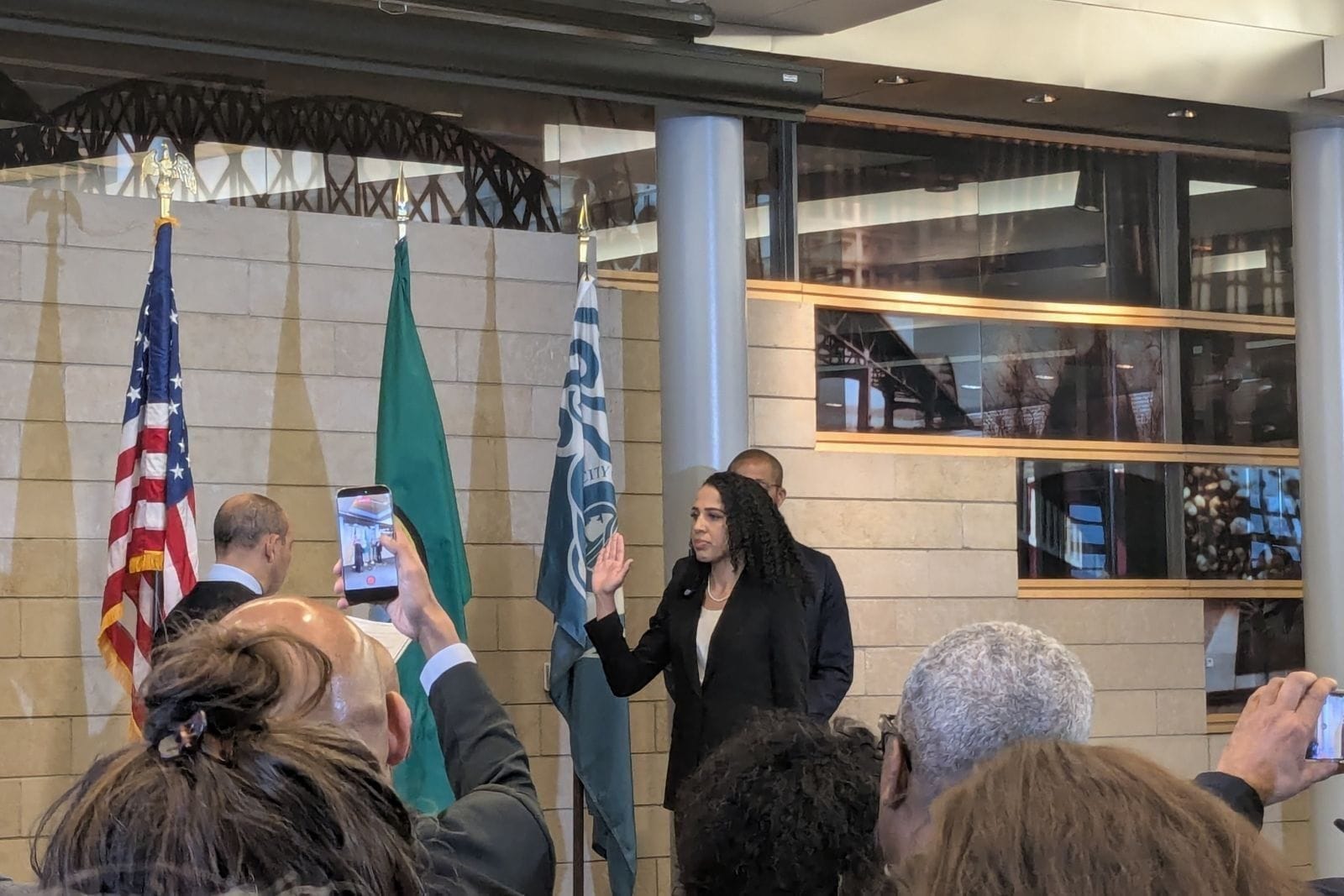
The new court program is being run at no additional cost to the City, providing an assessment with a court counselor to participants to determine which services would be the most appropriate for their individual needs. Evans talked about a menu of different services that includes medication-assisted substance use disorder treatment, help applying for health insurance, prescription delivery, mental health treatment, food, and ORCA cards. Participants will also have the opportunity to apply for jobs as downtown ambassadors with the Metropolitan Improvement District.
Evans is hoping to expand the program in the future, potentially hosting it at a local library and providing pet fostering for people who want to go into substance use treatment. And she has been in conversation with the Mayor’s Office about the possibility of setting aside a certain number of tiny homes or other shelter spots for participants in the program.
“I am very optimistic and hopeful that as we continue to grow and what we're able to provide for Connection Court, that the opportunity to have beds set aside for folks going through Connection Court is not only possible, but an absolute need for folks that are participating in the program,” Evans said.
Connection Court has a few key differences from its predecessor. These differences, which Kettle applauded, are points of contention between Evans’ office and DPD.
In the past, participants in community court would have their cases dismissed upon completion of the program, a policy supported by DPD. However, Evans has insisted on a 90-day jurisdiction period, regardless of how long the program engagements take, during which participants will need to avoid arrest in order to successfully complete the program. Participants also have to prove they’ve engaged with at least two different services.
Failure to meet either of these requirements and they could be sent back to mainstream court for criminal prosecution.
“We have to have a longer period to make sure we're actually engaging with participants,” Evans said. “I want to make sure that this is something that's going to be successful, and I know from us doing these cases, that's not in one day.”
DPD, on the other hand, believes cases should be dismissed when a participant successfully completes their engagement.
DPD also opposes stricter eligibility rules to the program. Evans has instituted eligibility restrictions for Connections Court based on prior criminal history, another change from the former community court. And Hurley said people will also be excluded if they are being held in custody for another offense, possibly because they are unable to afford their bail.
“We're really alarmed at that exclusion as well, as it denies the Connection Court pathway for people because they're not able to afford bail, and that's related to a case, a charge, where they're presumed innocent,” Hurley said.
Finally, people who are routed to the new HiPRO initiative won’t be eligible for Connection Court.
“These restrictions exclude the very people for whom a Connection Court is really most needed: those people struggling with homelessness, with behavioral health, who need support and help addressing underlying issues, rather than an aggravated jail sentence,” Hurley said.
The HiPRO initiative
The new HiPRO program will apply to cases where people who have been charged by the CAO either three times in three months or six times in six months. In addition, cases can be routed into the program immediately if a person has shoplifted in a store where they have previously been trespassed or if they’re being charged for a car prowl case (breaking into a vehicle) and have a conviction of felony theft, car theft, or robbery in the last year.
People with a case flagged for the HiPRO program will be ineligible for either diversion or Connection Court, and attorneys will ask for longer sentences for these cases.
“We're making sure we're giving folks opportunities for those services and treatment,” Evans said. “You know, one time, two times, and then I think it is important to have some accountability, you know, a third time. Otherwise, there is no incentive to [say], okay, maybe I should think about this and engage in some way.”

Hurley had a different view on the program, saying it will exacerbate current issues at the Seattle Municipal Court.
“They're going to be asking for aggravated jail sentences for low-level property offenses,” Hurley said. “Almost all of those folks are experiencing homelessness and/or behavioral health disorders, and it's going to be very expensive for the City. If judges were to impose these jail sentences, it's going to make it less likely that we'll be able to resolve cases and will likely result in more trials as we vindicate our clients' rights, and will make it so that we don't actually address the underlying needs people have. You're going to pay a lot of money for a system to try to punish folks whose basic needs aren't being met.”
According to the press release about the program, “this approach lets prosecutors dynamically target patterns of individual behavior, rather than relying on a static list of names.” The reference to a list is a clear recall to Davison’s High Utilizers Initiative, which was in fact a list of frequent offenders with more than 12 misdemeanor referrals in five years. An investigation by PubliCola in 2022 showed that most of the people on this list were unhoused and many were suffering from major behavioral conditions, with almost half ordered to undergo a competency evaluation.
Evans said anyone with a major behavioral condition should be going through the mental health court and doesn’t think her program will have the same issues as the High Utilizers Initiative.
Hurley said that in some ways, the new HiPRO program is more expansive than Davison’s High Utilizers program due to its inclusion of shoplifting and car prowling.
“I was exceedingly surprised to see a theft related to someone who previously received a trespass notice be considered a HiPRO individual,” Hurley said. “That is a low-level behavior involving a nonviolent property offense, which almost always has no actual loss to the store.”
The CAO will be adding the ability to track the HiPRO cases to its data management system, although it is not clear when this new capability will be operational.
Evans emphasized that CAO attorneys will have complete discretion around decisions about eligibility for Connection Court and which cases to include in the HiPRO program.
But Hurley said it’s important to design systems with policies that make sense for the majority of cases coming through that system.
“It's hard for me to imagine in my mind a case that would not be appropriate for Connection Court where a person is charged with a low-level shoplift involving a business, including a trespass,” Hurley said. “And if you're going to rely on individual prosecutors, line prosecutors, to make decisions, it's going to invite bias. It's going to invite unequal decision making, and it's going to result in far more people being excluded from these pathways than we saw under the previous iteration of Connection Court.”
 Amy Sundberg
 Amy Sundberg