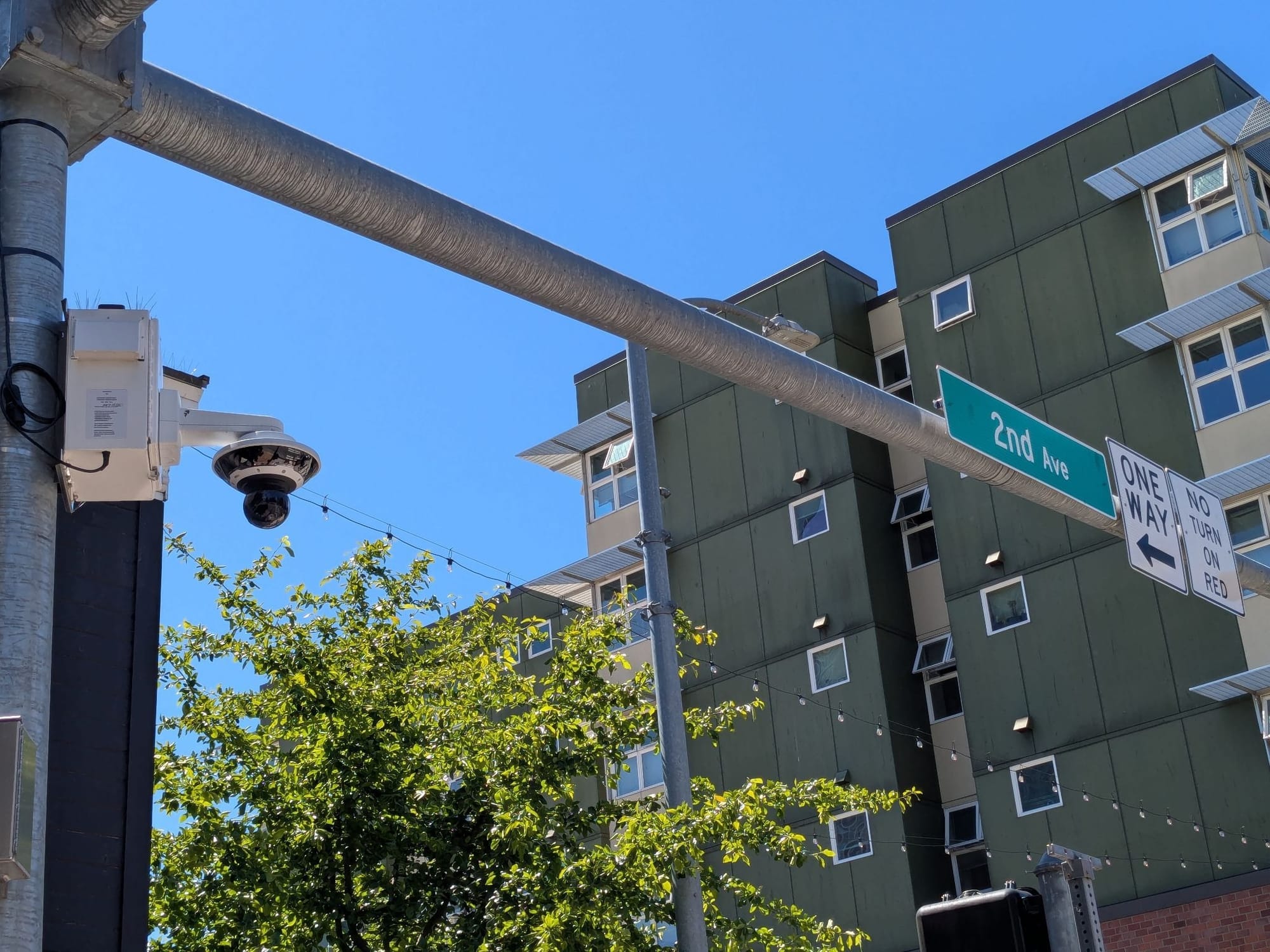
Last week, two newly released reports highlighted the vulnerabilities and sloppy implementation surrounding the Seattle Police Department’s (SPD) real-time crime center. Issues discovered included unauthorized Seattle Department of Transportation (SDOT) cameras being streamed through the center, federal access to SDOT camera data, and a lack of requirements and safeguards for private cameras incorporated into SPD’s system.
The two reports – one from the Seattle Office of the Auditor and the other from the Office of the Inspector General (OIG) – come ahead of the anticipated data governance and privacy audit of SPD’s surveillance program conducted by New York University’s Policing Project.
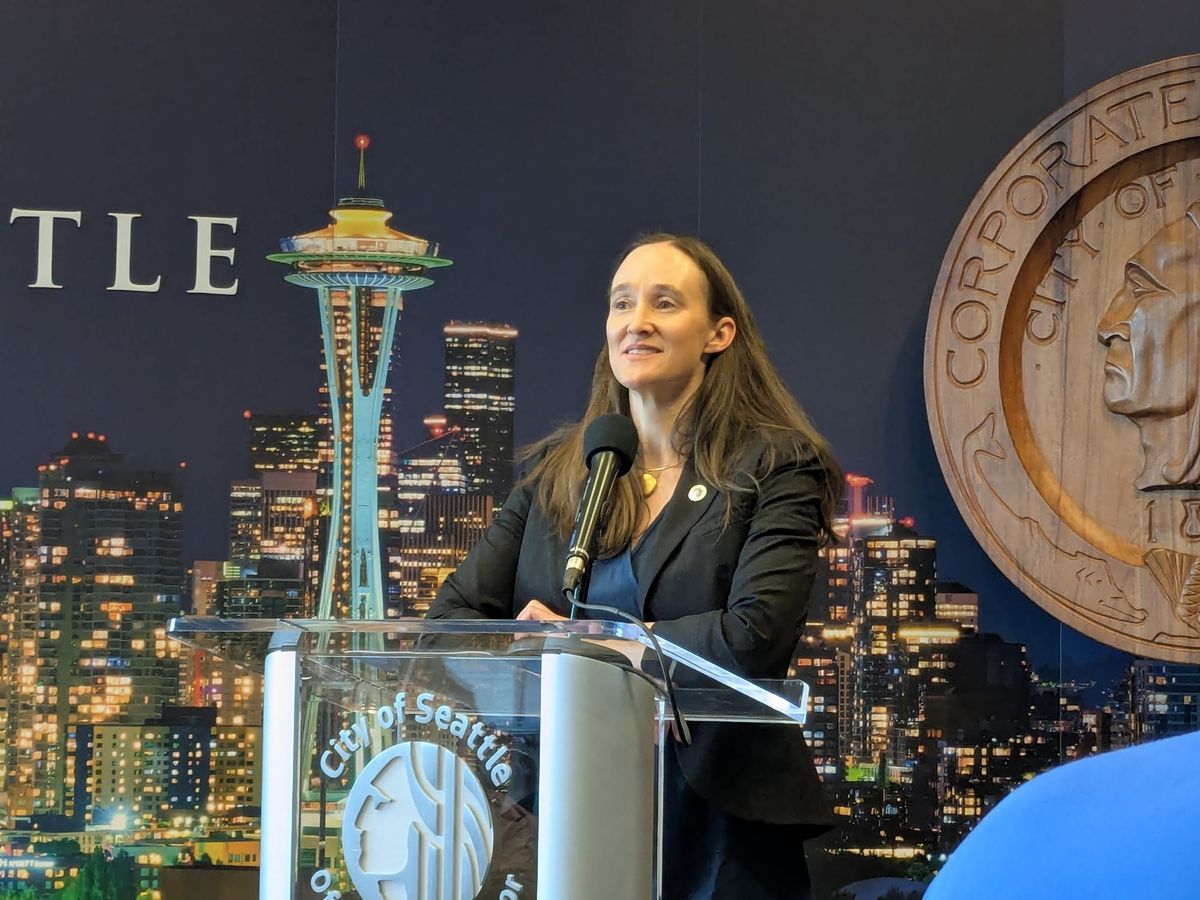
Seattle Mayor Katie Wilson initiated the Policing Project audit in March amidst privacy concerns around SPD’s surveillance cameras. Wilson paused much of a planned expansion of SPD’s surveillance apparatus while waiting for the audit findings. While cameras weren’t installed in Capitol Hill and the Central District, the new cameras for the Stadium District were installed and turned on for a short time during Seattle’s World Cup games this summer.
In September 2025, the city council voted 7-2 to expand surveillance cameras to the above areas and add SDOT’s traffic management cameras to the real-time crime center. Councilmembers Alexis Mercedes Rinck and Dan Strauss were the two ‘no’ votes.
SPD’s cameras remain operational in the downtown 3rd Avenue core, Aurora Avenue North, and the Chinatown-International District, where there are approximately 308 cameras in 62 different locations.
In addition to those 308 cameras, Hardpressed News reported on an SPD camera on the roof of 12th Avenue Arts in Capitol Hill, and Stop Surveillance City, a local activist group, reported on an alleged camera installation (including 5 cameras) attached to the East Precinct.
The Policing Project audit was expected by the end of September but has been delayed. The Mayor’s Office did not respond to a request for clarification on the expected timeline.
The Policing Project has a stated interest in regulating policing technology rather than outright banning it, a policy preference likely to be reflected in the final audit.
But the two new City reports call into question the implementation of the surveillance program, including a lack of critical agreements, policies, and privacy safeguards put in place, particularly in regard to the SDOT traffic cameras and private cameras being integrated into the real-time crime center.
“These reports underscore the need for meaningful protections and safeguards around law enforcement use of CCTV cameras and real-time crime center software,” said Tee Sannon, the ACLU of Washington's technology policy program director. “These technologies do not reduce violent crime or make our communities safer; they only open more of us to being tracked, especially when police access data from other agencies and privately owned cameras.”
SDOT cameras
The auditor’s report, released more than a year after the city council voted to incorporate SDOT traffic cameras into SPD’s crime center, revealed that additional unauthorized SDOT cameras not on the public SDOT map have been streaming into the real-time crime center.
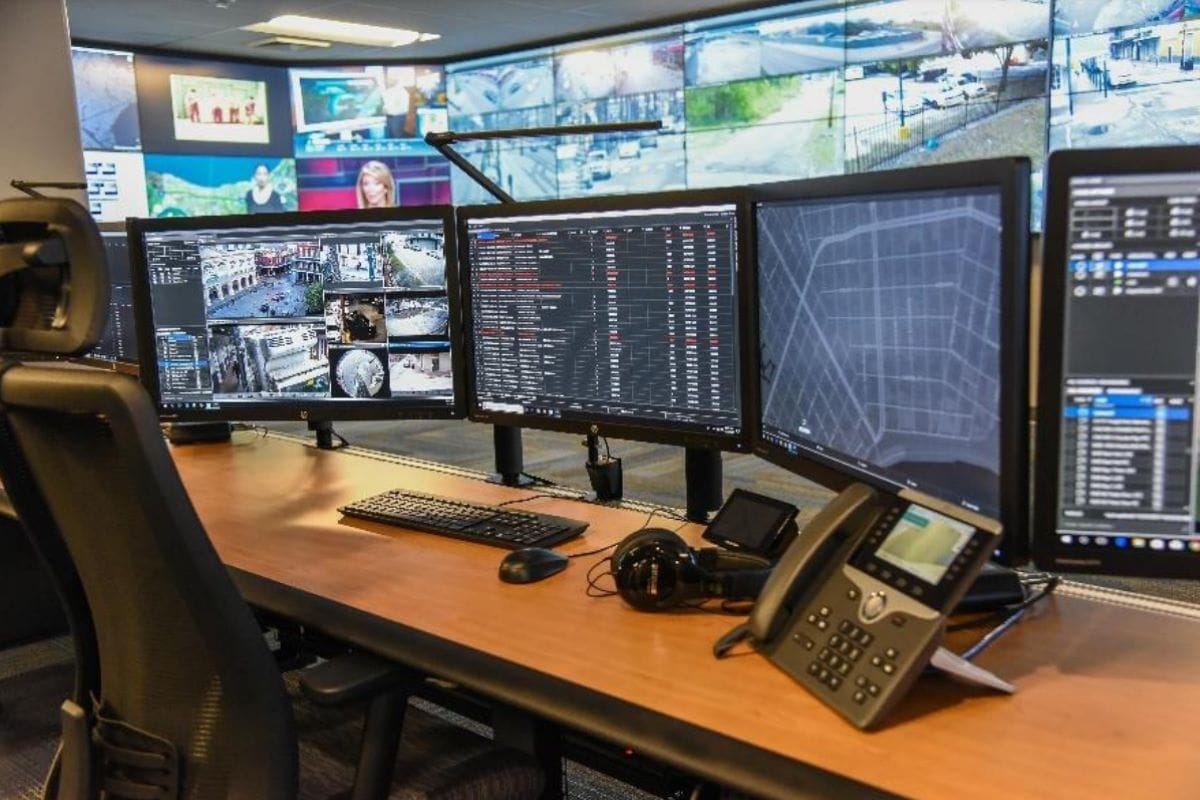
“According to SDOT, these cameras were unintentionally included when SDOT provided the list to SPD,” the report said. “SDOT said that it is currently working to remove those camera streams from the Real-Time Crime Center.”
Without the audit, it’s not clear that SPD or SDOT would have addressed these unauthorized camera streams, which still appear to be active for the time being.
The SDOT camera’s surveillance impact report specifically calls out that the cameras “not be used for civil or criminal enforcement purposes.” City staff told the Auditor’s Office that this did not “necessarily” need to be changed since the council passed the real-time crime center bill that allowed the integration of SDOT cameras more recently.
SDOT has not updated its operating procedures regarding how to work with the real-time crime center, including how to communicate when SPD wants a camera to be moved or zoomed and policy for informing SPD about new eligible cameras.
The audit looked into recordings created by SPD of SDOT camera footage over the last year and found that “the Real-Time Crime Center’s practices appear to result in more recordings being created from traffic cameras as compared with SDOT’s practice of manually creating recordings.” More recordings leads to more data that needs to be safeguarded.
But perhaps the biggest finding from the audit was the revelation that the federal government has access to the data from some of SDOT’s cameras. This possibility, and the erosion of civil rights it represents, has been one of the chief criticisms against using surveillance technology in Seattle.
The audit found that SDOT has a contract with the Artificial Intelligence vendor Derq, which says that while the City owns the camera data, for any work that uses federal funds, the federal government has the right to obtain the data, as well as authorize others to receive it. SDOT has used two federal grants on projects using Derq technology, meaning that the federal government is legally able to attain any related data and use or share it as it sees fit, including to U.S. Immigration and Customs Enforcement (ICE).
Once an entity has possession of data, they can use any software they choose on that data, including facial recognition software and license plate reading software. The software may be more or less effective depending on the resolution of the available camera data, but the City of Seattle’s prohibition on the use of facial recognition wouldn’t be able to prevent this practice once other entities access the footage.
Finally, the audit said that SPD using the traffic cameras “introduces additional civil liberties considerations and impacts,” pointing out that decisions SDOT now makes about placement of their traffic cameras have more possible unintended consequences. Any decision SDOT makes about where to put a new traffic camera also impacts law enforcement activity in the vicinity, including potential exacerbation of over-policing in poorer and more diverse neighborhoods.
“The fact that SDOT cameras have been regularly accessed by SPD, including via previously undisclosed feeds into the RTCC "by accident," when SDOT's public policy uses literally prohibitive language that those cameras "shall not" be used for policing purposes – this is beyond troubling: it's egregious. Lack of clear additional written policy elsewhere notwithstanding,” WA People’s Privacy wrote to The Urbanist. “WA People's Privacy stands with Community Not Cameras in their call for Seattle to dismantle its dragnet surveillance systems. These systems violate people's first, fourth, and fourteenth amendment rights, and that's a conversation we critically need to have.”
SPD’s addition of private cameras to the crime center
A few days after the audit came out, the OIG released a report on SPD’s surveillance “pilot” that found additional issues, many of which involved SPD’s “Connect Seattle,” which allows people to register their private cameras with SPD or even buy additional hardware that allows their private cameras to stream directly into the real-time crime center.

The Seattle Times reported that 427 cameras are currently streaming into SPD’s real-time crime center, including 23 private cameras. According to public records shared with The Urbanist, at least some of these private cameras are located in the Capitol Hill neighborhood, including at Chophouse Row. 893 additional cameras have been registered with SPD that don’t allow direct access.
The OIG found several issues with the Connect Seattle program. Right now, SPD’s cameras currently in operation are only located in the three original approved zones, but with no formal policy, SPD has opted to allow private cameras to plug into their system from anywhere in the city, which appears to go against the original intent of a limited pilot.
While only public areas are supposed to be surveilled by police cameras, SPD lacks control over private camera orientation and masking, which means abiding by these privacy rules relies on an analyst happening to notice any change that would knock the camera out of scope. Further, the report found that SPD has trouble following the masking requirement for its own cameras with delays observed due to the lack of timely availability of technicians.
SPD also lacks control of data retention times for private cameras. And Communities Not Cameras, a local anti-surveillance coalition, raised a concern about the security of the data provided by those cameras. “Axon supplies the device in every private camera connected to the Real Time Crime Center, and Axon holds federal immigration enforcement contracts. The city cannot yet say what Axon will do with Seattle's data when a federal agency asks for it,” the organization said in a press release.
In addition to the issues around the private camera program, the OIG highlighted that while crime center analysts are prohibited by policy from doing proactive surveillance, there are currently no controls in place to either prevent or monitor this behavior. SPD said they have met with provider Axon to discuss the possibility of adding a search justification requirement in order to view footage, but the real-time crime center has been live since May 20, 2025 without any such safeguards in place.
SPD’s in-vehicle automatic license plate readers (ALPRs), which are also provided by Axon, are currently suspended due to new state-level restrictions imposed by the passage of SB 6002 earlier this year. Before this capability was turned off, the OIG’s report shows that SPD officers were often failing to properly log their searches of this database, a behavior similar to that of law enforcement officers across the country searching Flock data.
“The failure of SPD to even bother to log a rationale for accessing ALPR data 47% of the time in 2025 and inability to limit access by the federal government is equally egregious and points to what we have been saying all along: this is dragnet surveillance, warrantless surveillance, and no private vendor offers the ability to secure the data from the federal government,” the Communities Not Cameras Coalition told The Urbanist.
The new findings from these two reports, which seem to indicate a myriad of problems and a recklessness in implementation on the part of SPD, might make Wilson think twice about resuming the expansion of surveillance cameras across the city. A recent local surge of ICE abductions only highlights the gravity of the possible consequences of her decision.
“Every ICE abduction reinforces the fact that surveillance is dangerous, and that AI-powered mass data surveillance has been downright murderous,” WA People’s Privacy told The Urbanist. “These harms are real and tangible, and mass surveillance is deeply impacting people's lives. This is no longer up for debate.”
 Amy Sundberg