No one expected the first transition of a new King County Executive in 16 years to go off without a few bumps along the road. In his first seven months in office, Girmay Zahilay has had to navigate a devastating flooding event, a scandal stemming from lax oversight of county dollars at the Department of Community and Human Services, and a significant budget deficit at Sound Transit.
In contrast with the initial tenure of Seattle Mayor Katie Wilson, which saw several major pieces of legislation put forward to advance core campaign priorities around adding shelter capacity, it's harder to find a signature piece of legislation that represents Zahilay's policy agenda over the course of his first seven months. But two pieces of legislation that were ultimately approved this month did reveal a lot about the dynamic between Zahilay and the King County Council.
In signing off on a major reorganization of the Executive's Office and Zahilay's first budget request, the county council showed itself as a body clearly ready to give significant deference to King County's new leader and how he wants to implement his agenda. Turning focus to structural issues that impact how the County does its work, the changes that were made are likely to impact policymaking at King County for a long time.
Five county offices eliminated, including budget, climate, and labor relations
Even before Zahilay took office on November 25, changes were already sweeping across county government. As reported by outlets including the Seattle Times and PubliCola, Zahilay and his transition team began to implement a major reorganization of the Executive's Office that left many longtime employees out of a job or reassigned to a new department.
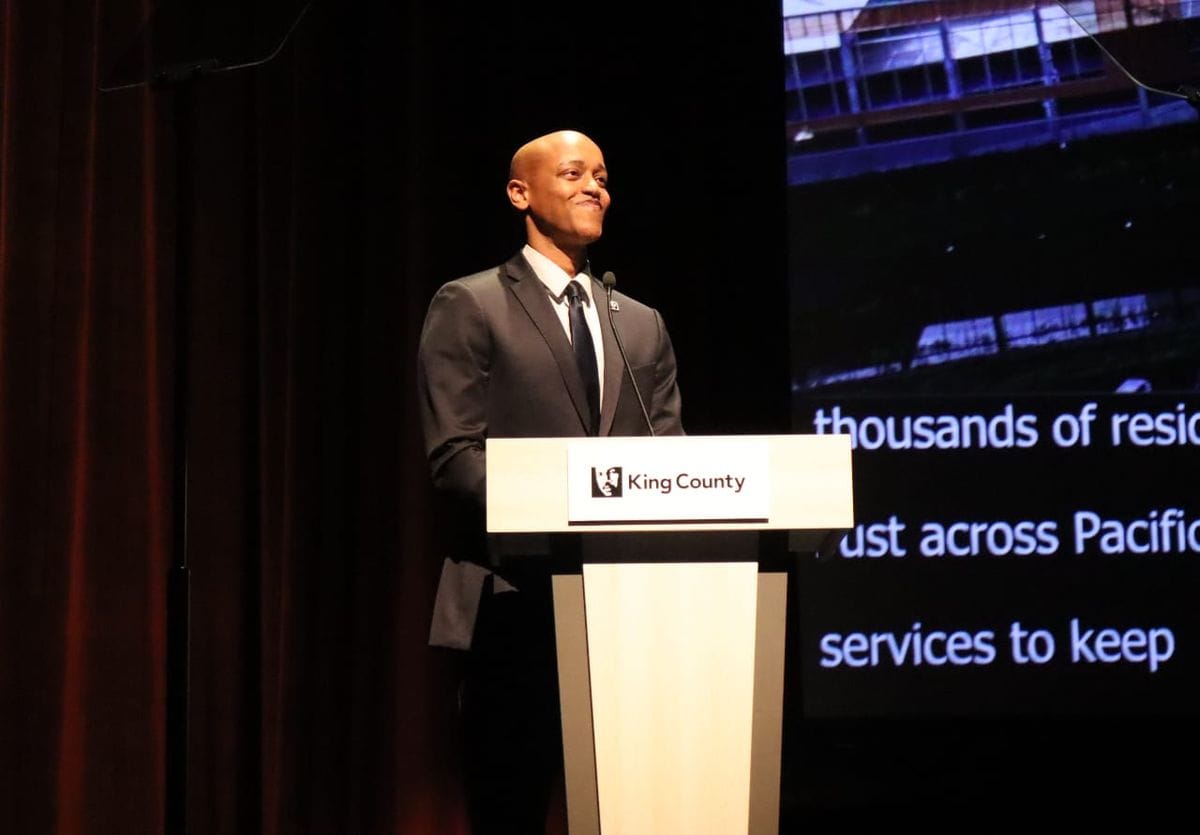
Zahilay was sworn in more than a full month earlier than a new county executive would normally be, since he was taking over for an appointed interim executive, who was filling in after Dow Constantine left to take the Sound Transit CEO job. A shorter transition period has not stood in the way of reforms.
While the entirety of the Executive's staff are political appointees on paper, the reorganization extended much further than was expected, touching county workers doing "bureaucratic" jobs. The changes included elimination of the Executive Climate Office (ECO), which had been created just two years earlier to consolidate emissions reduction work within the various arms of county government.
“This department has had the best culture of anywhere in the county,” one unnamed county staffer told PubliCola last fall. “It’s a fantastic place to work. It feels like that culture has been completely destroyed overnight. … No one is standing up and taking responsibility for the chaos they’re creating. And knowing how much institutional knowledge is going to be walking out the door—it’s going to have an impact.”
Nonetheless, those consolidations and cuts were codified into county code on June 16, with a 7-1 vote to officially eliminate the Office of Performance, Strategy and Budget, the Office of Labor Relations, the Office of Climate, the Office of Economic Opportunity and Creative Economy, and the Office of Equity and Racial and Social Justice.
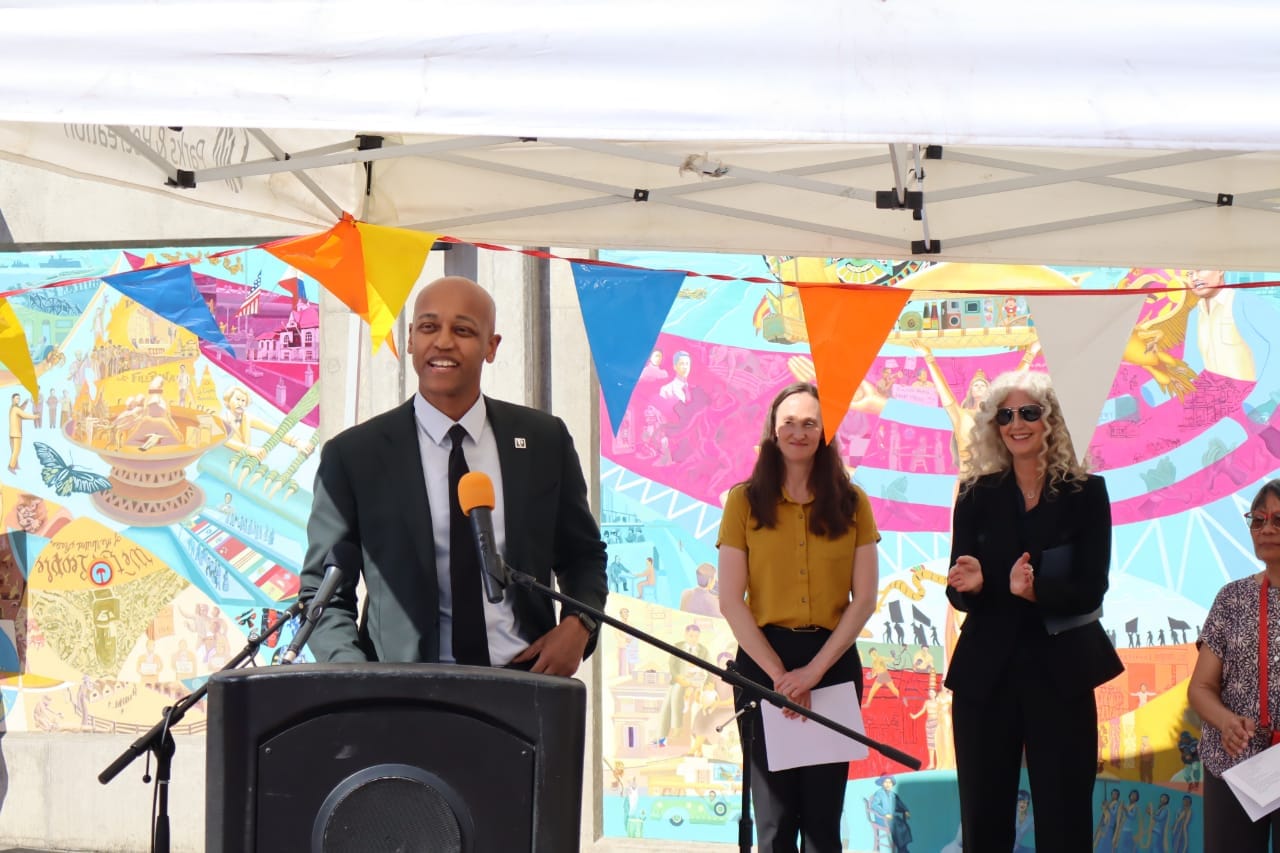
"The county executive's office will now work together as one cohesive unit to integrate the principles of equity, social, and economic justice into all decisions, and enable collaboration, advance priorities, and deliver services in the best way possible," the ordinance states.
Despite concerns from within county government about a loss of institutional knowledge, there was little pushback from councilmembers on the elimination of most Executive offices. Councilmember Claudia Balducci, however, did raise a concern over the idea of eliminating the county's budget office, and its labor relations office. It was Balducci who faced Zahilay in last year's Executive race, a contest that shook up the county's normal ideological divisions.
Balducci stated that her office was not able to locate another large local government anywhere in the U.S. without its own independent office focused on budget issues.
"This is absolutely the responsibility and the prerogative of the new administration to have their priorities," Balducci said. "I would suggest to you, colleagues, that having a budget office and a labor relations office are different. These are not priorities of any administration, these are basic and critical functions of government, especially a highly unionist government like ours. Having an organizational structure to them, where there is an office, it exists, it exists in code, it exists in org charts, it exists in the budget, and it has a clear head."
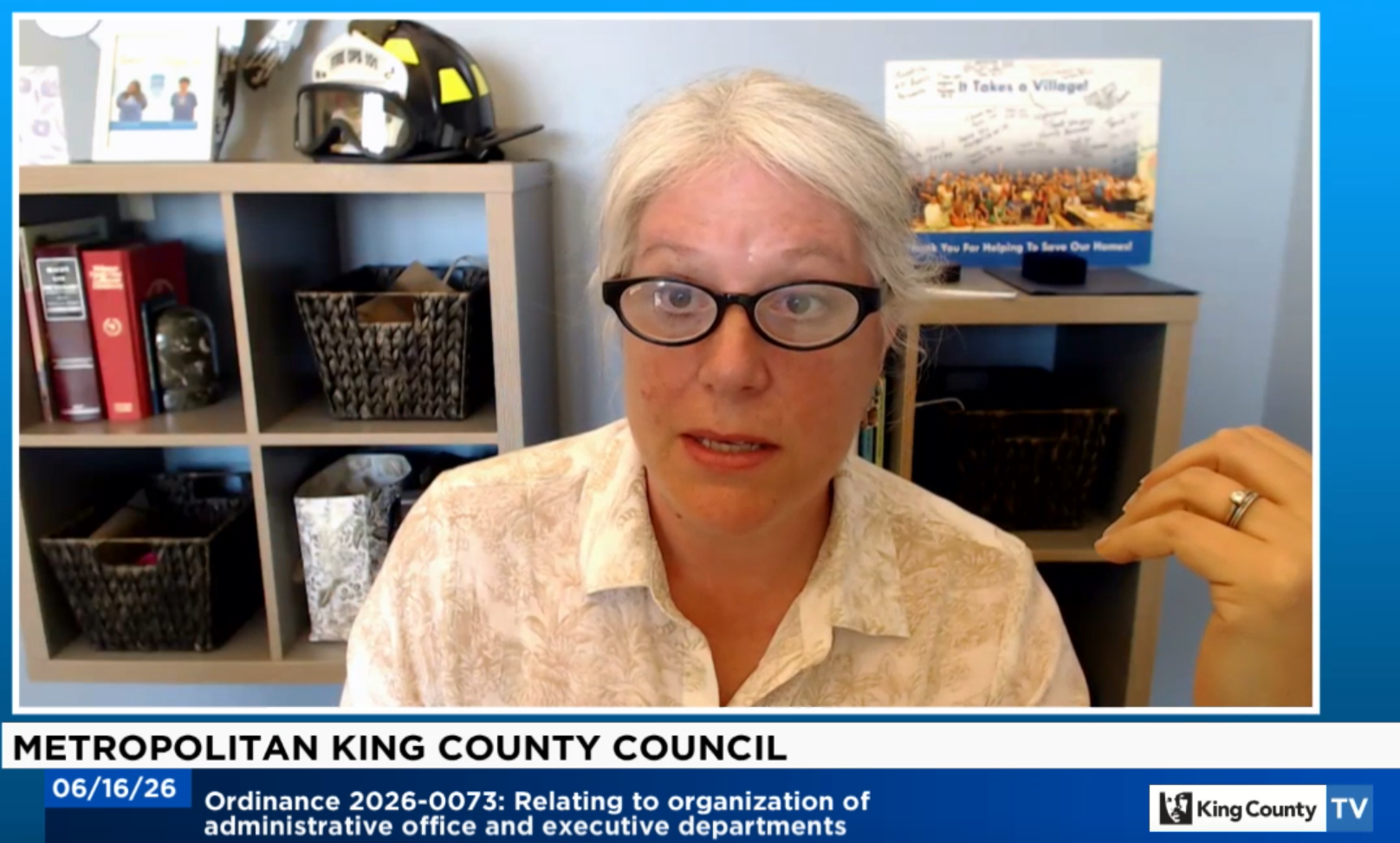
In response to a question about the justification behind eliminating the budget office, Garrett Holbrook, head of council relations for Zahilay's office, stated that it is seen as more transparent given the fact that everyone in that office ultimately reports to the Executive.
"We believe the structure is largely the same, but the offices that were created in code lacked transparency of how the ultimate reporting structure of the Office of the Executive worked, and in the end, all of those folks ultimately reported through [Budget Director] Dwight Dively up to Executive Constantine," Holbrook said. "In the new structure that we propose, we believe it's transparent that all of the [full time employees] within the Office of the Executive ultimately report to Executive Zahilay, so we're trying to create a structure that maintains the offices and roles that were in place previously, but that reflect the nature of the structure of the office."
Balducci didn't buy that argument, but was ultimately the only vote on the council in favor of an amendment she put forward that would have restored some of the functions of the budget office and labor relations office to county code. Councilmember Jorge Barón was recused from the vote due to the fact that his spouse, Tyler Crone, works in Zahilay's office.
"With all due respect, I don't see how it's not transparent to say you have an office that's got a head and the org chart shows who the head reports to," Balducci said. "I don't know that we have had a problem with transparency of our budget office or our labor relations function. Certainly, there's never been any complaints about that."
In hashing out the reorganization, some of Zahilay's biggest defenders have been its most conservative members. When a motion was made at the June 16 meeting to delay the vote an additional week, it was Reagan Dunn and Pete von Reichbauer who pushed to move the bill forward. While King County's council races are currently nonpartisan, both Councilmembers were originally elected as Republicans.
"A new county Executive was elected in November and won majority of the votes, and that Executive historically is entitled to organize his Executive branch in a way, as long as it's consistent with county rules, regulations, and code, in a way that he or she sees fit," Dunn said. "I believe we need to move forward on this reorganization in the interest of the public, so that the people's government can be organized, led, funded, and put to use within the first year of the Executive's tenure."
In a statement to The Urbanist, Executive spokesperson Callie Craighead defended the reorganization as a move that will allow Zahilay to effectively implement his policy agenda.
"[O]ur office still has these functions - budget, performance, labor relations, language access, accessibility, civil rights and more. These functions are no longer in stand-alone offices within the Executive’s Office, removing siloed workstreams and improving collaboration across teams," Craighead said. "At the six-month mark of this administration, our teams have started to solidify the office structure as we work to deliver on Executive Zahilay’s priorities. As additional fine-tuning occurs in the months ahead, we are happy to provide updated org charts to inform the Council and ensure our staff can collaborate effectively."
Signing onto a controversial return-to-office plan
On June 23, the County Council approved a $431 million supplement to the two-year budget approved last fall, Zahilay's first budget proposal. Negotiations over that budget surfaced a number of major issues, including oversight of county Best Starts for Kids dollars, and the future of the county-owned Harbor Island Studios soundstages. But a $5.4 million allocation to county facilities upgrades and moving expenses also garnered significant council attention, presenting councilmembers with a choice about whether to give their stamp of approval to Zahilay's proposed return-to-office (RTO) policy.
That policy, developed under his predecessor Dow Constantine, requires county employees across all departments to report to the office three days per week, and has faced considerable pushback from rank-and-file workers. According to a presentation made to the council on May 27, only four out of 12 county departments are currently meeting that standard, with a stated "seat deficit" of 1,400. What that means in practice is a significant shortage of work stations, with many county employees spending work days on couches in county offices.
The primary case being made in favor of increased RTO? A perceived need for increased collaboration among county employees, and for those in public-facing roles to be more accessible. Meanwhile, opponents counter that many King County employees never directly interact with the public, and often find themselves heading downtown to sit in a Zoom meeting with other employees elsewhere in the county or at other levels of government.
"This approach I believe leads to better customer service, more opportunities for face-to-face collaboration, and the government that is more accessible," Zahilay said in his State of the County address earlier this month in referencing the three-day RTO policy. "Let me give you an example: our permitting operations, because more staff are available in person, residents and businesses can now access walk-in permitting services four days a week, up from just one day a week in 2025 and by the end of this year, the public will be able to walk in and get help five days a week."
County employees don't agree that they need to be mandated to commute to a cubicle to do their jobs. In late April, a group of workers with the public employee union PROTEC17 staged a rally in the Chinook Building, where Zahilay's office is located. They presented a staffer with an oversized check made out to "downtown landlords" in opposition to the three-day RTO mandate.
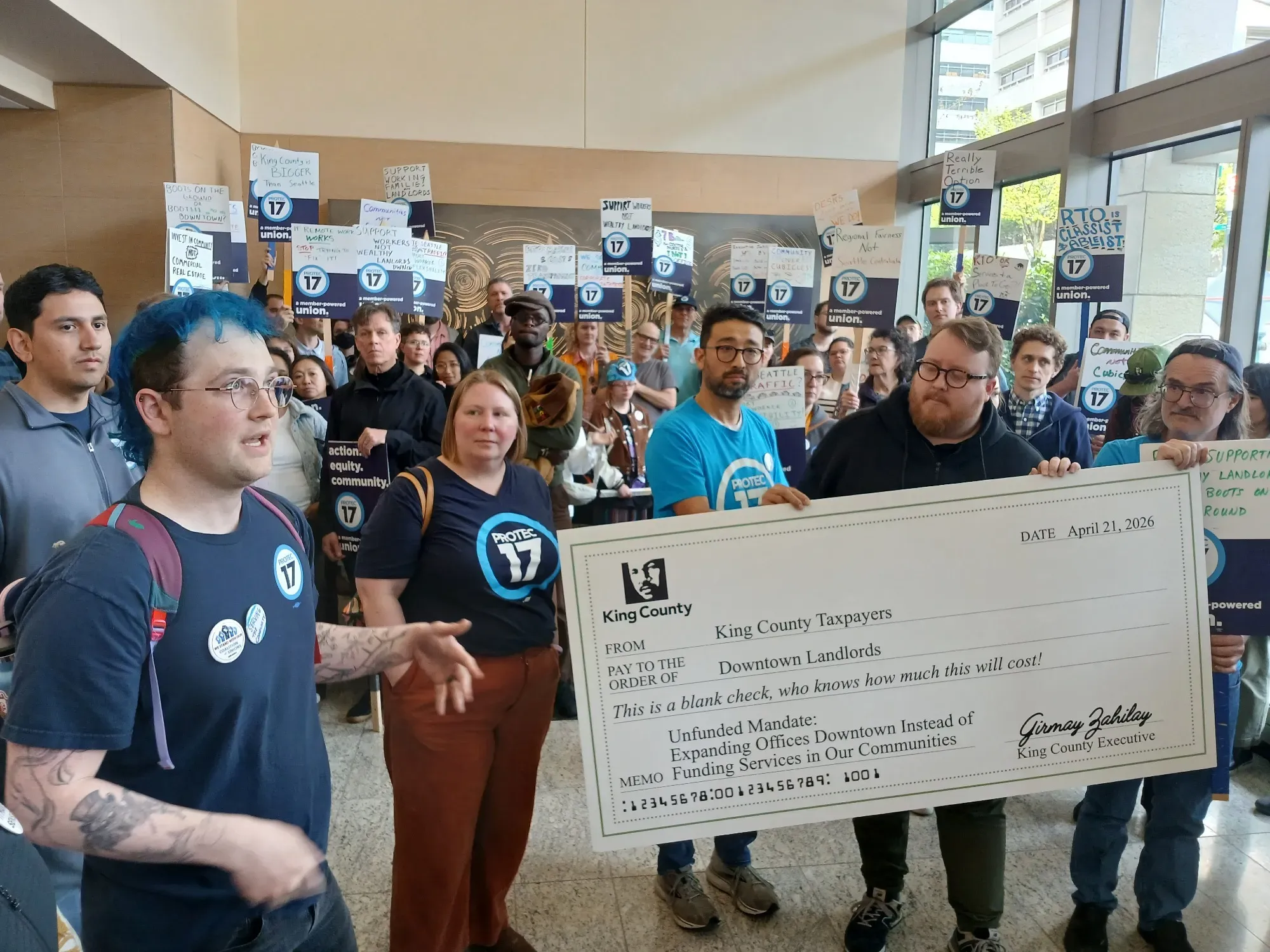
While the immediate cost of the facilities upgrades has become clear over the intervening weeks, many county employees have pointed out that those dollars don't account for indirect costs departments incur with additional return-to-office implementation, to say nothing of the costs to the employees themselves.
This $5.4 million, expected to be followed by a request for $16.7 million for 2027, will fund upgrades to the 1924 Dexter Horton Building, which the County purchased in 2024 and has turned into a hub of its operations downtown. More than six full floors of that building remain vacant, after unsuccessful attempts by the county to find commercial tenants looking for office space. But that money will also allow county officials to start the process of reopening the King County Administration Building, which has featured prominent "closed" signs since 2020 after all of the employees who worked there were relocated and mostly started working remotely.
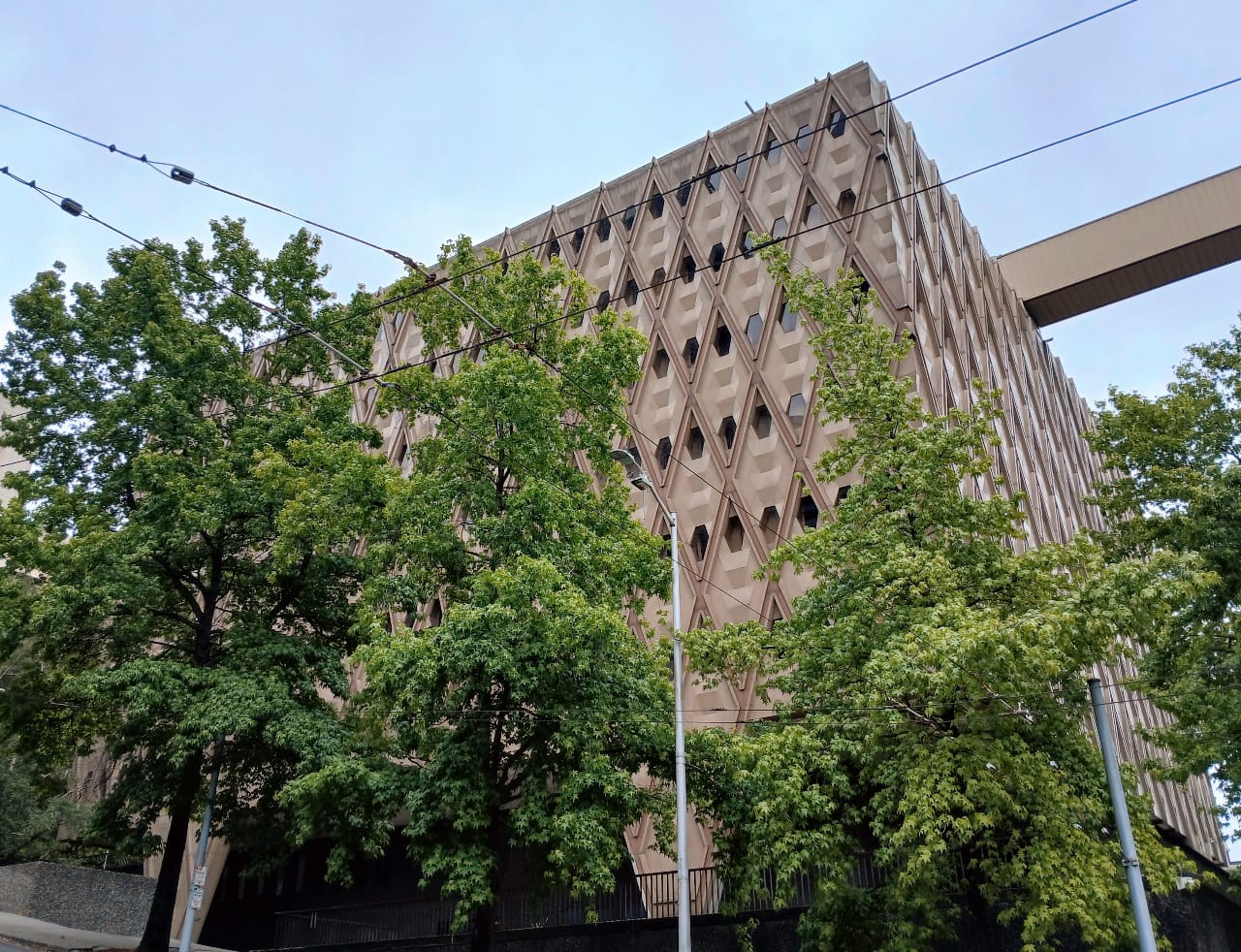
The centerpiece of Constantine's now-dormant Civic Campus redevelopment proposal, the Administration Building is in the path of Sound Transit's preferred route for a new downtown light rail tunnel, and the idea of reopening the building drew more concern from councilmembers than expanding the county's footprint at Dexter Horton.
"We have, for a number of years, worked on the downtown campus plan. There's been charrettes, there's been competitions, there's been visioning. We haven't really moved forward, but we know we need to," Rod Dembowski, chair of the council's budget committee, said in mid-May. "Going in and reopening the Admin Building, which is – it's beyond its useful life. The Dexter Horton building is old, but had been refreshed and remodeled and updated, although I think there's some additional work there when we bought that, but I'm kind of interested in some reflections with our [Facilities Management Division] folks on whether how this fits into bigger picture things. It feels a little bit like we're building it as we're going along."
David Dahl, a capital project manager in the Department of Natural Resources and Parks, told The Urbanist that the RTO mandate is having a significant impact on the day-to-day work-life of employees.
"We don't have desks to go to. So there are roughly 1,200 employees affected by the RTO mandate. We have about 80 actual desks, so that's less than 10%," Dahl said. "So if you're asking employees to do their work from a specific location where they don't have a desk or a chair, and asking them to do work on a laptop at a sofa or a bar stool or a breakout table or something like that, you're not asking them to actually be effective in their jobs, you're asking them to waste a lot of time. And the other perspective is that there has been very little clarity on what the purpose of this is."
With some council departments set to ramp up from one day per week in office to two this summer, even a two-day-per-week mandate would include some facilities costs. But Barón expressed concern that the value of going from two to three days hadn't been clearly articulated.
"I'm not objecting to the to the idea of return to office, I'm just concerned about the impacts, and particularly I haven't heard a good justification for the proposed additions, in terms of the number of workspaces and understanding the logic behind this," Barón said in May. "I understand there's like a lot of opinions about return to office, but just from a pure budgetary perspective, is one day in the office worth $16 million? I think that's the question that I think we need to grapple with over the next few weeks."
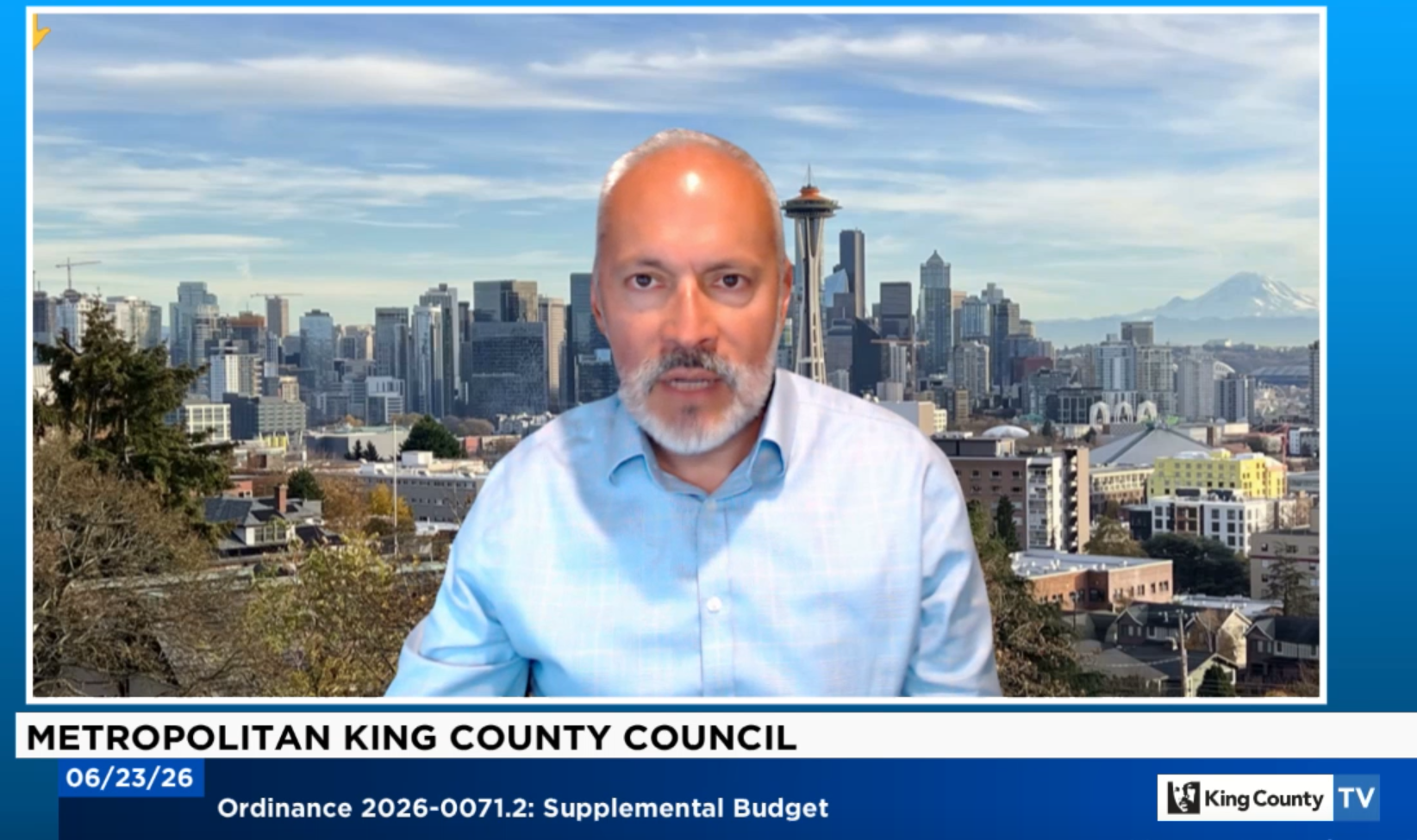
Balducci noted that many of the services county employees provide aren't best accessible from a downtown office, and pushed for Executive staff to think more comprehensively about the county's long-term space planning.
"If we're going to spend this kind of money, we may broaden our thinking a little bit and think about some chunks of different services that are different places that might go better," Balducci said. "Rather than to meet a goal that was previously announced about a certain number of butts in seats, a certain number of days, how about thinking about this in terms of making the efficiency of the entire county work best?"
A budget amendment put forward by Barón and Balducci would have put a hold on funds specifically to reopen the Administration Building until the Zahilay administration submits a report outlining its RTO strategy, but it failed to pass, another example of the council's tendency toward deference. A different amendment that was approved requests a report from Zahilay's office on the full RTO plan, but doesn't put any guardrails on that planning work.
With the Council giving its stamp of approval to these two bills, the stage is set for the coming months as Zahilay ramps up the policy work. So far, he's signaled interest in a countywide housing levy, and in using the expiring Best Starts for Kids levy to dramatically expand access to childcare. Those priorities will clearly be easier to advance with a friendly council ready to get on board, but it remains to be seen whether councilmembers will continue to go along to such a high degree.
 Ryan Packer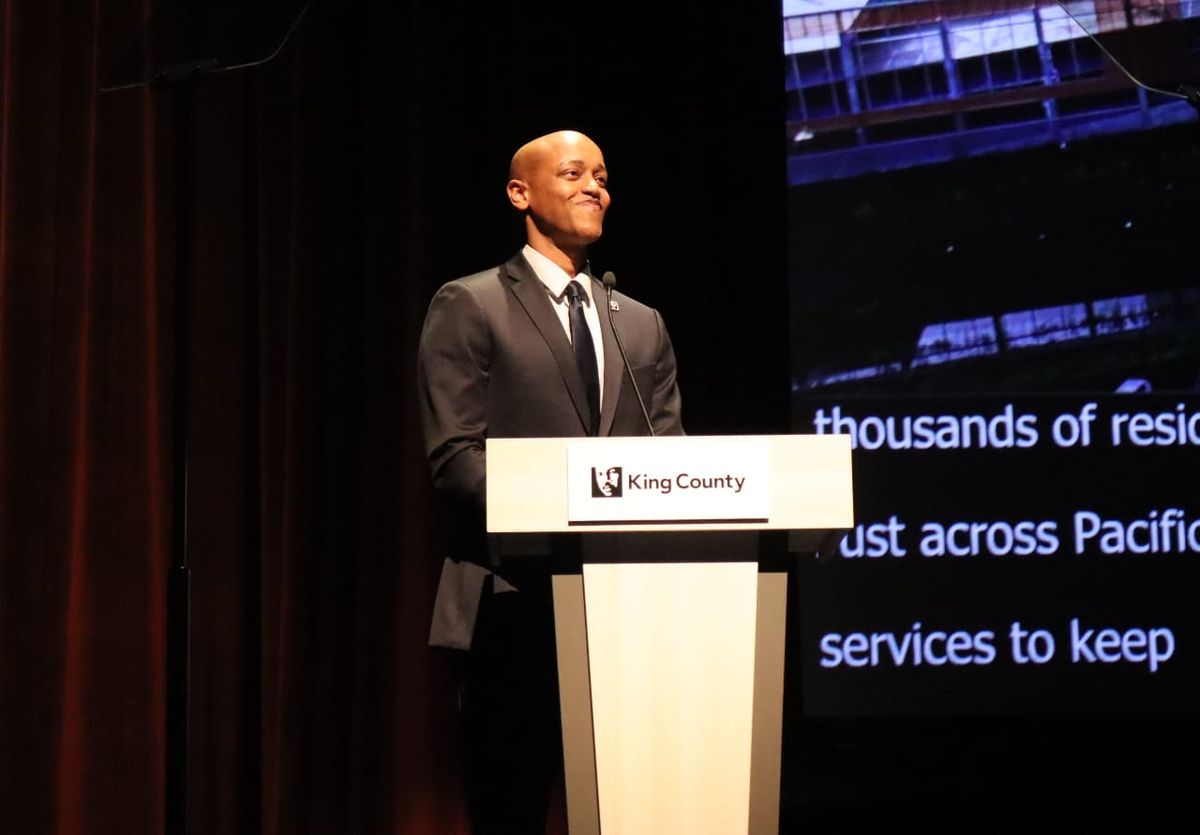
 Doug Trumm