The need for the City of Seattle to engage in a coordinated and evidence-based plan to prevent gun violence has entered the spotlight following the much-publicized shooting at the Bite of Seattle food festival at Seattle Center in July, during which three people were killed and five injured,
While the Bite of Seattle shooting received the lion’s share of media attention, three women were injured by gunfire in North Seattle three days earlier and two bystanders were injured during a shooting in Capitol Hill the previous day.
Data from the Seattle Police Department (SPD) shows that the most shots fired are reported in South Seattle, although this year to date, North Seattle is not far behind.
“In King County, youth and young adults account for 60% of gun violence incidents, with victims disproportionately being male and people of color,” the 100 Days of Action report noted in March of 2025.
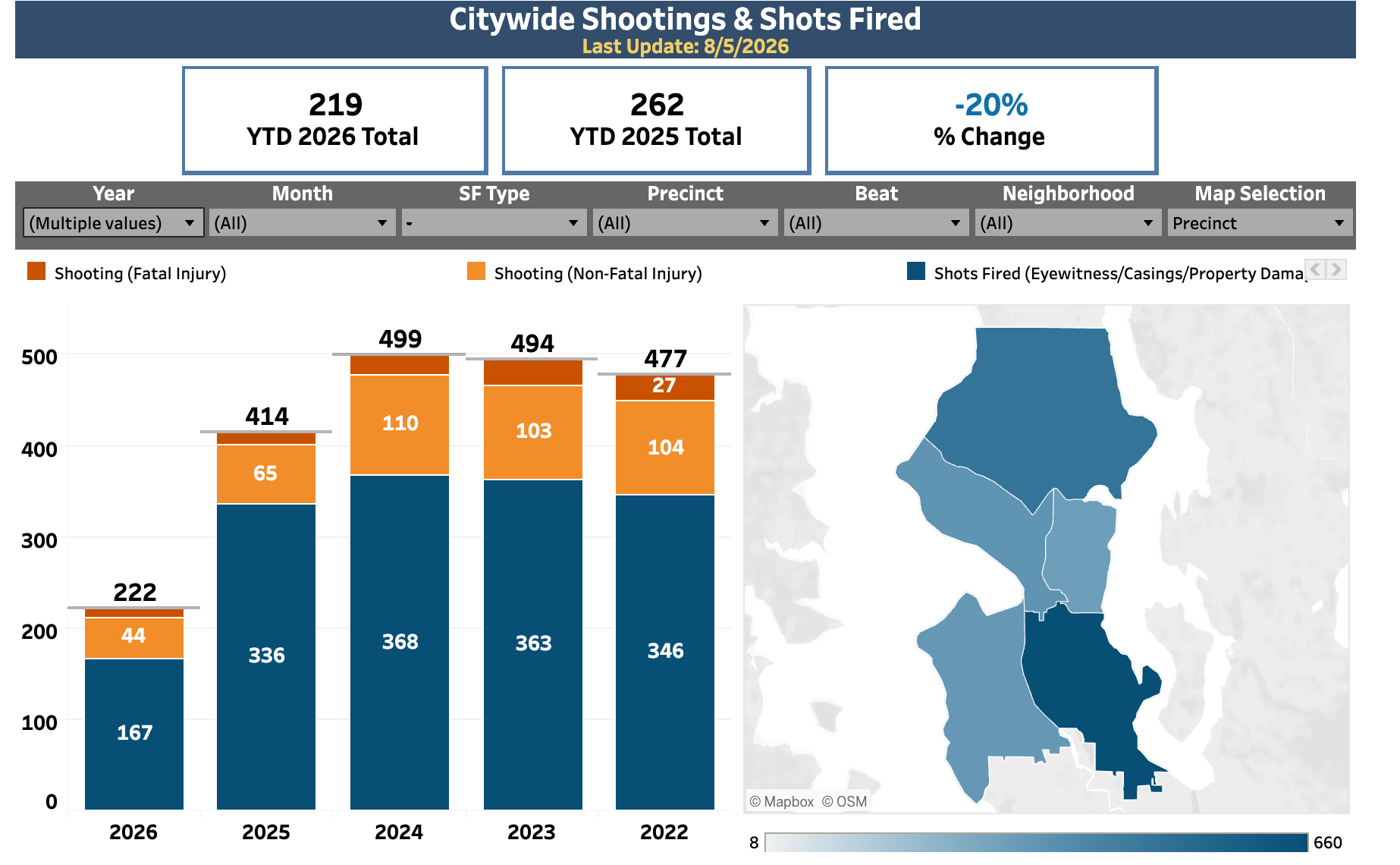
Incidents of gun violence have been going down in Seattle since their high point in 2024. This year to date, there have been 219 shootings and shots fired, a 20% decrease from last year at this time. And the city went the entire month of June without a single homicide.
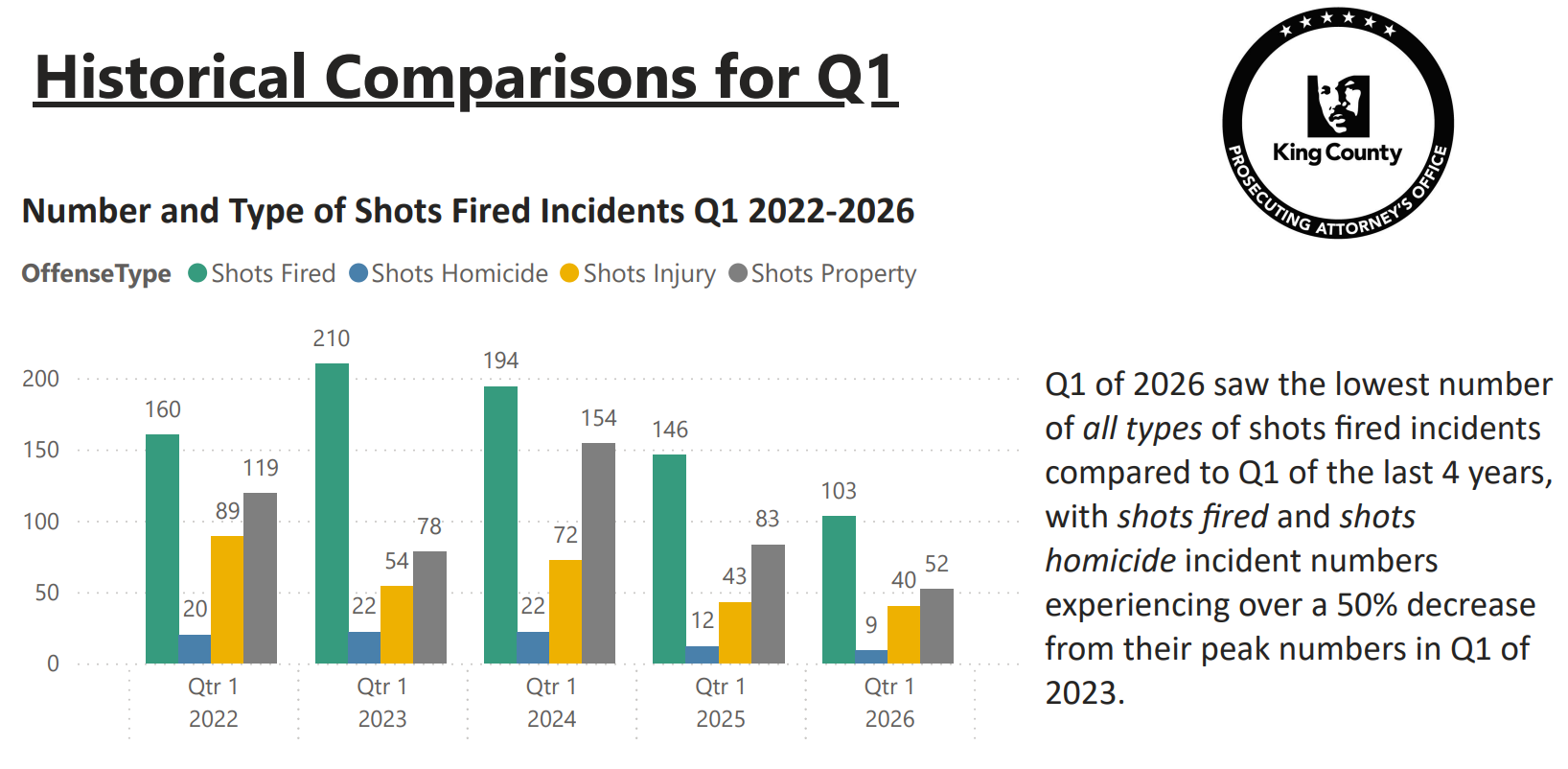
Data from the King County Prosecuting Attorney’s Office tells a similar story, with quarter one of 2026 showing the fewest shots fired incidents of any quarter one in the last four years and showing over a 50% decrease from the worst quarter one in 2023.
While the progress is encouraging, if the City of Seattle were to institute a well-coordinated plan to prevent gun violence, the numbers could drop even further.
Last year’s audit
Last March, the City Auditor’s Office released a report on gun violence patterns in Seattle. The report included four recommendations for improvement, including greater coordination, systematic reporting on patterns, and looking into whether the Community Assisted Response and Engagement (CARE) department could integrate the City’s violence prevention programs and play a role in increased reporting.
In April 2025, the Mayor’s Office, then led by Bruce Harrell, pushed back against the audit, touting their “One Seattle Restoration Framework” as the administration’s answer to an earlier audit. The dearth of detailed information released on this framework made it impossible to compare it to evidence-based models that have found success in other cities.
At the time, Harrell’s Deputy Mayor Tiffany Washington said in a council meeting that she had felt disrespected during the audit process.
Violence prevention programs in Seattle have a long history of having difficulty receiving the necessary funding, whether that be through tying funding to expensive audits or having a mayor question violence prevention investments that were 2% of the amount the City was spending on SPD at the time.
Response of City Council
In spite of a slew of Seattle’s big event organizers, including SeaFair, Climate Pledge Arena, and the Capitol Hill Block Party, calling for the cameras in Seattle’s Stadium District to be turned back on and for additional cameras to be installed around Seattle Center, the evidence doesn’t show that more surveillance decreases violence.
Surveillance cameras have been operational along a long section of Aurora Avenue N for over a year, and yet gun violence has continued to be a problem in this area of the city.
Based on documents obtained by journalist Glen Stellmacher, the shooting at the Bite of Seattle took place in spite of an increased deployment of SPD officers and close proximity to the SPD’s command center at the event. While SPD responded quickly, they were unable to prevent three people from dying.
Councilmember Maritza Rivera rebuked Mayor Katie Wilson after Wilson’s decision to ask SPD Chief Shon Barnes to resign.
"If [rumors of firing Chief Barnes are] true, the impulsive and reckless decision to fire Chief Shon Barnes is the latest in a series of missteps, including her inadequate response to serious gun violence in our city,” Rivera wrote in a press release. “Her lack of experience and her incompetence have led to poor decision making and put the safety of our communities at risk."
Three days prior to that press release, Rivera, who convened a gun violence prevention symposium earlier this year, advocated for the City to partner with the National Network of Safe Communities (NNSC), a research center at John Jay College of Criminal Justice in New York City. She told The Urbanist that SPD’s Dr. Lee Hunt already has experience working with NNSC.
NNSC promotes a violence prevention strategy – called group violence intervention – based on focused deterrence, which requires three components working together: law enforcement, “support, outreach, and services,” and the community “moral voice.”
“In every city there's a small segment of the population that's actually engaged in gun violence,” Rivera told The Urbanist. “So part of this strategy is identifying those folks in a city that are most at risk or who are getting involved with gun violence.”
Rivera said that in Seattle, the people most at risk represent 0.1% of the population, or about 900 people. She said this 0.1% of the population is responsible for 52% of the violence in the city.
“It's compelling when you think about… there is a group of people that we can identify and then get really dramatic reductions,” Rivera said.
NNSC’s strategy involves identifying the population referenced by Rivera and then offering them help, while also educating them on the legal consequences of any future violence.
Rivera said NNSC has provided a proposal to the City for two years of consulting, which would cost $417,000.
“To me, you know, 40 to 60% gun violence reduction is huge,” Rivera said. “It’s worth $417k over two years.”
Rivera is planning to seek the funding in the fall in the 2027-2028 budget, but she wants to wait until the consulting and trainings have been completed to consider adding funding for additional related social services.
“We provide a lot of social services so I don't know what extra would be needed,” Rivera said.
Rivera said that so far, Wilson’s administration has been noncommittal about supporting her plan, but she was glad to hear in recent days that Wilson wanted to work with her on this issue.
Meanwhile, Council President Joy Hollingsworth sponsored an amendment to the mid-year supplemental budget to add $250,000 in unused funding from SPD, which has been holding nine positions vacant in their real time crime center due to the pause in deploying CCTV cameras in Capitol Hill. This money would be used to hire Community Violence Interruption ambassadors from We Deliver Care through the CARE department, who would focus their work in Capitol Hill, First Hill, and the Central district.
“We've been working on this for the last year and a half to two years, and now we're here to implement it fairly quicker than we thought because of the rise in gun violence that's been happening on Capitol Hill alone, and First Hill as well,” Hollingsworth said at the most recent meeting of the Finance, Native Communities & Tribal Governments Committee.
This is one-time funding to jumpstart the program, which will be funded going forward by King County as part of an agreement to provide mitigation around the new crisis care center located in Capitol Hill.
The Mayor’s Office weighs in
The recent tension between the council and the Mayor’s Office might make collaborative efforts to institute a more coordinated violence prevention strategy more difficult.
At last week’s Finance, Native Communities & Tribal Governments committee meeting, Rivera was sharply critical of Wilson’s decision to pause the City’s CCTV camera expansion pending the results of a data governance and privacy audit conducted by New York University’s Policing Project, which had been originally designed into the pilot program. Harrell had moved to expand the pilot program even before the audit was done.
“I'm going to publicly say to the mayor right now that I want those CCTV cameras placed,” Rivera said.
“It puts us in a really precarious situation with constituents to not deliver on what we think is needed in order to respond to the gun violence that we're seeing,” Rivera continued. “This is not great.”
Councilmember Bob Kettle also spoke against the CCTV camera pause, calling it “unconscionable.” Kettle said if Hollingsworth’s amendment to divert funding from SPD’s surveillance program to violence interruption ambassadors were to pass, he would vote against the entire mid-year supplemental budget.
The results of the CCTV camera audit are expected this fall.
In spite of this continued friction, both Rivera and the Mayor’s Office have expressed a desire to work together to implement a gun violence prevention strategy.
“The Mayor's Office looks forward to continuing to work with Council as this strategy comes together,” Dawn Schellenberg, a spokesperson for the Mayor’s Office, told The Urbanist. “We share the Council's commitment to getting this right and are engaged with members as we develop a coordinated, sustainable approach.”
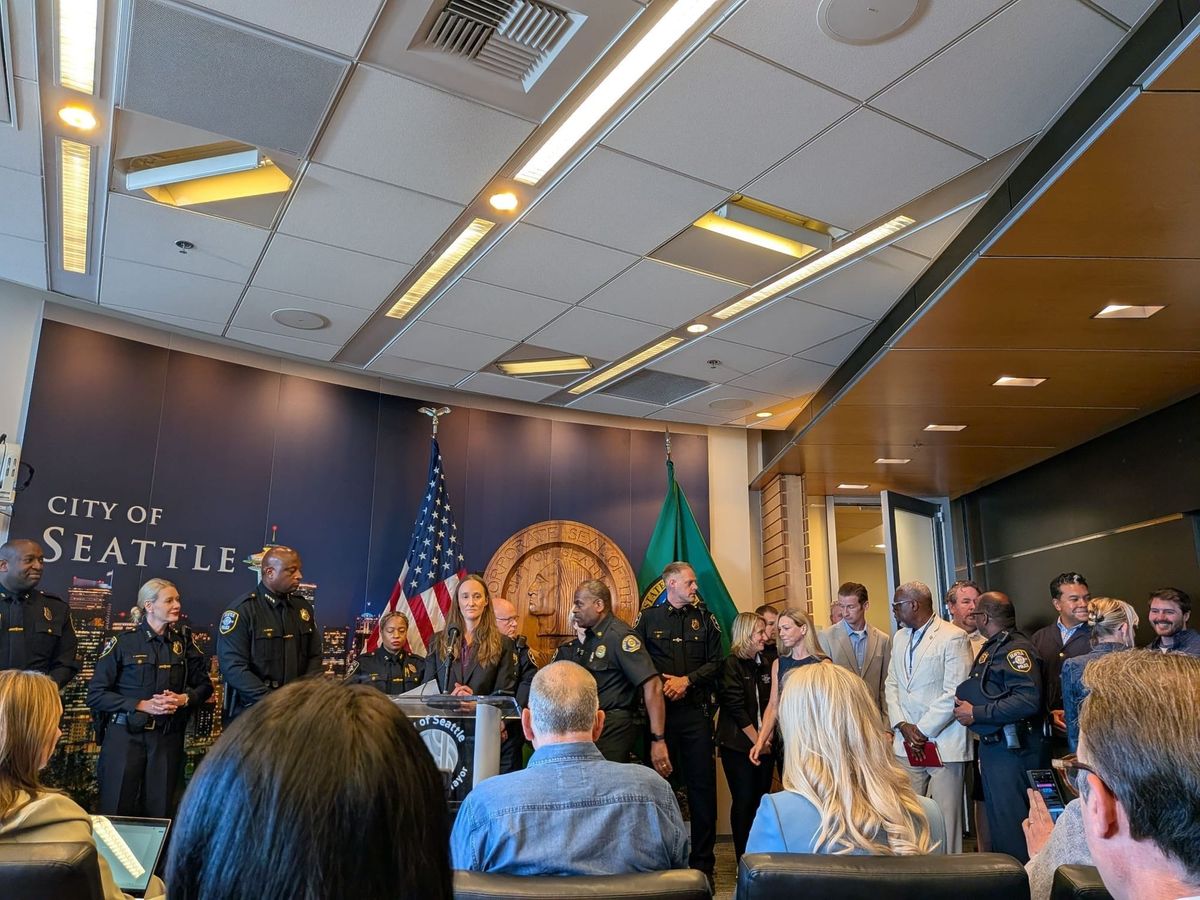
At a recent press conference, Mayor Katie Wilson expressed her appreciation for Rivera’s commitment to the work around gun violence prevention and mentioned her office’s participation in Rivera’s symposium.
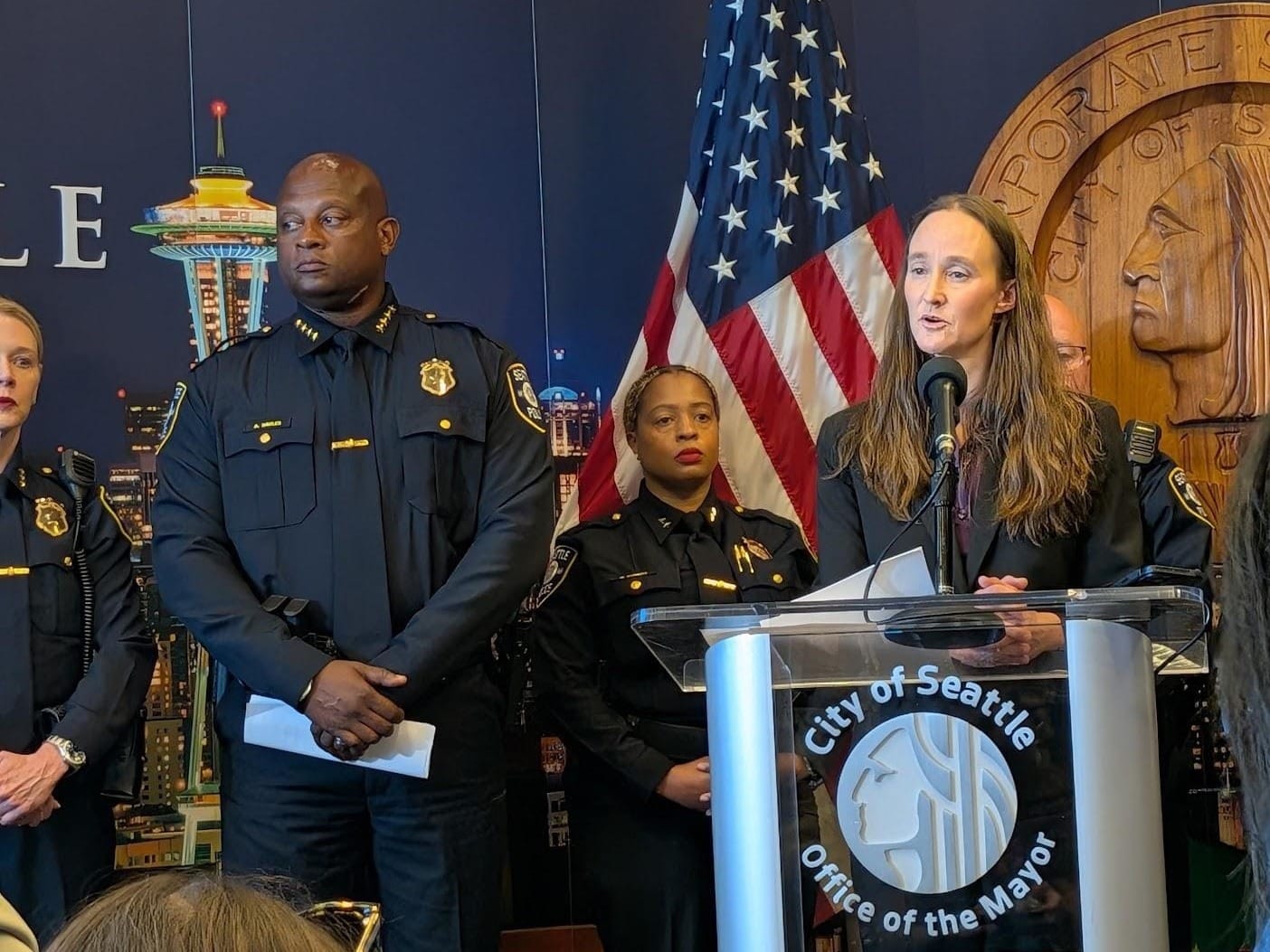
“We are committed to moving forward with that work, and we'll be doing that in partnership with council members,” Wilson said.
“The Mayor's Office is developing an evidence-informed strategy to reduce and interrupt gun violence. We are evaluating the City's current programs and investments, looking at where those efforts are working, where gaps exist, and how they can be better coordinated,” said Schellenberg. “This work includes consultation with local experts and nationally-recognized organizations to inform a strategy focused on clear leadership, measurable outcomes, and accountability.”
CARE Chief Amy Barden is working closely with the Mayor’s Office and other department leaders on developing an evidence-based plan.
“I think it’s the most urgent issue,” Barden told The Urbanist. “I think there’s a better understanding now of the system-level change we need.”
Schellenberg said the organizational structure and housing for the work is still being decided. She also emphasized the Mayor’s Office commitment to accountability and transparency, including public reporting on outcomes.
During recent press conferences, Wilson has shared a few details: that the Mayor’s Office will be hiring a gun violence prevention expert, and that the City is reaching out to several organizations with subject expertise to explore a possible partnership. In addition to NNSC, Wilson cited Cure Violence Global, the National Institute for Criminal Justice Reform, and Cities United.
The Mayor’s Office is also studying the example of Baltimore. A new evaluation of Baltimore’s approach of focused deterrence found that within 18 months of implementation, its strategy was associated with about a one-third decline in shootings and homicides and a 40% reduction in carjackings in the area of the city where it was practiced, with no spillover to adjacent areas.
When homicides in Baltimore decreased to their record lows, the Baltimore Police Department had 400 to 500 fewer police officers than their authorized headcount. Baltimore has seen a 68% drop in its homicide rate in the first half of 2026 compared to the first half of 2019.
“Research consistently shows that group-related gun violence is highly concentrated. That means focused, coordinated intervention with those individuals and groups, paired with genuine offers of support and opportunity, can have an outsized impact on public safety citywide,” Schellenberg said. “That insight is informing our strategy. It will require coordinated governance, measurable goals, data-sharing across systems, and sustained investment in the community organizations doing this work on the ground.”
Schellenberg said the Mayor’s Office expects to have more details to share soon.
Correction: The amount for the two-year NNSC proposal was stated to be $470,000 in the original version. We regret the error. Additionally, the last section was initially cut from the article by accident. It was restored on September 21.
 Amy Sundberg