If you walked through Portland, Tacoma, or Seattle today, you would no doubt note the vacant, seemingly abandoned parcels of land sitting collecting weeds and litter. You might also note the empty storefronts and “For Lease” signs that have become permanent fixtures of the streetscape. This leads one to wonder: who owns these properties, why are they empty, and what could they be better used for?
By Q4 2025, Colliers reported Portland, Oregon reached another post-pandemic high of downtown office vacancies – 27%. Consequently, the City of Portland has been considering implementing fees on vacant commercial properties in an effort to drive prices down since 2025.
Further north, Seattle saw its highest commercial vacancy rate since the pandemic, with reported rates falling between 25% and 34.7%. As part of her campaign, Seattle Mayor Katie Wilson pledged to consider a “well-designed vacancy tax or fine” as a means to drive small businesses back to the downtown core. As major cities in the Pacific Northwest consider commercial vacancy taxes, there is a question about the results and what it would look like for cities like Tacoma.
Taxes as a Means of Development
The economic model of vacancy taxes works in theory: property owners are taxed for their vacant properties and therefore incentivized to sell or rent the vacant property at a market occupying rate. In reality, properties are still vacant for a number of reasons including, high rents or high costs to convert the property to housing. Policymakers want to lower commercial rents and increase focus on adding housing downtown. A vacancy tax could help further those aims.
By taxing a property with a long-running vacancy, the property owner is incentivized to lower their asking rent or sell the property to a new owner who may put it to a better use. The cost to keep the property vacant and off the market altogether as a speculative asset becomes too great.
The idea is not new, and it has been implemented in several municipalities across North America. In 2018, Washington, D.C. implemented a tax on vacant residential and commercial properties at a rate of $5.00 for every $100 of assessed value, and increases to $10.00 for every $100 of assessed value for properties identified as blighted. As goes the economic theory, the intention for the tax by the D.C. Department of Buildings is to “bring vacant and blighted properties back into productive use.”
In 2020, voters in San Francisco passed Proposition D which applies a tax on ground floor, street facing commercial properties vacant for six months out of the year. San Francisco’s commercial vacancy tax is $250 per linear foot of frontage in the first tax year the vacancy occurs.
Taxes on the land and property are the tools of many municipalities, and one of the few progressive revenue generating options available to cities in Washington. Leaving that tool on the table could put at risk a municipality’s ability to raise the required revenue they need to encourage small business growth and housing development.
Vancouver’s Gold Standard
When looking at vacancy tax case studies, the most regionally famous would have to be Vancouver, B.C. In 2017, Vancouver implemented an “Empty Home Tax” (EHT) – a tax on vacant homes of 3% of a property’s assessed value. The province of British Columbia followed suit, implementing a Speculation and Vacancy Tax (SVT). With both taxes in place, the Vancouver model is one of the most studied cases for North American cities. The implementation of both taxes discouraged speculation and the removal of residential properties from the long-term rental markets.
With the combination of Vancouver’s EHT combined with the province’s SVT, the taxes are credited with reducing the residential vacancy rate to 0.49% by the end of 2024, according to the city’s annual assessments. By comparison, Seattle’s vacancy rate by the end of 2024 was 6.6% for apartment buildings according to data from Kidder Mathews and Simon Anderson Team.
Vancouver’s problem was that would-be domiciles were kept off market for speculation, rather than housing. The intention of both the EHT and SVT in Vancouver is not to raise funds, but to address and disincentivize vacancy. However, that does not mean the revenue was nothing. By 2024, Vancouver collected over 202 million Canadian dollars (~US$150 million) in tax revenues from the EHT, with annual collections of around 30 million Canadian dollars (~US$22 million). While this is dwarfed by Vancouver’s total budget of $3.8 billion, it is still a proven revenue stream for affordable housing projects.
However, Vancouver’s case is limited in its effectiveness. The C.D. Howe Institute introduced a study in 2024 that cast doubt on the effect on rents. While the tax reduced the number of empty homes without impacting new housing construction, it did not appear to affect average rent, counter to the supply-side narrative. This shows that while the tax improved housing availability, it did not address affordability, indicating a need for further measures to address the wider housing crisis.
A feature of the EHT is that it focuses on residential properties, not commercial spaces. The SVT similarly does not include commercial spaces. Commercial properties are not subject to the same rules as residential properties, the thinking goes, because their leases are longer and can be taken off the market for renovations and improvements to the property. Additionally, a longer lease tenant could go bankrupt during a longer-term lease, leading the landlord to evict or take action in court, leaving the property vacant. This could be seen as overly detrimental to the landlord.
Additionally, with the shift to remote work during the pandemic, office vacancies remain stubbornly high in many cities. The same Collier report this article opened with states, “Portland’s prolonged commitment to remote work, ongoing concerns around tenant safety, and high tax rates compared to nearby locales hamper the downtown office market and cloud occupancy projections.” Even if a vacancy tax pushed landlords to drop office rents significantly, demand may remain too low to fill empty offices.
What Vancouver reveals is a potential for Washington State and its municipalities to adopt a similar taxation scheme. One of the few mechanisms available to local governments are property taxes, with property tax revenues financing 15% of the state’s budget. But the intention of a vacancy tax in the style of Vancouver would be to increase supply, and drive housing to market. However, if applied to commercial spaces, there might be a similar result.
San Francisco and the Commercial Vacancy Tax
As alluded to earlier, the San Francisco commercial vacancy tax serves as an experiment in the taxation of vacancy commercial properties. There are notable exemptions for construction and improvements, getting around the disincentives applied to properties’ improvements were they to become vacant. Kidder Mathews reports that in Q1 2026 office and retail vacancies have been reduced - from 6.8% in Q1 2025 to 6%.
However, the current data is difficult to analyze, as its impact is mixed with post-pandemic recovery efforts, muddying the waters. Vacancies were indeed reduced, but rents remain high, increasing 5.9% from 2025 to 2026. If the point is to fill the vacancies, then a commercial vacancy tax seems like a viable option with the current data.
Commercial vacancy taxes are rarer, leaving less data to analyze to ascertain their effectiveness.
Washington’s legal barriers
Without question, Washington reformers will run into legal challenges. Honolulu and San Francisco both tried to implement a variation of a vacancy tax, targeting residential properties and empty homes, and both faced barriers that killed their momentum. Honolulu’s most recent EHT effort was shelved after their City Council, adding to several attempts that faced community pushback, constitutionality questions, and implementation concerns. San Francisco’s tax was struck down in 2024. Washington’s Constitution is no less troublesome, as the fight over the millionaires income tax has shown.
The trouble comes from the Uniformity Clause. Article VII, Section 2, states “The legislature shall provide by law a uniform and equal rate of assessment and taxation on all property in the state,” with all real estate constituting one class, intertwining land and buildings atop of it as a single taxable entity. However, a section prior, the Constitution reads: “All real estate shall constitute one class: Provided… [s]uch property as the legislature may by general laws provide shall be exempt from taxation.”
With exceptions allowed by the Legislature, there are workarounds, where the Uniformity Clause is not the barrier to the exception of property. In 1995, the Legislature passed SB 5387, which established the Seattle Multifamily Housing Tax Exemption (MFTE) program. The program enabled cities to exempt property for new multifamily housing developments. Under the same scheme, a vacancy tax would appear to pass legal muster and could be applied universally by the Legislature, exempting occupied units from the tax.
Any local vacancy tax would hinge on the Legislature’s approval. While unable to meet the “gold standard” in British Columbia, it would be a step toward adoption of the tax.
Realities and Local Perspectives
With a re-emergent interest in vacancy taxes, Pacific Northwest cities are exploring new territory as they contemplate commercial vacancies and the continued housing crisis. In Washington, the housing crisis still dominates conversation in Olympia. Meanwhile, Seattle leads the nation in falling office rents, which has been attributed to the city’s high vacancies. Foot-traffic and retail activity is only now starting to recover to pre-pandemic levels.
Vacant lots are peppered throughout Tacoma, but vacant homes, buildings, or parcels are not catalogued by the Pierce County Assessor-Treasurer outside of tax delinquency. Representatives of Tacoma Public Works’ Real Property Services confirmed with The Urbanist they have no current method of ascertaining what buildings or lots are considered vacant. Pierce County’s Assessor-Treasurer’s Office noted similarly that unless there was a change in ownership like a title transfer or sale to change the tax burden, there is no audit conducted on parcels’ vacancy status.
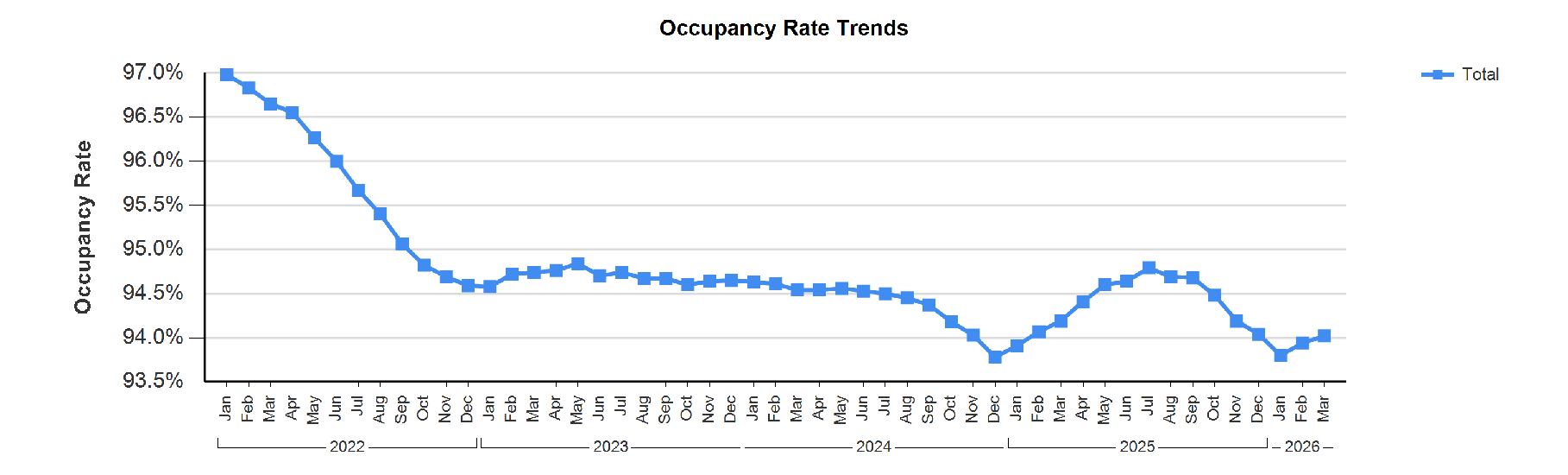
Tony Herrmann and Elijah Piper from Kidder Mathews provided information on the residential occupancy trends in Pierce County between 2022-2026. From 2022, there was an increase in housing stock through construction, resulting in a drop in the occupancy rate as those units were gradually absorbed. However, the vacancy rate since 2023 has stayed stable. As of March 2026, Tacoma’s vacancy rate for multifamily residential properties was 6%. According to another Kidder Mathews report, Pierce County rents increased 2% year over year.
“I am alarmed that we have so many vacant properties around Tacoma that are detrimental to the community,” Tacoma Councilmember Latasha Palmer said in a statement to The Urbanist.
Tacoma Councilmember Kristina Walker and former-Councilmember Kiara Daniels had collaborated and explored the possibility of a vacant property tax.
“Vacant properties and empty lots are a serious concern for the City,” Walker said. “We are missing an opportunity to convert these types of properties into more housing for people across our city, space for local businesses, and so much more.”
Tacoma Councilmember John Hines shared his interest in shrinking the vacancy rate through incentives. Hines worked with the City of Spokane and state lobbyists on SB 5884 last legislative session. The bill, sponsored by Senators Marcus Riccelli and Yasmin Trudeau, would have established a sales and use tax deferral program to stimulate the redevelopment of underdeveloped properties, effectively granting a tax break to developers as a landlord-friendly alternative to a vacancy tax.
“Tacoma has a number of underdeveloped properties that we want to see turned into housing and active commercial space,” Hines said. “Another area that I am focused on is helping to connect our current vacant commercial spaces with tenants.”

Tacoma Mayor Anders Ibsen expressed interest in vacancy taxes when he was on City Council in the 2010s, and optimism about what could be done at the municipal level in the future.
“The Council had previously looked into vacancy taxes as an idea, but it was determined to be legally questionable because taxes have to be uniform,” Mayor Ibsen said. “However, a higher fee specific to a particular property that pays for directly-related services – like more proactive code enforcement – is within the realm of possibility. I’m currently exploring that.”
Councilmember Palmer echoed interest in this idea.
“We need to take more robust action with our code compliance team to let property owners know that leaving vacant properties uncared for is unacceptable. I think a vacancy tax could also be very helpful, and I was disappointed to learn that state-level legal issues prevent Tacoma from adopting this type of tax. Our most important goal with vacant properties is to get them back into use.”
Vacancy Taxes in Tacoma and the Evergreen State
While land speculation may be less of a problem in Tacoma, that does not mean a variation of the tax would be worthless. As Seattle’s mayor campaigned on, a vacancy tax might be a solution to economic development that Puget Sound cities are looking for when wanting to protect their small businesses and downtown cores. While code compliance is the focus of many on Tacoma Council now, under the right legal framework, a vacancy tax may find traction in the Grit City.
 Carolyn Bick