A beefy executive order released by Seattle Mayor Katie Wilson Friday gives marching orders to an array of City departments on the issue of traffic safety, including clear direction accelerating work on safety-oriented road overhauls at the Seattle Department of Transportation (SDOT). The document is Wilson's most ambitious transportation-oriented move to date, eight months into her term in public office – after more than a decade of work as an organizer with deep ties within the transportation advocacy community.
"The simple truth is that, despite having a Vision Zero commitment on the books for over a decade, Seattle has not met our goals on transportation safety," Wilson said Friday. "We are not on track to eliminate serious injuries and fatalities by 2030, and we still see too many headlines, too many ghost bikes, too many families in mourning. We know the tools that can make a difference: safer street designs, safer speeds, better crossings, and better visibility."
The wide-reaching order includes five different sections, giving SDOT a laundry list of specific projects to implement at the same time that the department completes an update to its Vision Zero Action Plan and provides recommendations to the mayor on how to deliver safety projects more quickly across the board.
It calls for work to upgrade the vehicle fleets used both by City employees and by city contractors to improve safety, make adjustments to Seattle City Light-controlled street lighting systems, and increase the participation rate in the school street program at Seattle Public Schools to 40%.
"SDOT's team has done outstanding work, and we have the data showing its impact on particular routes or intersections,' Wilson said. "But we have not achieved our goals yet because one department can't keep up with the scale of this challenge, and we have lacked the political will to do what works. This is what this executive order does: It directs the city to take this issue seriously, from how we design our roads to how we manage our fleet of vehicles to how we do enforcement. A key part of this order is accelerating existing safety projects, taking work already underway and helping it move forward faster."
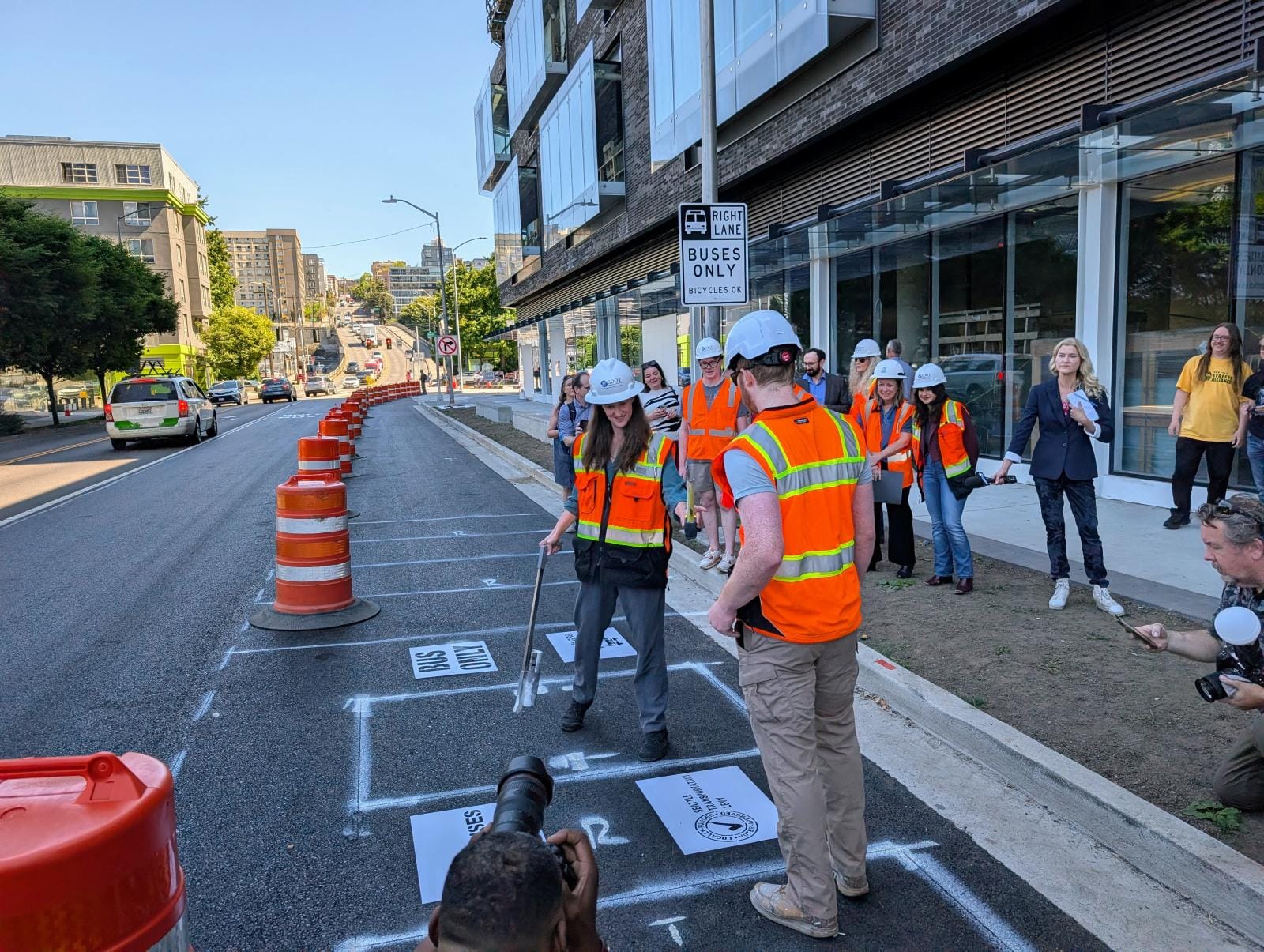
The order drops the day after Wilson helped put final touches on a bus lane on Denny Way set to open this weekend, joined by Councilmember Alexis Mercedes Rinck and "Fix the L8" advocates who pushed for the change.
By next summer, SDOT will add intersection "daylighting" at 20 intersections, creating a clear zone intended to improve visibility close to marked and unmarked pedestrian crosswalks. Even more significantly, daylighting will be implemented over the course of routine capital maintenance, matching a similar move made around no-right-on-red signage in 2023.
SDOT will scale up its automated traffic enforcement camera program, starting with four new locations for cameras and scaling up to 10 by spring of 2029, giving the City time to make staffing changes at the Seattle Police Department when it comes to personnel assigned to review camera violations. The department will also explore how to adjust signal timing to improve safety, a move that is a step away from projects that have sought to increase vehicle speeds with signal upgrades.
"I think what this represents is first of all, her commitment to Vision Zero, and her commitment to making sure that her action on this is substantive, impactful, and meaningful," Alex Hudson, Wilson's senior policy advisor on transportation and livability, told The Urbanist. "It is an expression of her understanding that it's a shared responsibility. Obviously, the Department of Transportation has an important role, but is not by a long shot the only department who has a role in this key public safety issue."
Councilmember Eddie Lin said his District 2 has long borne the brunt of the safety crisis, as a hot spot for fatal crashes. Addressing that is a crucial part of making the city safer.
— Doug Trumm (@metropolitanglide.bsky.social) August 21, 2026 at 1:27 PM
[image or embed]
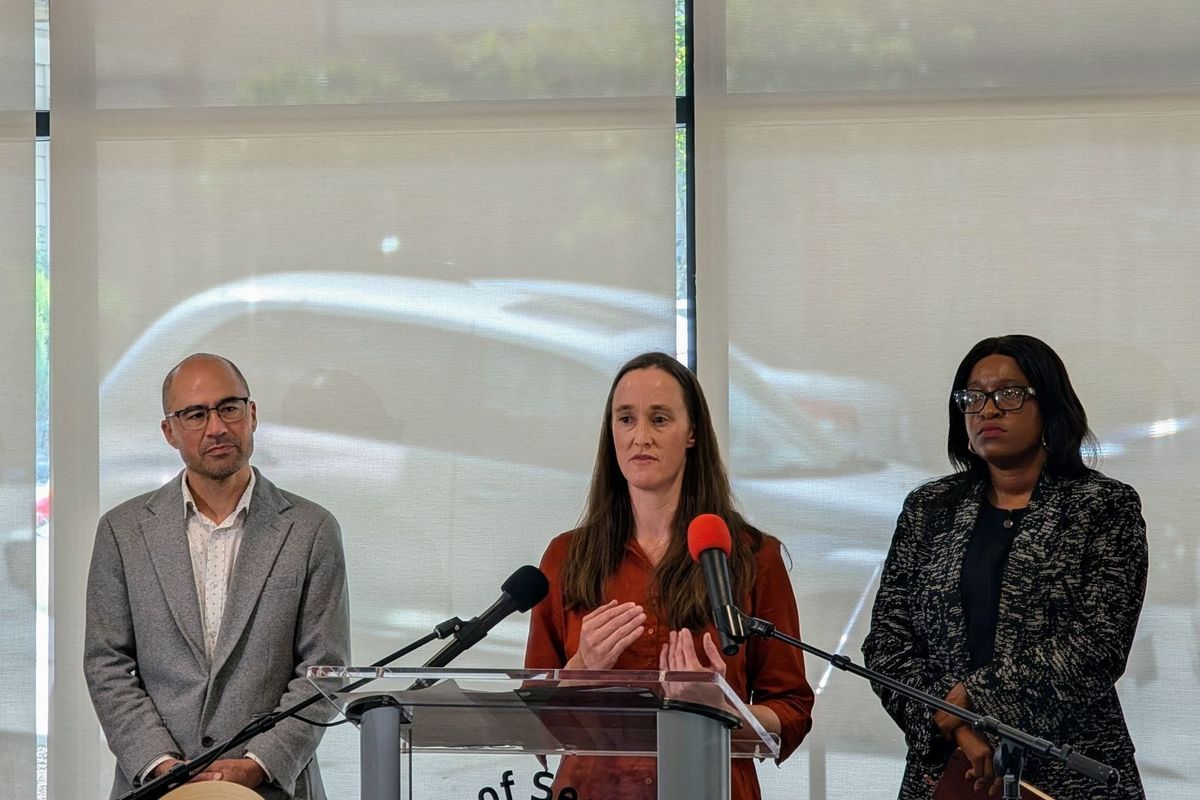
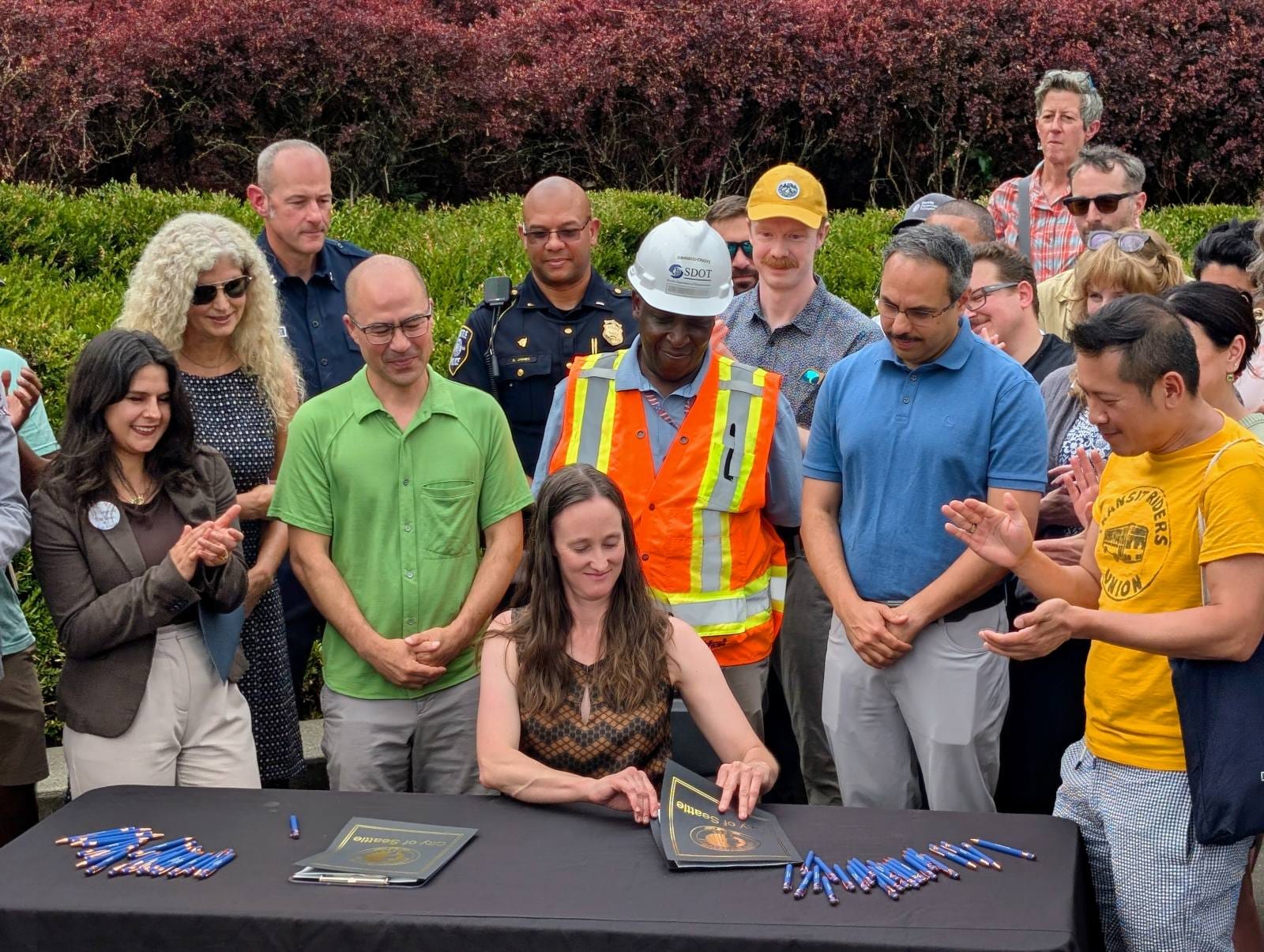
Councilmembers Alexis Mercedes Rinck and Eddie Lin spoke at Mayor Wilson's press event at Cleveland High School in Beacon Hill. Lin echoed the mayor's points about the need for political will and treating traffic safety as a key part of ensuring public safety broadly. Lin's District 2 has borne the brunt of traffic violence and gun violence crises.
"Certainly, it is important for us to focus on all types of public safety,' Lin said. "You know, youth gun violence has been devastating, again for South Seattle in particular, but for some reason we talk about transit traffic safety differently. We too often see it as just part of everyday life, as if it's not something that we have the ability to change or control. And I think that's why, for too long, it has been normalized, and it has allowed us to to not take the urgent action we need to to take."
Not present at Wilson's press conference was Councilmember Rob Saka, who chairs the transportation committee. PubliCola's Erica Barnett reported Saka was invited, but declined to attend, instead rolling out his own "Safer Street Act" as unfinished informational items on Thursday, a package which Barnett described as "mostly nonsubstantive" and a "hasty attempt to upstage her."
Two different reporters asked Wilson why Saka wasn't at the press conference, and she quickly pivoted to a collaborative note.
"I'm excited to have the partnership of our council and of the transportation chair," Wilson said Friday. "I think anyone who wants to work together to make our streets safer for all users, we're going to work together, and I'm excited about his leadership, too."
Letting Vision Zero projects "jump the line"
With this order, SDOT is directed to add a "new, early delivery phase" to major corridor projects in development including Rainier Avenue S, Aurora Avenue N, S Jackson Street, 4th Avenue S, and MLK Jr Way S. "These changes can impact lane configuration, turning, and parking on Seattle arterials, but SDOT should prioritize safety-first solutions tailored to the type and severity of crashes on the corridor," the order states.
These corridor overhauls are likely to be the most impactful projects in the 2024 Seattle Transportation Levy, giving the city an opportunity to redesign some of the city's most dangerous streets. But to date, few details have been made public around future street designs, as fatal and serious injury crashes continue to happen on those streets.
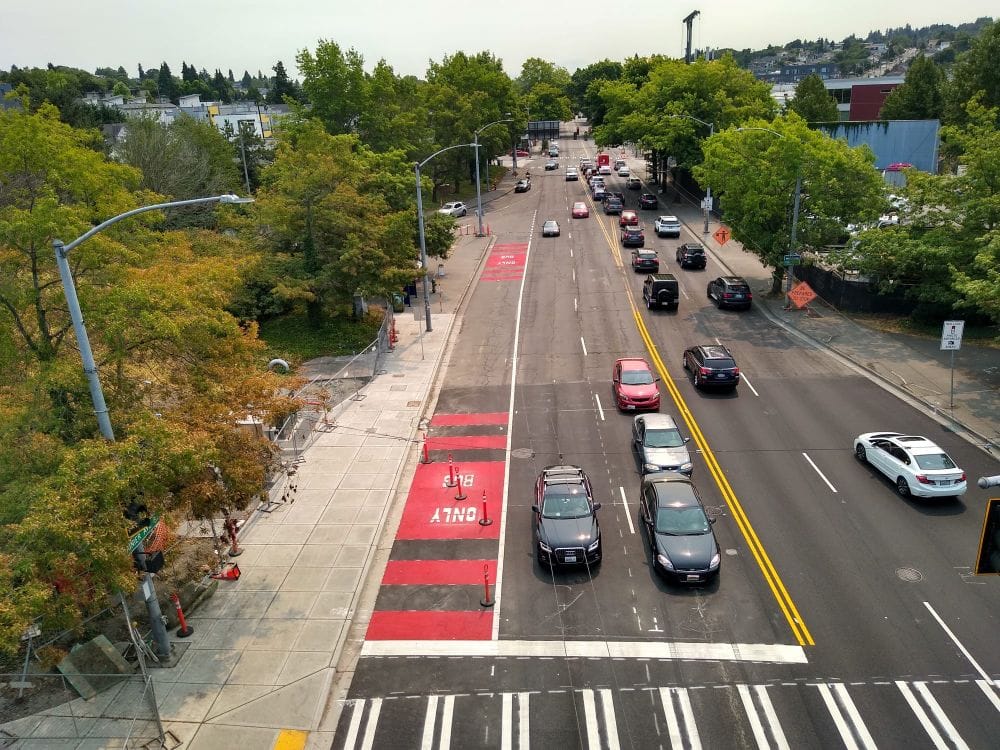
Other "key Vision Zero projects" are also on the list to be accelerated, including a planned protected bike lane along SW Wildwood Place and safety upgrades along 12th Avenue S – both locations of recent fatal crashes. The Mayor's Office is eying 19 other high-collision locations for changes by next fall. Francisca Stefan, SDOT's Senior Deputy Director, told The Urbanist this week that most of the projects on the list have already been in planning, with this order giving them even more urgency than they had before.
"They're all a little different, but what is largely going to be the case is they're going to jump the line, and basically, we are already doing a lot of that, but it's sort of just amplifying and and shining a stronger light on moving those things, putting them at the first of everybody's queue, and continuing to push them internally to be the first things that are out the door," Stefan said.
Longer-term, a report due next January asks for a "set of project types and criteria where adjustments to current practice could accelerate project delivery," getting safety upgrades completed more quickly. That includes exploring how to make safety adjustments separate from planned utility work, a coupling that often leads to long lead times on projects as SDOT coordinates with City Light and Seattle Public Utilities. The report also asks for recommendations on "expediting community engagement processes," a potential signal that city officials are looking to find ways to interrupt the Seattle Process when safety is at stake.
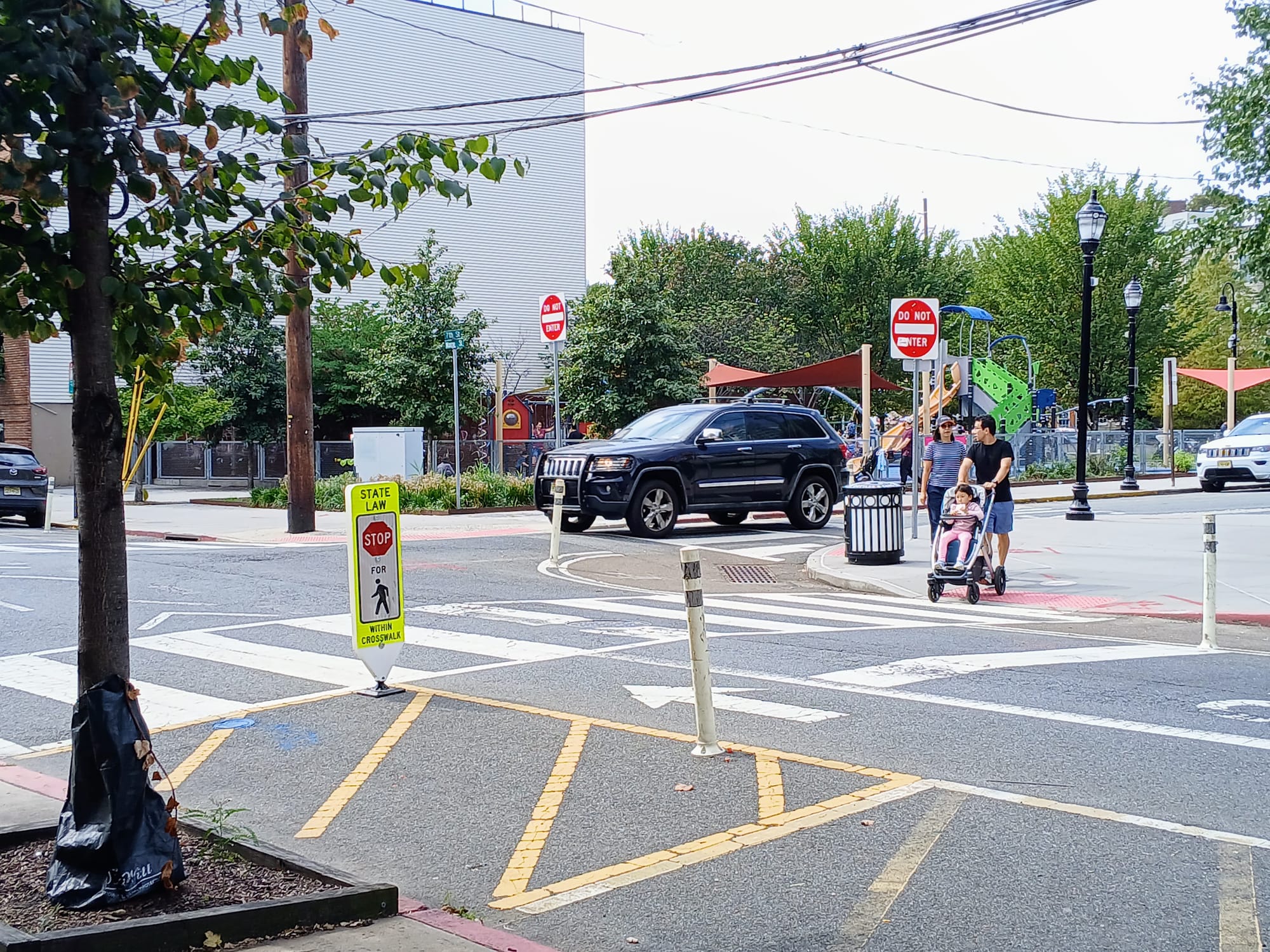
"One of the exciting things about the executive order is the forward momentum," Stefan said. "It's opening up new methods and new ways of doing things. It's exciting to see that as part of the bouquet of different efforts that we're all taking as a team."
Upgrading Seattle's government fleet for safety
Wilson's order also includes an entire section on safer vehicles, directing the city's department of Finance and Administrative Services (FAS) to develop a fleet transition plan intended to adjust vehicles with "safety protections for vulnerable road users by identifying opportunities to right-size fleet vehicles for smaller size, decreased weight, and reduced blind zones."
Specific safety upgrades including visibility cameras, convex mirrors, cross-over mirrors, side guards, and blind-spot awareness decals are all specifically called out in the order, which will impact new City vehicles and existing ones.
The order also includes a section on vehicles used by contractors, directing the City to explore adding some of those same features to required safety infrastructure that contractors are required to adhere to when operating under City contracts. That section even includes the potential use of Intelligent Speed Assistance (ISA) to ensure that city contractors maintain safe speeds on city streets, a provision that would likely need to be negotiated with labor unions if implemented on the city's own fleet.
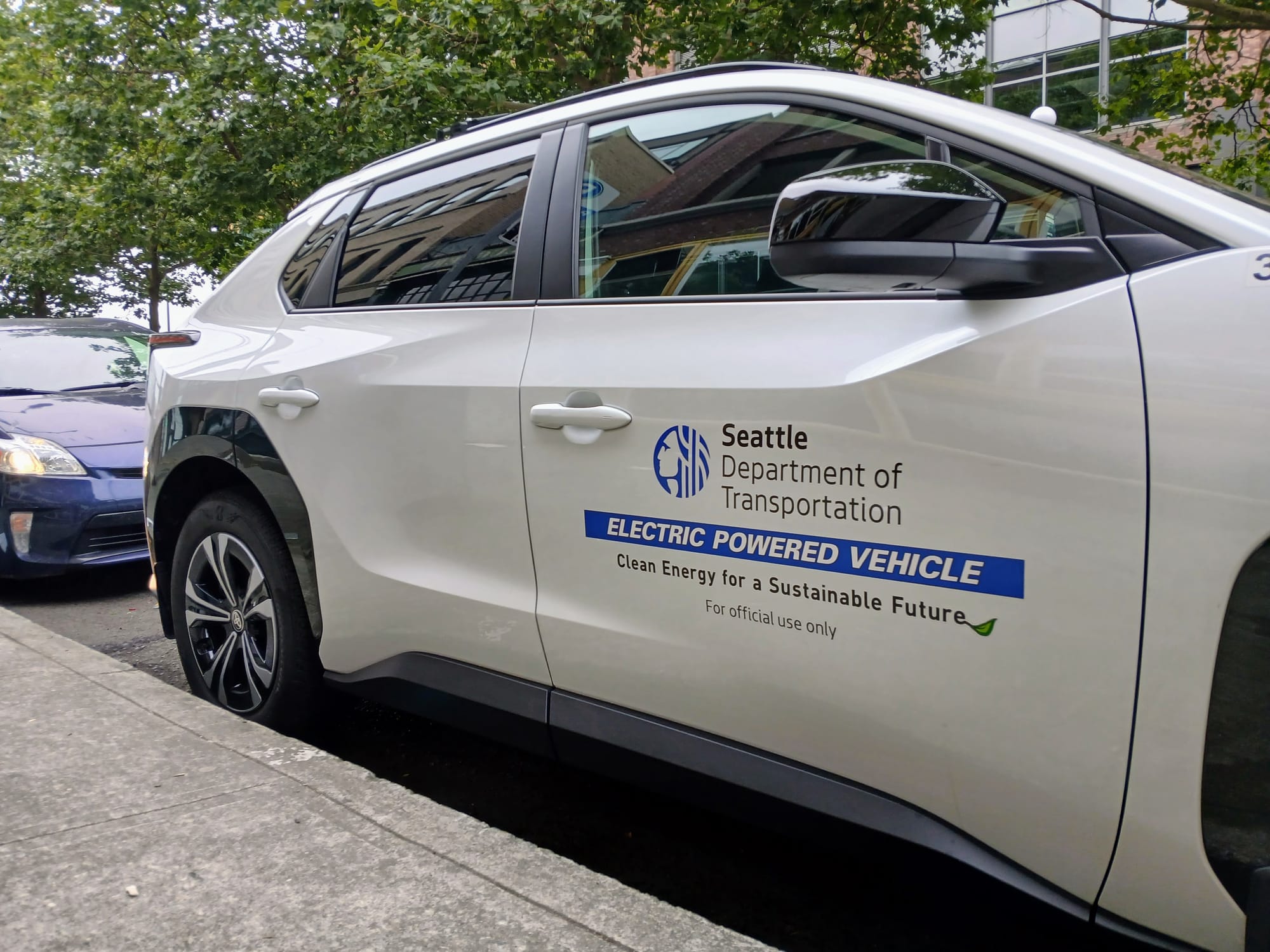
"We want to make sure that we're prioritizing safe vehicles, and so that means right-sizing them," Hudson said. "We don't need to wait to purchase new vehicles to make some of these safety improvements. So we're also directing further work on retrofitting. Some of that work is already underway, and I want to give a lot of credit to the Department of Transportation and others for having made progress on this work already."
An ambitious legislative agenda
Seattle's official legislative agenda for 2026, adopted in the final days of former Mayor Bruce Harrell's term, doesn't include any mention of traffic safety. But this order gives the City a substantive list of potential changes that the state legislature could implement to make a difference on the issue of reducing serious injuries and deaths on Seattle's roadways.
Some of those changes impact SDOT's ability to deliver projects. If the department makes immediate changes to a street following a devastating crash, the City is often found liable for that under a legal doctrine known as subsequent remedial action. Wilson's order asks the city's Office of Intergovernmental Relations (OIR) to advocate for reforms that would keep the City from being held liable from acting quickly in the wake of a crash.
The City will also push the legislature to raise the limit on capital projects that must go out to bid, a provision of state law that prevents the department from delivering modestly-sized projects with the City's own crews.
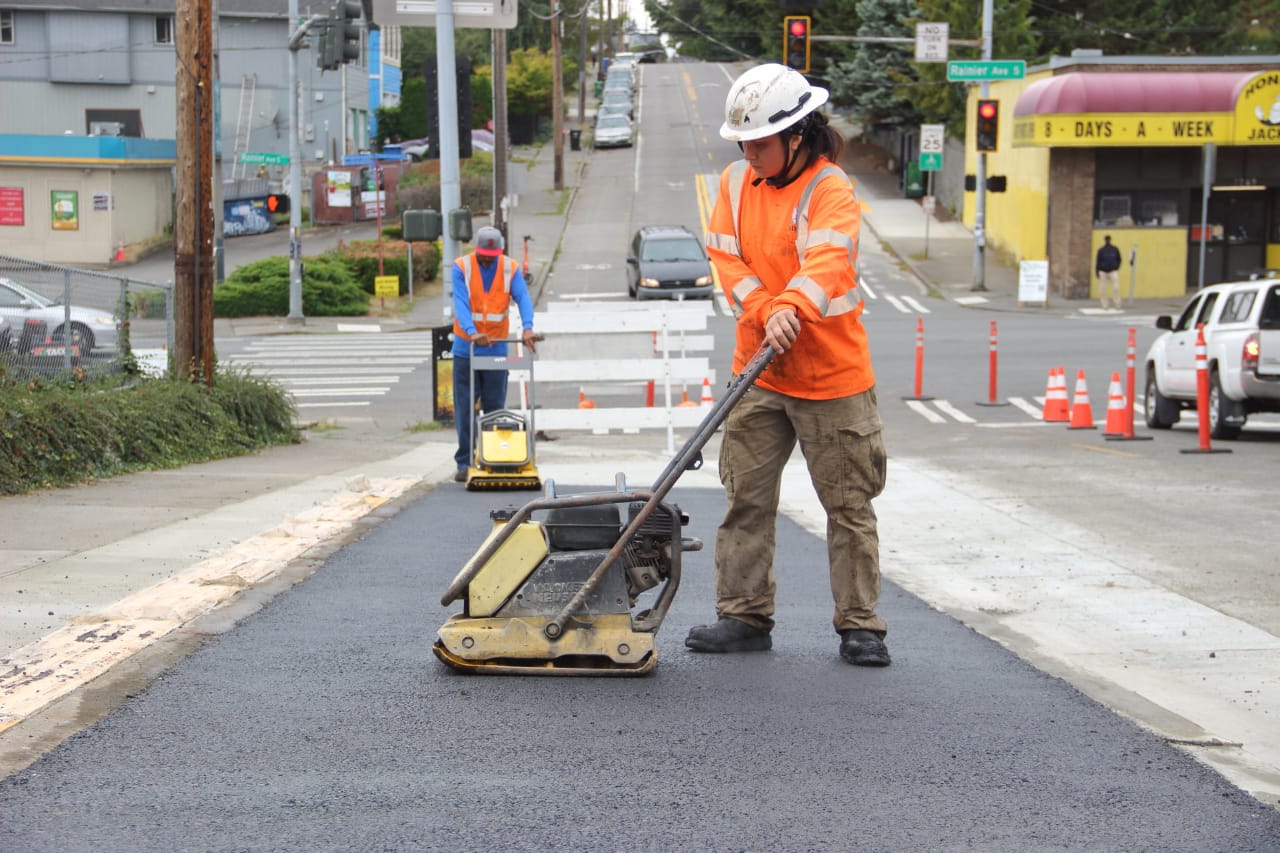
"We're doing a lot of research about this right now. Sometimes [it makes projects] up to six months longer and a minimum of 30% more expensive. So not an effective or efficient use of taxpayer dollars there, and we want to increase the threshold and index it to inflation," Hudson said.
The legislative agenda also includes a request to amend state law to allow Seattle to implement no-turn-on-red restrictions citywide without having to install a sign at every single intersection. It also references support for the statewide push for a lower, 0.05% blood-alcohol content (BAC) threshold when it comes to drunk driving, a push that has stalled out over multiple legislative sessions.
Speaking at the mayor's rollout, Gordon Padelford, executive director of Seattle Streets Alliance, mentioned the broader headwinds that make achieving zero road deaths challenging for any city, from the supersizing of SUVs and trucks to rampant speeding and distracted driving.
"I was there at the press conference in 2015 in Lake City when Vision Zero was announced as a bold new direction for the city," Padelford said. "And since then, across the United States, speeding has been rampant, distracted driving is increasing, intoxicated driving remains stubbornly high, and the proliferation of SUVs and passenger trucks that are too large for our streets is having deadly consequences, especially for pedestrians."
Padelford noted Seattle has been able to buck these negative trends to some extent, but not enough to save hundreds of people from facing severe consequences from crashes every year.
"But in the face of these headwinds, Seattle's safer than many of our peer cities: San Francisco, Minneapolis, Washington D.C., Philadelphia, Portland, and Denver. And that's a laudable achievement. We should take a moment to recognize, and it's thanks to the Vision Zero program's efforts to set safer speed limits, implement traffic calming, and build safer crosswalks," Padelford said. "But we must do more. In 2025, more than 200 Seattleites suffered life-altering injuries, and 27 lost their lives."
Several speakers brought up that behind each statistic was a human tragedy that shouldn't be sanitized as a mere numerical datapoint.
"These are not statistics; these are not numbers," Padelford said. "These are families. These are individuals with communities and friends and colleagues, and the ripples of devastation that happen from each of those incidents affects people for a long, long time, and there are stories behind each of those. And I would implore the media today to humanize the people behind the statistics to think about why they're not able to get home to their loved ones and what we can do to make sure everyone gets home safely."
Traffic safety issues consistently rank among the top public safety concerns voiced by Seattleites, with the 2025 Seattle University-conducted Seattle Public Safety Survey of nearly 9,000 residents finding that no other issue ranked higher.
"This isn't about paint on pavement for its own sake," Rinck said Friday. "It's about a mother living off of Aurora Avenue, not squeezing her child's hand a little tighter every time they cross the street. It's about an elder in the Rainier Valley being able to get to the bus stop without playing chicken with many lanes of traffic, and it's about saying finally out loud with the force of city government behind it, your life is worth more than someone else's convenience."
Friday's order has reportedly been in the works for months, gaining extra urgency following the death of Christian Salyer at 12th Avenue and Yesler Way in June and the death of Maridee BonaDea on SW Wildwood Place just a few weeks later. In its breadth, it likely represents the biggest reaffirmation of Seattle's 2015 Vision Zero commitment to eliminate deaths and serious injuries on the city's roadways by 2030 – a tall order, but certainly not one that the city will be able to make progress on without accelerating work and doubling down on safety interventions that are known to be effective.
Doug Trumm contributed to this reporting.
Update: This article was updated at 4:30pm Friday with quotes and photographs from the press conference. On 11am Monday, the information about Saka's legislation was added.
 Doug Trumm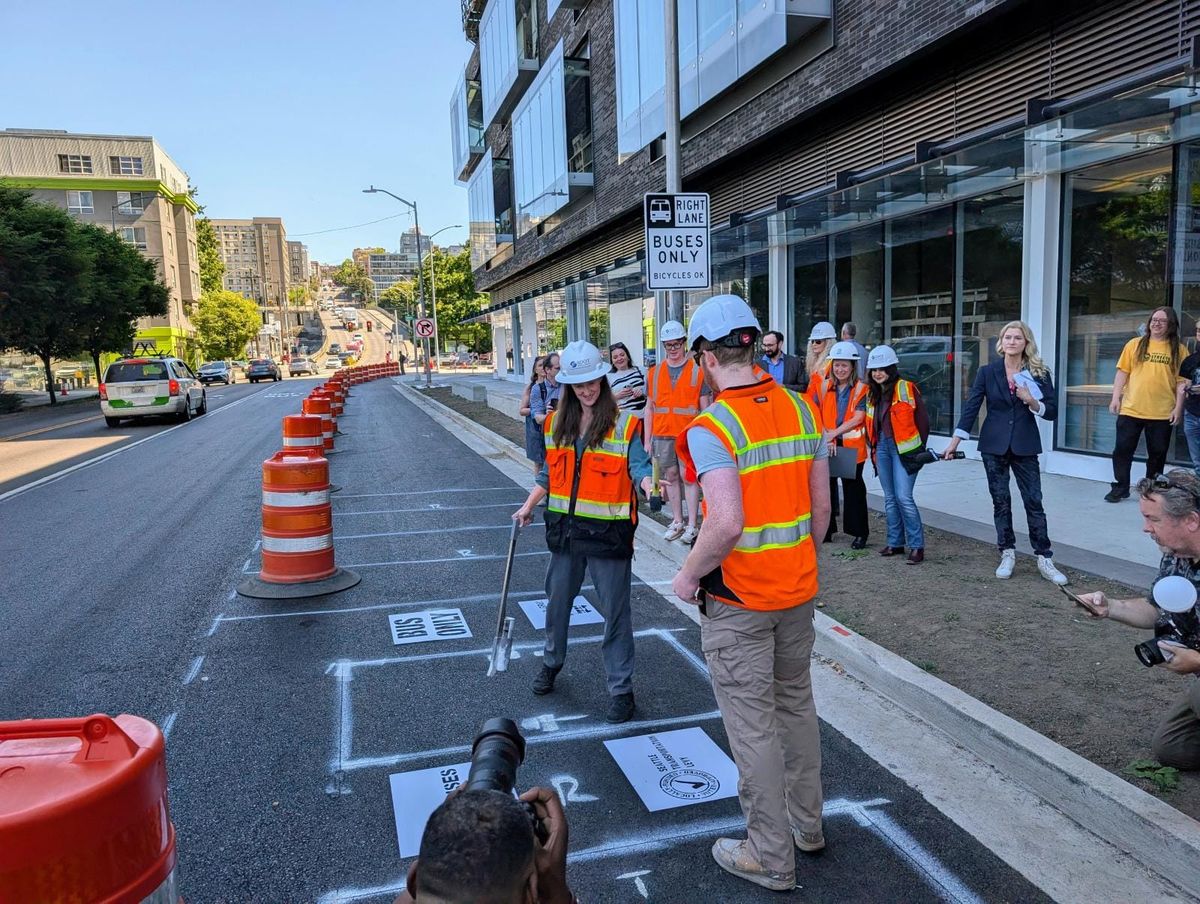
 Doug Trumm