From Seattle to Spokane and everywhere in between, August’s primary results show an electorate yearning for more options, and proportional ranked choice voting is the way to make viable candidates from outside the two-party system.
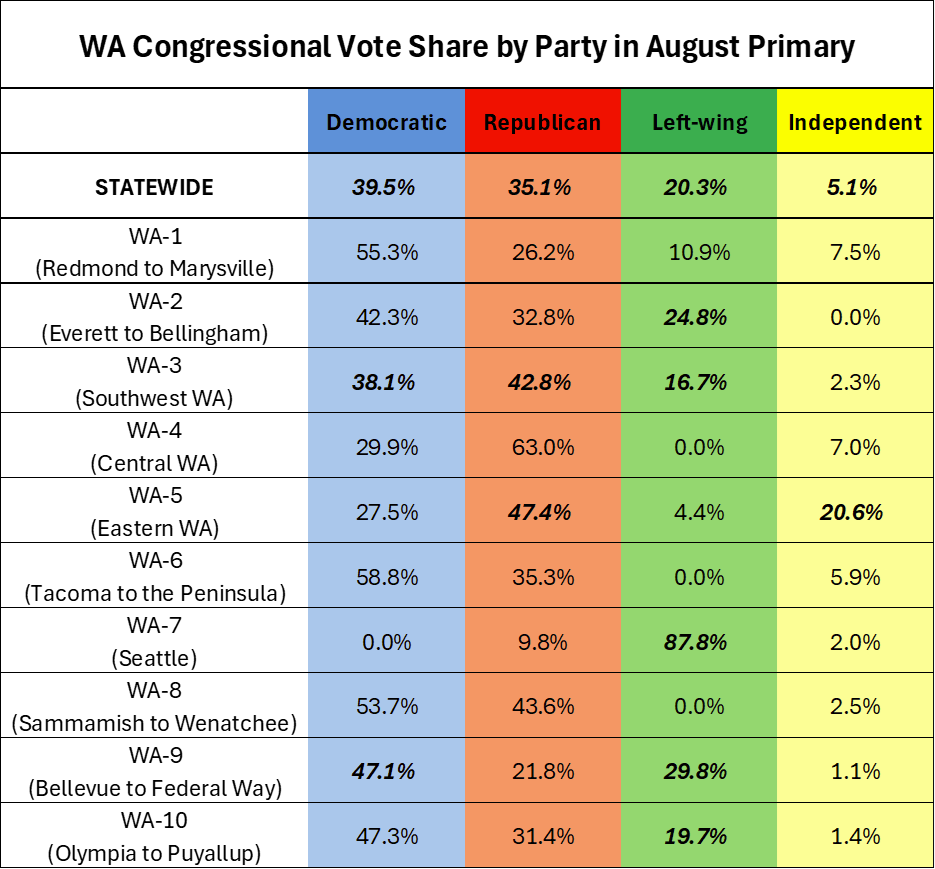
Contrary to the blinkered two-party analysis in the Seattle Times, which explicitly excluded independent candidates and ignored major differences between Democrats, Washington primary voters showed they support three viable statewide political parties: Democrats (40% of the statewide Congressional primary vote), Republicans (35%), and an emerging left-wing party (20%).
For this analysis, I analyzed candidate websites for rhetoric and policy platforms to identify which candidates are running as establishment or moderate Democrats and which candidates are running on progressive or socialist platforms. The left-wing label includes members of the Democratic Socialists of America (DSA) like State Rep. Shaun Scott, progressive Democrats like Congresswoman Pramila Jayapal, Brent Hennrich, and Kevin Fagan, and independent left-wing candidates like Kshama Sawant and Melissa Chaudhry.
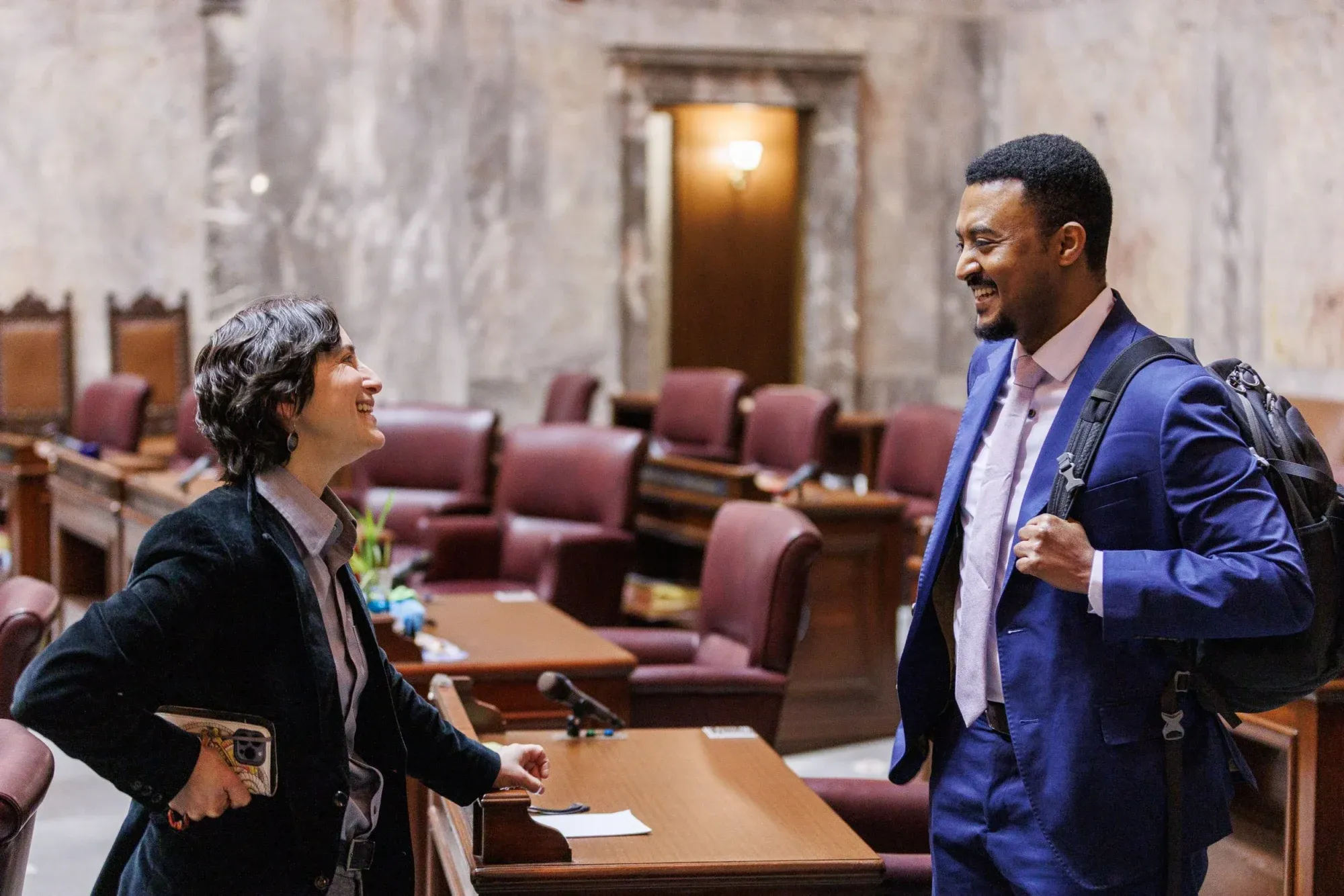
These primary results are evidence of what is already known in Olympia: that the governing Democratic Party in Washington State is a coalition of at least two smaller parties. Or, as Senate Majority Leader Jamie Pedersen put it on my podcast Ungerrymander America: “I’m already the leader of a multiparty coalition called the Democratic Party, that includes a broad range of people. From people who, if you could just get them to say what they think, identify as communists or socialists, to people who in a different time could easily have been Republicans, and everything in between.”
Though this emerging left-wing party is not yet formalized, candidates espousing anti-establishment, progressive, or socialist rhetoric and policies are finding support across the state. In addition to former Congressional Progressive Caucus chair Pramila Jayapal (WA-7), left-wing candidates received enough votes across Western Washington to prevent four incumbent Democratic Congresspeople from reaching 50% of the vote: Rick Larsen (WA-2), Marie Gluesenkamp Perez (WA-3), Adam Smith (WA-9), and Marilyn Strickland (WA-10).
Across the mountains in Eastern Washington's Fifth Congressional District, incumbent Republican Michael Baumgartner underperformed, receiving just 47.4% of the vote. The remaining 52.6% was split between mainstream Democrats, progressives, and independents.
Failing to win 50% of the vote means Baumgartner is vulnerable. But for challenger Carmela Conroy to win, she will need to build a cross-spectrum coalition that includes everyone from the 4.4% of voters who voted for left-wing candidates to the more than 20% of voters who voted independent. Conroy's coalition building efforts were helped by the full-throated endorsement of her by independent Nate Powell, who finished third with 16.5% of the primary vote.
Taken together, over one-quarter of primary voters voted for either a left-wing or independent alternative to the two-party system to represent them in Congress.
The same kind of multiparty dynamic is playing out in legislative races across Washington State.
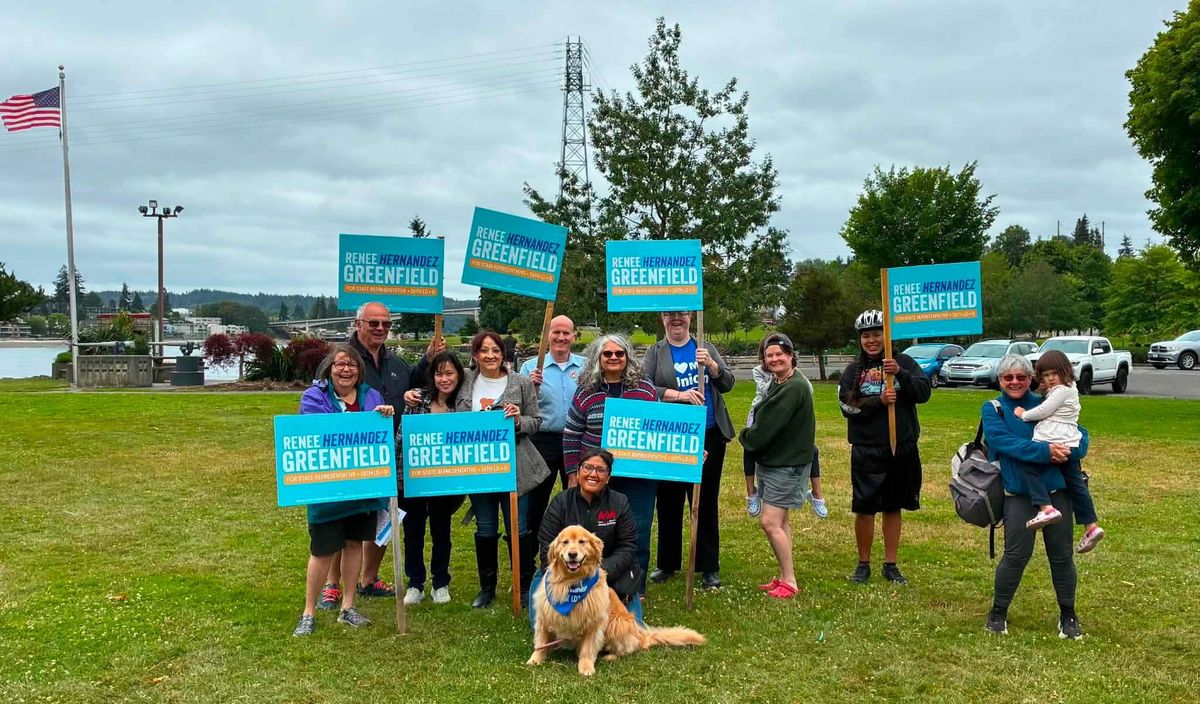
First, contests in the 37th and 43rd districts show that Seattle has a two-party system of moderate/establishment Democrats being challenged by progressive Democrats and DSA-candidates. Both districts will send a DSA-member to the legislature, with the 43rd's Shaun Scott running unopposed for reelection and the 37th’s Jaelynn Scott winning an overwhelming 88% of the primary vote.
Both districts have contested races, with the establishment Democrat Sen. Jamie Pedersen favored to win reelection in the 43rd. On the other hand, left-wing challenger Kelabe Tewolde won more than 51% in the primary in the 37th. These results should not be interpreted as definitive victories for either the moderates or the progressives; the key takeaway is that there are two distinct factions competing across Seattle districts and the more left-leaning democratic socialist faction is making headway and establishing itself as a distinct political force.
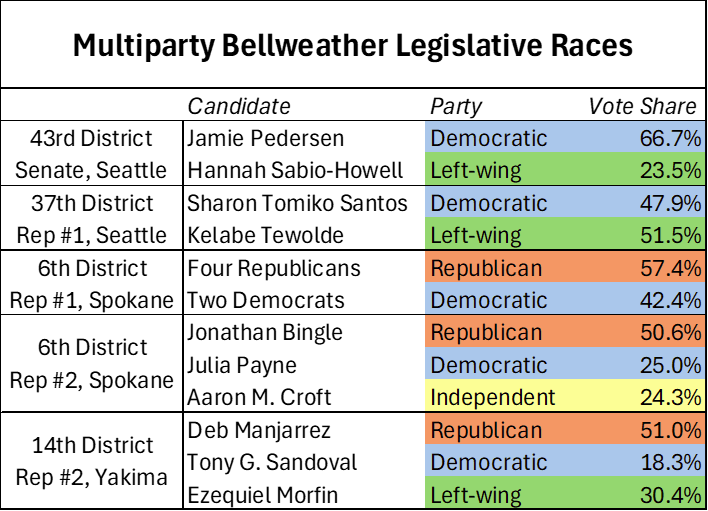
This isn’t only playing out in Seattle. Left-wing candidates are making gains elsewhere too. In the redrawn 14th district that stretches from Yakima to the Tri-Cities, incumbent Republican Rep. Deb Manjarrez received 51% of the primary vote, showing that the district will be competitive in November. In the race for second place, the labor and immigrant rights activist Ezequiel Morfin beat self-described moderate Tony G. Sandoval. To be clear, Morfin identifies as a Democrat. I categorize him as part of this emerging left-wing party because his platform centers working families and places his campaign in opposition to corporate donors and party insiders.
Meanwhile, voters in Eastern Washington are looking for independent alternatives. In addition to Nate Powell coming within 3% of second place in the Fifth Congressional District, the 6th Legislative District had independent Aaron Croft come within 259 votes of advancing to the general. Powell and Croft were two of five independent candidates in Eastern Washington endorsed by the Independent Veterans of America.
The concurrent and separate races for the two State House seats in the 6th LD show the appeal of independents. For seat #1, four Republicans combined for 57% of the vote while two Democrats received 42%. But just 50% of 6th LD voters supported Republican Jonathan Bingle for seat #2. Some 2,000 voters, 7% of the 6th LD primary electorate, voted Republican in one race then voted Independent in the other.
Take it all together and the shape of Washington’s multiparty politics comes into focus: the governing moderate to center-left Democrats fighting off a challenge from a left-wing party currently strong in Seattle and growing across the state; and a Republican Party losing relevancy in the State Legislature facing challenges from increasingly organized independent candidates.
Unfortunately, the structure of Washington’s top-two voting system is artificially keeping the two-party system in place and contributing to the widespread political cynicism that contributes to many people opting-out of voting. Voter turnout in the 2026 primary was just 37%, lower than the more than 40% turnout in midterm primaries in 2022 and 2018.
By implementing a proportional voting system, such as proportional ranked choice voting (RCV), Washington could send a multiparty delegation to Congress and have a formal multiparty politics in the State Legislature. This would help heal our political cynicism by providing voters real options beyond the two-party system.
Instead of a winner-take-all system like we have now, where the candidate with 50.1% of the vote wins and the other 49.9% of the district is left without, proportional RCV elects multiple winners in the same district. This means far more than 50% of voters will see someone they voted for win the election. For example, in a district where the top three candidates win, 75% of voters would be represented; in a four-winner district this goes up to 80%.
Individual candidates would still need to win at least 20% of the vote to be elected in a four-winner district. For a deep dive on the mechanics, see chapter 6 of my 2024 book Polemic for Democracy on the Ungerrymander America blog.
Finally, if implemented, the multiple winner function of proportional RCV makes gerrymandering functionally impossible, according to analysis by the Brennan Center for Justice.
Shifting to proportional RCV for electing members of the State House could be done through the normal legislative process, while changing the voting system for the Senate may require amending the state constitution (Article 2, Section 6).
But, such a change may be unlikely to be popular among legislators bought into the existing two-party system. A final option if legislation for proportional RCV fails to gain traction in Olympia would be for Washington voters to bring an initiative to demand a better voting system that would give them more options.
The primary results show that at least 25% of voters are already putting their votes toward alternatives to the two-party status quo. And if there were a real chance to change the system? Who knows how broad the support for such an initiative might reach.
 Doug Trumm