The Bellevue City Council has signed off on a plan to add more than $100 million in transportation funding over the next decade, utilizing a dedicated 0.1% bump in the city's sales tax rate. The spend plan for that money ramps up the pace of spending on bicycle and pedestrian projects by nearly 40%, but also invests heavily in big-ticket items including several pricey intersection expansions and a new roadway project through BelRed that has proven divisive.
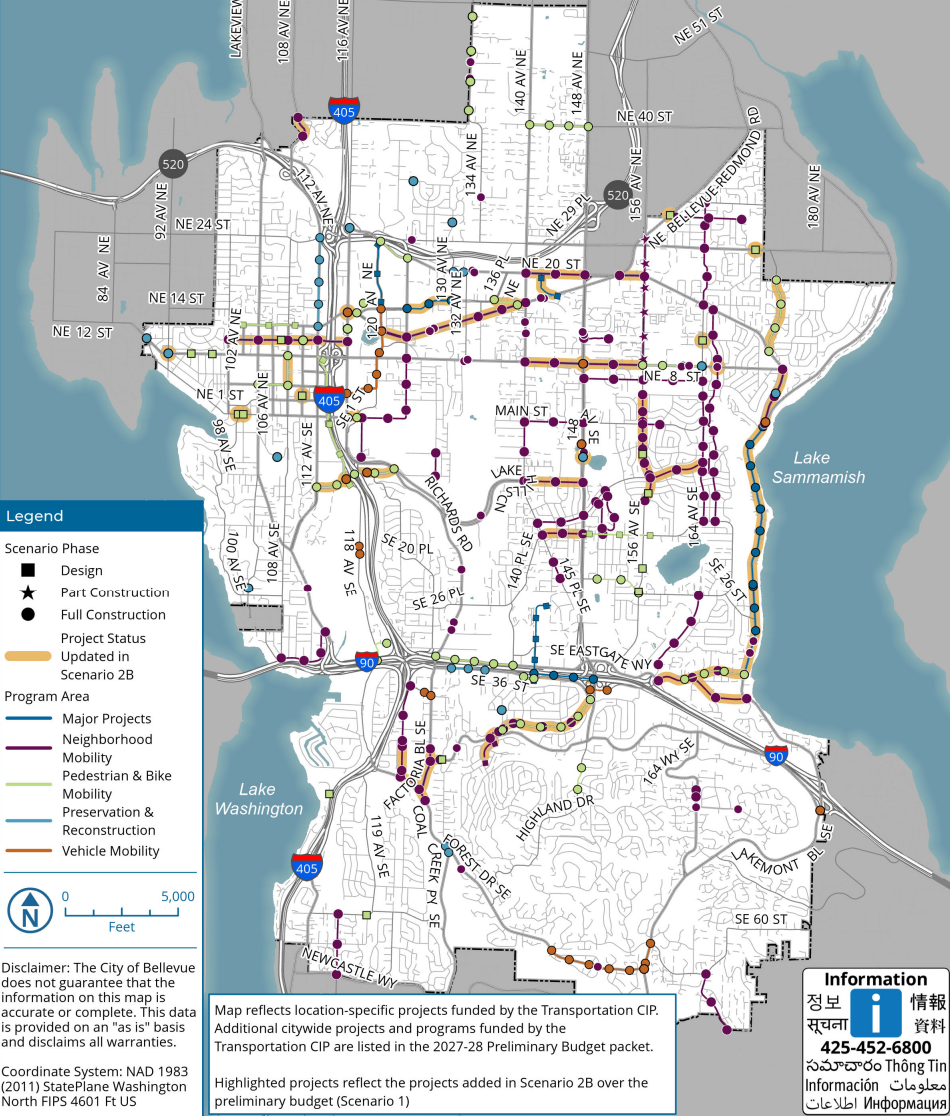
With an additional $33 million expected to flow into city coffers through 2036, Bellevue would advance 37 projects to improve bike and pedestrian infrastructure, five more than had been planned previously. Those include multimodal upgrades to 108th Avenue NE, pedestrian improvements along Main Street in Old Bellevue, and design funds for a connection to Eastrail near Main Street in Wilburton.
Plus, the number of neighborhood safety projects intended to calm vehicle traffic would jump from 33 to 46 thanks to an additional $13.2 million investment.
Bellevue would also invest an additional $18.9 million in projects intended to improve traffic flow, including $14 million to widen two intersections – NE 12th St at 116th Avenue NE, and SE 8th Street at 114th Avenue SE – and another $4.45 million for partial intersection changes at 148th Avenue NE and NE 8th Street. Those three projects alone represent 30% more spending than the planned increase for neighborhood mobility.
Advancing walking, biking, and safety upgrades for all users while at the same time chasing the dream of free-flowing traffic – a priority of the Bellevue Chamber of Commerce and other business leaders – illustrates Bellevue's current political reality, stuck in a liminal space between suburb and city. That reality has manifested in other ways this year, including a reluctance to follow other major Washington cities in rethinking things like parking mandates.
Over the past few weeks, the funding proposal has been walked back slightly compared to earlier iterations. A $20 vehicle license fee that would have been paired with the sales tax bump has been dropped; instead, the City will allocate $8 million in one-time funding toward neighborhood safety projects that would have been funded with those dollars.
The council rejected a motion made by Jared Nieuwenhuis at its November 3 meeting to send the package to voters next April, citing a clear need to make these investments in transportation.
"We have heard from residents who are concerned about the cost of living, and we have also heard from people who have been waiting years for safer streets, sidewalks, and better transportation," Mayor Mo Malakoutian said. "And both concerns are real, and we should take them seriously. And we also need to look at where Bellevue is heading. We are planning for 35,000 more homes and 70,000 more jobs by 2044, and we are already seeing that growth take shape, in Wilburton. Since we updated the zoning last year, we have seen application for more than 2,300 new homes in just that one neighborhood, and that is exactly why we need to act now. Transportation projects take years to plan, design, and build. If we wait until those homes are built and traffic get worse, we have waited too long."
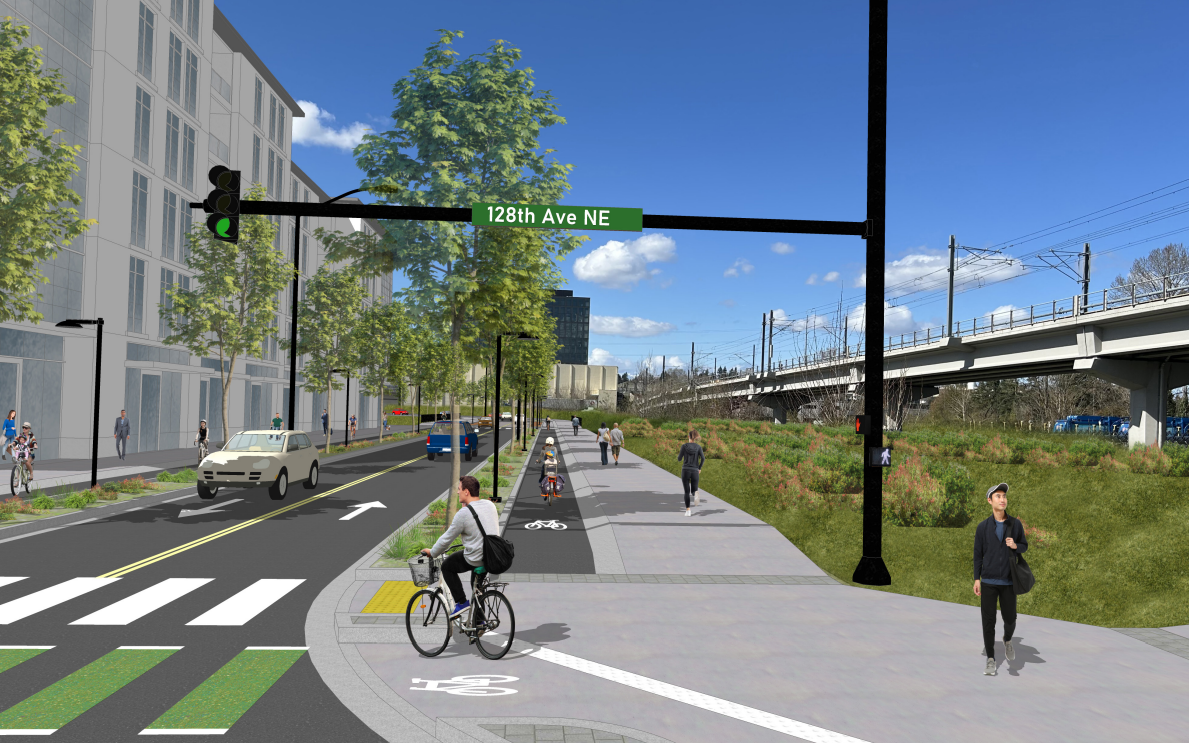
A full third of the new dollars – $37 million – will be used to get the Spring Boulevard Zone 3 project completed, a connection that City leaders see as essential to future growth in and around the BelRed and Spring District growth centers. As an alternative to the high-speed arterial that is BelRed Road, the new street will come with separated bike lanes and sidewalks in addition to one vehicle travel lane in each direction. But the eye-popping $74 million price tag has left sour taste in many Bellevue residents' mouths, urbanist or not.
The new stretch of Spring Boulevard will cut directly through one of the only new parks planned in the area, and the dollars lavished on this project could potentially be leveraged to achieve bigger citywide gains in bike and pedestrian access, in the wake of the full pivot away from the ambitious quick-build Bike Bellevue plan in 2024.
Councilmember Vishal Bhargava also framed the need to ramp up transportation spending as being directly tied to planned growth, roping in the issue of safety. That has been a major topic of conversation at the council for most of this year, in the wake of three deaths and 38 serious injuries occurring on Bellevue's roadways in 2025 – the highest rate in 10 years.
"I think there is a need for us to take action to match the development of transportation infrastructure to keep pace with the growth that we have bolstered in the city, through things like middle housing, the comprehensive plan re-densification in many areas, even the economic development efforts that we're putting in to bring jobs into the city," Bhargava said. "We need to make transportation investments to keep pace. Otherwise, we're going to struggle not just from a mobility standpoint, and more importantly, from a safety standpoint."
But even as the plan tries to please everyone, some Bellevue residents pushed to scale back the investments in walking and biking to spend more on congestion reduction. On council, it was Nieuwenhuis who gave voice to the idea that the plan was weighted too far away from cars, asking to see a breakdown of exact levels of spending for bikes versus pedestrians.
"I don't know how much we're putting towards either one of those right now, and it's challenging because, as the mayor rightly said, we are experiencing growth," Nieuwenhuis said. "I don't think the growth is going to happen quite as quickly, but we are experiencing growth. But we are spending almost like 70% more on bike and ped than we are in [the] vehicle [category]. So how are we going to adjust for that growth, be able to get cars, trucks, first responders, etc., through the city, if we are putting more of our emphasis on bikes than we are on vehicles."
In his response to Nieuwenhuis, Bellevue Transportation Director Andrew Singelakis framed the city's bike infrastructure as long neglected.
"There's a significant amount of money that's in there as well for the vehicle mode that needs to be addressed as well," Singelakis said. "But I think that really we're so far behind in the bike mode that making connections and having those connections occur will end up enhancing that system."
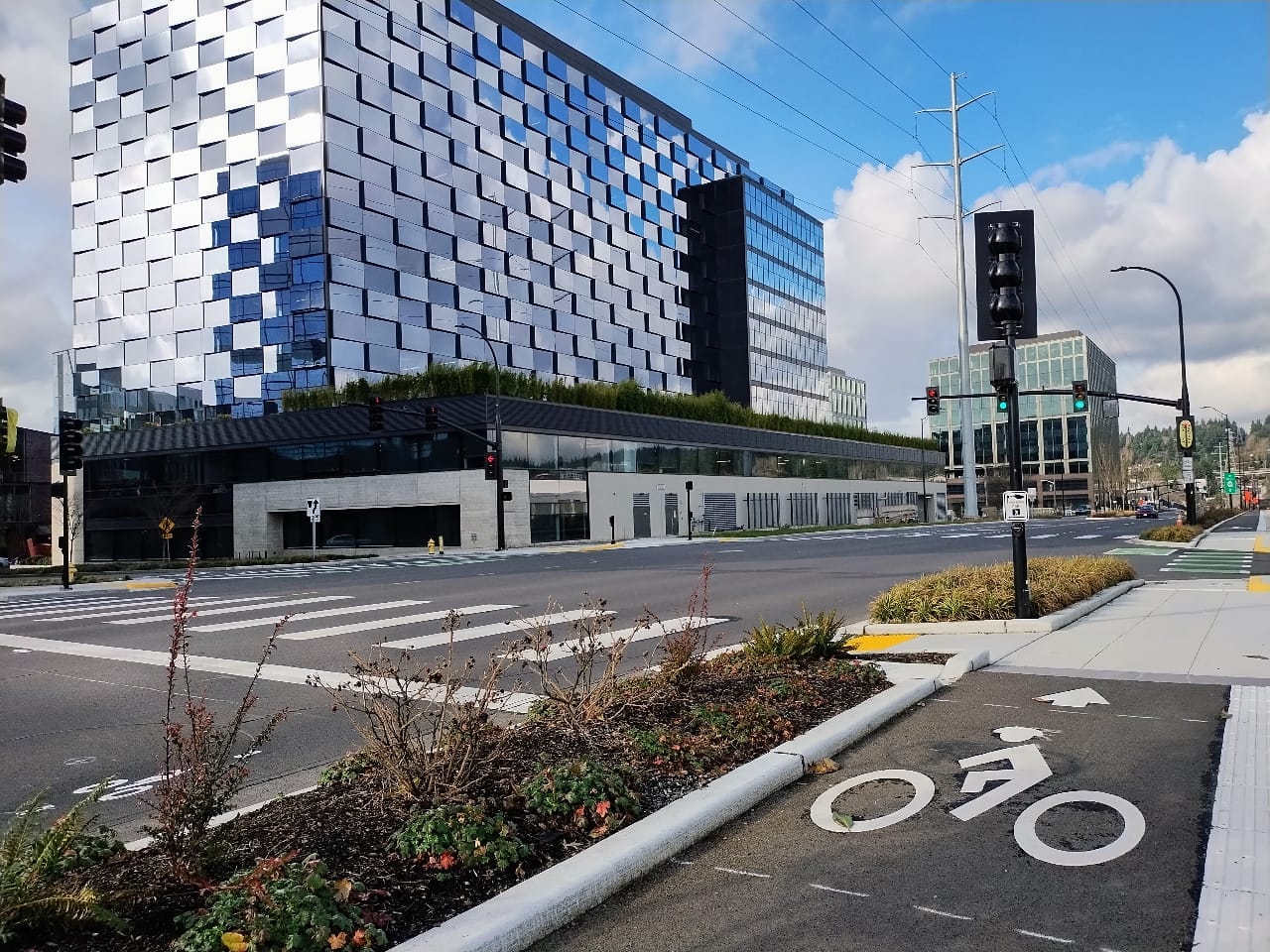
Another major factor that is limiting Bellevue's ability to satisfy calls to improve congestion is the high expense of car projects compared to bike and pedestrian ones, a fact that will only become more pronounced as the city continues to densify.
"As we're thinking about the available land for roadway infrastructure, there are very few spaces left to add vehicle capacity, and that's part of the reason why you're seeing such an emphasis on completing that system with access to transit, with bike and ped, because it's building on the existing capacity to make sure that the roads function well and provide a full network," John Resha, Bellevue's Chief Financial Officer, said. "We're kind of in that space of, we're now a little heavier weighted in the multimodal side because of that constraint of the land, [it] just isn't available to build more roadways."
Some councilmembers voiced support for retaining the $20 car tab, a funding source that would have freed up some general fund dollars, but also allowed Bellevue to complete three more neighborhood mobility projects. Additionally, car tab funding could have added one more bicycle and pedestrian project to the workplan, a multimodal study on Main Street between 100th and 108th Avenue NE.
"I think that for the families who have two working parents that have to be to work before school starts, they have to pay for childcare, and if their children can walk to school from their home, that's a cost saving for them, if it's safe. And that's a reality for a lot of families in Bellevue," Councilmember Lynne Robinson said. "Also, we're retiring a parks levy in two years, and so that's going to be I think almost $50 that people will not be paying if we do not re-up it."
While the new funding source will start to flow in mid-2027, the 10-year plan won't actually be set in stone; so, there is the potential for a reassessment of the project list sometime down the road. The intersection expansion at SE 8th and 114th, for example, won't start design until 2031, according to the City's current plans. The widening of 148th Avenue NE and NE 8th Street would be designed at the same time, but not start construction until 2036.
"The council will have the opportunity, with staff support and help, to revisit the prioritization of these projects as we get additional information on safety impacts, congestion changes, behavior changes, and across modes," Bhargava said. "The modal split can change, and different things can become more important from a safety and connectivity standpoint."
A final vote to approve Bellevue's 2027-2028 budget, including the 0.1% sales tax increase, is set for the November 17 meeting.
 Ryan Packer
 Ryan Packer