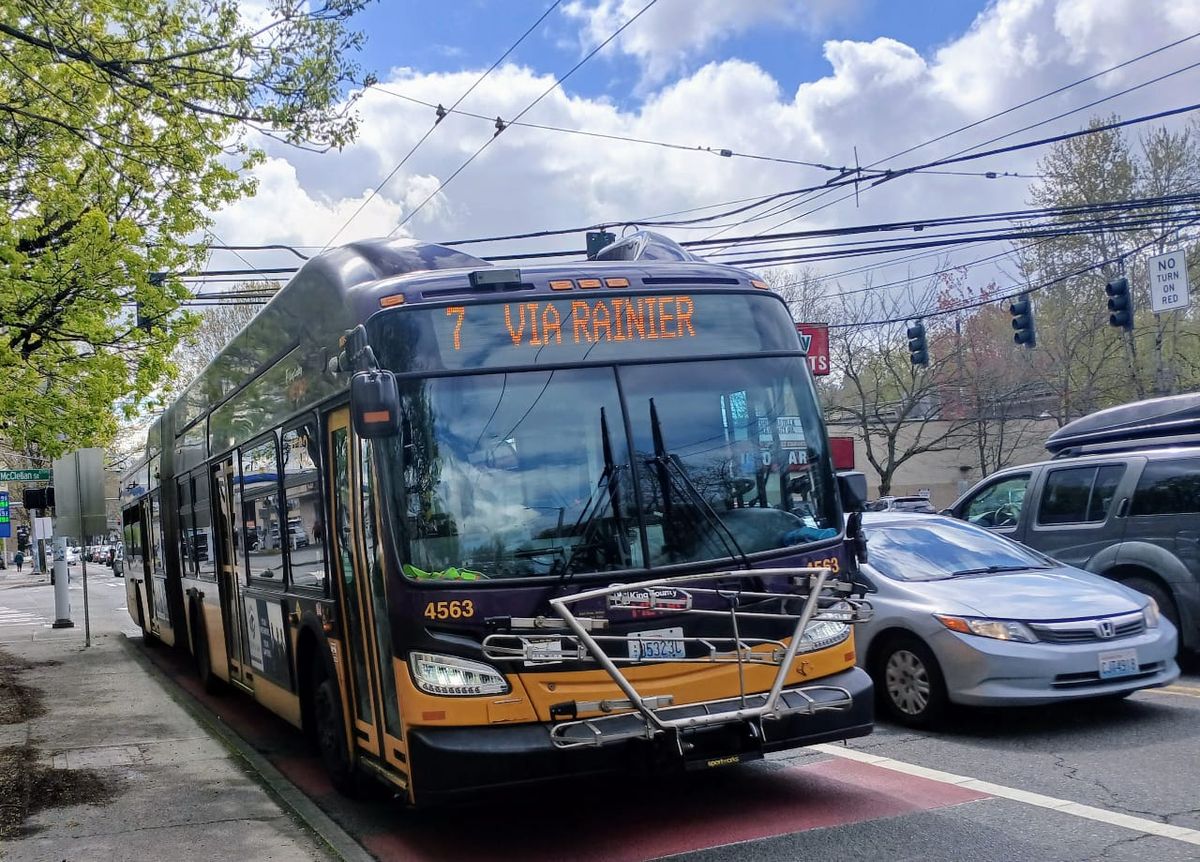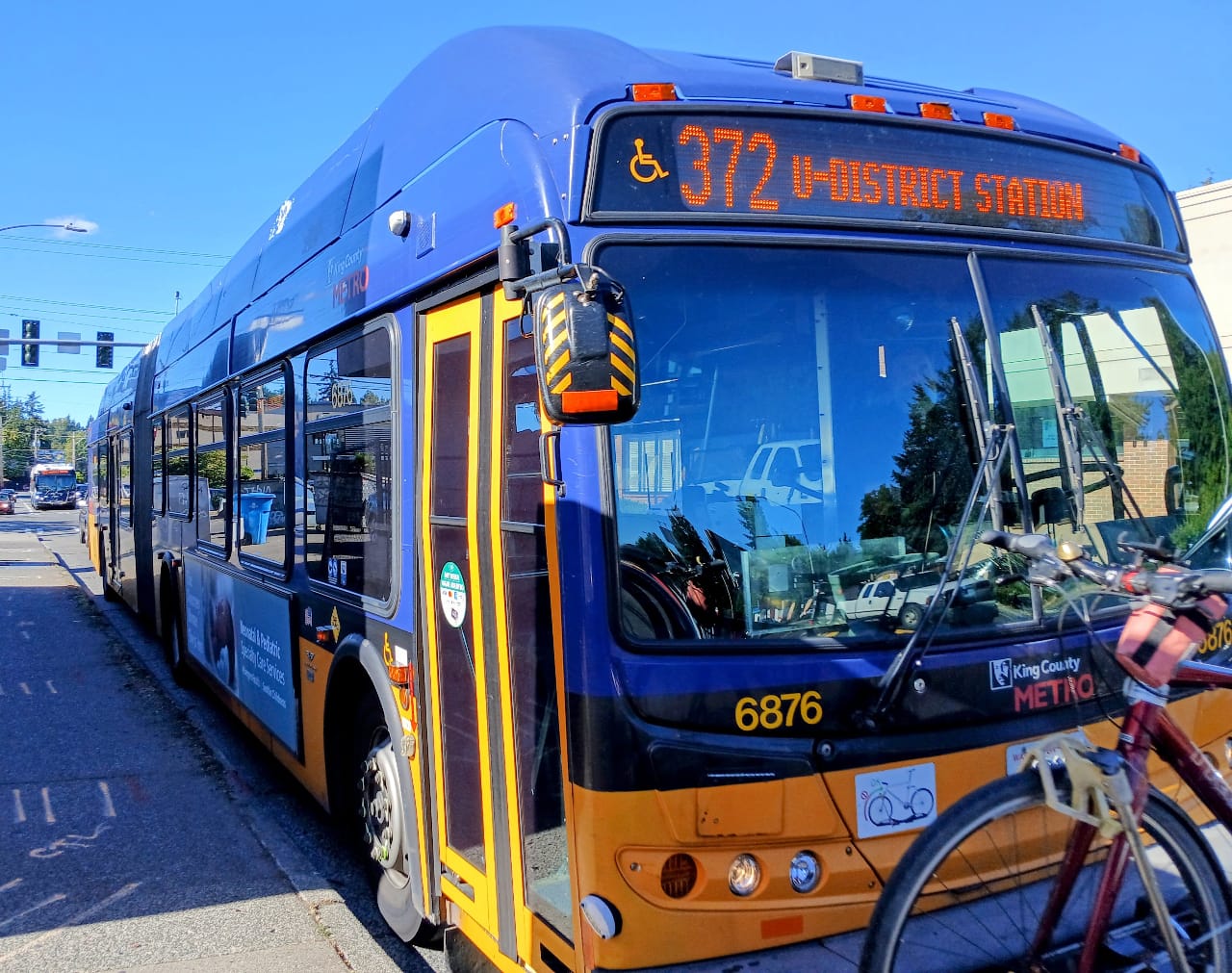
King County Metro is about a month from implementing a major service change across North Seattle and cities along the north shore of Lake Washington, with several new bus routes on deck intended to optimize connections to light rail. But councilmembers in Lake Forest Park are raising alarms around the plan, which they say shortchanges city residents' access to transit and could decrease pedestrian safety by forcing transfers at a dangerous intersection.
On August 29, Metro will implement the third and final phase of its Lynnwood Link Connections restructure, timed to coincide with the conclusion of the FIFA World Cup and the opening of the Pinehurst light rail station at NE 130th Street.
Among the changes: the elimination of the Route 372 between Bothell and the U District, following the creation of the new Route 331 between Kenmore and Shoreline in 2024 and the new Route 72 between the U District, Lake City, and Shoreline that will launch at the same time that the 372 is retired. The Route 331 will be extended to UW Bothell, giving that campus another direct connection to light rail, and that route will run much later into the evening than it did previously.
Full details of the restructure, including exact trip times, have not yet been released by Metro, with that information expected by mid-August.
Metro touts its new network as allowing the agency to offer 43% more trips for riders late at night, 9% more trips on weekdays, and 32% more trips on weekends. But the adjustments certainly come with other tradeoffs, as most broad adjustments to bus networks usually do when agencies are forced to balance frequency and coverage with limited resources.
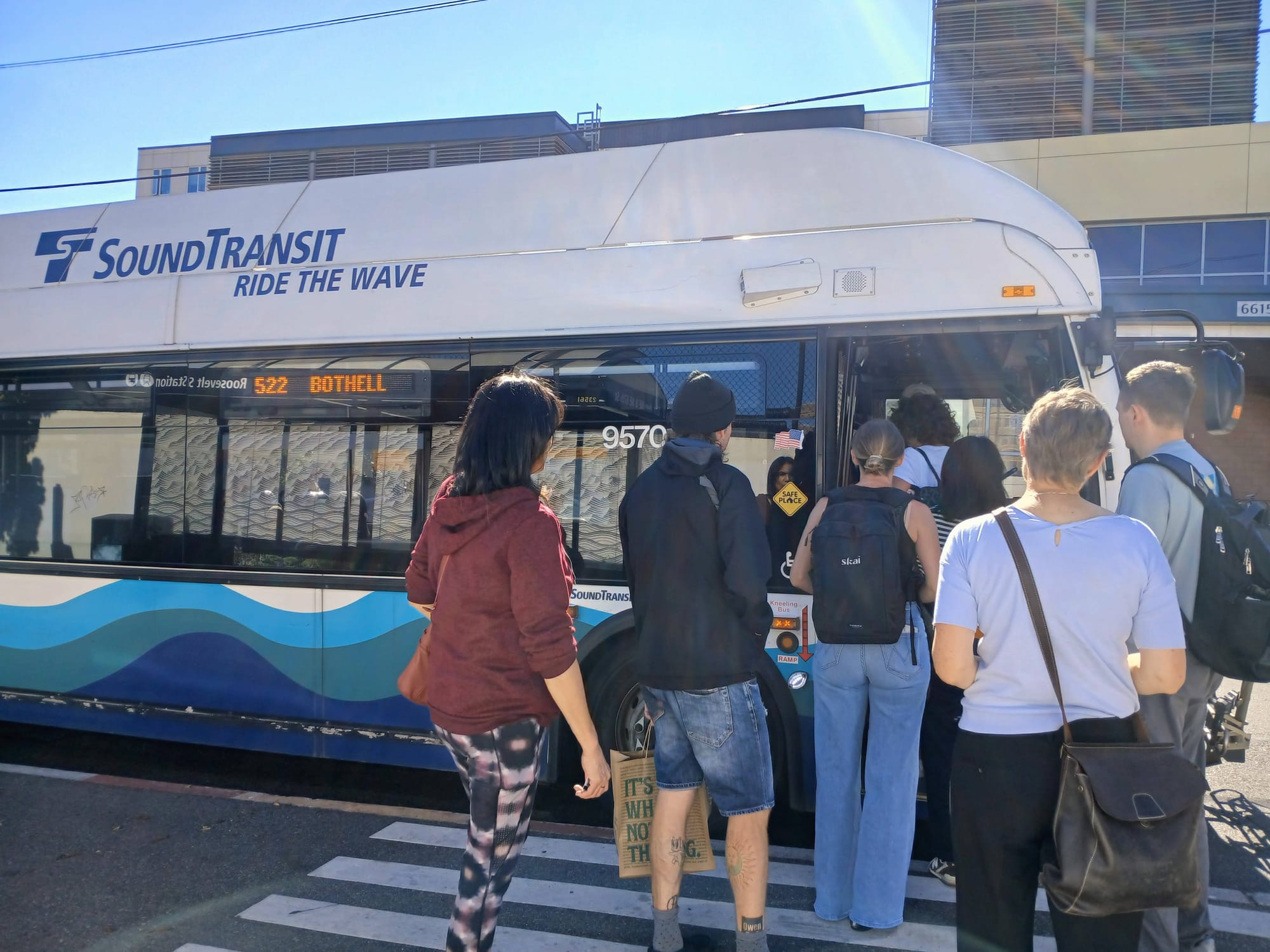
Coming at the same time will be a major change for riders of the Sound Transit Route 522, with a reroute up 145th Street to terminate at Shoreline South Station instead of the current terminus at Roosevelt Station. While that change is an adjustment intended to get riders to light rail more quickly before the under-construction Stride S3 line takes the same route, it also means less direct service between Lake Forest Park and Lake City, especially in conjunction with the loss of the 372. Riders will still have the 322, but that route only operates during peak hours.
Lake City residents around NE 125th Street and points south will also have access to the new Route 77, connecting to both the U District and Pinehurst Station. According to Metro, 85% of the ridership on the 372 today is occurring south of 145th Street, which doesn't erase the fact that it provides essential connectivity to the north as well.
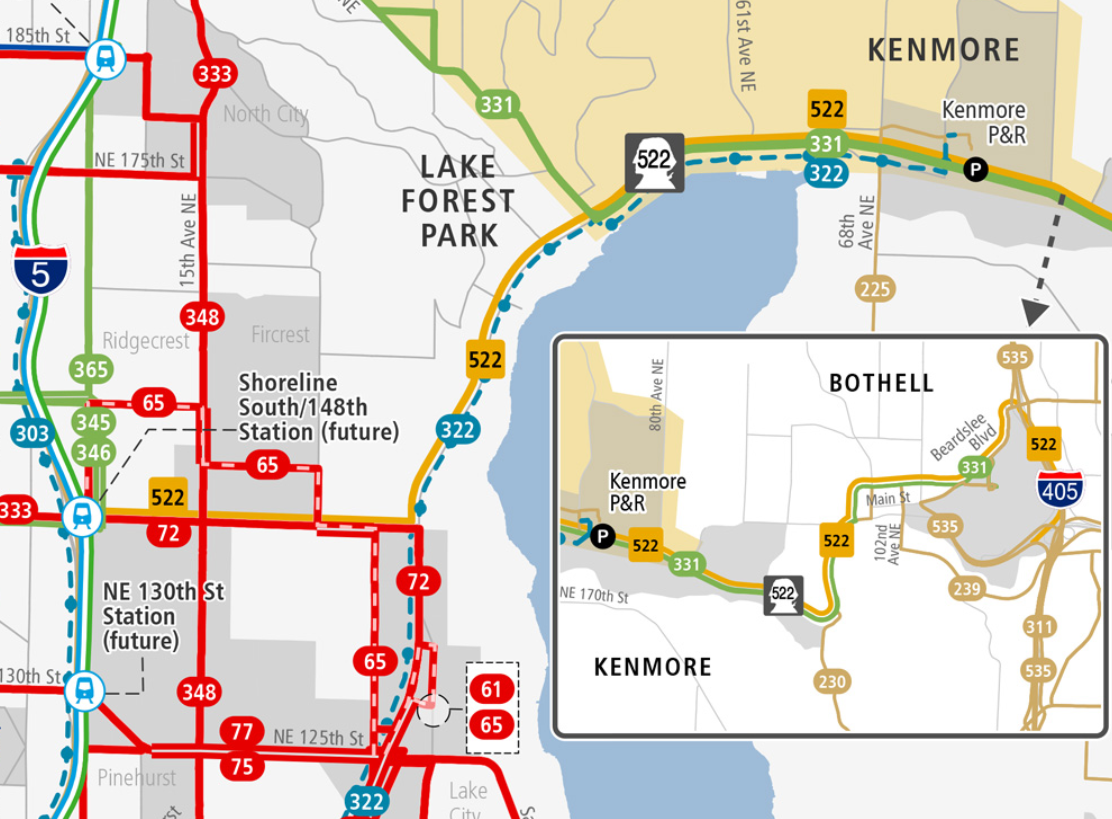
In a letter to Metro approved on June 25, the Lake Forest Park City Council raised a slate of concerns with the service change, including the loss of a one-seat-ride for city residents to the University of Washington.
"Our concern is that, taken together, Metro's and Sound Transit’s changes will leave riders with worse service. Compared to today's service levels on the Bothell Way (SR522) corridor north of 145th Street, Metro's and Sound Transit's proposals will cut frequency in half (from eight (8) buses/hour to four (4) buses/hour) and remove all bus service between Lake City and Lake Forest Park/Kenmore/Bothell (Northshore communities)," the letter stated. "To put it bluntly, asking people to switch from a one-seat trip to a three-seat trip will lead to more people driving and more greenhouse gas emissions which is something that none of us want to happen. This is especially problematic considering that Sound Transit recently implemented paid parking permits at Link stations to discourage people from driving to Link stations."
The letter also raised issues with the proposed transfer environment at 145th and Lake City Way/Bothell Way, where riders heading from Lake Forest Park will have to transfer from the 522 to the 72. Riders won't be able to change buses at the same stop in order to keep heading south, instead crossing a fairly wide intersection along a state highway lacking right-turn-on-red restrictions.
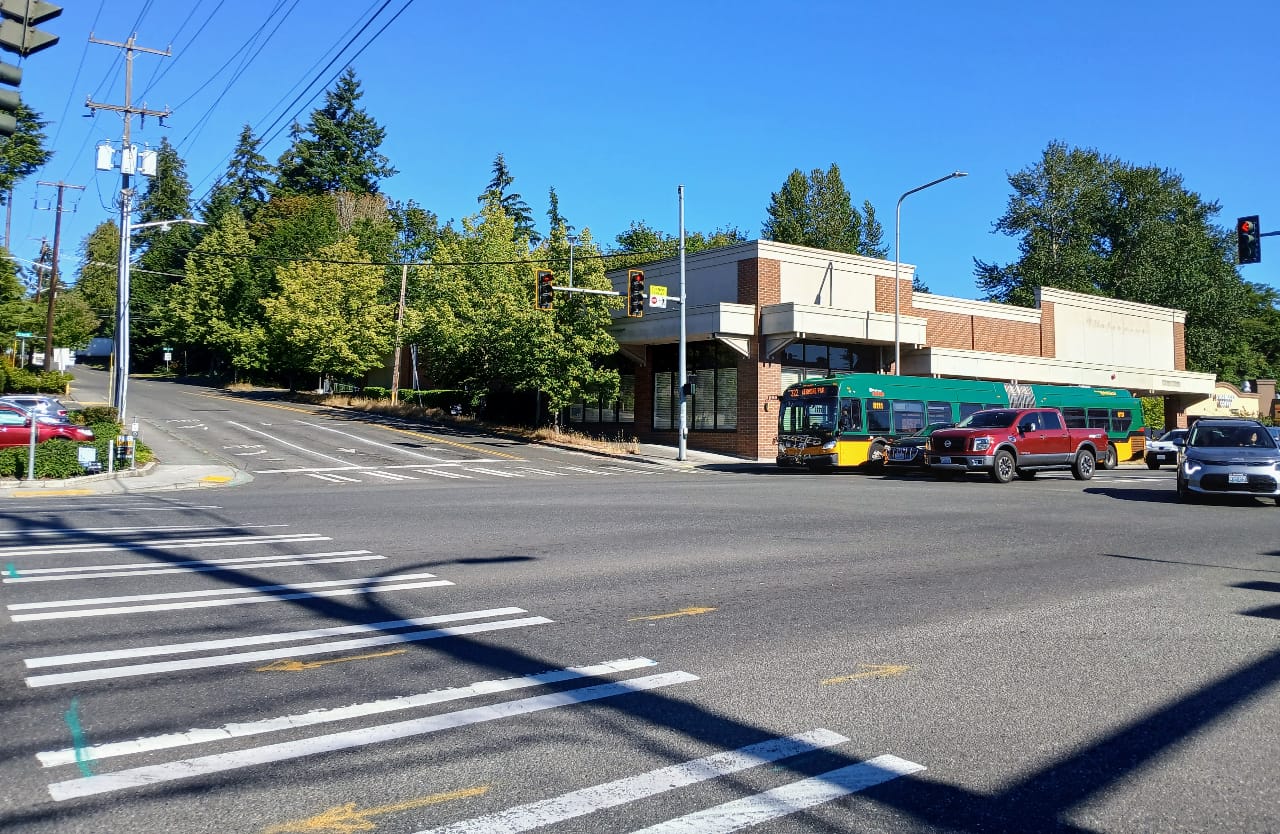
"Right now my daughter would be able to take the bus to school, which seems wonderful to be able to take public transit to school, but with that transfer at 145th and the high volume of accidents at 145th and Lake City Way/Bothell Way – it is one of our more dangerous intersections in general – I do not feel comfortable sending a 14-year-old down there in the winter. I do not feel comfortable sending her down there in the spring," Lake Forest Park Councilmember Semra Riddle told Metro staff at a briefing on July 23. "It seems like an easy thing to do when you're fully mobile, and you're an adult. Engineers totally think it's okay, and in some cases it might be. If it was a quiet intersection, I wouldn't really care. But it's 145th and Lake City Way/Bothell Way, it is not a quiet intersection."
Lake Forest Park officials have also brought up the fact that these service adjustments come at the same time as numerous closures of grocery stores and pharmacies, including the Lake City Fred Meyer last year.
"We have heard directly from constituents who don’t have cars and currently rely on transit for routine errands that will no longer be able to do that once the current bus service is lost," the letter noted. "Microtransit options such as Metro Flex aren’t a solution because many of these constituents don’t live in the Flex service area. Are those residents simply supposed to start taking Uber to get their groceries and prescriptions?
Lake Forest Park became sharply divided over the coming Stride S3 line, with a past city council spending a considerable amount of time trying to get Sound Transit to reverse its plans for a northbound bus lane on Bothell Way. Now, local officials on either side of that issue have become united around the idea of pushing to retain the city's existing bus service.
The letter asks Metro to restore the 372 to its network, but that's a move that couldn't be made in isolation.
"This is one of our longer routes, and more expensive routes," Metro Government Relations Administrator Genevieve Jones told Councilmembers, after noting that the King County Council approved the network change a full two years ago. "And so it would require either finding funding, or potentially taking funding from other transit service."
Seattle voters are set to decide whether to invest additional revenue in supplemental Metro bus service this fall, increasing the size of the Seattle Transit Measure from a 0.15% sales tax to 0.3% in order to add another 100,000 service hours per year across the city. But that funding source won't be able to resurrect an entire route like the 372, especially given the percentage of stops along the route located outside the city. On the other hand, if King County were to pursue a countywide transit funding measure, this corridor would likely be a place where additional service would be considered.
After the Lake Forest Park approved its letter, it was signed onto by the Kenmore and Bothell City Councils as well, with Seattle City Councilmember Alexis Mercedes Rinck, State Senators Derek Stanford and Javier Valdez, and Representatives Gerry Pollet and Davina Duerr also signing on. Groups like the Lake City Business Association, Urbanist Shoreline, the Transit Riders Union and the Nondrivers Alliance have also given the letter their stamp of approval.
"The people really are thinking of this corridor as a cohesive community and making sure that it has that transit service that unites it, that people don't have to get into the car to move through it, or make a transfer across a busy and dangerous road to get there," Councilmember Josh Rosenau told Metro. "So whatever we can do to continue maintaining that connectivity for people on those local trips while we're connecting to the spine for those longer runs."
 Ryan Packer
 Ryan Packer