How Seattle’s permitting system results in inequitable requirements for historically redlined communities.
Seattle’s permitting policies for new housing requires that applicants pay for public infrastructure upgrades within historically marginalized neighborhoods that are not required of applicants in more affluent neighborhoods.
Redlined communities faced policies, including the denial of access to home loans that restricted home ownership and affordable housing. Two current Seattle permitting policies for new-home construction continue this inequitable treatment.
Despite Seattle’s official commitments on racial justice and social equity, inequitable outcomes are embedded within the sidewalk and water service policies and fees associated with new home construction. The outcome for many marginalized communities is increased costs, which could exceed those in more affluent communities by $350,000 for the same type of project.
Seattle’s sidewalk policy
The Seattle Municipal Code has a two-tiered sidewalk policy. The code gives relief for housing projects outside of Urban Centers, while no such relief is afforded to the projects within. This relief applies to projects of nine units or less. For those small projects required to install sidewalks, the cost can be upwards of $100,000.
Since Seattle has designated the lion’s share of its Urban Centers in historically “red-lined” communities, there is a social equity disparity that is reflected in the Seattle Sidewalk Code. Relief is provided to more affluent communities, however no such relief to historically marginalized communities.
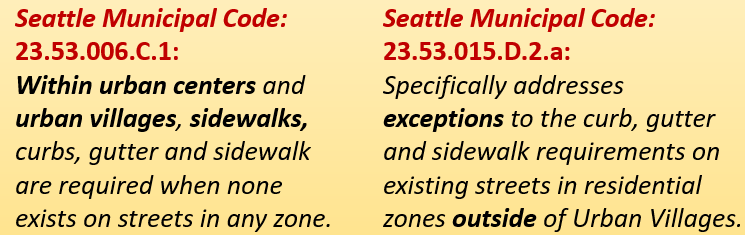
A better solution may be to change the Seattle Municipal Code to allow the option for payment of a reasonable fee-in-lieu-of sidewalk construction. This will facilitate equitable relief regardless of the location of the project within the City. The money collected could be applied to areas of the city with the highest need for sidewalks.
SPU’s costly water value requirement
Another disparity appears in Seattle Public Utilities’ (SPU’s) water-service policy WTR-440. It applies to a water main that runs primarily through historically marginalized communities and is installed within Beacon Avenue and extends north and continues under 21st Avenue S.
The policy requires permit applicants whose property is on a street where the supply main is located to pay for and install a large valve at a total cost around $250,000.

Furthermore, Seattle’s supply main is located within communities that are also designated as Design Review Equity Areas. Outreach to these communities is required to ensure that they have a meaningful voice in projects affecting them. These Design Review Areas coincide with historically redlined areas.
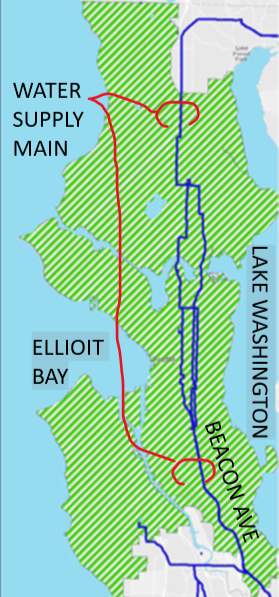
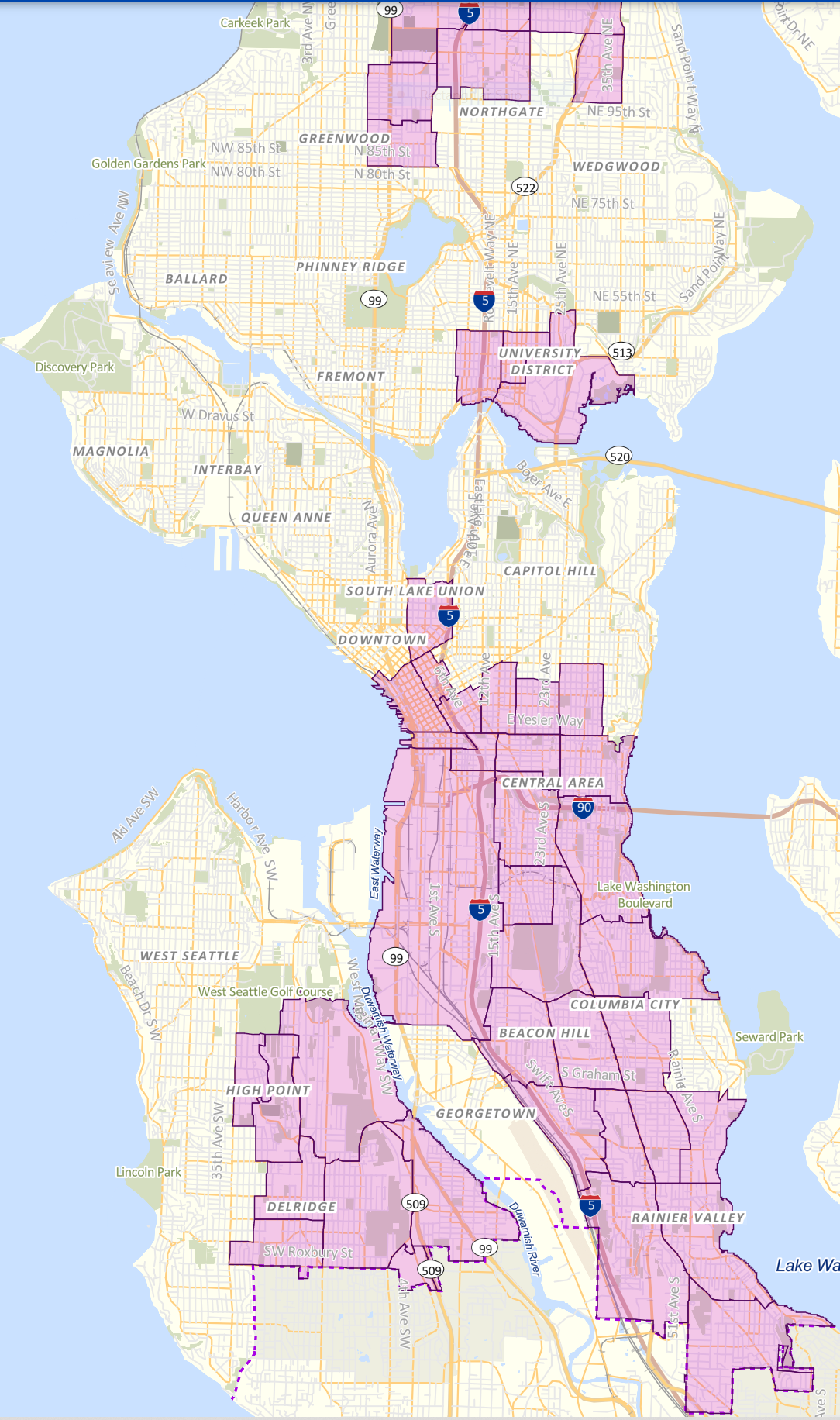
Seattle’s primary water supply main runs through areas of social and economic disparity within the city. Seattle’s Design Review Equity Areas coincide with historically redlined communities. (City of Seattle)
One neighborhood in the North Rainier Urban Hub, has seen five small housing proposals unable to proceed. Numerous projects along Beacon Avenue have come to an abrupt halt once the project proponent is informed of the valve requirement. Small projects have no economy of scale to pay the $250,000 estimated cost. Small-scale homebuilders are not suited to perform major public works water system upgrades and the end result is unrealized housing and ongoing social inequity.
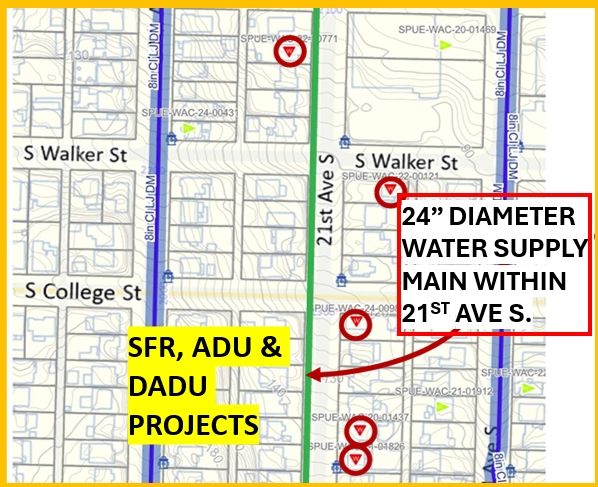
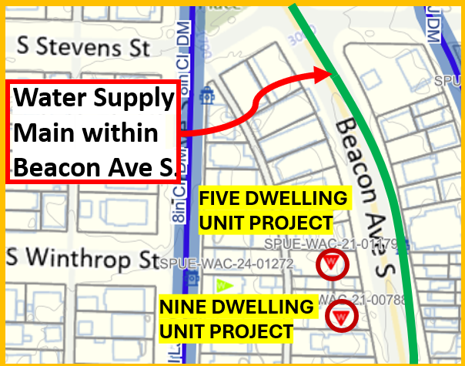
Water valve requirements are killing many projects including five projects (shown left) encompassing 19 dwelling units along 21st Avenue S and two unsuccessful projects (shown right) along Beacon Avenue S. (SPU, edited by Donna Breske)
A symposium to discuss permit barriers
Not all permitting barriers include a social inequity component. Moreover, permitting policies that affect housing outcomes do extend beyond Seattle to many jurisdictions throughout the Puget Sound region.
Barriers run the gamut and include storm water policy, road network, strict floor area ratio requirements that limit housing capacity, critical area interpretations, and more.

Learn how permitting policies throughout the region are affecting housing production and join in on the conversation to find solutions by attending my Permit Barriers Symposium on October 15 at Seattle University.
As an Urbanist reader, you are offered a 50% discount
Use the Code: DBINVITE50 to secure the 50% discount
Get involved and become part of the conversation.
 Parker Dawson