Next year will mark Jay Worley’s 15th year since they last experienced homelessness.
The Gig Harbor-based Worley is a longtime disability and homeless rights advocate. They also worked to help create Pierce County’s new Unified Regional Approach to Homelessness (URA), a recently-proposed plan meant to better coordinate homelessness response in Pierce County and substantially reduce homelessness across the county.
Worley, who served on the governance task force for the URA, is heartened that the URA exists at all. It means progress towards countywide coordination, which didn’t exist before, and may be able to help people more easily access the help they need.
Other advocates The Urbanist spoke with shared Worley’s view that the URA is a good start, and said that they welcomed it. But Worley and other advocates also expressed their misgivings, with concerns ranging from the plan’s governance structure and accountability framework to a lack of complete data from which to work. It remains to be seen whether the framework is strong enough to galvanize Pierce County to action to make a real dent in homelessness.
The path to a regional approach
Following an assessment by Uncommon Bridges, a Seattle-based consulting firm, Pierce County first proposed the idea of a URA in 2022. A combination of community members, Pierce County staffers, and representatives from Pierce County jurisdictions worked together across five different working groups, including three task forces, to come up with the plan’s structure, which the Pierce County Council introduced this year and passed in a 5-4 vote on June 9.
Uncommon Bridges recommended that Pierce County helm the initiative, and the county wrapped up its work with Uncommon Bridges about six months earlier than expected.
Unlike the embattled King County Regional Homelessness Authority, which is an independent authority created via an interlocal agreement between the City of Seattle and King County, the URA is not meant to be a direct service provider. As a Pierce County-run system, it is meant to operate with oversight, and relies on data-sharing and collaboration between jurisdictions and providers to coordinate services and contract with individual providers. The system requires financial buy-in from jurisdictions to function.
Because the system is voluntary, and no jurisdiction has to buy in if it doesn’t want to, the County has yet to nail down exact amounts each jurisdiction interested in participating will need to pay. For instance, Gig Harbor — whose leaders helped to create the plan and expressed an interest in joining — may have to pay an annual fee in the range of $5,000 to $9,000.
Gig Harbor is a small city, with just over 13,000 residents; the fee would increase for larger cities, with Tacoma’s population 17 times greater than its neighbor across the Narrows. County staff have noted that the methodology for coming up with price points for each jurisdiction needs work, and they have yet to zero in on improvements.
Hitchen said that the County is still discussing the methodology. It “will be part of the conversation we will have at our next elected leadership group meeting. We used population as a way to calculate the shared costs, but there continues to be conversation about how best to support smaller communities joining, and how best to capture enough revenue to cover the staff while not pulling too much for any one jurisdiction that might use funds to provide services.”
Before and after passing the URA, Pierce County Council Chair Jani Hitchen (District 6) has been working to try to raise support for the plan. She wrote a 2024 County blog post about the URA, explaining its ins and outs.
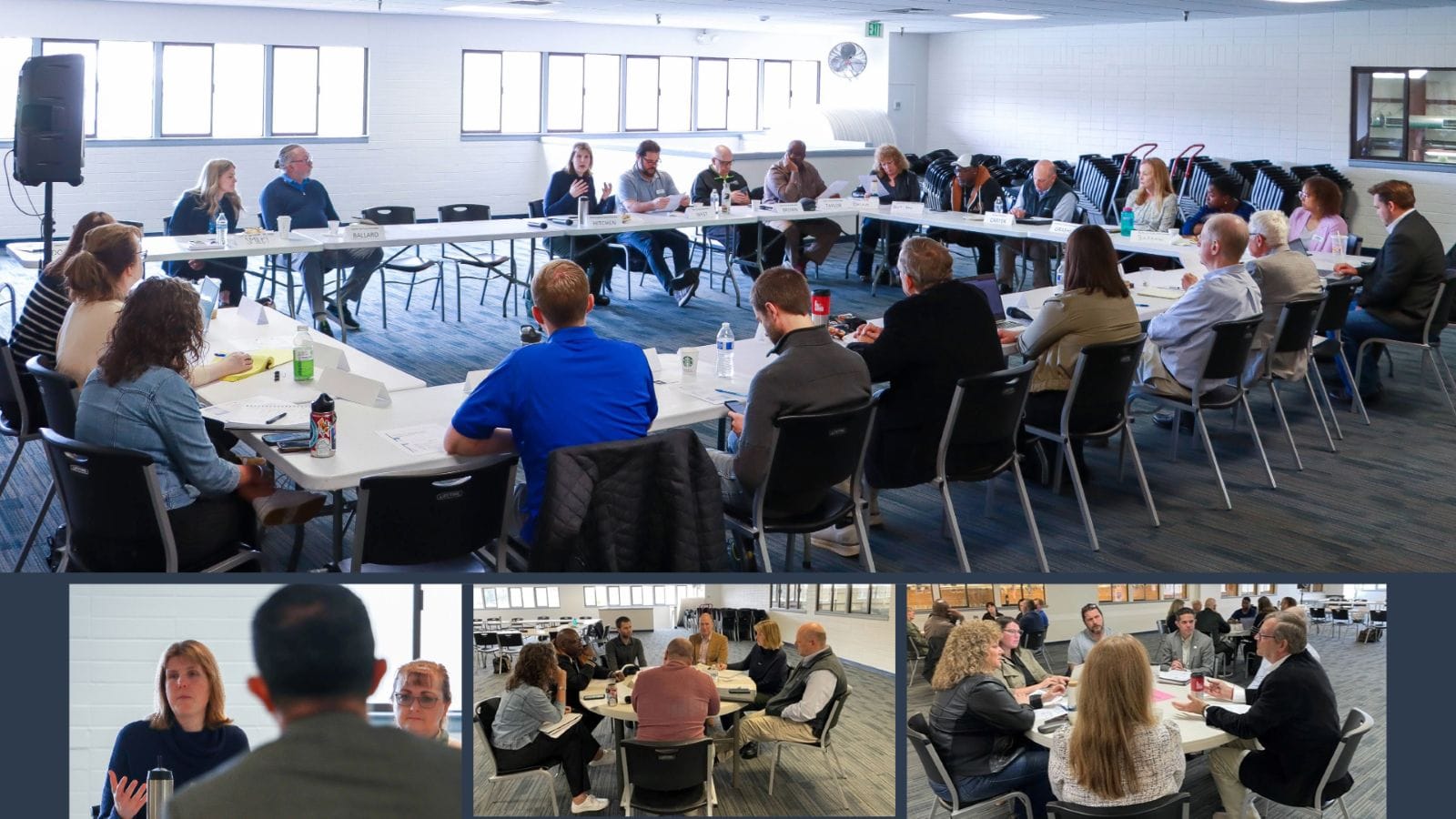
In the post, she gave an example of a person who lives in Frederickson, but has to flee a violent situation with their two children. They end up in Tacoma, because that’s where most of the homelessness services and service infrastructure in Pierce County are concentrated. But their entire life, including their job and community, are in Frederickson.
“The system should be able to help keep them safe AND help them get back to the Frederickson area if it is safe to do so,” Hitchen wrote. “It is about no wrong door in Pierce County. It is about helping people where they are, and if we can’t because that area doesn’t have those services, we work together to provide services and get them back to their original community when the crisis is over. It should be able to move swiftly in a crisis like a weather event, or if a funding opportunity comes up. It should be able to tell providers exactly where we have openings for shelter anywhere in the county, in real time. It should be able to know where gaps are, where resources are and where opportunity for improvement might be.”
Data gaps
But it’s the spotty data that all of this relies on that concerns Kenneth King, a longtime advocate and behavioral health provider who sits on the county’s Continuum of Care governance board, and who participates in countywide Homelessness Management Information System (HMIS) case coordination efforts as well as inclement weather emergency planning sessions. King also experienced homelessness when he was a teenager.
King is running for the Pierce County Council’s District 1 seat. Republican County Councilmember Dave Morell is vacating that seat, because he is not eligible for a third term due to Pierce County’s term limits. District 1 stretches from Auburn to Orting all the way east to the Yakima County border. It’s long been a Republican stronghold, with Democrats not even fielding a candidate in 2022. But Democrats are hoping to make inroads in 2026, with Trump backlash driving turnout and dragging down the Republican ticket. King hopes to be the Democrat to flip the district.
King said the URA framework is “a critical step forward” that “spreads out the actual tools we use in the field … creates new [accessibility] paths for our housed and unhoused community members, who shouldn't be forced to travel 30 miles from places like East or South County into Tacoma just to ask for basic, stabilizing services. [It] forces a shared baseline.”
But jails and hospitals — including mental health and substance use inpatient facilities — do not participate in coordination discussions. Neither behavioral health programs nor legal programs are considered homelessness services, but both courts and hospitals “constantly connect people to ongoing housing and resource services, such as post-release Oxford [Houses, a kind of independent recovery house], or [other] recovery houses,” King said. “Even if that person gets kicked out and lives on the streets, it's not recorded.”
This, in turn, affects the data the County is relying on for the URA’s implementation. King himself only sees this happening because he is a service provider who works with people experiencing homelessness. If he were not, he said, he would not see the gap.
“[They are] never connected to the rest of the system. And then what we have is an entirely different dataset because these are not isolated events, but something that actually happens quite often” to people experiencing homelessness, King said, referring to things like overnight emergency hospital stays or stints in jail.
King pointed to other potential flaws in the overall data collection system, saying that the HMIS is a fairly new, siloed system and that the data regarding schoolchildren experiencing homelessness (such as McKinney-Vento Act data) isn’t automatically collected and added to the larger regional data pool. He also said that service counts are almost entirely based on where services are actually available. This means that if a jurisdiction doesn’t fund services, “your service counts will falsely tell you nobody is there.”
“For a long time not every community or provider used the HMIS system. Part of the commitment for any jurisdiction to be part of the URA is that they will commit to using HMIS as their data system for any project, program, provider or staff entering contacts with unhoused community members,” Hitchen said in an email. “If we are ALL using the same system and are all trained to use it well, we will increase the accuracy of the data. However, there are members of our unhoused community that actively avoid or refuse to engage, that number is something we have to utilize observation, word of mouth and our street outreach teams to try and capture.”
Moreover, he said, most of the time, the only data a community ever sees is a Point-In-Time (PIT) Count of homeless people. While those counting efforts have become more accurate and effective, he said, “the reality is still flawed.”
“[In 2022], the county released the PIT count with an actual count and a separate estimated count for the first time, because the county momentarily recognized and admitted that the undercount was simply far too large to ignore,” he continued. “We cannot build an effective regional response on numbers we know are fundamentally incomplete.”
The County has not since released an official estimate of people experiencing homelessness in subsequent years — but last year, an outreach manager with Tacoma’s St. Vincent de Paul told councilmembers that he believed there were at least 10,000 people experiencing homelessness in the county. In contrast, the official PIT count last year was 2,955 people.
“The Point-in-Time Counts are historically an undercount, because they are just a snapshot in time and don’t paint the full picture of homelessness. We use data from our Homeless Management Information System (HMIS) that is collected year-round to understand the realities of homelessness in our community, which is the higher number Jake mentioned that is four times the PIT count,” said Kari Moore, a Pierce County spokesperson. “The PIT Count data is collected just one night, but we have many more people that experience homelessness at some point throughout the remainder of the year. That is why the PIT Count is considered an undercount.”
King pointed to yet another problem in getting people into the system: the lack of infrastructure for providers in outlying areas of Pierce County, combined with a lack of buy-in from jurisdictions.
In his work, King has often encountered jurisdictions that are too jaded by the current system to muster any confidence in a new one. All Pierce County jurisdictions already pay the Behavioral Health Sales Tax, he said, noting the perception in outlying areas that they see little benefit from it, because so many services and service infrastructure are concentrated in and around Tacoma. Any services that exist in outlying areas are often privately funded through churches and organizations like FISH.
“The countywide services don't exist over there. So what we have is the county contract team won't go over there because they don't have an office over there to use as ground zero,” he explained of jurisdictions further from the center of Pierce County government. “This is what we're seeing over in Bonney Lake and in Spanaway. […] If we were actually spreading out the resources instead of centralizing them … there would be an actual spot for them to drop off over there and do their documentation while they're over there, or a closet where they can pick up outreach supplies — all that little stuff that would make them more incentivized to spend more time out there and not having to go back and forth to reset every time.”
In some communities, the dearth of homeless services appears intentional, with some hoping that keeping service providers out would also help keep out homeless people in a sort of scorched earth policy. The debate surrounding Bellevue’s men’s shelter is a recent example of this. Worley said that some legislators' constituents, particularly those concentrated in wealthier areas, have long pressured their electeds to prevent robust social services and supportive housing from coming to their communities.
Political winds
URA governance task force committee member Sally Perkins told The Urbanist that she supports the URA, but that she sees a serious problem with the structure. Perkins has worked with people experiencing homelessness in Tacoma’s Hilltop neighborhood for the last six years and has repeatedly voiced her concerns to the county council.
Perkins told The Urbanist that because Pierce County controls the URA, any change in political leanings of the council could wipe out the URA.
“One council seat flips and the whole thing falls apart. Executive’s job flips, the whole thing falls apart,” Perkins said. “We are a purple county and nobody should kid themselves for a minute that we are not a purple county. And so the back and forth is razor thin.”
The County’s control over the program also leaves the door open for what Perkins called in a document the County’s “genuinely helpful” willingness to administer the URA to slide into control.
In addition to hiring and supervising the program’s director, the County is in charge of administering the organization of the URA and employing its staff. But there is no one to hold the County in check except for itself. Asking any entity to hold itself accountable is a tall order, she said, regardless of good intentions (which she believes they have). Based on her involvement in creating the URA, Perkins does not believe the County has fully considered the implications of an entirely County-controlled plan.
“Intentions, in the end, won't be a firewall around governance. … Even if the board advises on who the [URA] staff people are going to be, the staff people are still working for the County. It's pretty hard to avoid that,” she said. “The County also staffs the Continuum of Care. They staff the implementation advisory board. They staff everything.”
“I think the current homeless service staff at the County is pretty darn good. I think they're great to work with and I think they do good work,” Perkins continued. “Do I think they are going to do the kind of rigorous accountability work that I wish they would do? No, I don't. And partly they don't have time and partly they've taken a very relational approach to working with people. And that's wonderful. You have no idea how nice that is. It's really great to work with them. But it also means that it's painful to hold somebody accountable if your goal is to have a good relationship with them. And so it makes it, it just creates a little bit of a disincentive to be rigorous in accountability.”
In a document she submitted to the County, Perkins asked another critical question that she argued must be answered before any interlocal agreement is signed: “If the URA board directs the URA to do something that Pierce County disagrees with, what happens? The current design does not answer this.”
“That type of decision will be ironed out in the upcoming Interlocal Agreement (ILA),” Hitchen said in an email to The Urbanist. “I know we have talked about it, but it is hard to plan for hypotheticals in this space until we have a firm idea of what decisions the Board is making, the Director is making, and any other feedback the URA staff will be provided. However, it will have to be clearly outlined in the ILA so that the URA and the county know what to do in such a situation.”
Losing community focus
Worley said that their biggest concern with the URA is that they have seen the internal governance board “bickering” about itself and its structure, and that most of the issues revolve around money and how much any one jurisdiction is going to pay — even though, Worley said, “there isn't ever going to be a right answer. And it is definitely the best way to stop something from going forward.”
While seeking to tighten up data protocols and gently encourage countywide collaboration is nice, advocates like Worley pointed to the fundamental issue of needing more investment in homeless services and housing — and some residents being reluctant to support that.
“We're still having talks in this realm and everybody's forgetting about the veteran that needs a home today. Those conversations don't help that veteran or the others that we have or the grandmother that couldn't afford the retirement community or the mom who just lost her husband and lost her house at the same time,” Worley said. “Those people can't afford for our elective officials to be bickering at each other because the constituents that have money don't like the idea of helping homeless people.”
Another fundamental obstacle is the othering of homeless people, which has enabled policymakers to leave the issue on the backburner for so long.
“And that's where my concern is. Each homeless person is also your constituent. Each homeless person has a job, or had a job. Each homeless person has done something to contribute to the whole. And now it's really time for our elected officials to contribute to us when they haven't before,” Worley continued. “When we start seeing our homeless as our community — and I'm talking about our elected officials — until that person on the corner is your cousin or that person that's hiding in the woods is your sister, until you recognize those faces as people, you can't really design a system to support them.”
In order to do this, they said, politicians should “simply stop getting bought. You are in a position and you got elected because you want to be a voice for a whole community, not the ones that could afford to put you there."
“Almost every elected official has become an elected official for one of two reasons,” they said. “They either want their name in big bold type to look good, or they have a calling to do service [for the] community. And I would like to believe that every one of our elected officials are sitting in a seat because they are answering the call to service, not the call to their pocket.”
 Amy Sundberg