As voters receive their ballots in the mail and the August 4th primary draws near, a few progressive candidates challenging Democrat incumbents have been catching the public’s attention. One race in particular, in North Seattle’s 46th Legislative District (LD), drew not one but two challengers to long-time Democratic legislator Gerry Pollet.
While Pollet first ran for, and lost, his seat in 2008, he has been serving in the state house since he was appointed at the end of 2011. Since then, he has enjoyed the incumbent’s advantage while making a name for himself as both a tenacious advocate for education and a thorn in the side of urbanists due to his opposition to zoning reform and his weakening of a key accessory dwelling unit (ADU) bill.
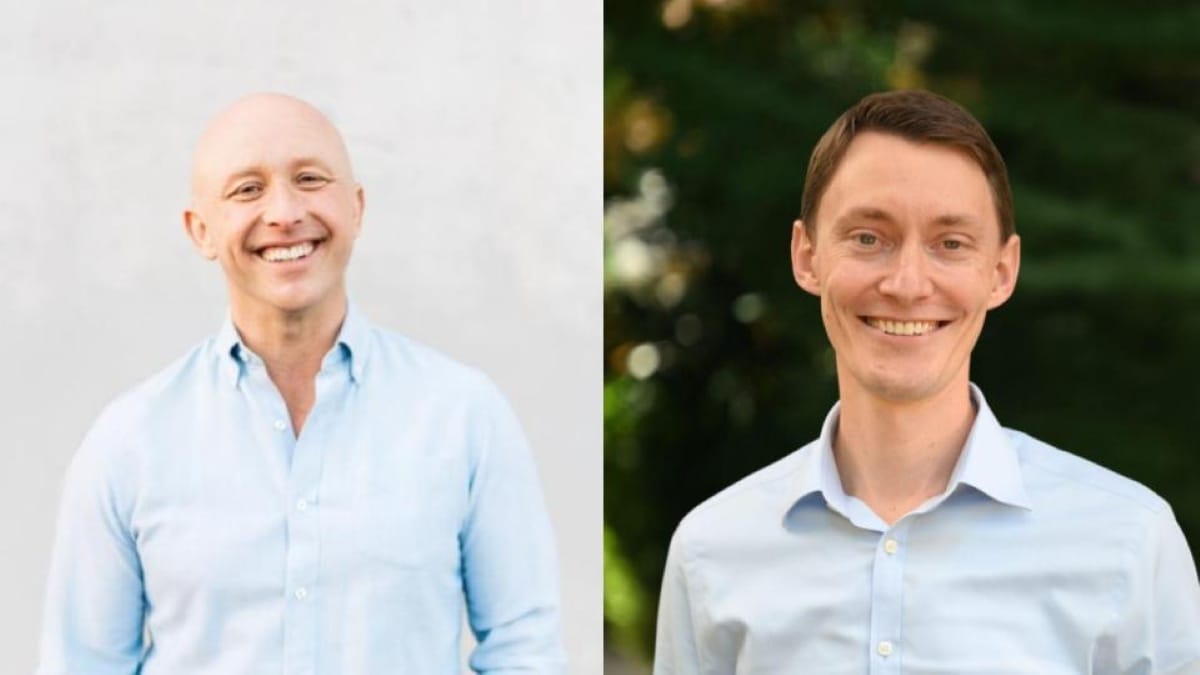
Ron Davis, the unabashed urbanist who features regularly on local op-ed pages (including our own) and narrowly lost the 2023 race for Seattle City Council District 4 to Maritza Rivera, stepped forward to challenge Pollet earlier this year.
Later in the spring, a second challenger stepped forward: Will Dreher, an attorney who moved to Seattle in 2019 and is now in private practice. Dreher has been making waves since he filed, both due his past clerking for then-District Judge Brett Kavanaugh (since a Trump appointee installed on the U.S. Supreme Court) and beginning his tenure at the Department of Justice (DOJ) during the first Trump administration, and for the large amount of out-of-state donations his campaign has been receiving.
“What the new thing is this year is how many [challenges of incumbents within the Democratic Party] there are, and it's an unprecedented number that are so well funded, that are running serious campaigns,” Dean Nielsen, founding partner of CN4, a political consulting firm, said at a recent forum at The Rabbit Box. “This Will Dreher guy comes out of nowhere and raises $280,000 in five minutes. I mean, Ron Davis, who has been a fixture of Seattle politics, raises $150,000 or so. I mean, these are real challengers.”
In a surprise twist, The Stranger, often considered to be a local “kingmaker” of sorts for political candidates running in the progressive/left lane, snubbed Davis, who it had endorsed in the 2023 Seattle City Council race, and gave its endorsement instead to new kid in town Dreher, writing, “He’s a fed, but we think he should be our fed.”
The Seattle Times gave its endorsement nod, which typically cements the moderate/business lane candidate, to incumbent Pollet.
Meanwhile, The Urbanist gave its endorsement to Davis, as did Seattle Mayor Katie Wilson. (The reporter of this piece does not serve on The Urbanist’s Election Committee.)
“With Dreher a black box on many issues and potentially a carpetbagger with more support outside the state than inside it, why gamble when the race already has a proven progressive?” wrote The Urbanist Elections Committee. “We know that Davis is deeply familiar with and committed to urbanist issues, and that in the legislature he will walk the walk, bike the bike, drive the bus, and fight to put roofs over more heads. Vote Davis.”
Pollet did not reply to The Urbanist’s request for an interview for this piece. Dreher’s campaign told The Urbanist he’d be “happy to sit down and chat” after the primary, which would be long after this article’s publication date. Dreher was also given the option to respond to questions via email but didn’t respond.
Dreher’s bid for office
While Pollet is a known quantity both in his Seattle district and in the state legislature, Dreher is a bit more of a cipher. Since announcing his run, he hasn’t appeared to give substantive interviews to any of the regular local media establishments, although he did talk to Seattle Times columnist Danny Westneat about his time prosecuting January 6 rioters in Washington DC.
Dreher made news early after his election bid due to a letter of support for Kavanaugh he and other former Kavanaugh clerks wrote during the U.S. Supreme Court judge nomination process. The letter was written before Kavanaugh was accused of sexual assault, and Dreher later signed onto a second letter supporting an FBI investigation of the allegations.
Some critics have questioned the fact that Dreher clerked for Kavanaugh in the first place, which has led to a debate about how much choice law students at top schools have in their clerkships.
Not in question is Dreher’s career decision to join the DOJ under the Trump administration in 2019, which was two years after President Donald Trump signed the executive order instituting the so-called “Muslim ban.” Dreher’s choice to sign onto the second letter suggesting an investigation of Kavanaugh’s behavior did not prevent the DOJ from hiring him the next year.
In contrast, Seattle City Attorney Erika Evans, who has endorsed Dreher, did not join the DOJ until 2021 after President Joe Biden had taken office. She quit her position soon after Trump resumed the office in 2025.
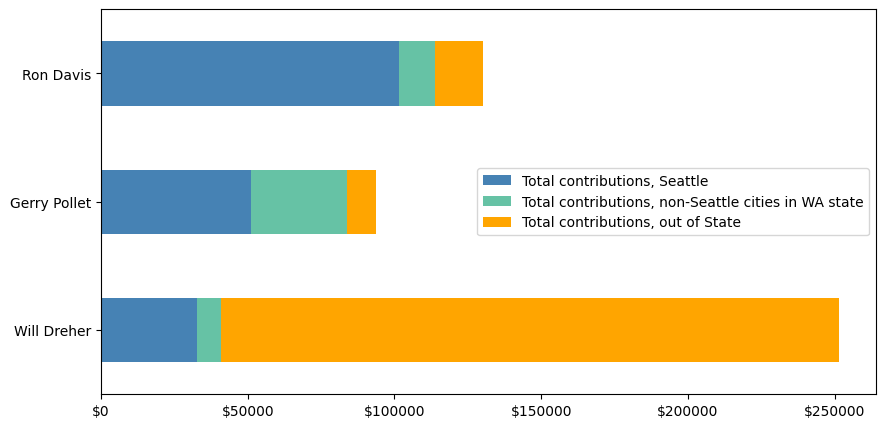
As of July 20, Dreher had raised the most money of all three candidates for the state seat with a war chest of $267,000. Davis was next in line, having raised $156,000, and Pollet was lagging slightly behind at $134,000.
Critics have also highlighted that most of Dreher’s contributions have come from outside Washington state: about 80% as of the end of June. A noticeable number of Dreher’s contributors are employed by big AI tech companies, particularly Anthropic. In contrast, the bulk of Davis’s contributions come from Seattle residents.
It’s undeniable that big money plays a sizable role in politics, with more contributions leading to more opportunities for candidates to communicate with voters, whether that be through mailers or broadcast advertising.
The Sightline Institute looked into campaign finance back in 2016, finding that the bulk of donations for Washington state legislative races came from Seattle and Olympia, even for seats in other parts of the state.
“Candidates devote much of their fundraising time to talking with big donors in the dark green and orange-outlined zip codes, leaving less time to talk to their own constituents,” Kirstin Eberhard and Margaret Morales wrote on the Sightline site.
The concern when large amounts of donations come from out of district, whether that be elsewhere in the state or from other states altogether, is that the candidate will ultimately feel more beholden to the people who donated to their election rather than the people they were elected to represent.
As for why so many Anthropic employees have been donating to Dreher, The Washington Observer wrote an article later reprinted in Post Alley saying Dreher’s platform highlighting state-level AI regulation drew the attention of Eric Neyman, a researcher at the Alignment Research Center, which works to “align future machine learning systems with human interests.”
Neyman lives in California and is a regular poster on Less Wrong, a rationalist forum closely linked with effective altruism, longtermism, and the whole TESCREAL bundle as coined by moral philosopher and historian Émile P. Torres to describe the techno-utopian Silicon Valley worldview that he says is the “eternal return of eugenics.”
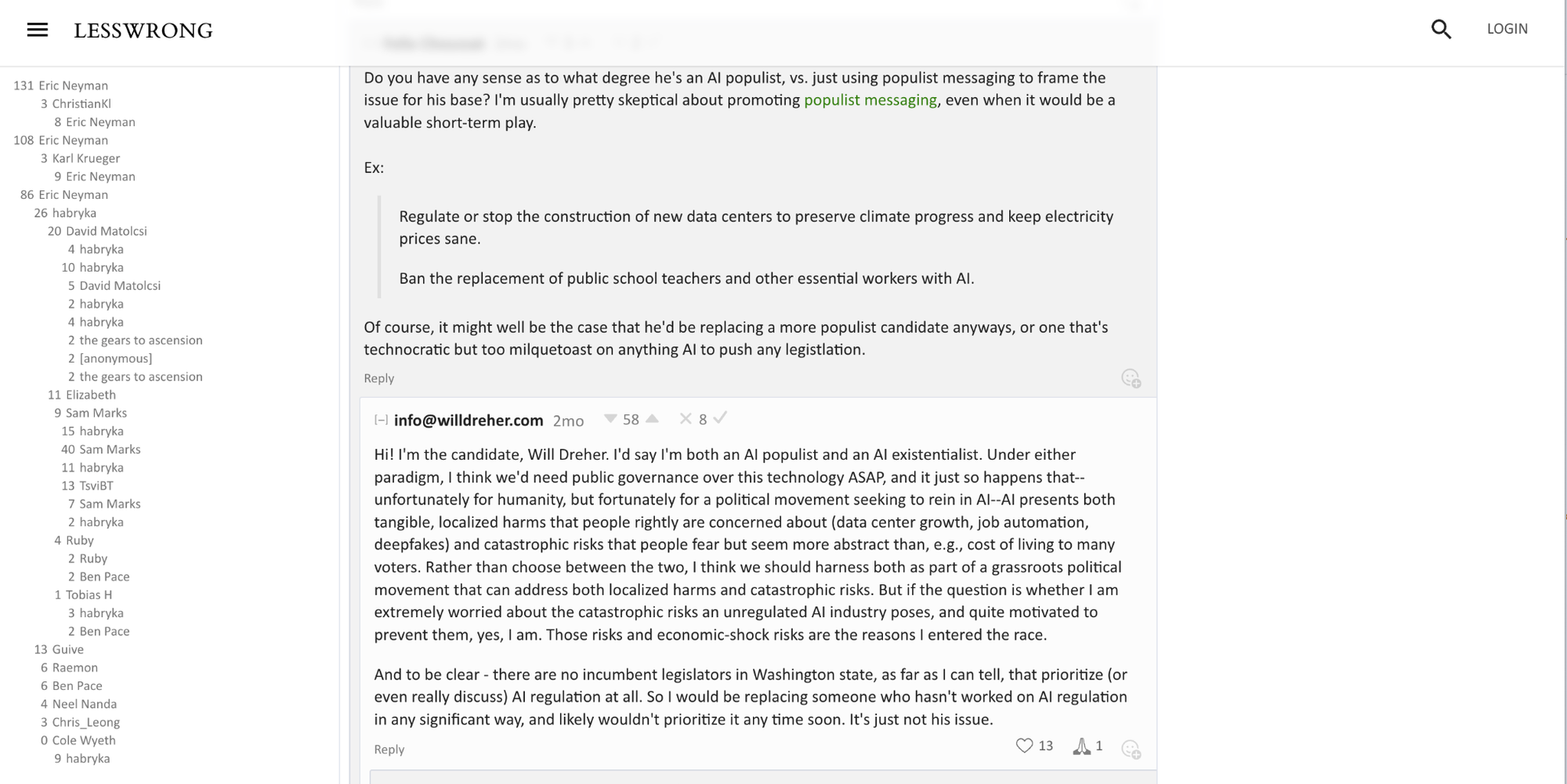
Neyman posted on Less Wrong encouraging others to donate to Dreher, writing, “I think that Washington is one of the more important states for AI regulation, as a number of AI companies have big offices there. So I'm excited to have an AI safety champion in the Washington legislature.”
Dreher himself popped up slightly downthread from this recommendation. “I'd say I'm both an AI populist and an AI existentialist,” Dreher wrote. “Under either paradigm, I think we'd need public governance over this technology ASAP, and it just so happens that--unfortunately for humanity, but fortunately for a political movement seeking to rein in AI--AI presents both tangible, localized harms that people rightly are concerned about (data center growth, job automation, deepfakes) and catastrophic risks that people fear but seem more abstract than, e.g., cost of living to many voters. Rather than choose between the two, I think we should harness both as part of a grassroots political movement that can address both localized harms and catastrophic risks. But if the question is whether I am extremely worried about the catastrophic risks an unregulated AI industry poses, and quite motivated to prevent them, yes, I am. Those risks and economic-shock risks are the reasons I entered the race.”
At the same time, Anthropic has been pushing for state-level legislation that addresses “catastrophic” AI safety risks, including scenarios that include AI causing financial and infrastructure disasters or mass deaths. However, as Wired reported, Anthropic hasn’t been so aggressive about pushing for regulations around issues like data centers, lost jobs, and the harm caused by chatbots.
In his endorsement questionnaire for The Urbanist, Dreher listed his top legislative priority as “regulating artificial intelligence and social media companies.”
Numbers 2 and 3? Early literacy interventions in public schools and progressive tax reform, and he listed a number of new taxes he supported, including a corporate income tax and a tax on new data centers.
Davis claims that in The Seattle Times endorsement interview, when asked about closing the state budget deficit, Dreher’s only answer was to make cuts, whereas Davis wants to tax the rich and close the gap that way. Unfortunately, The Urbanist was unable to hear Dreher’s side of the story before publication, as he declined to interview or comment.
After publication, Dreher did reach out to clarify, claiming Davis had greatly misrepresented what he said in the Seattle Times endorsement interview.
"In that answer and interview, I discussed fixing our regressive tax code, including through new progressive taxes and switching from our state's B&O tax to a corporate income tax," Dreher said in an email. "I also mentioned that some new progressive taxes, like the Millionaire's Tax, are not or may not be immediately effective. In my Urbanist questionnaire, which is public, I discuss several new progressive taxes I would support depending on the need, including a corporate income tax, eliminating the Advanced Computing Surcharge cap, and an income tax or, if that is deemed unconstitutional, a statewide payroll excise tax. That was written before the Seattle Times interview. I've said the same on my website, where I also discuss a tax on AI."
Davis presents himself as a progressive fighter
Accusations have been flying that Davis is an AI CEO himself, a claim Davis was quick to clear up. Davis said his start-up didn’t involve AI in any way. Eight years ago, before the current AI boom, he did work for six months at a company making AI automation easier, but this was during a time before large language models (LLMs).
“That's very different than working for one of the giant AI companies like Anthropic or taking $100,000 from their employees,” Davis said. “I don't know if it's still true, but the last time I looked, Will Dreher had taken more money from employees of frontier AI companies than he had taken from humans living in the state of Washington.”
That being said, Davis said more regulations around AI at the state level are needed, and he has a plan. He would also like to see the bill regulating automatic license plate readers be revisited.
“I think in a moment when we are under threat of a panopticon of mass surveillance, and in a moment when our government is completely trotting over people's civil rights and human rights, no fucking way, right?” Davis said. “I think [license plate readers] should be banned or at least severely restricted, and of course the watering down that happens in those bills is the same kind of thing that happens whenever lots of people from an industry donate to politicians.”
When speaking to The Urbanist, Davis positioned himself as a fighter for his district. For example, when asked about how he’d handle his new progressive revenue goals given that Governor Bob Ferguson has committed not to include any new revenue proposals in his 2027-2029 state budget proposal, Davis said the legislature has its own power and needs to act with its own conviction while not being overly afraid of the governor’s veto power or legislation being challenged in court.
“We don't need to be constrained by the fact that the governor disagrees with us in setting the agenda that we want to set,” Davis said. “And I think that kind of showdown is good for democracy, and it's good for the people.”
Davis’s top legislative priority is housing, full stop. He called out successes in zoning reform, and while he wants to continue to push in that arena, he said he wants to work on reforming the building code and building finance, as well as scaling social housing and having more permanent supportive housing.
“If I had to pick one priority, it would be rental assistance,” Davis said. “We see that that's one of the most effective ways to reduce evictions, to reduce the choice between paying your rent and putting food on the table. It is one of the most effective ways to keep people out of homelessness or to pull them out of homelessness if they aren't also dealing with some other serious behavioral issue.”
To go along with what he calls ending the pipeline to homelessness, Davis supports taxing the rich and corporations in order to pay for it. He has a variety of ideas of how to do so, whether that be through a corporate profit tax, a payroll tax like was proposed with the Well Washington Fund, an increase of the state capital gains tax, or closing various loopholes.
“I also think that there's an opportunity here for the state to give local jurisdictions options and to make sure those options are structured in a way so that the local jurisdictions aren't afraid of being played off against one another,” Davis said, expressing bafflement that helping “starving” local governments hasn’t been more of a priority for the legislature.
Another top priority for Davis is universal child care.
“We do not have to be a Scandinavian paradise to pursue and achieve universal childcare,” Davis said. “New Mexico is doing it. We are vastly richer than New Mexico. They're not some deep, deep, deep blue state that taxes themselves like crazy, right? This is a doable thing.”
Davis wants to combine providing child care with a combination of capital investment opportunities and pay rate increases for providers to reduce teacher poverty and increase the child care workforce.
While Davis respects Pollet’s record of being an advocate for K-12 education, he was quick to add that he would also advocate hard for fully funding public education. “I'm the only person in this race that's got all of his kids in public school, and I have a stake in this,” Davis said.
Seattleites should have already received their ballots in the mail, which must be placed in a drop box or postmarked by 8pmTuesday, August 4 to count in the primary election. If incumbent privilege from name recognition holds, only one of Pollet’s challengers – either Davis or Dreher – will make it through to the November election.
The results of this race will illustrate both the relative power of fundraising versus longstanding connections within the community and whether The Stranger remains a local kingmaker – at least for now.
Update: This article has been updated with Dreher's quote rebutting Davis, which was emailed after publication.
 Elections Committee
 Ryan Packer