We say it every year, but we really mean it this year: It’s a great year to wade into politics and vote like your life depends on it.
For too many of us, it does. Whether it’s the gutting of America’s fragile health care system, defunding the Center for Disease Control and cancer research, the denial of basic medical care to women, transgender people, and undocumented immigrants, or the attacks on voting rights that seek to disenfranchise young people and communities of color, the Trumpists in charge at the federal level want to make us sicker. They welcome death if it will own the libs. They’re intent on depriving constitutional rights, and they have installed and bought a Supreme Court that very often will happily oblige and invent new legal precedents out of thin air.
While politics can feel hopeless and overwhelming when drinking from the firehose of terrible federal news, we also came out of the dozens of candidate interviews we conducted and more than 100 questionnaires we read inspired by the leaders rushing to fight back and pushing to strengthen our democracy and build up our shared commonwealth. Despite the band of charlatans currently occupying D.C., not everyone is getting into politics to line their own pockets, dole out wanton violence on their enemies, or whistle while it all burns.
Washington State’s congressional delegation did not exactly inspire us to believe that they were leading that charge, and too few long-time incumbents drew credible challenges. Further down the ticket, however, we saw plenty of exciting candidates entering the fold – some even daring to challenge powerful incumbents and force them to defend how they are adapting to our present political moment.
The progress being made in Olympia stands in stark contrast to intractable federal gridlock on key issues and increasing democratic backsliding. In a productive period from 2023 to 2025, state lawmakers phased out single-family zoning in favor of more affordable middle housing, enacted rent stabilization, reduced parking mandates, and barred cities from broadly banning apartments near our biggest transit investments.
The Washington State Legislature is fresh off passing a millionaires’ tax that will help ease the burden on the working class once it goes into effect in 2029. We were impressed by the broad coalition that advanced the tax, which only hits those who earn more than $1 million in compensation per year, and convinced Governor Bob Ferguson (hardly known for his boldness or backbone) to get behind the effort.
Unfortunately, after queuing up the millionaires’ tax, Ferguson has settled back into his lane of opposing new efforts to tax the rich and focusing the agenda on cuts to state programs. We do not think the work of progressive tax reform is done, and we want to see the state do more to invest in our future, whether expanding public transit, investing in affordable housing, ensuring universal health care, or meeting the state’s paramount duty to ensure the “ample provision for the education of all children.”
Our slate of candidates for the state House and Senate is ready to continue that work, and we’re excited to see what our state can accomplish when it sheds outmoded constraints, like a car-centric approach to infrastructure investments or an instilled fear of taxing the rich.
Oh, and did we mention control of the Seattle City Council could also be up for grabs due to a special election in District 5? With centrists still holding a grip on council, progressive legislation continues to face a fraught path forward. Whether Mayor Katie Wilson gets a chance to deliver on campaign promises to make Seattle a more affordable and safe place to live could depend on electing progressive councilmembers, like Nilu Jenks, who [spoiler alert] we enthusiastically endorsed in the D5 race. Read on to see why.
Ballots should be arriving in your mailboxes by July 17. Washington voters have until 8 pm Tuesday, August 4 to return their ballots at a drop box or get them postmarked. Visit the Vote WA portal to register or check your voter information.
The 2026 Elections Committee is led by chairs Forrest Baum and Kelsey Vanhee. Membership includes Tamer Abouzeid, Mike Bollich-Ziegler, Angela Compton, Austin Field, Caitlin Hepworth, Amber Hu, Naomi Lewis, Oliver Moffat, Ryan Packer, Maya Ramakrishnan, Jazmine Smith, and Doug Trumm.
Note: By the way, we also got to endorse an Election Committee alumna in the 43rd Legislative District. Read on to see why we picked Hannah Sabio-Howell over the Senate Majority Leader.
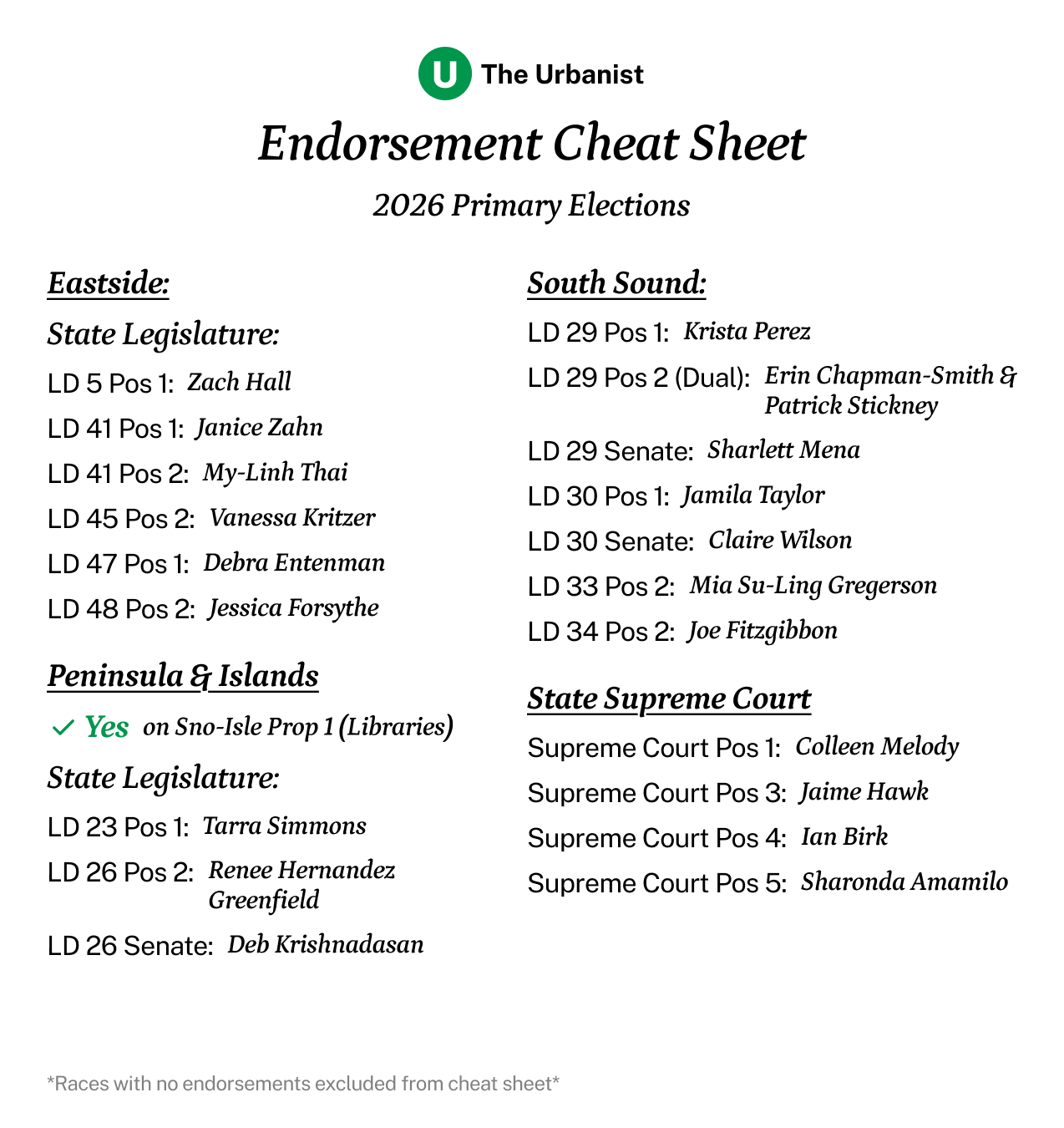
Endorsements Cheat Sheet

Find our endorsements useful? Donate to support our Election Committee's work and our local reporting that informs it.
Table of Contents
- King County
- Congress
- Seattle Council
- Library levies in Seattle and Sno-Isle
- State Supreme Court
- Washington State Legislature
King County Council, District 2: Rebecca Saldaña
We’re lucky to have an embarrassment of riches when it comes to the King County District 2 election: State Senator Rebecca Saldaña and Seattle Port Commission President Toshiko Hasegawa are both visionary and formidable progressive urbanists. Both have extensive experience and bring strong coalitions and policy chops beside them. But voters only get to fill one bubble, and we’re proud to pick Saldaña.

With a decade of distinguished service at the state legislature, Saldaña is a proven coalition builder with experience dealing with challenging budgets without leaving the community behind, which is just what the county could really use at this moment. Her vision for King County Metro focuses on connecting communities and translating community needs into policy for an expansive, regional, and sustainable future.
“In the last 10 years, we have put a price on carbon,” Saldaña told The Urbanist when she jumped in the race in December. “We’ve passed progressive revenues. We have put a lot of infrastructure in to try to Trump-proof us during his first regime.”
Saldaña wants to lower costs and expand opportunity through “reliable transit, childcare, infrastructure, and good union jobs.” In her questionnaire, she said, “[h]ousing, climate, transit, and public health are deeply connected, and I believe King County must continue leading on progressive revenue so working families are not paying a larger share of their income in taxes than the wealthiest among us.”
Hasegawa has some great ideas regarding transit-oriented development, land banks, social housing, conventional affordable housing, and building community infrastructure around transit. She’s a strong progressive voice and also committed to equity and has done impressive work at the Port and is no stranger to the inner workings of the county.
Miriam Mboya brings direct experience in County government, where she works on public health. Mboya immigrated from Kenya when she was six years old. She has made tackling the homelessness crisis and ending the school-to-prison pipeline campaign priorities. She had some solid insight, and we commend her run.
When it comes to the leadership we need to represent District 2, we’re proud to support Rebecca Saldaña. Vote Saldaña.
*Note: Tamer Abouzeid recused from King County races.
King County Council, District 8: Teresa Mosqueda
The Urbanist has endorsed Teresa Mosqueda three times in the past, and we are enthusiastic to endorse her once again. The county needs her leadership and moxie in trying times.
With nearly a decade of experience under her belt in public office, Mosqueda has proven to be an effective progressive leader. Mosqueda has scored many wins over the last nine years that demonstrate her urbanist values. From fighting to keep the West Seattle Link light rail project moving despite numerous hurdles to expanding worker protections to pushing for greater affordable housing investments at the county level, Mosqueda’s record is quite impressive.
Mosqueda burst onto the scene as Seattle City Councilmember for citywide Position 8, winning election in 2017 and quickly becoming one of the key stalwart votes to rezone urban center neighborhoods citywide, taking the Mandatory Housing Affordability program “citywide.” She also shepherded the Jumpstart payroll expense tax to passage in 2020, securing a key progressive revenue stream that spared the city from pandemic austerity cuts and greatly boosted investments in affordable housing.
In 2023, Mosqueda won a seat on the King County Councilmember in District 8, and she has continued to deliver progressive victories at the county level and using the seat on the Sound Transit Board of Directors that she lobbied for and won at the beginning of 2026. Mosqueda was a strong voice to save Rainier Valley’s Graham Street infill light rail station from the chopping block.
Such a long career as an elected official does not come without its share of votes and policy decisions that we didn’t agree with, though. Her vote to fund Sound Transit’s Renton parking garage to the tune of $100 million during a budgetary crisis was a head-scratcher for us. When Mosqueda has taken iffy votes like this, she has often pointed to the boost to union jobs as her motivating factor. While we appreciate her labor loyalty, at a certain point infrastructure investments have to stand on their own merits, rather than coasting on job creation claims.
Minor blemishes aside, our board voted unanimously to endorse her again because she is absolutely the best choice to continue representing King County District 8. Neither of her opponents, Nick Duda and Mia Jacobson, present a credible challenge and hold some incoherent positions.
Vote to re-elect Teresa Mosqueda for King County Council.
*Note: Tamer Abouzeid recused from King County races.
King County Assessor: Rob Foxcurran
Sometimes Rob Foxcurran isn’t quite sure whether King County Assessor should even be an elected position, and we share that sentiment. Nevertheless, The Urbanist endorses him for the position because he has the right background for a role that requires both technical experience and an understanding of how the office affects the daily lives of King County residents. In government, Foxcurran serves as the Senior Appraiser for the City of Seattle, and previously served as a hearing examiner on King County’s Board of Appeals and Equalization. This follows a private-sector career as an appraiser starting over a decade ago.
Foxcurran speaks about the King County Department of Assessments in a serious tone: it is a 200-person department that depends on highly skilled staff who must be given the best training, support, and resources. His priorities are accuracy, transparency, and affordability: rigorous, continuous assessments; plain-language explanations and tools that are easily used by community members and advocates; and conducting more outreach about current home exemption programs and advocacy at the state level.
Foxcurran argues that underassessing certain properties like surface parking lots and vacant parcels in urban, transit-connected neighborhoods subsidizes car-dependent land use patterns and discourages density. Foxcurran is a fan of a land value tax, a homestead tax exemption with renter credits, and circuit breaker programs, and wants legislators to explore funded inclusionary zoning as a long-term alternative to the Multi-Family Tax Exemption (MFTE), a program that creates moderate-income housing in participating new residential buildings.
As for golf courses, Foxcurran is not a fan of the special tax treatment they receive, but believes the answer lies with the state legislature, which he argues can instruct assessors to disregard restrictive covenants that limit their use to golf. Under current case law, he argues, those covenants legitimately factor into the valuation.
Christopher Roberts is the other standout candidate in this race, and he would also bring strengths to the position. Roberts is a two-term mayor and four-term city councilmember from Shoreline who is a member of the Choctaw Nation. He promises to work with the state legislature to advance a homestead exemption, and argues that one of the main jobs of the Assessor is to go out to the community and help people understand what is available to them.
Roberts also argues that differences in the timing of valuations of MFTE properties leave too much money on the table. Roberts serves on the Executive Board of the National League of Cities and chairs the Public Issues Committee for the Sound Cities Association. He is a committed public servant and is a qualified candidate for this position.
This race has two strong candidates, and we believe that Rob Foxcurran is better prepared and more ready to hit the ground running in leading the King County Department of Assessments. Vote Foxcurran.
*Note: Tamer Abouzeid recused from King County races.
Yes for Libraries!
The civic palaces that are public libraries are an integral part of city life, oases of knowledge, community, and basic amenities. We can’t imagine life without a well-functioning public library system, and this fall voters in both Seattle and in Snohomish and Island Counties are being asked to put their money where their mouth is in supporting libraries. We endorse an emphatic yes on both measures.
Seattle’s library levy renewal unfairly became a punching bag earlier this year, for reasons mostly unrelated to libraries. The clear desire of Seattle residents for additional public services is starting to come up against a state-imposed levy cap, of $3.60 per $1,000 of assessed value. But the library levy renewal itself will only make up $0.23 of that, or around seven percent of the new total rate. The library levy isn’t the time to start nickel and diming city services, even if the state legislature is going to need to figure out some additional revenue options for cities like Seattle to turn to.
The levy now includes even more essential spending thanks to additional investments pushed by councilmembers, which Mayor Katie Wilson probably would have proposed herself if not for having to negotiate one-on-one with library committee chair Maritza Rivera, Council’s most conservative voice. The Central Library, the crown jewel of the system and a symbol of our city itself, will be able to get refurbished as it nears its 25th birthday. That means fewer broken elevators and escalators. The library will also be able to give one more aging branch a seismic retrofit – libraries not falling down in an earthquake seems like a pretty big public benefit to us. (Apparently the Seattle Times Editorial Board disagrees.)
Vote yes on Seattle Proposition 1.
Voters in Snohomish and Island counties should vote “Yes” and renew the library levy. The levy restores the property tax rate previously approved by voters in 2018 and will fund over 90% of the budget for 23 branches in the Sno-Isle Library system. Transit nerd pro tip: some of these branches are reachable by public transit like Lynnwood/Mountlake Terrace (Sound Transit Link light rail), Edmonds/Mukilteo (Sounder Commuter Rail), and Edmonds, Mukilteo, and Clinton (Washington State Ferries) and make great day trip destinations.
By the way, if you’re voting no, we assume you’d be fully prepared to give up your Libby account.
Find our endorsements useful? Donate to support the Election Committee's work and our local reporting that informs it.
U.S. House of Representatives
Washington is such a reliably blue state in presidential elections that it’s easy to overlook the complexity of our political landscape. Like any state, we have our cliques and our alliances, the candidates who share consultants or who make handshake deals to trade endorsements or defer challenges. There is implicit and even explicit talk about whose turn is next; grumbling when a candidate skips the line or runs for an office held in all but name for the anointed choice.
Opportunities to grab a seat in Congress are treated as sacred since so few of them arise. Many members of Congress treat the job as a lifetime gig, only leaving in a body bag. Washington’s delegation fits into this trend. Adam Smith has been in Congress 30 years, and Rick Larsen is close behind with a 26-year tenure. Suzan DelBene is now a 14-year veteran, and Pramila Jayapal is reaching the decade mark.
Part of the reason why officeholders almost never leave is that the two major political parties, the election system, and campaign architecture are set up to shield incumbents. Incumbents tend to have long memories and their prominence in the party gives them an opportunity to punish primary challengers down the road. As a result, rising political stars tend to wait for an open seat rather than rock the boat by challenging a party colleague, even one who has been there since dial-up internet.
Such a system can seem inevitable, especially given the influence of unfettered money in politics following the Supreme Court’s Citizens United ruling. But voters appear increasingly unsatisfied with the status quo. This primary season has seen upsets in New York and Colorado already. Instead of being satisfied with the cynicism of accepting that there is no alternative, progressive voters have been turning out to make the case for alternatives once dismissed as unserious or non-viable. Will Washington continue this trend?
The Election Committee is not reflexively pro- or anti-incumbent. When we meet to discuss each race, we weigh the calculus of what is lost (experience, seniority for committee assignment with more clout, skilled staff) and what is gained, such as fresh perspectives, new energy, and a willingness to try new approaches. We also have to consider that rhetoric is easy, while legislating and forging a winning coalition on a 435-member legislative body is hard.
We hope our writeups will illustrate the disparity in the strengths of challengers and flaws of the opponents, even when we could not arrive at an endorsement. Several young, progressive challengers we chose not to endorse had solid questionnaires and interviews, but could not demonstrate a serious understanding of the legislative process or what it would take to win. We’re willing to be convinced down the road.
1st Congressional District: No Endorsement
Suzan DelBene is hardly blowing us away with her leadership, and she attracted a number of challengers, but none of them seemed quite ready for prime time. Catherine Hildebrand and Hunter Gordon are challenging the seven-term incumbent from the left. James Etzkorn, meanwhile, is a market-oriented independent who listed cutting the national debt as a top priority. Several other candidates are in the race, but did not return questionnaires.
DelBene is a former Microsoft executive who has been in Congress since 2012, taking over Jay Inslee's former seat. As a one-percenter herself she has not been on the vanguard of efforts to tax the rich. Instead she is a former chair of the New Democrat Coalition, which has sought to push the party to the right. DelBene has amassed a huge campaign warchest, raising $2.7 million. Gordon is the only other candidate to report significant fundraising, with nearly $70,000 raised.
Hildebrand and Gordon both had better answers than DelBene to our question about reining in an absolutely unhinged U.S. Supreme Court, which has been shredding long-held legal precedents in the name of appeasing Trump and further enriching his wealthy benefactors. Hildebrand made it crystal clear she supported term limits for justices and judges, which would help root out the ultraconservative activist judges that Trump has installed, noting it was a top issue for her. Gordon agreed and also backed expanding the Supreme Court.
DelBene’s Supreme Court answer was more convoluted and contorted. Heaven forbid Democrats that have been in Congress for a decade plus use that experience to do stuff, instead of coming up with empty rhetoric and reasons why we can’t go bigger. Instead of packing the courts and/or imposing term limits, DelBene pointed to her co-sponsorship of the Supreme Court Ethics, Recusal, and Transparency Act of 2025 (H.R. 3413), which “promotes greater accountability for justices through public access to ethics rules, a formal system for filing complaints against justices, potential disqualification for those found to have violated various ethical standards, and more robust disclosure standards for gifts and amicus activities.”
Sunlight might be a helpful disinfectant, but this court system is infected beyond the point where a few more ethical guidelines and disclosure rules are going to do anything impactful.
The charitable read on DelBene is that, while she isn’t rowing very hard, she is rowing in the right direction usually, and serves as a party loyalist that has helped fund other Democratic nominees around the country via her perch as Chair of the Democratic Congressional Candidate Committee. Like others in the Washington delegation, she uses her seniority to push to bring home infrastructure grants, funding which has helped Sound Transit build out its network. She also co-sponsored the American High-Speed Rail Act, which would unlock $41 billion for passenger rail projects nationwide if passed and if Trump and his lackeys ever cease their blockade on rapid transit investment.
The uncharitable read is that DelBene is a boring centrist who has not found a fight she won’t shrink from when the going gets tough. She’s fighting the creep of facism and threat of Trump’s massive kleptocratic heist with stale, ineffective tools. Can one more fundraising email save democracy? We better hope so, because not a lot of fresh ideas are being attempted.
We may revisit this race in the general, but for now do with that what you will.
- Catherine Hildebrand questionnaire
- James Etzkorn questionnaire
- Hunter Gordon questionnaire
- Suzan DelBene questionnaire
Correction: The original draft incorrectly state that DelBene succeeded Dave Reichert. We regret the error.
2nd Congressional District: Tomas Scheel
Tomas Scheel seems like a longshot challenge to an incumbent so entrenched he’s asking voters to send him to his 14th term in Congress. Incumbent Representative Rick Larsen, who did not seek our endorsement, has seen his share of challengers on the left and the right over his many years, and has kept his seat through them all. Scheel is hoping to break through where others have failed, and he’s the clear urbanist choice.
Scheel has a solid grasp of policy and values around economic and environmental justice we think the 2nd district deserves. Unlike Larsen, we can confidently say he’s an urbanist, ready to prioritize transit and housing abundance. He’s also an unabashed supporter of universal single-payer healthcare, while Larsen has dithered for 26 years while our health care system turned into a nightmare for all but the richest.
Scheel, an air force veteran and owner of a small software company, impressed us with his bold ideas about reducing car dependency, even in rural areas. Drawing from his experience in Japan, he’d like to see us work toward the kind of rail system that connects urban and rural areas enough to meaningfully reduce car traffic. He did not seem naive about the cost and challenges of such ambitious infrastructure projects, and identifies mismanagement and ineffective military spending as an opportunity to re-direct the necessary resources.
Year after year, CD2 voters have chosen a familiar name, perhaps valuing his seniority on the transportation committee and his middle-of-the-road approach that doesn’t land many soundbites in major media outlets. Despite his longevity, his record has plenty of room for critique.
Larsen recently endorsed BUILD America 250, a deeply misguided package capitulating to Republicans on infrastructure policy and eviscerating transit and rail funding and the Reconnecting Communities highway mitigation fund. This highway expansion or bus approach is deeply out of step with voters. His team spun the bill as an investment in “job-creating infrastructure”, illustrating a disappointing lack of vision about transit and complete streets while buying into the debunked ‘one more highway lane will fix congestion’ ideology that is bankrupting our transportation system and destroying our environment.
While Larsen collaborates with Trump and Secretary of Transportation Sean Duffy to gut infrastructure policy, Scheel made impeaching Duffy part of his transportation plan. This cemented for us that he wants to go to DC to change things rather than become part of the furniture.
While happy to surrender to enemy forces on domestic policy, Larsen’s consistently hawkish foreign policy and staunch support for Israel’s warmaking have not aged well. Plus, his corporate and PAC-heavy contributions give us little reason to hope for much change in his positions.
Scheel knows he’s got an uphill battle; Larsen has a massive fundraising advantage and Scheel’s vow to take no corporate or PAC money will limit his ability to compete. He’s banking on support for Larsen to crumble if Scheel can demonstrate his campaign is serious. It’s going to take a lot more fundraising than Scheel’s yet demonstrated.
We hope to see him increase his visibility and messaging, especially in ways that will reach young voters and build the volunteer base he’ll need to knock doors in the district. His campaign could use an infusion of the smart, joyful energy that has buoyed progressive challengers in other states, inspiring voters to imagine a better alternative to business as usual. Let’s kick the bums out. Vote Scheel.
- Tomas Scheel questionnaire
- Incumbent Rick Larsen did not return a questionnaire.
6th Congressional District: No Endorsement
We are inclined to support incumbent Emily Randall, but unfortunately she did not submit a questionnaire for our consideration. Representative Randall has served one term in Congress, during which time she and her progressive colleagues unfortunately have had little opportunity to pass helpful legislation with Trump in the White House, but she generally has been a reliable vote trying to block the worst policies coming from the Trump regime. Before her jump to Congress, Randall served six years in the state Senate and was instrumental in flipping the 26th Legislative District for Democrats.
Her challengers, Brian O’Gorman and Leon Lawson, do not appear to be credible candidates. We do not, as a rule, take a position on artistic merit; so readers may consider for themselves if Lawson (a.k.a. DJ Dogcon) is a credible musician. We’re unable to endorse in this race but hoping to see a questionnaire response from Randall to make her eligible in the general.
- Brian O’Gorman questionnaire
- Leon Lawson questionnaire
- Incumbent Emily Randall did not return a questionnaire.
7th Congressional District: No Endorsement
Generally speaking, we’re fans of U.S. Representative Pramila Jayapal, but unfortunately she did not participate in our endorsement process. The candidate who did, Nirav Sheth, is running as a Republican and seemed inordinately focused on local governance issues, such as vandalism at his Normandy Park restaurant, rather than federal ones. We aren’t able to make an endorsement in this race, but we trust the voters will send Congresswoman Jayapal back for another term, even though she is highly allergic to Urbanist questionnaires.
- Nirav Sheth questionnaire
- Incumbent Pramila Jayapal did not return a questionnaire.
9th Congressional District: No Endorsement
The Urbanist Elections Committee was disappointed in our choices in the 9th Congressional District. Longtime centrist incumbent Adam Smith is about as inspiring as a chunk of kelp-covered driftwood, and he did draw two challengers from the left, but neither convinced us they’re the real deal and ready to actually do the hard work of legislating, as opposed to simply grandstanding and throwing elbows.
Frankly, it’s baffling that Adam Smith hasn’t attracted more opposition. A proud New Democrat, he helped mastermind the Democratic Party’s move away from civil rights groups and organized labor. He and other New Democrat leaders pushed their peers to embrace corporate money, a disastrous calculation that led to Democrats embracing a wide spectrum of policy failures: financial deregulation – leading to economic crises in 2002, 2008, and the current crisis – the wars in Iraq and Afghanistan, virtually unlimited military support for Israel, and the atrophy of local government.
While his post-2024 media tour criticized Democrats for having failed to govern – criticism that relied heavily on the work of Christopher Rufo, the bigot who accused African immigrants of eating pets – Smith has spent years backing local candidates who have spectacularly failed to govern. He’s endorsed, among others, Bruce Harrell, Kevin Schilling, Jim Ferrell, Sara Nelson, and Republican ex-Seattle City Attorney Ann Davison, twice. All these candidates were resoundingly rejected by their constituents after failing to deliver on basic governance. This year, Smith is also supporting Judge Sean O’Donnell, the Washington Supreme Court candidate backed by anti-millionaire-tax corporate lawyer Rob McKenna, one of the last Republicans to hold statewide office.
Smith has also shrewdly made it a habit of disguising his many corporate-friendly centrist moves with progressive peacocking on some issues, such as signing on to Medicare For All and the Green New Deal. Those are great initiatives, but, no, throwing his weight behind a few deadlocked bills did not throw us off his centrist scent. And his broader politics (namely supporting centrist hacks and conceding political terrain to conservatives) makes it harder for those important efforts to bear fruit any time soon.
In our interview, Smith’s left-leaning pivots (less military spending via an increased reliance on drone warfare and building more data centers in the hope that they’ll one day be powered by fusion energy) did not paint an image for a future we’re excited to see. Allowing Smith to continue to represent one of the most diverse districts in the country after palling around with Republicans and Christopher Rufo would be a tragedy. His longevity is a testament to the power of corporate money in politics and atrophy within the Democratic Party, and he needs to go. Unfortunately, we were not able to select a challenger to replace him since none cleared the bar for us.
While we were impressed with perennial challenger Melissa Chaudry’s tenacity – especially in the face of her husband’s abduction by ICE agents – we don’t feel that she’s spent the last two years building the durable coalition necessary to unseat Smith. She lacked the substantive political accomplishments necessary to justify a stint in Congress.
We were also concerned about Kshama Sawant’s ability to win this race and be effective in office. Sawant boasts some genuinely impressive political accomplishments, including the $15 minimum wage from her time on Seattle City Council. We’ve endorsed her for Seattle City Council in 2015, 2019, and in her 2021 recall battle. She has been a tenacious fighter for tenant rights and public transportation, and generally a pretty solid vote on housing abundance.
But Sawant has also injured her own causes through unnecessary intra-coalitional conflict. She appears to relish excoriating Democratic establishment figures far more than outmaneuvering Republicans and laying the groundwork for new progressive wins. In her questionnaire responses, she presents her priorities as “demands” – illustrating our concern that she is more comfortable as an outside agitator and would struggle to be effective in Congress, where coalition building is necessary. We welcome her criticism of Smith, but we aren’t convinced her alternative vision is viable. While Sawant has long promised a mass movement to make her socialist wishlist a reality, her Socialist Alternative and Workers Strike Back parties have rarely, if ever, elected candidates other than her, or forged lasting alliances with other left-wing parties.
We’re hoping for a credible progressive challenger in two years. CD9 deserves better.
Our endorsements are possible because of readers like you. Donate to support our work and the local reporting that informs it.
10th Congressional District: No Endorsement
Incumbent Marilyn Strickland did not participate in our process, and none of the three challenges who did quite convinced us, although some were close. Strickland is the former Mayor of Tacoma and led the Seattle Metropolitan Chamber of Commerce. As her chamber association would suggest, she has occupied the Democratic Party’s centrist wing, rather than pushing at the vanguard for progressive change.
Why fill out questionnaires when that would take away from fundraising time? Strickland has raised more than $1 million, even without a big-name challenger. We could do a lot better, and her progressive challengers had much better visions for health care, housing, and ending Trump’s illegal wars.
Alex Scheel’s top three priorities are ending military aid to Israel, funding the VA healthcare system, and Medicare for All. An Army veteran, he has experienced the homelessness crisis firsthand, and said he lost a sister and two friends to opioid addiction. Scheel’s campaign website notes housing for all is also a top priority: “After nearly a decade of anti-war and housing justice organizing in Tacoma, I quit my job in the craft beer industry to run for Congress.” In his questionnaire, he set a goal of closing ICE’s Northwest Detention Center (NWDC): “Shutting down the NWDC is a top priority, I abhor living a mile away from that concentration camp.”
Adam Arafat is also challenging Strickland from the left, listing his top priority as Medicare For All. Like Scheel, he’s an Army veteran and a sharp critic of Trump’s illegal wars abroad, stating “the executive branch has claimed war authority that belongs to Congress, and WA-10 families at JBLM bear the human cost of that constitutional breach.” Like Scheel, he supports the data-driven housing first model to address homelessness. Displaying a fiscal hawk streak, Arafat’s website also makes a “no new taxes” pledge. In contrast, Scheel noted support for taxing “vacant housing hoarded by absentee landlords.”
Kurtis Engle, meanwhile, is a perennial candidate who gallops in like a wild stallion with outside-the-box ideas. In fact, Engle’s questionnaire informed us of his equestrian streak: “I would outlaw horses on paved roads outside parks, and mandate a cycle/horse track be paved alongside the road.” Giddy up, and cyclists, mind the horse pies. While he may have a cowboy streak, that does not mean he supports vigilante justice. Engle wants to charge Trump and the six Republican-appointed Supreme Court justices with crimes against humanity at “the Haig,” which, to be fair, is a more phonetic way to spell The Hague, where the United Nations’ International Court of Justice is located. After that simple matter is taken care of, he would disband the Republican Party altogether. Engle is a Navy vet affiliated with the Union Party.
We are looking forward to revisiting this race in the general election, hoping one of these candidates can seize the zeitgeist and make this a real race. Just who that is could be anybody’s guess.
- Adam Arafat questionnaire
- Alex Scheel questionnaire
- Kurtis Engle questionnaire
- Incumbent Marilyn Strickland did not return a questionnaire.
Seattle City Council, District 5: Nilu Jenks
It’s time for Seattle City Council District 5 to receive the progressive, urbanist candidate it deserves. The Urbanist is proud to support Nilu Jenks in the District 5 special election.
Seattle City Council District 5 has been fraught with centrist or conservative-leaning elected officials. The seat is currently held by Debora Juarez, who was appointed on an interim basis until the November 2026 election. Under normal circumstances, this seat would not be up for election until November 2027, but Cathy Moore, who was elected to this seat in 2023, suddenly resigned citing “health and personal reasons.” The timing of the resignation gave Juarez an extra-long, year-and-a-half appointed term.
Whoever wins this year’s special election will serve one year and have to run again in 2027 before earning the standard four-year term, making this the last Council race without ranked-choice voting, which is being rolled out next year.
For the last few years, Jenks has worked as the Political and Partnerships Director at FairVote Washington to advance voting reforms that foster a more inclusive and representative democracy. She will be one of the few on the City Council who will have an intimate understanding of how our implementation of ranked-choice voting will work.
That brings us to today. Jenks ran for this seat in 2023 and, unfortunately, did not make it past the primary. The Urbanist endorsed her campaign then, and we are proud to endorse her again. Jenks was originally inspired to run because of the climate emergency and need for environmental justice in Seattle. That reasoning is still one of her motives for why she is running for this seat again - but don’t let her climate advocacy mislead you into thinking she aligns with proponents of the low-density, pro-tree folks who have weaponized the State Environmental Protection Act (SEPA) to delay Comprehensive Plan implementation time and time again.
On the contrary, Jenks understands that the dire need for housing is not at odds with retaining and increasing our tree canopy. One idea she has to address this is by providing more flexibility in development standards - for example, giving height bonuses - if a developer is able to retain trees on the lot.
As we transition into the next phase of the Comprehensive Plan (coined the Taller Denser Faster plan by Mayor Katie Wilson), we need advocates on City Council who are willing to stand up to those who use the very real need for a healthy, vibrant tree canopy as a facade to oppose upzoning. In contrast to Jenks, Seattle Times-backed centrist challenger Julie Kang has appeared hesitant to embrace the Taller Denser Faster plan, raising concerns about infrastructure and the concurrency of improvements.
Jenks’ number one priority if she is elected is to build 1,000 units of affordable housing in District 5. Jenks gets that homelessness is a housing problem, and that one of the most effective ways to tackle our homelessness and housing affordability crisis is by building more homes. She is a supporter of stacked flats and middle housing, and wants to expand development opportunity and capacity beyond major arterials.
As a Lake City resident who lives directly on Sand Point Way, Jenks understands the need for pedestrian safety in District 5. Sand Point Way, Lake City Way, and Aurora Avenue N are amongst some of the major District 5 arterials that are in need of serious pedestrian safety improvements. In addition to the Seattle Transportation Levy, which already has a goal of building 350 blocks of new sidewalks and walkways by the end of 2032, Jenks wants the City to look into other creative solutions to increase walkability, such as pocket park infrastructure that connects to transit stops, promoting multimodal transit connections to link light rail stations, and investment in east-west transit.
Jenks' staunch progressive values and experience make her stand out from her opponents, Julie Kang and Silas James. Over the course of some major political waffling, Kang has done some progressive cos-playing, but on some of the biggest issues, she has staked out conservative positions, such as pushing widespread camera surveillance and “stay out” order banishment zones, neither of which is particularly data-driven or supported by empirical research.
Nilu Jenks is the progressive, yet practical, voice we need to bring to the City Council to shift the balance of power back to progressives. Vote for Nilu Jenks!
Washington State Supreme Court
Legislators and levies are very important, but the five most important votes you cast this year will be for judges. An unprecedented five seats are open on Washington’s Supreme Court – the most powerful statewide body you never hear about. Given the importance of these elections, we’ve chosen to endorse candidates in the four genuinely contested races (congratulations on coasting to victory, Justice Stephens!).
Washington’s Supreme Court is extremely important. While the US Supreme Court gets far more attention, the vast majority of prosecutions and lawsuits occur in state courts using state constitutions and state law. Washington’s Supreme Court has the final say on Washington law, giving our elected justices sweeping authority over everything from the Growth Management Act to the death penalty. Every urbanist priority will end up in front of the court sooner or later.
Our Supreme Court also runs Washington’s third branch of government: the courts. Our Supreme Court gets to decide how Washington lawyers are licensed – and disciplined – and can make rules for lower courts governing everything from public defender workloads to cash bail. While Washington’s courts are more decentralized and disorganized than most states’, our Supreme Court justices are still the undisputed leaders of our legal system.
With five Supreme Court justice positions up for grabs, this is the perfect moment to ask how well Washington’s legal system works. The simple answer: badly. Despite our Supreme Court’s progressive reputation, Washington has, at best, a two-tiered legal system that privileges wealth over justice. Since 1933, Washington’s Supreme Court has starved the state of badly needed revenue at the behest of the wealthy. The Court’s 1933, 5-4 decision in Culliton v. Chase created the myth that Washington’s populist Constitution prohibits fair taxation–a myth that has been debunked by generations of legal scholars.
While the Court’s current justices recently upheld the new capital gains tax, they also failed to fix Washington’s judge-made tax system, which means taxes in Washington remain more unfair than taxes in Texas, West Virginia, or even Mississippi. As a result, Washington lags behind comparable states in critical urbanist indicators, from transit to K-12 education to mental healthcare. The Legislature’s new millionaires’ tax seeks to fix that, but corporate lawyers have already filed a lawsuit, citing Culliton, intending to destroy that tax. The justices we elect this year will decide the fate of the millionaires’ tax and of Washington’s entire tax system.
Washington’s courts haven’t just favored the wealthy in tax fights; powerful not-in-my-backyard interest groups can easily derail necessary reforms through vexatious litigation. Yet Washington’s Supreme Court has admitted – for decades – that 90% of low-income Washingtonians who need civil legal help (landlord/tenant disputes or divorces, for example) never get the help they need. Washington’s criminal courts are no better: approximately 90% of criminal defendants are too poor to afford an attorney, forcing them to rely on an overburdened public defense system that’s been operating in crisis since at least 2004.
So, who do we elect to fix all this? Picking judges isn’t as simple as picking legislators; judges can’t make campaign promises and should follow the law – not their personal beliefs. Fortunately, our questionnaires and interviews revealed serious, substantive differences between the candidates’ backgrounds, work experience, and values. We have tried to select candidates with a demonstrated commitment to the values embodied in Washington’s Constitution: transparency, democracy, and, in the words of one prominent Washington scholar, a “general objection to the concentration of power in elites.”
Right now, power is too concentrated; Washington’s increasingly unaffordable cities currently reflect elite preferences. To change that, Washington needs justices who embrace our state constitutional values.
This year’s candidates can be divided into three groups: dark-money conservatives, cautious institutionalists, and reformers who embrace Washington’s Constitutional values. Washington’s legal system needs to change. We’re backing the reformers.
Finding our endorsements useful? Donate to support the Election Committee's work and our local reporting that informs it.
State Supreme Court, Position 1: Colleen Melody
Our first judicial endorsement is also our easiest: only Justice Melody, the incumbent, participated in our endorsement process, and only Justice Melody seems to embrace Washington constitutional values. Vote Justice Melody.
Although Justice Melody has only ever represented the government, her career has focused entirely on civil rights. She worked in the Department of Justice’s Civil Rights Division under President Obama before returning to Washington to run our state Civil Rights Division. During her 11 years in the Washington Attorney General’s office, Justice Melody led lawsuits against various disastrous Trump policies, including his failed, racist effort to end birthright citizenship, before being recently appointed to Washington’s Supreme Court.
We appreciated Justice Melody’s questionnaire and interview responses: her personal advocacy for affordable housing, her civil rights lawsuits against exclusionary zoning, and her reliance on Washington State Ferries and public transit. Importantly, she’s also never been a corporate lawyer. Of the available choices in this race, we’re confident she’s the candidate most likely to give urbanist causes a fair hearing and to improve access to Washington’s increasingly inaccessible courts.
Justice Melody’s two opponents declined to meaningfully participate in our endorsement process, and we found no reasons to support them. Laura Christensen Colberg is a family lawyer endorsed by the Washington Republican Party. She no-showed our interview and wrote terse questionnaire responses that gave us no insight. Scott Edwards is a tax attorney for one of America’s largest law firms and seems exactly the type of candidate who can’t be trusted to fix Washington’s regressive, judge-made tax system. Vote Justice Melody.
*Note: Maya Ramakrishnan recused from State Supreme Court races.
State Supreme Court, Position 3: Jaime Hawk
While the choice for this open seat was more difficult, we ultimately decided to support a proven, open-minded reformer over a cautious institutionalist. Vote Judge Hawk.
We were very impressed by Judge Hawk, a King County Superior Court judge. The first in her family to go to college, let alone law school, she worked as a public defender in state and federal courts before joining the ACLU of Washington. While at the ACLU, she worked on ending mass incarceration and promoting economic justice. She was subsequently appointed to King County Superior Court by Governor Inslee, and she also serves on the Supreme Court’s Minority and Justice Commission. We appreciated Judge Hawk’s demonstrated commitment to fighting for individuals targeted by powerful institutions.
We especially valued Judge Hawk’s perspective on housing law, which was informed by her work as a volunteer tenants’ rights attorney and as a judge hearing eviction cases. In her interview, she emphasized her efforts to ensure that tenants facing eviction in King County have meaningful access to lawyers. Judge Hawk described facing institutional pressure from other judges to speed up eviction cases, even though tenants’ lawyers are already overwhelmed. We appreciated her willingness to resist that pressure. We believe she will be a strong, fair Supreme Court Justice.
We were also impressed by Judge Hawk’s opponent, Court of Appeals judge J. Mike Diaz, whose inspiring personal story – immigrating from Peru and excelling in college and law school–is very moving. We were concerned, though, that Judge Diaz’s career exemplified a more cautious, institutionalist approach than Judge Hawk’s long career fighting for justice. Judge Diaz’s six years as a corporate lawyer gave us pause – especially given some of his anti-worker judicial opinions, one of which was unanimously reversed by Washington’s Supreme Court.
We also worried about some of his experiences as a lawyer for the Department of Justice. In that capacity, he defended the US Postal Service for allegedly retaliating against an employee who reported racial discrimination, a Navy recruiter who acknowledged causing a car accident, and three ICE agents accused of unlawfully detaining an American veteran. This experience contrasts sharply with Judge Hawk’s record of fighting for the victims of mass incarceration–including fighting for immigrants as a federal public defender.
To be fair, Judge Diaz did engage in civil rights work after these cases: he helped enforce the federal Fair Housing Act and the federal consent decree that attempted to reform the Seattle Police Department. But Judge Diaz lacks Judge Hawk’s ground-level experience with housing law, and his comments about the consent decree illustrated the limits of cautious institutionalism. Judge Diaz began by invoking the murder of John T. Williams, but, when asked why the consent decree failed to reduce police killings, claimed that his team had only focused on reducing other forms of police violence while, apparently, ignoring killings and violence against protestors. What good is a consent decree that doesn’t protect basic constitutional rights, or even the right to breathe? We’ll take Judge Hawk’s years of advocacy over the consent decree’s empty promises.
Oh, there’s also a third candidate: David Stevens, a Mason County Superior Court judge endorsed by the Washington Republican Party who loves Clarence Thomas. He didn’t engage with our process, which saved everyone a lot of time. Don’t vote for him.
Washingtonians should elect justices who fight hard and consistently for equal justice. While we respect Judge Diaz, and would probably endorse him against a weaker opponent, we feel that Judge Hawk’s track record makes her the best candidate in this race to confront Washington’s pressing legal crises. Vote Hawk.
*Note: Maya Ramakrishnan recused from State Supreme Court races.
State Supreme Court, Position 4: Ian Birk
Voters have an easy choice: Judge Birk is a thoughtful, experienced Court of Appeals judge who has written fair, deeply researched opinions on land use, transportation, and other urbanist issues. His opponent, Judge O’Donnell, is a King County Superior Court judge who opposed reducing public defender workloads, worked to speed up evictions, and enjoys support from anti-millionaire tax corporate lawyer Rob McKenna and perennial conservative Supreme Court candidate Dave Larson. Vote Judge Birk.
Judge Birk is the candidate we envisioned when we asked ourselves, is there such a thing as an ‘urbanist’ judge? We were impressed by Judge Birk’s passionate praise of cities during his interview, and also by his professional experience–which includes volunteering as a tenants’ rights attorney and fighting for individuals in insurance and consumer protection cases. We were also impressed by his ability to wrestle years of conflicting laws and court decisions on complex issues – including reimbursing businesses displaced by Sound Transit and municipal water rates – into clear, easily applicable rules capable of reducing needless litigation. While we didn’t love some recent Court of Appeals decisions he joined, we take that as a sign of his impartiality. We believe Judge Birk’s expertise will be a valuable addition to Washington’s Supreme Court.
We appreciated Judge O’Donnell’s willingness to meet with us, and we found him both affable and engaging, but we had too many questions about his record to feel comfortable supporting him. Given the upcoming Supreme Court fight over the millionaire’s tax, we were concerned by Judge O’Donnell’s strong ties to opponents of fair taxation: his work for former Republican senator – and income tax opponent – Slade Gorton, and his support from fellow Supreme Court candidate Dave Larson (who we did not endorse) and Republican corporate lawyer Rob McKenna. McKenna is leading the fight against the millionaire’s tax and donated to Judge O’Donnell’s campaign.
Judge O’Donnell’s record was also troubling. We were concerned by Judge O’Donnell’s claim, in our endorsement interview, that he worked to speed up eviction cases in King County. With tenants’ attorneys already overwhelmed, speeding up eviction cases means denying tenants effective legal representation. His public opposition to reducing public defender caseloads raised similar concerns. We aren’t confident that Judge O’Donnell shares the populist values of Washington’s constitution. Vote Birk.
*Note: Maya Ramakrishnan recused from State Supreme Court races.
State Supreme Court, Position 5: Sharonda Amamilo
This race contains one reformer, Thurston County Superior Court Judge Sharonda Amamilo, one institutionalist, incumbent Justice Theo Angelis, one dark-money conservative, retired municipal court judge Dave Larson, and one Greg Miller (who are you, Greg Miller?). We strongly endorse the reformer, Judge Amamilo.
Judge Amamilo brings a wealth of practical experience to this race, giving her the knowledge necessary to, as she put it in her interview, make powerful people uncomfortable. Powerful people seem very comfortable with our current legal system, which makes us even more grateful for a trailblazer like Judge Amamilo. Summarizing her professional accomplishments forces us to ask, where does she find the time? A mother of seven, she served for 25 years as a military intelligence analyst while also earning an MBA and a JD. After graduating from law school, she spent 12 years fighting for the vulnerable as a public defender before winning election to Thurston County Superior Court–making her the first person of color elected to that court.
As urbanists, we were grateful for Judge Amamilo’s thoughtful questionnaire and interview answers, particularly those that touched on her efforts–as a public defender and a judge–to increase access to public transportation for vulnerable people. We are confident that Judge Amamilo has the experience, work ethic, and tenacity to bring badly needed change to Washington’s legal system.
We felt less strongly about incumbent Justice Theo Angelis. Justice Angelis was personable and thoughtful during his interview, and his pro bono advocacy is genuinely impressive. But his previous day job–26 years at top corporate law firm K&L Gates–worried us. While Justice Angelis didn’t give us any reason to believe he’d pre-judged the millionaire’s tax, we’re not sure a corporate attorney is the best choice to fix Washington’s regressive, judge-made tax system, especially with Judge Amamilo in this race. K&L Gates also lobbies aggressively on behalf of data centers, an emerging urbanist issue that raises serious questions about energy use and economic justice.
While, again, we have no specific reason to doubt Justice Angelis’s integrity, we did note that his endorsement interview included him casually mentioning a recent conversation about AI with Brad Smith. Justice Angelis spent a long time in elite corporate law. Given our options, we aren’t sure he’s the best choice to enact Washington’s populist constitutional values.
Oh, and then there’s Dave Larson. We’ll give Larson a lot of credit: he fully engaged with our process and has previously reached out to us to discuss op-eds we published detailing his links to Rob McKenna and conservative dark money organizations. Larson isn’t afraid to engage with those he disagrees with, and he seemed sincerely worried that we saw him as a billionaire shill. We don’t; we recognize that Larson’s beliefs are sincere. Unfortunately, his beliefs align with those of the Washington Republican Party, which has endorsed him. For a self-described populist, his judicial philosophy aligns strongly with elites: we believe he’d oppose the capital gains tax and the millionaire’s tax, keeping Washington trapped in a regressive revenue nightmare.
And then there’s Greg Miller. Who are you Greg Miller? We don’t know. He didn’t engage with us. Ignore Greg Miller.
A note about viability: we acknowledge that Judge Amamilo’s fundraising lags well behind both Justice Angelis and Larson, who have each raised over $200,000. Given Justice Angelis’s corporate background and Larson’s embrace of dark money, we’re not surprised that a former public defender lags behind them in fundraising. We also acknowledge that Judge Amamilo’s current fundraising is, arguably, below the threshold of viability for a statewide candidate. We’ve chosen to endorse her anyway for two reasons: one, we believe she’s the best choice for this race and, two, if she ends up facing Larson in the general election, then the money will come. While we recognize that money may be tight this year, especially with multiple statewide races and potential initiatives on the ballot, Judge Amamilo’s performance in this endorsement process convinced us that she is a viable candidate. We are confident that she can win this race. Vote Amamilo.
*Note: Maya Ramakrishnan recused from State Supreme Court races.
State Supreme Court, Position 7: No endorsement
No candidates returned questionnaires in the race. We expect incumbent Debra Stephens to win, and have no qualms about that.
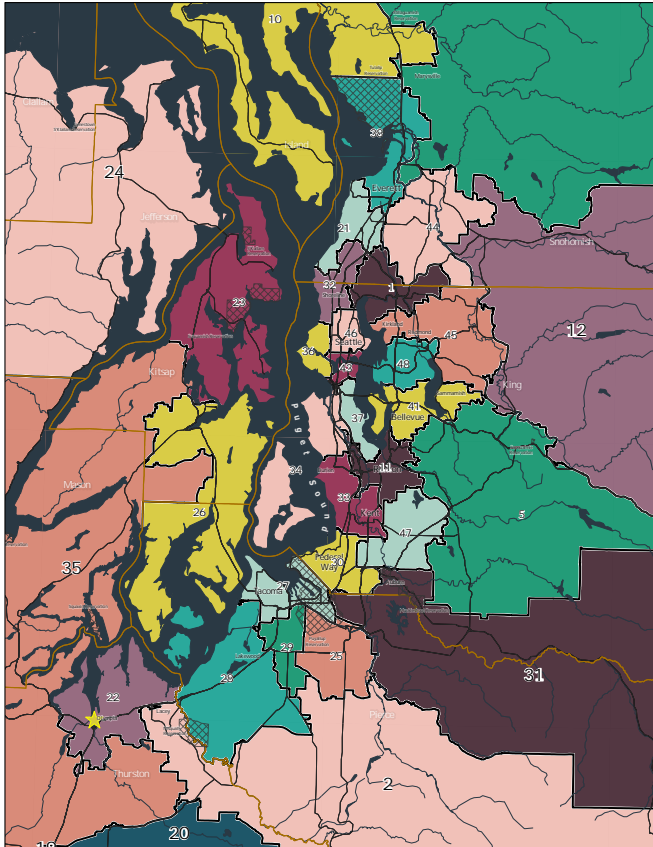
Washington State Legislature
LD 1, Position 1: Davina Duerr
Representative Davina Duerr joined the legislature in 2019, and has consistently built a coalition to support housing and transportation choices. An architect by trade, she brings professional experience to home building policy. Serving on the Transportation Committee and as a prime sponsor of many housing affordability bills, she has made a tangible difference in the state during her time in the House.
Looking forward to her next sessions, she already has plans to address building codes, the wildland-urban interface, and create a statewide model tree ordinance. It was clear during our interview that she has a strong grasp on policy and politics. Furthermore, she has paid attention to how the legislation she wrote has been implemented at the local level, such as her bill requiring climate pollution reduction planning. Someone with her experience is well positioned to craft legislation that will survive legal challenges and weaponization by anti-housing activists.
Her opponent, Maggie Wang, is a conservative Republican with little public policy experience to speak of. Wang’s responses to our questionnaire revealed that she had little interest in creating safe transportation options or in finding progressive sources of revenue.
Davina Duerr is a bold voice for a future Washington state that welcomes new neighbors with plentiful, high-quality housing while achieving our sustainability and climate justice goals. Vote Duerr.
LD 1, Position 2: Jenne Alderks
The Urbanist is excited to endorse Bothell Deputy Mayor Jenne Alderks for State Representative. This was an easy decision. Alderks has been an urbanist leader on the Bothell City Council: abolishing parking mandates, legalizing corner stores, and has pushed the city to go beyond lower speed limits to make streets safer.
Alderks is a Bothell City Councilmember who has demonstrated her commitment to housing and behavioral health. Her life experience outside of politics as an early childhood educator and with behavioral health makes her well-suited to tackling urbanist issues holistically.
She has written publicly about her personal experience with loved ones who have died of suicide. Alderks is running on a platform of a “fully built-out crisis continuum of care,” which includes someone to call (988), someone to respond (regional crisis response), and somewhere to go (Kirkland Connections). While Seattle has hobbled its CARE team, Alderks has been a leader building out the Regional Crisis Response (RCR) partnership that dispatches civilian social workers alongside police. And unlike Kloba, Alderks has promised to fight for universal healthcare and pledged to reject money from healthcare corporations.
Shelly Kloba has served in the House since her election in 2016, but almost ten years later, she lacks the kind of legislative accomplishments we hoped to see from someone with her tenure and experience in elected office. Alderks has won backing from organizations in the 1st LD who want to see bold action in Olympia, not just more tinkering around the edges.
Also on the primary ballot are Republican Cliff Moon and libertarian Jeff Lyon. Cliff Moon is a perennial, unserious candidate whose website lists fake endorsements and did not respond to our questions. Voters will remember Lyon as the crypto-bro who poured $250,000 into a failed bid to take over the Woodinville City Council last year, in which he received 31% of the votes. Lyon is running on a platform of dismantling the Growth Management Act, and did not participate in our endorsement process.
Alderks is a rare candidate who is strong on housing policy, has professional experience in education, and has a track record of delivering pro-urbanist results at the local level. The Urbanist endorsed Alderks for Bothell City Council last year, and we are proud to endorse her now for State Representative.
Vote Alderks!
LD 5, Position 1: Zach Hall
We enthusiastically endorse Zach Hall as an urbanist hero for Legislative District 5. Hall is a lifelong resident of the district elected in 2019 to the Issaquah City Council and serving as its youngest member of the Council in the city’s history. His website notes he led council efforts to “expand affordable housing, public safety, land conservation, and transportation infrastructure.”
In 2025, he was appointed to fill a vacated seat in the State House of Representatives, replacing Representative Victoria Hunt, who filled the vacant State Senate seat following the passing of Bill Ramos. During his short stint in the House, he has become the vice chair of the Energy and Environment Committee and also serves on the Local Government and Transportation Committees.
Hall has continuously demonstrated his commitment to urbanist priorities, like affordable housing, multimodal transportation, and energy resiliency. His votes reflect this, including HB 1923 for the Mosquito Fleet, HB 2266 for streamlining the development of permanent supportive housing, transitional housing, and indoor emergency shelters, HB 2489 to prevent criminalizing homelessness.
Throughout his questionnaire, Hall described the challenges facing the district for affordable housing and came to the table with solutions, including amendments to the State Building Code for elevator sizing and scissor staircases, reducing difficulties in the siting of supportive housing facilities, allowing mobile dwellings to operate as housing units, performance-based housing regulations, and reducing State Environmental Policy Act (SEPA) red tape. Hall understands that tackling affordable housing requires a menu of solutions.
Hall recognizes that “preemptive action from the legislature can sometimes be challenging, especially when city staff are already hard at work implementing their own work plans informed by council and community feedback….it’s clear to me that they need additional implementation resources. Local governments are just a collection of people doing their best. They need our support”.
Hall has also been an advocate for multimodal transportation. He voted in favor of SB 5581 for complete streets. While this bill did not pass, in his questionnaire, he highlights the value of continuous investment into transportation programs and recognizes that the legislature must invest in both nonmotorized transportation options that produce safer travel networks. He vowed to “continue advocating for these kinds of solutions with transportation and caucus leadership”.
Also running is Aimee Warmerdam, a first-time candidate who does not have the same level of experience as the incumbent. However, she was knowledgeable and in-tune with issues pressing District 5, with a focus on the areas outside of Issaquah. While she was aligned with urbanists on core values and had ideas for addressing challenges in affordable housing and boosting state support for Sound Transit, we felt that the experience and collaboration skills that Hall brings to the table are invaluable towards passing vital state legislation.
Hall will also compete with Michelle Bennett for the position. Bennett is running as a Republican and pushing to repeal the millionaire's tax.
Vote Zach Hall.
Our endorsements are possible because of readers like you. Donate to support our work and the local reporting that informs it.
LD 5, Position 2: No Endorsement
The Urbanist does not endorse either candidate for the LD5 Position 2 race. The candidates in this race are Patrick Peacock, a registered Republican, and incumbent Representative Lisa Callan.
While Callan is clearly the better option in this race, serving the district since 2019, she did not participate in the endorsement process. Callan has voted in favor of some recent pieces of legislation, such as HB 1923 for the Mosquito Fleet, the millionaires’ tax, and HB 1175 for small neighborhood businesses in residential zones. She has also voted in favor of housing legislation, including HB 1110 for middle housing and HB 1337 for accessory dwelling units.
This is Peacock's first election; he previously served 23 years in the U.S. Army, earning a bronze star. He currently works for Boeing as a Senior Security Specialist and is Vice Chair of the King County GOP. We were not impressed by Peacock’s questionnaire. He opposed multimodal transportation projects and investments, and supported the continuation of heavy car-dependency, stating “LD 5 is a bedroom community and rural” and “the ability to commute to work via autos is essential for the constituents.” Peacock seemed car-brained and out of touch with actual transportation solutions.
Regarding the housing affordability and homeless crisis facing the region, Peacock expressed that homelessness is “more of an issue for urban areas” and that “we don't have a homelessness problem, we have a mental health and drug problem which results in homelessness,” criticizing Seattle leadership for “subsidizing and enabling the homeless communities.” Peacock left the impression that homelessness is not an issue for his district or for him, which is fairly ignorant of the fact that over half (51%) the households in his district earn less than the area median income (AMI) of $149,321 and roughly 22% are households earning 50% AMI or less - all while the average household price in his district is $819,900.
Ironically, favorable economic policies in his eyes include eliminating the millionaire's tax, ending Washington Applecare, and eliminating the fuel tax.
We hope to revisit this race and weigh in during the general, if and when we hear from the incumbent.
- Patrick Peacock questionnaire
- Incumbent Lisa Callan did not return a questionnaire.
LD 11, Position 1: No Endorsement
The 11th legislative district’s delegation could use a glow-up. But unfortunately, the Urbanist election committee couldn’t get all the way to endorsing first-time challenger Ashley Fedan against three-term incumbent David Hackney.
Hackney is a fairly middle-of-the-road member of the Democratic caucus in the House. He voted for the millionaire’s tax, but has seemingly never met a police department that didn’t need more funding, and seems more focused on vehicle electrification compared to multimodal transportation. In his interview with our committee, he had to ask what social housing is, despite a number of bills dealing with social housing that have advanced through the House in recent years. And that’s even setting aside his endorsement of Republican Seattle City Attorney Ann Davison and fellow closeted Republican Andrea Suarez.
We liked Fedan, a nurse and Navy veteran, and appreciated her ambition around tackling housing and transportation issues. But we didn’t see the specifics we were hoping for, and worry that her background won’t equip her to be set up for success when it comes to getting bills through the House, particularly in our issue areas. We’ll be following this race through the general election, and may ultimately end up landing on an endorsement, but we’re not there yet.
LD 21, Senate: No Endorsement
Marko Liias is Chair of the Senate Transportation Committee, and despite his efforts to change the direction of Washington State’s transportation priorities, you’ll notice we’re not endorsing him. This is because we’d like Liias to pursue his own vision and lead with a stronger sense of urgency. We do endorse Liias’ stated priorities of more access to transit, increasing affordability, and building more housing. We would like to see more progress striving toward those goals.
We know moving forward can take careful compromise, yet compromise can’t bring progress to a standstill or be an excuse to do things the way they’ve always been done. The Senate Transportation Committee has shifted in a bit more of an urbanist direction under Liias’ tenure, but the state is still prioritizing highway expansion to an unhealthy degree. Despite a colossal highway maintenance backlog and a highway funding system on the path to insolvency, state lawmakers just keep adding more highway lanes, with the transportation chairs leading the way. In fact, they’re rushing to build the most expensive highway project in state history, supersizing the I-5 bridge to Portland, with the second half of the project an underfunded IOU.
In another carcentric example, Liias blocked a “Mosquito Fleet” bill to increase local foot ferry funding options, saying state car ferries should take precedence and that the bill’s sponsor had been too brash and politically clumsy. It seemed like a thin reason to sabotage a potentially helpful piece of legislation, and an example of sinking a bill with a bunch of provisions that, on their own, all seem like good ideas.
Stating goals where accomplishments are thin shows the need for more ambitious collaboration. We need our state transportation committees to be leading the way in building out our transportation system in a sustainable fashion, both fiscally and environmentally. We appreciate Marko Liias’ goals, but we want more action and progress.
Liias’ challenger is perennial candidate and former Mukilteo Council member Riaz Khan, a Republican who has not raised any money or released any policies or priorities.
Find our endorsements useful? Donate to support our Election Committee's work and our local reporting that informs it.
LD 21, Position 2: Lillian Ortiz-Self
Lillian Ortiz-Self is the only serious candidate in this race, facing a Libertarian challenger who has challenged her twice before, in 2016 and 2024; she is a clear choice in this election. Ortiz-Self has been serving in the House for a dozen years, rising through the ranks to become House Majority Caucus Chair. Most recently, Ortiz-Self worked with Attorney General Nick Brown and was the primary sponsor of the Immigrant Worker Protection Act, which requires employers to inform their employees if a federal agency is inspecting their employment-eligibility paperwork.
We are also encouraged by questionnaire responses where she states she “absolutely” supports universal healthcare in Washington State, that she is skeptical of blanket uses of facial recognition technology because of well-documented biases, and that she has “severe concerns” about blanket automation, even for traffic cameras. She wants to continue to build on HB 1110 by legalizing missing middle housing, simplifying standards for accessory dwelling units, and easing permitting timelines and processes.
LD 22, Position 2: No Endorsement
Jamie Keenan-deVargas, an activist, renter, and retail worker, is challenging incumbent Lisa Parshley for her Position 2 House seat in the 22nd Legislative District, representing Olympia, Lacey, and Tumwater. Representative Parshley did not participate in our endorsement process. Keenan-deVargas did, and his questionnaire and interview demonstrated high alignment with urbanist-friendly policies on affordable housing and transit.
But he failed to make the case that Parshley is the problem on these issues. Parshley has been a reliable vote on housing and transit issues, as well as a champion for reproductive rights and access to healthcare. Without a clearer case for change, and with a significant gap in fundraising and endorsements, Keenan-deVargas will have a difficult time making a case to the voters of the 22nd.
- Jamie Keenan-deVargas questionnaire
- Incumbent Lisa Parshley did not return a questionnaire.
LD 23, Position 1: Tarra Simmons
Rep. Tarra Simmons is a remarkable and inspiring person who we endorse as the best urbanist in the race, albeit with a few caveats.
Simmons is Washington’s first formerly incarcerated legislator whose lived experience is invaluable in the legislature. Her legislative victories include restoring voting rights to formerly incarcerated people in Washington, expanding housing support for people re-entering the community from prisons, and expanding eligibility for free hospital care for low-income people. She has also demonstrated a strong urbanist track record, cosponsoring bills like the Mosquito Fleet Act, a transit-oriented housing Bill, and the Traffic Safety for All Act.
And like her legislative record, Simmons’s questionnaire and interview with this committee both demonstrated a strong understanding that urbanist priorities like housing, transit, and walkable communities are essential parts of both anti-poverty and environmental work.
Simmons has had some controversy since taking office. She is currently fighting ethics allegations related to donations made with campaign surplus funds. Simmons is taking an unusual step and fighting the charges, which she denies, saying the complaints are politically motivated and part of a "campaign of harassment" by her political foes. As of publication, the Ethics Board had not yet released its findings.
More concerningly to this committee, in 2024, Simmons was fired by Civil Survival, a civil legal aid nonprofit she founded. While a lawsuit settled in her favor, the allegations of mistreatment by the staff of Civil Survival trouble us.
Regardless, Simmons’s work in the legislature has earned our endorsement. Her only opponent in the race, Daria Ilgen, does not appear to be urbanist-aligned, and did not respond to The Urbanist’s questionnaire. We are endorsing Tarra Simmons because she has delivered results in Olympia for affordable housing, transit, and justice for all, and we believe she will continue to do so.
- Tarra Simmons questionnaire
- Daria Ilgen did not submit a questionnaire.
LD 23, Position 2: No Endorsement
We didn’t get a chance to hear from incumbent Greg Nance. We did get a questionnaire from progressive challenger Kristian Lillegard, but didn’t yet see enough to endorse her over the current officeholder. A Republican candidate is also in the race, nominally.
We appreciated Lillegard’s commitment to investing in social infrastructure via her priorities of transit, affordable housing, and universal healthcare. She also displayed a healthy skepticism of car culture, as well as of artificial intelligence platforms and their ongoing creep into more aspects of our lives. She told us she didn’t use AI to craft her responses, and the typos bear proof of that claim.
Nance has been a fairly middle-of-the-road Democrat, but he did get plenty of attention for his “Mosquito Fleet Act,” which sought to increase local foot ferry funding options. The bill died after running into stiff opposition in the senate, with Transportation Chair Marko Liias saying Nance’s handling of the legislation had hardly been deft, seeking to steamroll his colleagues into submission rather than bring them along, according to the chair’s telling. Foot ferries are a nimbler and greener alternative to Washington State Ferries’ lumbering car-focused fleet, but the Mosquito Fleet bill will need more political savvy from its sponsors to avoid running into the shoals again next session.
Lillegard is idealistic, a bit green, and she could be a very good candidate one day. We’re not yet convinced that day has arrived, but when it does, she could send Nance packing on the first schooner out of Olympia.
- Kristin Lillegard questionnaire
- Greg Nance did not return a questionnaire.
LD 26, Senate: Deb Krishnadasan
Vote for Deb Krishnadasan for State Senate in the 26th Legislative District. Krishnadasan is a first-term state senator who has a background in moving to support her priorities of schools and housing for teachers. As Vice Chair of Transportation, she engages deeply on issues related to transit, digging deep into safety and engagement, especially on longer-timeline projects such as the current Gorst highway project in her district. On the Mosquito Fleet Act, Krishnadasan is interested in passenger-only ferries and thinks that more work and time can use data to find a way to move forward.
She also has holistic engagement with housing issues, looking at types of housing and digging into answers for homeless students as well as housing for teachers. Krishnadasan also voiced some of the change in thinking about how more housing types are becoming more desirable and viable options for those looking for housing.
A huge advocate for education, Krishnadasan sponsored two pieces of legislation related to funding schools, SB 5186 and Senate Joint Resolution 8200. Though neither made it through the process, it can take time to gather support, and this gives us a good idea of the priorities she is acting on.
Krishnadasan is being challenged by first-time candidate, former tech guy, and current BBQ businessman Gary Parker. Interestingly, Parker’s campaign has jumped onto the affordability train, adding that to some of the traditional cutting of regulations to support business, and specific support of seniors and more law enforcement. Parker is running in the low-effort Republican lane, having only raised $8,500 dollars, or about a hundredth of Krishnadasan. A tsunami of outside money could arrive if Parker manages to beat expectations.
Deb Krishnadasan is the best candidate for LD26, with a great depth of understanding of the most important issues and how to move forward on housing, transportation, education, and more.
Our endorsements are possible because of readers like you. Donate to support our work and the local reporting that informs it.
LD 26, Position 1: No Endorsement
Neither the Democratic incumbent, Adison Richards, nor the Republican challenger, David Olson, participated in our process. We did interview Natalie Bornfleth, another Democrat challenging Richards, and you can read her questionnaire answers below. We ultimately opted against endorsing in this race.
While we appreciate Bornfleth’s support of progressive revenue, housing, and transportation, we feel she needs to get up to speed on policy details and fully flesh out her campaign.
While Olson did not respond, his public statements show an interesting trend in Republican campaigns to talk about tackling affordability and other essential issues, yet not provide policies in support of those goals. Beneath Olson’s statements, the details tell the true story. Olson’s stance on the importance of allowing growth, yet only in new places which already have the supporting infrastructure, is inherently flawed. Either he doesn’t understand how growth works, or this is specifically written to sound pro-growth while not actually allowing it.
Bornfleth, while more grounded in reality than Olson, doesn’t seem to have the ground game to catch up to Richards, the incumbent. Hopefully, Bornfleth’s pressing of the issue of progressive revenue will help move this essential tool forward.
We may revisit this race in the general election.
LD 26, Position 2: Renee Hernandez Greenfield
Renee Hernandez Greenfield is the best choice in a hotly contested race in the 26th Legislative District, following the retirement of Republican Michelle Caldier, who has held the seat since 2015. Caldier was the last Republican holdout in a district that has shifted to Democrats in recent years, and Republican donors near and far will be spending big to try to hold the seat.
Hernandez Greenfield impressed us with her focus on actual policy to increase affordability through housing and transportation, and she articulates her approach with extremely thoughtful detail and depth of understanding. A teacher and family advocate, Hernandez Greenfield spoke to her personal experience in using the systems we at times discuss in more theoretical terms. In Hernandez Greenfield’s role as family advocate, she spoke of encountering the downsides of families losing childcare, trying to access transportation, and struggling with housing affordability. She found these challenges especially acute for families of children with disabilities, and she’s intent on tackling those big issues across her district and state.
Fellow Democrat Tedd Wetherbee, independent Randy Phillips, and Republican Katy Cornell are also running, and all but Cornell completed our questionnaire. Wetherbee is a Cannabis retailer who describes spending 11 years advocating in Olympia for the cannabis industry, and being told he should run by elected officials. Wetherbee has some urbanist approaches, though he was also in favor of highway widening in our interview.
Phillips offered decent, if terse, answers, yet he hasn’t raised money for his campaign. Cornell has raised the most, with over half of her war chest coming from large Republican groups. Wetherbee has raised slightly more than Hernandez Greenfield, but both are neck and neck and appear capable of mounting a strong enough campaign to fend off Republicans.
We’re proud to endorse Hernandez Greenfield for her well-thought-through urbanist priorities and approach.
LD 27, Position 1: No Endorsement
Speaker of the House Laurie Jinkins (again) did not answer our questionnaire or sit for an interview. Why bother talking to voters when you can coast to reelection? Party leadership has drawn criticism in the past when key legislation has died on the doorstep at the last minute through rules and scheduling snags of their own making, but progress passing the millionaires’ tax, rent stabilization, and statewide zoning reform has cooled that criticism for a spell.
Republican Carole Sue Braaten, a perennial unserious candidate from Fife, is the only registered challenger to Jinkins. The best thing we have to say about Braaten is that at least she didn’t use AI to fill out her questionnaire, instead authoring right-wing slop the old-fashioned way.
- Carole Sue Braaten questionnaire
- Incumbent Laurie Jinkins did not return a questionnaire.
LD 27, Position 2: No Endorsement
Incumbent Representative Jake Fey, chair of the House Transportation Committee, is running unopposed for his seventh term. Fey is a car-centric, middle-of-the-road politician who supports highway expansion while trying to present himself as a transit champion.
Double-digit inflation has been wreaking havoc on Sound Transit capital projects. Instead of helping, Fey shamed the agency for the cost overruns and killed a bill that would have allowed Sound Transit to take on longer-term, 75-year bonds. Fey’s fiscal conservatism has not extended to highway expansion. He supported more debt for highway maintenance and more spending on wider highways.
We appreciate Rep. Fey at least took the time to fill out our questionnaire and sit for an interview; he’s running unopposed and could have easily ducked our questions. Urbanists want leadership in Olympia who will invest in transit infrastructure for the next century, not continuing to burn money on outdated highways.
LD 29, Senate: Sharlett Mena
Rep. Sharlett Mena has proven herself to be an effective, thoughtful, and results-driven legislator, earning a reputation as a collaborative leader bringing people together to solve some of Washington's toughest challenges. This session, she helped establish Washington's first statewide low-income utility assistance program, continued championing protections for renters, and has been a leading voice for making housing more affordable through rent stabilization, transit-oriented development, and investments in deeply affordable housing.
Just as importantly, Mena understands that affordability is about more than housing alone. She is focused on ensuring working families can afford to stay in their communities, creating apprenticeship and workforce opportunities closer to home, investing in safer multimodal transportation, and holding large corporations accountable for the impacts they have on Washington communities. She has also made clear that the state must continue investing not only in building affordable housing, but in the supportive services that help people remain housed.
Representing one of Washington's most diverse legislative districts, Mena brings both lived experience and legislative expertise to Olympia. Her ability to build relationships, navigate the legislative process, and turn ideas into policy has made her an increasingly influential leader. With urgent work still ahead on housing, affordability, transportation, and climate. Vote Sharlett Mena!
LD 29, Position 1: Krista Perez
The 29th LD has been craving new leadership, and there’s a candidate that can deliver it in a big way: Krista Perez. With deep roots in the district, a history of community organizing, small business advocacy, and public-sector problem-solving, Perez is prepared to work to make Tacoma more affordable and livable for all. We also endorsed Perez’s 2025 bid for Tacoma City Council in at-large Position 6. She grabbed 19% of the vote, finishing third and narrowly getting edged out of the primary.
As the daughter of immigrants and farmworkers and a mother raising two kids on Tacoma’s Eastside, Perez brings both lived experience and deep policy knowledge to the table. Perez understands what policies need to be in place to build healthy, resilient communities, and as such is a strong supporter of progressive revenue.
Representative Melanie Morgan did not return a question. While we respect that she brings a lot of perspective to the table, including her experience with homelessness and as a military veteran, when The Urbanist interviewed her in 2024, it was abundantly clear she has some blind spots, too. Elected in 2018 after defeating a serial harasser in the height of the Me Too Movement, Morgan has also undergone multiple ethics investigations regarding her mistreatment of legislative staff since taking office. These complaints concern us, and they impact her ability to be an effective leader at the State Capitol.
When we asked for Morgan’s response to these mistreatment claims, she used the time to skirt accountability, blaming the hiring process of staff and the inability for new employees to get the hang of working the legislative session. We agree with Morgan that due to structural racism, systems in place often villainize women of color like her. But this does not mean anyone is above the responsibility of respecting her staff, the backbone of legislation in Olympia, and responding to allegations thoughtfully rather than lashing out defensively.
We want to see a collaborative, innovative, and progressive leader in this seat. If you do too, vote Krista Perez for LD 29!
- Krista Perez questionnaire
- Incumbent Melanie Morgan did not return a questionnaire.
Find our endorsements useful? Donate to support our Election Committee's work and our local reporting that informs it.
LD 29, Position 2: Erin Chapman-Smith and Patrick Stickney
The race for LD 29 Position 2 is a crowded one, with four serious democrats. The Elections Committee prefers not to dual-endorse, but with such a talented field in this race, we are proud to endorse both Erin Chapman-Smith and Patrick Stickney. Each demonstrated strong urbanist values and credible community support, and we are confident either would represent the 29th well.
Erin Chapman-Smith aced our questions on housing and human services. She supports expanding publicly owned, permanently affordable social housing. As the executive director of ROOTS Young Adult Shelter in Seattle’s U District and with nearly 20 years spent working directly in housing and homelessness services, Chapman-Smith will bring exceptional depth and experience with her to Olympia on one of our state’s most urgent crises.
Chapman-Smith also won over the endorsement committee by telling us she went door-knocking in a “Build The Damn Trains” t-shirt. She identified transportation safety as an equity issue because traffic violence disproportionately impacts historically marginalized communities and said she is a strong proponent of complete streets policies that make roads safer for all users (not solely catering to motorist speed and convenience).
She is the only LGBTQ person in the race and also the only parent. And if elected, she would make history as the first openly transgender woman elected to the Washington State Legislature.
Patrick Stickney, an attorney and Senior Policy and Legislative Affairs Advisor at the Washington State Office of Equity, impressed us with his commitment to advance progressive revenue and tenacious support for transit funding. He’s got a solid grasp of how to craft policies beyond slogans and make them tangible, which came through loud and clear in his interview.
He’s candid in his questionnaire that he wants not just universal access to health care, but single-payer health care for Washington. He’s lined up an impressive array of labor and environmental endorsements, and makes a compelling case for an approach to public safety that addresses root causes, not symptoms.
Also running are Tacoma Deputy Mayor Joe Bushnell and Natasha Laitila, a former legislative aide and state employee. Bushnell has a somewhat progressive record in Tacoma, but veers to the center on public safety. We were concerned about his support from the Tacoma police union. When we asked him about this endorsement in our interview, he chalked it up to his general support for labor, lumping police unions in with other unions in a way we found convenient for him and concerning for us. Laitila impressed us with many of her responses, but spoke more to her time as a legislative aide than to issues facing the community. In a field with so many strong candidates, her campaign seems a bit green by comparison.
Voters can confidently vote Chapman-Smith or Stickney and know they’ll be picking a champion for affordable housing, transit, and progressive revenue in Olympia. We’ll be watching this race closely and eager to see which candidates advance to the general.
- Erin Chapman-Smith questionnaire
- Patrick Stickney questionnaire
- Joe Bushnell questionnaire
- Natasha Laitila questionnaire
LD 30, Senate: Claire Wilson
Senator Claire Wilson is a strong urbanist supporter who backed rent stabilization, parking reform, and transit-oriented development. She has earned our enthusiastic endorsement since she was first elected in 2018. If you spend any time talking with Wilson, it’s clear how much passion she has for serving the needs of families and the most vulnerable populations in her district and state. Wilson chairs the Human Services Committee and vice chairs the Early Learning & K-12 Committee.
Her questionnaire and track record reflect her work on prevention, treatment, and early intervention investments to address community safety. Over the last two sessions, Wilson was the primary sponsor of SB 5082 and SB 5940 to establish a program for youth in extended foster care who are homeless or at risk of homelessness to access rental assistance. Despite reductions in scope over two sessions, the bills died in Ways & Means without funding. Wilson told us she isn’t giving up.
She gets things done by partnering with those who will do the work, whether that includes county and city governments or public and private entities. She cited accomplishments in this area, including helping secure a $1 million grant to expand the Pete Andersen FUSION Family Center in Federal Way, a 90-bed emergency family shelter, and a $250,000 grant to study and plan for a youth shelter.
Wilson is an ally on urbanist issues, sees the intersection of urbanism and her work on human services and education, and is a fighter for our most vulnerable. Vote Wilson.
LD 30, Position 1: Jamila Taylor
We were pleased that Representative Jamila Taylor engaged with our endorsement process and returned a questionnaire this cycle, as we haven’t previously endorsed her. Taylor has a strong record of sponsoring and voting in favor of urbanist bills throughout her tenure since she was first elected in 2020. Her legislative focus and victories reflect a long career of serving others, particularly youth violence prevention and crime victims. She’s an attorney who previously oversaw community interventions for the Seattle Youth Violence Prevention Initiative and managed a network of attorneys for the Northwest Justice Project.
Over the last two sessions, Rep. Taylor led overdue condo liability reform by first sponsoring HB 1403, which revised implied warranties that had often resulted in expensive litigation for builders. Last session, she sponsored HB 2304, building on this reform by raising the allowable building size to four stories and to 12 units, targeting stacked flats. These reforms join a number of middle housing bills that, in combination, should help make these types of projects pencil out as financially feasible for builders.
Taylor also sponsored HB 1474, creating a first-in-the-nation Covenant Homeownership Account program to provide zero-interest down payment and closing-cost loans to first-time homebuyers from communities historically excluded by racially restrictive covenants.
We appreciated Taylor’s focus in her questionnaire on roadway safety, prioritizing redesigning dangerous roadways, expanding protected bike and pedestrian infrastructure, and slowing vehicle speeds in high-risk corridors.
Taylor’s opponent is first-time candidate Tiffany Bowyer, a small-business owner, running as a Republican. Her questionnaire reflects a prioritization of car dependency, vague criticisms of housing and homelessness program funding without offering alternative policy solutions, and opposition to progressive revenue policies.
Jamila Taylor is the only serious candidate in this race, and her strong urbanist record has earned our endorsement. Vote Taylor.
LD 32, Senate: Jesse Salomon
Senator Jesse Salomon has delivered enough policy wins to earn another term in Olympia. He’s wonky, he’s in the weeds, and urbanists appreciate his accomplishments as one of Washington State’s most effective pro-housing legislators. He’s led the way in cutting red tape, sponsoring urbanist reforms legalizing smaller elevators, allowing single-stairway “point access block” buildings, de-weaponizing historic landmarks, allowing co-living micro housing, fighting AI rent fixing, and exempting infill housing from costly State Environmental Policy Act (SEPA) appeals.
Salomon has been a longtime pro-housing champion. Despite local ‘not in my backyard’ (NIMBY) backlash, Salomon led upzones in Shoreline’s station areas over a decade ago, resulting in thousands of new multifamily housing units near the light rail stations.
As a result, NIMBYs hate Salomon, and his longtime political nemesis, State Representative Cindy Ryu, has mounted a challenge to unseat him. But urbanists remember Ryu got her political start fighting against Shoreline’s Aurora corridor improvement project; a pioneering highway project that reduced crashes and improved community safety in Shoreline. And in 2019, she co-sponsored a bill that would have cut Sound Transit 3 funding.
Despite having been an elected official for over 20 years, Cindy Ryu had a hard time naming any urbanist legislation she’s delivered. In contrast, in his time both on the Shoreline City Council and in the Senate, Jesse Salomon has gotten a lot done that appeals to urbanist voters.
Salomon is not perfect, and we have plenty of criticisms to go with the accolades. He sided with Republicans to gut the rent stabilization bill, a vote Ryu has made a campaign centerpiece. Worst, politicians should talk about their controversial opinions, but he refused to answer when we too asked Salomon why he opposed the farmworkers collective bargaining rights bill. Salomon also blocked the neighborhood cafe and corner store bill, saying cities should decide whether to legalize corner stores or not. Salomon has spewed rhetoric excoriating the State Supreme Court over caseload standards for public defenders. And a PAC working to defeat pro-Palestine candidates has endorsed Salomon.
If re-elected, we want Salomon to do better and support renters' and workers' rights. Ultimately, we are endorsing Salomon because he has been one of the most effective pro-housing legislators in Olympia. In contrast, Ryu’s record is less impressive, and her campaign unfortunately appears intent on channeling NIMBY energy in an attempt to unseat an effective housing and land use reformer.
Vote for more housing. Vote Salomon.
LD 32, Position 1: Danica Noble
The Urbanist is proud to endorse Danica Noble because we urgently need an anti-tech-bro champion in Olympia. An antitrust attorney who spent the last two decades fighting corporate power, Noble told us she is the only union member in this race (and the only mom), and when elected, she will be the only legislator with AI expertise who does not work for big tech.
While Noble conceded she’s not yet a wonk on housing and transportation policy, her background fighting monopolies and big tech gives her a perspective unique amongst urbanist candidates that we need in Olympia. Driverless cars threaten the safety of pedestrians and cyclists while causing chaos on already jammed city streets. Noble told us she supports “radical transparency” about safety data for people outside the vehicle because it is a moral dilemma that can’t be decided in corporate boardrooms.
On housing, it won’t be sufficient to only streamline permitting to lower housing costs. Real estate speculation also drives up rents, and Noble told us she would work to boot private equity out of housing in Washington State. She would also prohibit landlords from using AI to raise the rent and ensure there are robust mechanisms to protect renters’ rights.
Noble told us she supports expanding light rail and “creating neighborhoods where people can meet most of their daily needs without getting in a car.” She opposes the whack-a-mole approach to homeless encampments, supports universal healthcare in Washington State, and told us, “we need to figure out how to TAX the RICH!”
With six candidates on the ballot, this is an unusually competitive race, and despite what you may have read elsewhere, this is not an easy pick for urbanist voters.
Urbanists will love Keith Scully’s campaign promise to abolish zoning, and he has been a longtime proponent of concentrating density in neighborhoods near highways and transit stations. But Scully has used tree removal fees and hard-scape maximums to keep new, denser housing out of Shoreline’s low-density single-family neighborhoods, and he’s pushed for narrower sidewalks and bike lanes to preserve trees. He also prefers traffic cops over automated speed cameras. NIMBY rabblerousers Sandy Shettler from Tree Action Seattle and Kathleen Russell of Save Shoreline Trees are donating money to Scully’s campaign. Scully gets second place because his track record and his list of supporters don’t match his rhetoric.
Chris Bloomquist is a newcomer to public service and lacks the policy depth of either Noble or Scully. In his answers to our questions, Bloomquist wasn’t able to convince us why urbanists should vote for him, and he repeated some disqualifying car-brained and anti-homeless rhetoric in his answers that didn’t land well with the committee.
Also running for the seat are two centrist Edmonds city councilmembers intent on failing up. Jenna Nand is a NIMBY activist and a “business lawyer” who is styling herself as on a crusade to halt the gentrification of Edmonds, seeking to apply the wonderful power of single-family zoning and excruciating design review meetings. She doesn’t appear to be running a serious campaign. Will Chen, meanwhile, is a supporter of homeless camping bans and didn’t answer our questionnaire or sit for an interview.
Perennial Republican candidate Lisa Rezac is again running for this seat and again did not respond to The Urbanist questionnaire. Rezac received over 25% of the votes in her 2024 bid for this legislative seat. With five Democrats competing in this top-two primary, she could plausibly make it to the general election while denying a second-place Democrat a spot on November’s ballot.
We are backing Danica Noble because the monopolization of tech and consolidation of corporate power is a threat to the urbanist movement, and Noble appears uniquely positioned to do something about it.
Vote Noble!
- Danica Noble questionnaire
- Keith Scully questionnaire
- Jenna Nand questionnaire
- Chris Bloomquist questionnaire
Our endorsements are possible because of readers like you. Donate to support our work and the local reporting that informs it.
LD 32, Position 2: Imraan Siddiqi
The Urbanist is proud to endorse civil rights leader Imraan Siddiqi. His background as a frontline civil rights activist led Siddiqi to challenge incumbent State Representative Lauren Davis. One of the original plaintiffs in the lawsuit against Trump’s first Muslim ban, Siddiqi is a battle-tested defender of the civil rights of immigrant communities.
Siddiqi told us that “transportation equity is health equity,” and he said his family is dependent on mass transit. He committed to being a leader at the state level fighting for Sound Transit’s expansion to Everett, Ballard, and Tacoma to deliver promised improvements to riders and combat urban sprawl. He said he supports funding for pedestrian infrastructure and bike lanes to make transportation safer for everyone.
Siddiqi told us housing is a human right and said he supports “a massive shift toward public and social housing models” because the affordability crisis is the most pressing issue of our time. To fund the direct construction of missing middle housing, he promised to “advocate for a permanent, dedicated state housing fund bolstered by progressive revenue sources, such as a high wealth tax.” He also supports universal healthcare in Washington State, framing that as a human rights issue as well.
To fund these goals, Siddiqi supports going further than the millionaires tax and said we must do better to address our regressive tax system. Siddiqi said the estate tax rollback was harmful, for example, while his opponent, Representative Lauren Davis, voted to roll back the estate tax.
Lauren Davis (again) didn’t return a questionnaire or sit for an interview with The Urbanist. Davis hasn’t been much of an ally to urbanists. In 2019, she co-sponsored a bill that would have cut Sound Transit 3 funding. This year, Davis was one of a handful of Democrats who voted with Republicans to kill a bill that would have regulated AI data centers. She supports Flock surveillance cameras, is anti-cannabis, and supports tougher criminal punishment for children and johns. She says public defenders want to “dismantle” the legal system and is sponsoring a constitutional amendment to curtail the state Supreme Court. Davis’s campaign has received contributions from police lobbyists and healthcare corporations.
Imraan Siddiqi is a vocal critic of Israel's military actions in Gaza, and he is the executive director of the Washington state chapter of the Council on American-Islamic Relations, an organization reviled by MAGA politicians. Not surprisingly, Davis has been endorsed and taken money from Washingtonians for a Brighter Future, a PAC focused on suppressing pro-Palestinian politicians.
The Urbanist endorsed Siddiqi in 2024 in his bid to unseat Congressional Representative Kim Schrier, and we are backing Imraan again.
Vote Siddiqi!
- Imraan Siddiqi questionnaire
- Incumbent Lauren Davis did not return a questionnaire.
LD 33, Position 2: Mia Su-Ling Gregerson
We are proud to endorse Mia Gregerson for re-election. Gregerson is a champion for housing, transit, voting rights, and workers. She led the efforts to fill out housing options with mobile dwelling units and micro studios and to expand ORCA transit cards for students. In our interview, Gregerson praised the millionaires’ tax and made it clear that she sees that as a step, not a cure-all, to addressing our state’s budget challenges. Gregerson has made a career of being bold, getting ahead of good policies and fighting for them well before they’re popular enough to pass.
Gregerson highlighted her efforts under the first Trump administration to support immigrants and refugees, and the ways she’s building on those efforts now. We were impressed that she had policy proposals to address trauma and mental health impacts on immigrant communities. She emphasized the need for culturally appropriate outreach and learning from other states’ efforts to replicate what works.
Gregerson sponsored the Shelter Not Penalties Act to push jurisdictions to rationalize local anti-homeless regulations when no shelter is available. This is a stark contrast to her opponent, Burien City Councilmember Alex Andrade, who supported the Burien camping ban despite having no shelter in the city that accepts men.
Andrade, who did not participate in our process, has also been an outspoken opponent of the voter-approved minimum wage initiative and has been supportive of controversial service provider Kristine Moreland of the More We Love.
Andrade brands herself as “A Democrat You Recognize” and we certainly do recognize the centrist rhetoric wrapped in progressive buzzwords. The other candidate in the race, Yuri Marinchik, is running as a Republican and did not seek our endorsement. Gregerson is the clear choice for urbanists, and her record speaks for itself.
The 33rd has been well represented by Gregerson, and she has earned another term in Olympia. Vote Gregerson.
LD 34, Position 2: Joe Fitzgibbon
As the House Majority Leader, Joe Fitzgibbon has a laundry list of impressive, urbanist legislative accomplishments like the Clean Energy Act, Climate Commitment Act, and the recent millionaires’ tax (to name a few). Fitzgibbon finds the balance between pragmatic compromise and bold ambition, between the political demands of his leadership role and representing the 34th.
We hope another term will see Fitzgibbon continue to push for progressive revenue and resist the calls for austerity. He’s clear-eyed about the impacts of the federal funding cuts and where Washington will have to defend our values. We appreciated his emphasis on how the unincorporated parts of the 34th are feeling those impacts without municipal investment.
Fitzgibbon is facing a primary challenge from Mary Anito, a landlord, engineer, and parent. Anito’s central argument against Fitzgibbon is that he hasn’t been responsive or available to constituents. We’re all for challenging powerful incumbents, but Anito did not demonstrate enough of a command of the issues or the legislative process to be a compelling alternative. When asked about protecting immigrant communities, for example, Fitzgibbon talked about plans to expand healthcare access for undocumented residents, while Anito suggested that, because she speaks Spanish, she could represent communities impacted by ICE activities.
Fitzgibbon’s record shows he has the skills, experience, and relationships to follow through on his priorities. We’ve endorsed him before, and we’re excited to endorse him for another term.
LD 36, Position 1: Julia Reed
It is our pleasure to endorse Representative Julia Reed, a strong urbanist favorite representing the thundering 36th. She exemplifies the values and focus on pressing issues that we look for in candidates, and is someone intrinsically dedicated to safe streets, robust transit, and housing. Reed has continued time after time to show up and deliver for progressive urbanism, whether that's leading on and passing transit-oriented development, pushing legislation to legalize shared streets, protect vulnerable road users, and so much more. While Reed is running unopposed, she still took the time to participate in our process, which we greatly appreciate.
Reed serves as Vice Chair of the Transportation Committee and is a critical champion to ensure Sound Transit 3 expansion plans can get back on track and deliver light rail to Ballard Extension. She has also been a champion for safety improvements, and stressed the need to improve the Ballard Bridge for people walking, rolling, and biking. In her questionnaire, she identified a state jobs package focused on reducing permitting timelines and spurring housing starts as a top priority – a refreshing people-centered approach as opposed to expecting AI to fix everything. Staffing shortages at local permitting offices are a major ingredient in delays greenlighting new housing.
Reed backs a highway users fee to stabilize a state transportation budget hurdling towards insolvency, as gas tax proceeds erode away and the system gets more unsustainable and inequitable. Reed said that the State Environmental Policy Act (SEPA) “was intended to provide reasonable environmental review for projects but has been too often weaponized to stop projects entirely, putting communities and workers at a serious disadvantage.” We want to see reforms to realign SEPA with the goal of environmental protection rather than how it has been weaponized against the environment and against badly needed housing and road safety projects.
It fills our urbanist hearts to have a champion representing us in the 36th. Vote Julia Reed.
Find our endorsements useful? Donate to support our Election Committee's work and our local reporting that informs it.
LD 37, Senate: No Endorsement
The Elections Committee is not yet ready to endorse either of the candidates running for the state Senate in LD37, an open seat due to incumbent Rebecca Saldaña’s run for King County Council. This race includes Representative Chipalo Street and first-time candidate Tatiana Brown. We struggled to choose a candidate in this race because both candidates have urbanist values and could serve as excellent advocates.
Street has represented LD37 in the House since 2023 and is Vice Chair of the Finance Committee and a member of the Environment & Energy and Innovation, Community & Economic Development, & Veterans committees. Some of his accomplishments include sponsoring and passing HB 2610 for property tax exemptions for nonprofit housing, sponsoring the proposed HB 2480 concerning residential development in commercial and mixed-use zones, and seconding HB 1195 for siting of permanent supportive housing, transitional housing, indoor emergency housing, or indoor emergency shelters.
While Street is a landlord himself, he has been a good vote on tenant issues, backing the rent stabilization law passed in 2025. We appreciate his ability to speak to developer experience and raise the need to make it easier to build more homes, while not sacrificing fairness to tenants or succumbing to a race to the bottom in terms of protections.
This is Tatiana Brown’s first campaign election, but her background is impressive. She graduated with a dual Masters in Public Health and Public Administration, and she served as the youngest representative of Governor Inslee’s Environmental Justice Council. Brown presented a compelling case in her questionnaire and interview with The Urbanist, demonstrating she is both knowledgeable and empathic on a range of urbanist topics.
Ultimately, we found both candidates appealing, but prefer not to dual-endorse in a two-candidate race. We plan to continue to evaluate both candidates and will revisit an endorsement during the general election.
LD 37, Position 1: Kelabe Tewolde
Kelabe Tewolde is a rising policy superstar, and we’re enthusiastically supporting him in his run against incumbent Representative Sharon Tomiko-Santos. Santos is one of the longest-serving legislators in the Seattle delegation in Olympia, and we appreciate her years of service – and think it’s time for the next generation of electeds to get a chance to lead. (King County Executive Girmay Zahilay apparently agrees.)
Tewolde is an educator with Rainier Scholars, and knows what life is like on the ground for young people in the 37th. We’re excited by his ideas for adding density, like creating school-oriented development, which he emphasizes along with increasing renter protections. We also love that he’s invested in improving the 37th’s transportation system, though we’re not 100% on board with his skepticism of automated traffic enforcement.
As a current member of the Seattle Planning Commission, we trust that Tewolde will get in the weeds, rather than leaving that indispensable hard work to other legislators. It’s time to send him to Olympia. Vote Tewolde.
LD 37, Position 2: Jaelynn Scott
We are excited to endorse Jaelynn Scott, the executive director of Lavender Rights Project, a multifaceted advocacy nonprofit fighting for Black Trans liberation. Facing no serious opponent, she will also be the first openly trans person in the Washington State Legislature, although two other trans candidates running for other seats have a chance to tie her for that distinction.
In terms of urbanist priorities, Scott is a strong proponent of social housing and investing in nonprofit housing developers. She is not shy about raising progressive revenue to boost investment in top priorities like affordable housing, voicing support for the Well Washington Fund, a proposal that would have instituted a payroll expense tax at the state level. She backed reforms to the State Environmental Policy Act (SEPA). In our interview, she brought up concerns about the ways review processes like SEPA are weaponized largely by wealthy communities to avoid new neighbors.
As a first-time candidate, she is green on some issues. But we were impressed by her ability to take in information, learn on the fly, and already we’re seeing a stronger candidate than when she first launched her campaign. Although Scott is not a frequent transit rider (yet!), she understands the importance of frequent, reliable, and safe transit, and she knows what we have now is not enough.
Scott’s commitment to antipoverty work, antiracism work, and gender justice is clear, as is her ability to see the through lines between these projects. We believe she will serve us well in the legislature. Vote Scott.
Our endorsements are possible because of readers like you. Donate to support our work and the local reporting that informs it.
LD 38, Position 1: Julio Cortes
The Urbanist is proud to endorse Julio Cortes, the incumbent for Legislative District 38 Position. As a two-time elected official, Cortes has shown that he is serious about improving the lives of everyday Washingtonians. He has an impressive record, being a strong advocate for the millionaire’s tax, expanding the utility assistance program, fighting against unnecessary restrictions that contributed to the proliferation of food deserts, helping strengthen worker protections, and much more.
If elected again, he would like to continue fighting against homelessness by ensuring services don’t get gutted because of budgetary shortfalls, update state legislation to treat housing as a crucial form of infrastructure, and preempt local governments from blocking needed housing density. We were also impressed by his grassroots work with communities impacted by ICE mass deportation activities, and his interview demonstrated the difference between candidates who are removed from this issue and those on the frontlines, like Cortes.
His opponent, Annie Fitzgerald, ran against him two years ago and is throwing her hat in the race again this year. Although her progressive values are outstanding, Cortes has shown that he also harbors progressive values and has the experience and skills to back it up. We would be in good hands if either of these candidates were to get elected, but we think Cortes has earned another term. Vote Cortes.
LD 41, Position 1: Janice Zahn
The Urbanist is proud to endorse Janice Zahn for LD41 Position 1. We also endorsed Zahn’s successful bid last year, noting her advocacy for abundant housing, safe streets, ubiquitous rapid transit, and a just, decarbonized economy. Zahn previously worked as the chief engineer for the Port of Seattle and was on the Bellevue City Council for seven years. This election would be Zahn’s first full term with the legislature after being appointed in 2025 to succeed Tana Senn.
During Representative Zahn’s first year and a half in the legislature, she has had an impressive track record. She sponsored HB 1992 for adoption of the Safe System approach that would require greater collaboration between municipalities and WSDOT to implement industry best practices as well as act with greater urgency on dangerous roadways identified by communities across the state.
In her questionnaire, Zahn demonstrated a strong commitment to and knowledge of key urbanist issues and identified the inherent value in multimodal investments, stating that “Vision Zero and Complete Streets principles are essential for quality of life and carbon emission reductions.” What impressed us most is that Zahn is able to get into the weeds on transportation planning and coordination. She sponsored bills that help to streamline transportation infrastructure projects through HB 1970 for Highway Alternative Contracting, HB 1967 for Public Works Bonding, and HB 1966 for Public Works Contracting.
Zahn also sponsored a number of housing-oriented bills, including parking reform easing mandates, HB 1808 for creating an affordable homeownership revolving loan fund program, HB 2228 allowing more cost-effective scissor stairs, and HB 2702 to increase short plat thresholds. She supports state preemption in communities blocking needed housing, expansions to accessory dwelling unit allowances, and modular housing. She expressed empathy and compassion for households experiencing homelessness, and her record shows she is not ignoring their plight.
Also running is Elle Alexsi Nguyen. Nguyen has never held public office previously, and her questionnaire demonstrated a fundamental lack of knowledge on housing, transportation, and the affordability crisis. Her priorities are not urbanist-focused, which are supporting law enforcement, government transparency, and parental rights. When asked about how she would encourage increased production of housing, she stated that she “support[ed] faster permitting timelines, clearer rules, reduced duplication, and accountability when agencies delay projects”. While supporting these measures is not harmful to the development of housing, it fails to recognize the need to go farther to support greater housing diversity and affordability. The slowdown of housing production does not solely rely on a municipality’s review timelines and process.
Nguyen had lackluster responses regarding universal healthcare. She stated that while she supported improving privatized healthcare and increasing access to affordable healthcare, she supported “preserving personal choice, private healthcare options, competition, and innovation within the healthcare system rather than eliminating private healthcare entirely.” Furthermore, she stated that while she “support[s] practical transportation policies that improve mobility, reduce congestion, and give people safe and reliable transportation choices,” policies should not be “unfairly targeting drivers,” which seemed like a blaring dogwhistle to carcentrism.
The choice in this race is abundantly clear: Zahn is a true advocate for good urbanism, and we are proud to endorse her in this election. Vote Janice Zahn.
LD 41, Position 2: My-Linh Thai
Representative My-Linh Thai deserves another term in Olympia so she can continue delivering results on housing, transportation, and progressive revenue. Thai has been a leader working to fix Washington’s regressive tax code and was the prime sponsor of Washington’s Working Families Tax Credit, providing tax relief to working families. We also endorse Thai in 2024.
Thai was the prime sponsor of House Bill 1074, protecting renters from abusive landlords, and she secured $2.5 million for affordable housing within her 41st legislative district. In the 2026 transportation budget, Thai secured $6.7 million for Sound Transit electric bus infrastructure, $6.6M for the Mountains to Sound Greenway Trail, $6 million for the Eastrail Corridor, and $9.6 million for King County Metro improvements. Thai is also doing important work on education policy; she was the prime sponsor of a bill this session expanding behavioral health for students.
Michael Rosen is the political newcomer challenging Thai. He repeated right-wing anti-homeless rhetoric, told us he’s a “treatment first guy” and called Plymouth Housing “cruel”. He used AI to submit a questionnaire with anti-tax slop, hardly building a strong case.
When Thai won in 2018, she became the first refugee legislator in Washington state, making her an important voice from a community increasingly under threat.
Vote Thai!
LD 43, Senate: Hannah Sabio-Howell
Hannah Sabio-Howell is an inspiring up-and-coming leader and exactly the kind of candidate we’re excited to see run. We’d love to send her to Olympia to get to work. We don’t just say that because she is an alum of The Urbanist Elections Committee after serving as a member or chair from 2022 to 2025 – although that certainly doesn’t hurt. Sabio-Howell put in long unpaid, largely thankless hours for us to make our endorsements happen, and we’re grateful for volunteering her time to lead our motley crew.
More importantly, Sabio-Howell oozes creativity and political savvy. Check out her clever campaign videos and social media posts for proof of that. For example, in her first campaign video, she biked around town introducing herself to voters, ending with a clip of her ringing her bell and saying “on your left” as she passed two pedestrians – showing she knows cyclist etiquette AND a genius way to remind voters she is the progressive in the race, running to the left of the incumbent.
Sabio-Howell has been in the trenches fighting for workers, serving four years as a communications director for Working Washington and another four years in Olympia as a legislative aide. She has fought to raise wages and worker standards, and we have absolute faith that she will continue to fight for the little guy in the state senate.
Sabio-Howell did not choose the easy path to get into elected office, and some have criticized her for it. But while some see a presumptuous young candidate trying to unfairly dethrone an anointed Democratic Party insider, we see a fighter who is willing to take a political risk if it means better outcomes for all. This is precisely the ethos we’d like to see more of from a Democratic Party that still somehow appears flat-footed and ill-equipped to mount a cohesive, effective resistance to Trump after six years worth of being the opposition party countering his increasingly unhinged regime.
Jaime Pedersen has long been a centrist representing one of the most progressive districts in the state. By virtue of being in office for a long time and being good at political fundraising (helps when you’re a bigshot lawyer with bigshot friends), Pedersen has climbed into party leadership. Despite a long history of pushing a centrist agenda, including endorsing Sara Nelson in her ill-fated Seattle City Council reelection bid, he read the shifting political winds well and put his name atop the list of sponsors of the millionaires’ tax this past session and saw it through to passage – a laudable achievement.
We wonder where the tax-the-rich Pedersen was for the other 19 years he spent in Olympia, as Democrats spun their wheels and dithered while the state tax code continued to be ranked the most regressive in the nation, hitting the working poor particularly hard.
The millionaires’ tax could be a great capstone on 20 years of service in the Washington State Legislature. The key question is what Pedersen’s next accomplishments would be if voters give him another four years. Has he jumped the shark and pulled off his biggest political stunt? Or has Pedersen turned a new progressive leaf, with more big swings in store? Will we have to wait another 20 years for Pedersen to land another win like that?
In our interviews with each candidate, we were convinced that Sabio-Howell had the clearer and stronger vision of where to go next. While Pedersen has been circling the wagons and scoring plenty of endorsements from establishment figures, Seattle Mayor Katie Wilson endorsed Sabio-Howell, underscoring where local progressives stand in this race, even if one prominent endorsing body appears confused.
Sabio-Howell reflects a district that is progressive, renter-heavy, scrappy, and feeling the pinch as disastrous Trump policies poison a fragile economy and rip gaping holes in a rickety social safety net while Democrats do too little to resist. Frankly, we’re ready for a new direction, and Sabio-Howell can offer it.
*Note: Jazmine Smith and Maya Ramakrishnan recused from this race.
Find our endorsements useful? Donate to support the Election Committee's work and our local reporting that informs it.
LD 43, Position 1: Nicole Macri
Nicole Macri has long been an urbanist favorite. She is a champion for housing affordability. Last year, she shepherded rent stabilization through the house. In her decade of service, she’s also chipped away at exclusionary zoning, joined the war on cars, and earned national recognition for her work championing just cause eviction protections. Macri understands the connections between housing supply, affordability, and homelessness, and it shows. Outside of session, Macri works as Deputy Director for Strategy at the DESC, the Seattle region’s largest provider of permanent supportive housing and wrap-around homeless services, giving her frontline experience.
While doing great work at the state level, we’ve grown a bit concerned with Macri’s approach to local housing advocacy, where she and the DESC have used their influence to help to stall out reforms to Seattle’s Mandatory Housing Affordability program, which builders say is contributing to a big slowdown in housing starts as they’ve struggled to shoulder fees under worsening market conditions and higher interest rates. Seattle needs to avoid a housing slowdown to prevent a big jump in rents, and we hope the temporary pilot program offering reduced builder fees can be used to jumpstart homebuilding.
Macri has backed housing abundance legislation at the state level, so we’re hopeful she will come around. She has been a rock-solid vote on a number of other urbanist priorities, including traffic safety, overhauling Aurora Avenue, and 75-year bonds for Sound Transit.
She faced one challenger, apparently named Alby D Clendennin IV. Clendennin did not return a questionnaire and is not giving off serious candidate vibes.
We are proud to have endorsed Macri every year that she has run. The legislature is better with her in it. Once again, vote Macri.
LD 45, Position 2: Vanessa Kritzer
Two major candidates jumped into the race to replace longtime moderate Democrat Larry Springer, even before he announced his retirement. However, only one has elected experience and a record that prioritizes housing and transportation choices. Vanessa Kritzer has served on Redmond City Council since 2020, where she has consistently advocated for increased housing and transportation options.
She helped advance a new permanent supportive housing project which opened just steps from Downtown Redmond Station, saving it after it stalled in Kenmore. In her day job as executive director of the Washington Association of Land Trusts, she is intimately familiar with conservation efforts and the state’s longtime planning policy: the Growth Management Act.
Chandler Torbett is a corporate attorney for Amazon who moved from his native Oklahoma to the region after the pandemic, and has limited experience advocating for public policy change in the 45th. His main progressive bona fides, which he identified, are his personal experience benefiting from social programs run by the tribal government that gave him economic opportunity. Although he demonstrated that he is actively learning about urbanist issues ranging from street design to inclusionary zoning, we believe that he needs more experience before sending him to such an important position.
Vanessa Kritzer is a mother with deep ties to the district, having grown up in Bridle Trails. This area has changed dramatically since Larry Springer first entered office, and Kritzer represents the future of the district. She is engaged in her community, balancing professional life, family, and community, all while embodying values that voters in the 45th hold dear: hard work and environmentalism. Vanessa Kritzer has not only the experience, but also the voting record to back up her urbanist values. Vote Kritzer.
LD 46, Senate: Javier Valdez
Senator Javier Valdez was first elected to the state Legislature in 2018 and since then has developed a well-rounded repertoire of legislative accomplishments including gun safety and protecting immigrant rights. Although his big-ticket bills aren’t always focused on urban issues, in the interview Valdez demonstrated strong knowledge of the challenges facing the 46th.
For example, he personally met with representatives of Fred Meyer in an effort to prevent the closure of Lake City’s only full-service grocery store. Valdez also expressed the importance of protections for immigrant communities within the 46th and across the state, and we appreciate his advocacy in the current political climate.
His opponent is a conservative with little experience in public policy or engagement with the community. Vote Valdez.
LD 46, Position 1: Ron Davis
Most readers of the Urbanist are likely familiar with Ron Davis, a progressive policy advocate and the wonk behind Rondezvous, a popular political blog. We endorsed Davis when he ran for city council in 2023, and Davis has been both a volunteer guest contributor to this publication many times over the years. Davis’s policy platform is (unsurprisingly) very urbanist— his priorities include more housing, more transit, safer streets, and progressive taxation. And just as importantly, Davis is willing to do the work required to make these policies reality.
From calling out large corporations attempting to sabotage Seattle’s social housing initiative, working on parking reform at the legislature, to setting up a progressive political action committee (PAC) to support Mayor Katie Wilson’s campaign, Davis is an enthusiastic do-er.
Davis is challenging a 15-year incumbent in the state House: Gerry Pollet. Rep. Pollet has long been at odds with urbanists. In 2021 and 2022, he “earned” our recognition as legislative “Zero” due to his opposition to zoning reform and inability to work with his colleagues. We are excited that Pollet has a strong challenger – and we are even more excited that person is Davis, someone who has been working his butt off for progressive and urbanist causes consistently over the last decade.
Davis is already seasoned in the lawmaking process after partnering with our friends at Sightline Institute to advocate for urbanist-minded legislation like statewide reforms to parking mandates and inclusionary zoning requirements. Unlike many play-it-safe Democrats, Davis has been willing to stick his neck out and criticize powerful opponents of progressive change, like the Seattle Chamber of Commerce and the Downtown Seattle Association. He gets behind progressive causes early, enthusiastically, and wholeheartedly rather than needing to be dragged along.
Also running is attorney Will Dreher. Dreher has focused on regulating AI, and he’s reaping in a lot of donations from employees at AI firms, and 85% of his early donations came from outside the state. Much has been made of Dreher’s first job out of law school–a clerkship for Justice Brett Kavanaugh, then a judge on the D.C. Court of Appeals–and his signature that appeared on a letter of support for Justice Kavanaugh’s nomination to the Supreme Court. Dreher has repeatedly explained his professional decisions, and readers can decide for themselves whether this matters – but even readers who take no issue with Dreher’s clerkship do not have a difficult choice. Dreher simply does not have the urbanist chops and credibility that Davis does.
With Dreher a black box on many issues and potentially a carpetbagger with more support outside the state than inside it, why gamble when the race already has a proven progressive? We know that Davis is deeply familiar with and committed to urbanist issues, and that in the legislature he will walk the walk, bike the bike, drive the bus, and fight to put roofs over more heads. Vote Davis.
- Ron Davis questionnaire
- Will Dreher questionnaire
- Incumbent Gerry Pollet did not return a questionnaire.
Our endorsements are possible because of readers like you. Donate to support our work and the local reporting that informs it.
LD 46, Position 2: Darya Farivar
Representative Darya Farivar has been a natural urbanist ally since she joined the legislature in 2022, cosponsoring rent stabilization and voting in favor of parking reform and transit-oriented development. We are excited to again endorse Farivar for re-election.
Farivar has consistently addressed challenges and opportunities in the district she’s grown up in by pulling groups together, diving deeply into the details, and introducing progressive policies to make government work while standing by her values.
Last session, Farivar sponsored legislation to address the food desert created by the high-profile departure of Fred Meyer on Lake City Way, leaving the district without a large grocery store or nearby pharmacy. One bill that made it through the session prohibits the restrictive covenants that let departing grocers block new stores from opening in the buildings they leave behind. During our interview with her, she spoke about how meaningful a grocery store is as a community anchor, and about her unfinished work to address this long-term, both by incentivizing private grocers to operate in underserved areas and by changing the law to allow for publicly owned and operated grocery stores.
She also spoke about the need to urgently address traffic safety along Aurora Avenue N, which cuts through the district, and she was supportive of calming measures such as barriers that slow traffic along the residential streets connecting to Aurora.
Farivar’s opponent is an independent named Rodney ‘Star’ Thornley, a man with a vanity license plate running a vanity campaign. His website says he wants to repeal the Climate Commitment Act, and is loaded with conservative dogwhistles, such as wanting to crack down on graffiti and get rid of land acknowledgments honoring Indigenous tribes. He has yet to report any fundraising.
Farivar is a proven fighter for a more affordable, more just region, and a reliable vote for urbanist values. Vote Farivar.
LD 47, Position 1: Debra Entenman
Debra Entenman was first elected to serve the 47th District in 2018, beating an incumbent Republican. She has built a solid reputation on issues like criminal justice reform and public safety. She is a supporter of universal healthcare and believes that data centers should not shift their infrastructure costs onto residents, supporting HB 2515.
Entenman takes a nuanced approach to automated enforcement, viewing it as a safety tool that can be good if used properly (“carefully, transparently, and equitably”) and in the right places (“where the goal is clearly preventing harm: school zones, work zones, red-light intersections, high-injury corridors, bus lanes, and areas with documented speeding or crash risks”) and not as a revenue trap. And she speaks about Vision Zero in a way we can get behind: treating “traffic deaths as preventable failure of system design, not unavoidable accidents.”
Entenman is being challenged by an interesting group of candidates — and interesting can be good or bad.
One of the challengers is Cobi Clark, who is listed on the ballot with a Libertarian Party preference and whose questionnaire contains some hot takes like “[p]ublic transport is a huge excuse to stop and frisk.” But we do appreciate his opposition to surveillance and automated enforcement and his desire to invest in protected bike lanes and traffic calming measures, his declaration that “car’s [sic.] are awesome” notwithstanding.
Logan Evans is challenging Entenman as a “Cascade Democrat.” The Cascade Party bills itself as the home for “Washingtonians who are tired of the extremes.” Evans has raised almost $30,000, with about a fifth of that coming from himself. He wants to bring European-style cities and urbanist environments to Washington but seems focused on enforcement (including a three-strikes response to overdoses, crime, or shelter refusal that triggers involuntary treatment) and his support for social housing consists of public loans to private developers. But he does support “moving toward universal healthcare” and was supportive of HB 2525 to regulate data centers. As for automated enforcement, he rejects a false dichotomy between safety and freedom that pushes people to “surrender to the tender mercies of Palantir (the guys who help make the drone kill lists for certain other countries).” You can say “Israel,” Logan.
The third challenger is a young family lawyer from Kent, Jasnoor Kaur Hans, who has raised just over $20,000. Jasnoor did not engage with our process, so we don’t have a questionnaire or interview to go on. Her website mentions things that we can generally get behind, like stable housing, right to counsel for tenants facing eviction, and community land trusts, but we have not had a chance to ask about or test some of those claims.
Debra Entenman has the experience and track record to have earned our endorsement to go back to Olympia and continue her work. Vote Entenman.
LD 48, Position 2: Jessica Forsythe
The race for LD48 Position 2 has a clear frontrunner: Jessica Forsythe. We feel particularly excited about what Forsythe can bring to the table in the State House after delivering strong results at the Redmond City Council, where she has served since 2019. She has also been an active volunteer with King County Access for All, League of Women Voters and the 48th Legislative District Democrats, as well as being the co-chair for Eastrail Regional Advisory Council, which oversees the Eastside’s premier 42-mile bike and pedestrian trail.
Forsythe captured the Election Committee’s attention in her thoughtful questionnaire and highly personable interview. She highlighted some of her major successes in supporting good urbanism and progressive policymaking - including her work on the 2024 Comprehensive Plan, strengthening tenant protections, backing SB 5452 for the use of impact fees for pedestrian/bicycle projects, and helping establish OneRedmond's Small Business Grant Program.
When asked what she would do at the state level for housing, she stated that she would want to strengthen HB 1110 and HB 1337 to discourage local workarounds to avoid middle housing, increase funding to the Housing Trust Fund, expand SEPA exemptions for housing, state pre-emption, and consider incentivized inclusionary zoning. In her words, ‘State preemption should go as far as needed to ensure cities deliver the housing the state has authorized. The eastside needs to build.”
Forsythe’s experience navigating many challenges and partnership in major accomplishments in her time on the Redmond City Council demonstrate she is aptly ready to take on Olympia. Her perspective as a renter, small business owner, and union member also provides greater diversity needed at the Capitol. We are excited to see what she is capable of in the state House and confident she will be a champion and advocate for progressive policies.
The incumbent in this race, Representative Amy Walen, did not secure our endorsement as a result of our collective heartburn from her past votes. The general idea of embracing a car dealership owner is also a struggle for us.
Walen has served in the House since 2019. She previously was on the Kirkland City Council (2009 - 2019) and was the Mayor of Kirkland (2014 - 2019). Walen voted against a number of housing bills that have given us cause for concern, including statewide middle housing reform in 2023, accessory dwelling unit reform in 2023, rent stabilization in 2025, and was recently the only House Democrat to vote against HB 2266 for relaxing regulations for the siting of permanent supportive housing and homeless shelters. Walen additionally voted against the millionaires’ tax earlier this year, as well as the domestic workers bill of rights and the farm workers bill.
In her questionnaire and interview during our endorsement process, Walen had some redeeming responses, voicing support for universal health care, social housing, and upzoning in some instances. She has supported some progressive bills, including her recent vote on the ill-fated neighborhood cafe bill. Ultimately, Walen needs to do more to rebuild trust after a number of bad votes.
We can do better. Jessica Forsythe’s experience and promising grassroots campaign have earned our endorsement for LD48 Position 2. Vote Forsythe.
Find our endorsements useful? Donate to support our Election Committee's work and our local reporting that informs it.