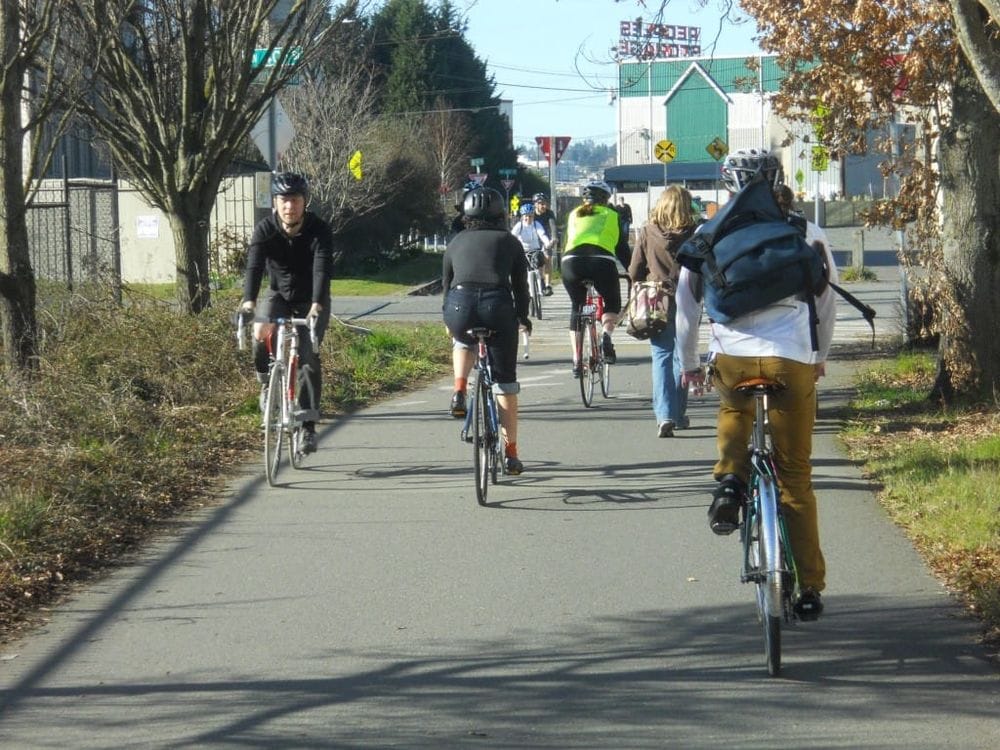
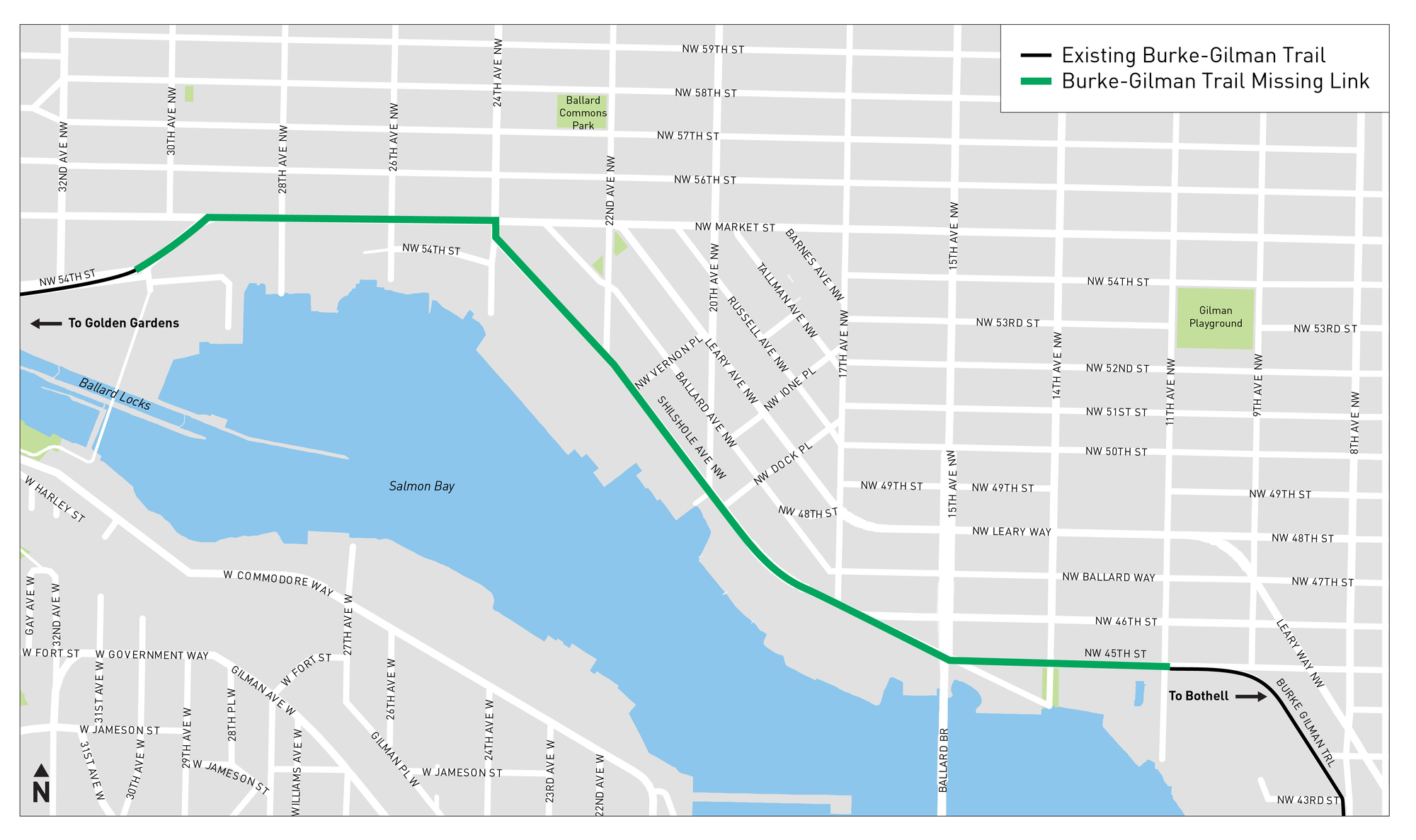
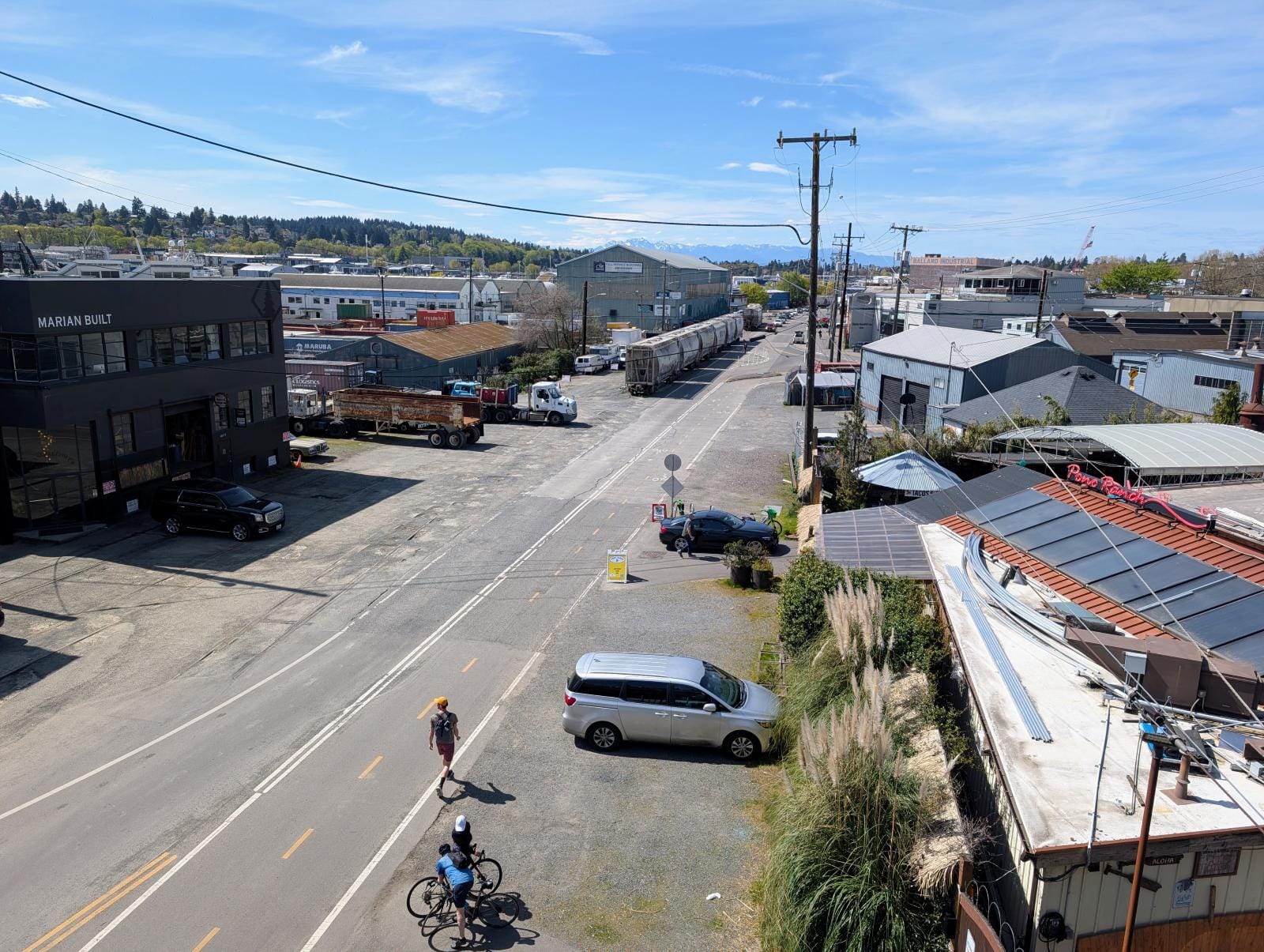
The never-ending quest to bridge the Burke-Gilman Trail across Shilshole Avenue through Ballard hit another road block Monday, with the Washington Court of Appeals ruling against the City of Seattle on the question of whether construction can proceed. The decision closes off a "fast" track that the Seattle Department of Transportation (SDOT) had been pursuing... for the last five years.
The ruling marks just the latest legal setback for the beleaguered project to close a 1.4-mile gap in a trail corridor stretching from Bothell to Golden Gardens.
Since 2008, a coalition of business owners, including Salmon Bay Sand & Gravel, the Ballard Terminal Railroad, and CSR Marine, have been fighting plans for a trail along the south side of Shilshole Avenue. The group, which now refers to itself as the Ballard Coalition, have argued that a formal trail would bring conflicts with freight vehicles and impede the viability of their businesses.
The tool business groups have been using to stop construction is the State Environmental Policy Act (SEPA). They've won previous legal fights to get the City to both complete a lengthy environmental analysis in 2017 and then to update it with an even lengthier economic analysis in 2019.
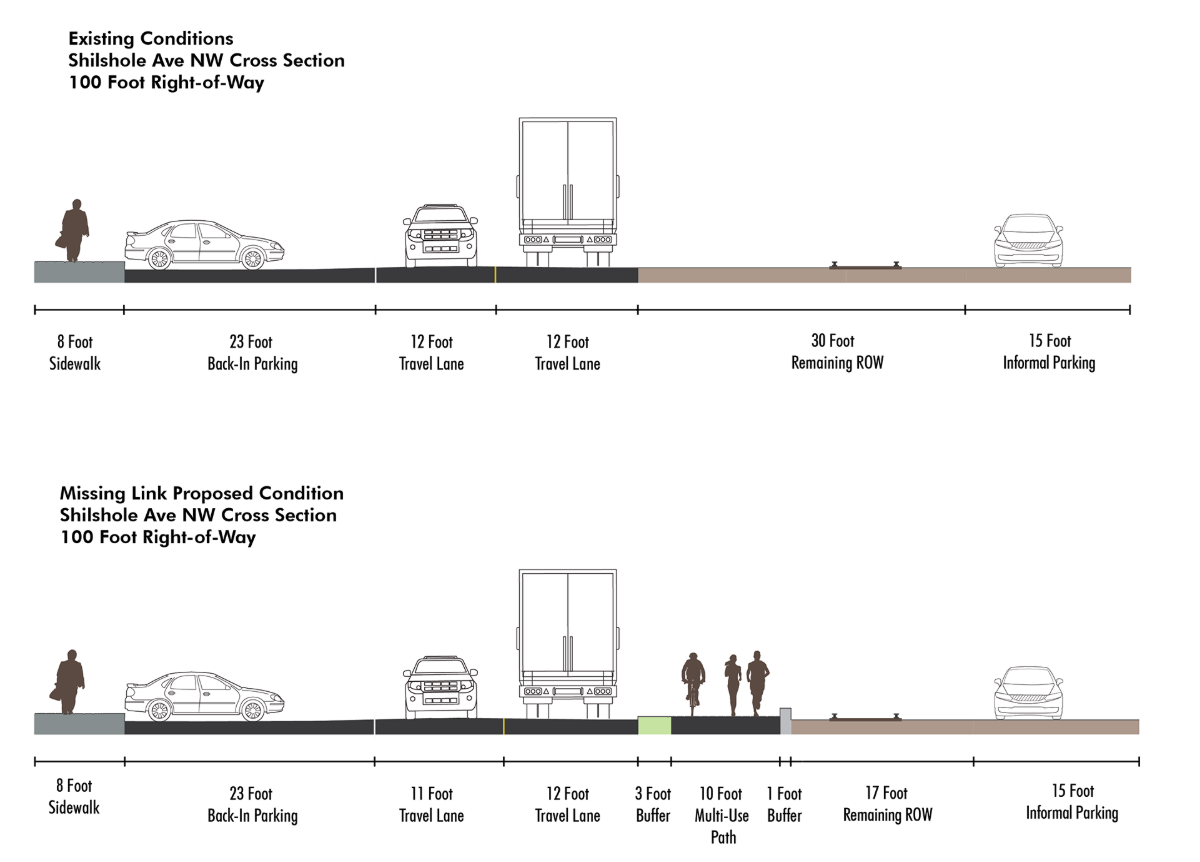
In 2021, SDOT tried a different approach, redesigning the trail to have a smaller footprint and avoid any rail line relocation that might rope a federal railroad hearings board back into the debate. At the time, Mayor Jenny Durkan's administration wagered that a slimmer design would speed up the approval process and shield against appeals.
But this week's 3-0 ruling, authored by Judge Janet Chung, upholds a 2023 ruling by the state Shorelines Hearings Board that found that the project still isn't exempt from SEPA, despite existing exemptions under state law for "bicycle lanes, paths and facilities."
"The City does not identify any facts that show that the Board failed to apply the standard of review correctly," Chung wrote. "Simply because the [Shorelines Hearing Board] arrived at a different conclusion than the City does not mean it failed to give substantial weight to the City’s SEPA-exempt determination."
The ruling is also a loss for Cascade Bicycle Club, which has been fighting alongside the City for years, after being granted intervenor status.
Despite redesigning the project fairly significantly, the court continually ties the City of Seattle to the previous iterations of the project, referencing internal emails that point to SDOT's strategy to find a path forward under SEPA and using those emails to spell out reasons that the trail isn't exempt, painting the city as trying to use a shortcut.
"[T]he record contains SDOT memoranda that explicitly mention the ongoing litigation as a reason for its redesigns to minimize the scope of the project," Chung noted. "Accordingly, the SHB’s determination that the 1.4-mile Missing Link did not fit within the City’s proclaimed categorical exemptions was supported by substantial record evidence."
At the same time that it was fighting to move forward with a route on Shilshole, SDOT has also been advancing plans for an alternative route supported by District 6 Councilmember Dan Strauss along Leary Way and Market Street. Though that route comes with significant issues, including more conflict points with cars – most notably at the Ballard Landmark senior living facility along Leary – this legal setback certainly bolsters its credentials.
The ruling comes at a time of increased scrutiny around process delays caused by SEPA, with Seattle's entire growth plan currently on hold until next year due to a pair of appeals that worked their way to the same court of appeals, which sent them back to the City for additional work. Other projects that have suffered SEPA-related delays include the Fort Lawton affordable housing project in Magnolia, and more recently a planned Winco Foods store on Aurora Avenue that had been poised to replace a vacant former Sam's Club.
The idea of reforming SEPA seems to be gaining more momentum, as a bike trail, affordable housing project, and a grocery store hardly seem poster children for the environmental dangers in the era of climate change. Nonetheless, a state legislative proposal last year to explicitly clear a path for the Missing Link in state law – and no other project – was unable to make it across the finish line.
During oral argument on this case back in December, Cascade Bicycle Club attorney Darwin Roberts noted the harmful status quo that the continuous legal appeals are keeping in place – maintaining a dangerous trail gap that has become infamous for hurting people on bikes.
"The coalition's argument [...] it's blind to the present hazards, which are unrebutted in the record. The Final Environmental Impact Statement shows that there are dangers today, every day, from the users of the road. There are bicyclists on that road right now, and the Final Environmental Impact Statement demonstrates that there is an increased incidence of traffic hazards as a result of the present condition of the road," Roberts said. "The coalition just told you they've been litigating against this for years, decades, almost. The hazards that occur today, they are blind to those, and it cannot be the case, it is not the case that SEPA requires those hazards to go on indefinitely."
Cascade Bicycle Club told The Urbanist that the organization is reviewing potential avenues to move forward.
"We are disappointed by the ruling from the Court of Appeals related to Shilshole Avenue and our efforts to make Shilshole safe for all users by closing the 'Missing Link' on the Burke-Gilman Trail," Cascade Executive Director Lee Lambert said. "We are reviewing the ruling with our attorneys to determine next steps."
Meanwhile, the Ballard Coalition took a victory lap Wednesday in a press release.
“The Coalition has once again proven that determined legal and political advocacy can overcome even the most entrenched political and special-interest opposition,” coalition attorney Josh Brower said. “The Court’s decision affirms and ensures that all voices including the unions, businesses, and industrial associations that make up Ballard's working waterfront, and not just the voices of well-heeled bicycle lobbyists, will have a say in where the City completes the Missing Link."
Now SDOT will be forced to decide whether to fully restart its environmental review, or try a different tactic. And so one of the longest-running sagas in Seattle bicycle advocacy continues into its next era, with cyclists no closer to being able to safely connect across the Missing Link.
 Doug Trumm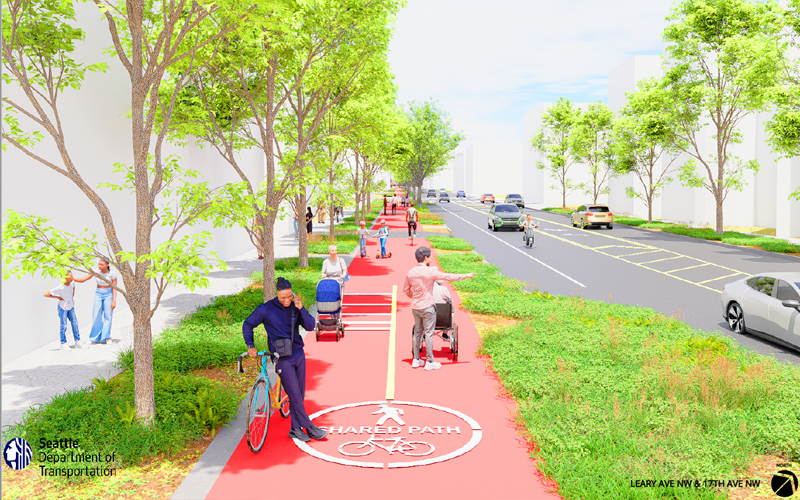
 Doug Trumm