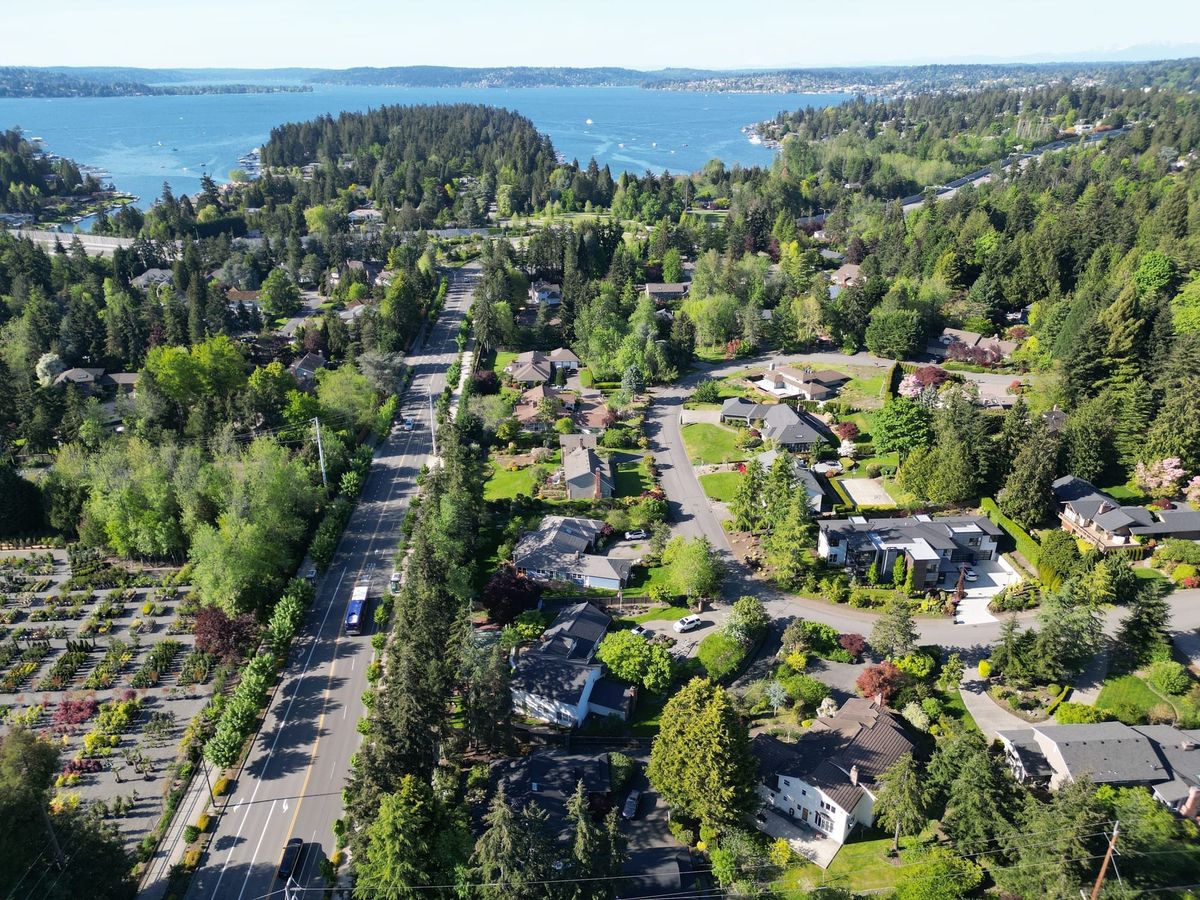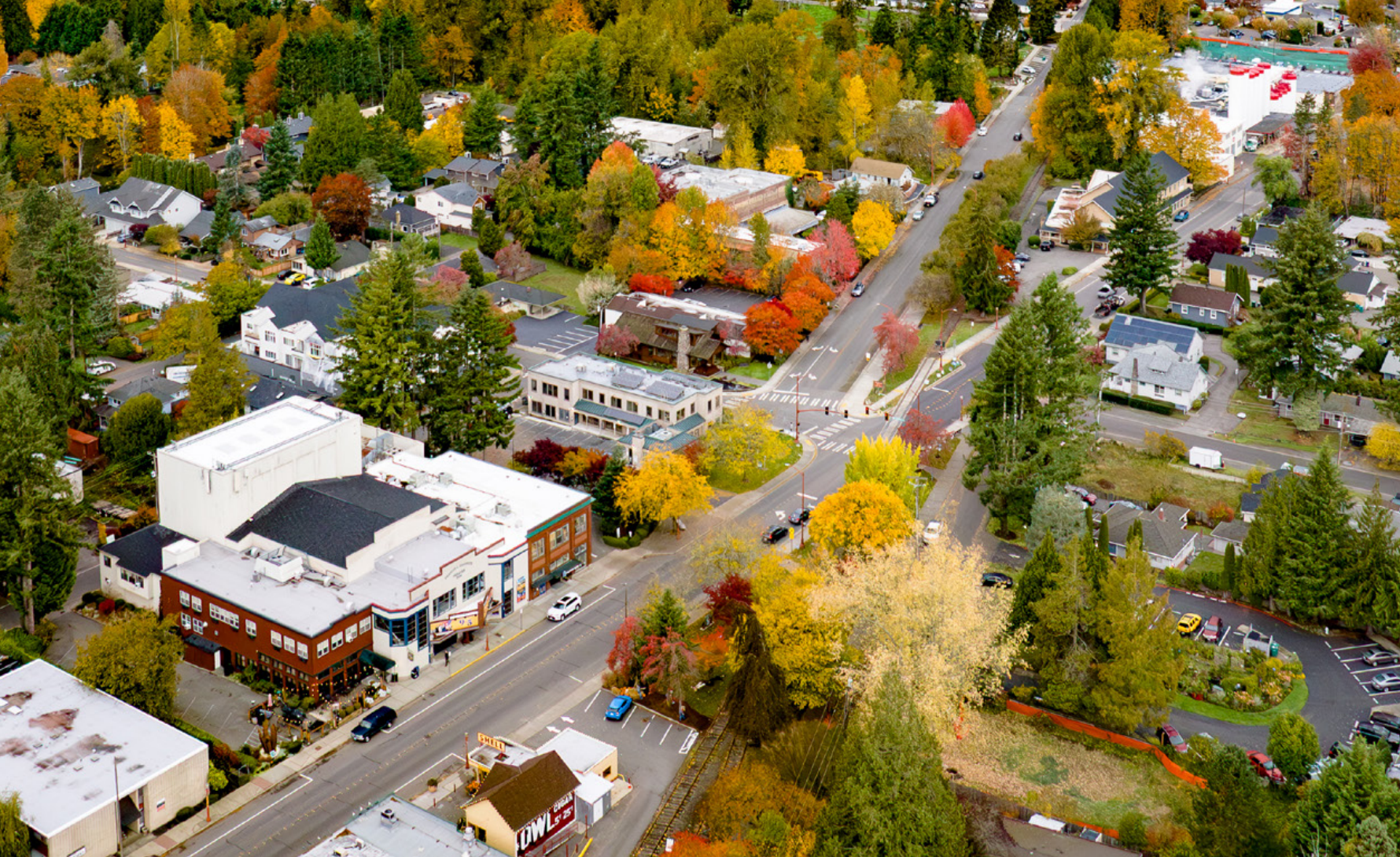
Clyde Hill, the Eastside city of 3,000 tucked in between Medina and Bellevue, has a budget problem. In five of the last seven years, city expenses have far outstripped revenues coming in, and reserves have been draining away.
While city leaders, including Clyde Hill's last two mayors, spent years pointing to an unsustainable budget trajectory, few steps have been taken across those years to address the issue. Despite the considerable wealth Clyde Hill residents contain in their portfolios and their homes – the city's 1,100 or so properties are valued at a collective $4.93 billion – lower tax rates are a major draw for city residents.
A vote taking shape this November could mark a turning point for the city, with Clyde Hill's leaders painting the decision as existential. Without getting back on a more sustainable financial path, they say, Clyde Hill could be forced to explore merging with a nearby jurisdiction like Medina or Bellevue – a nuclear option that most city residents would likely want to avoid.
This past Thursday, on the eve of the long holiday weekend, the Clyde Hill Council held a special meeting to advance plans for a property tax increase that will equate to a 69% hike compared to the current city rate. Though that will push the rate to $0.50 for every $1,000 of assessed value, still below the rates of most nearby cities, voters will be asked to sign onto the biggest local property tax increase in Clyde Hill in decades, and likely the city's history.
If given final council approval on July 14, Clyde Hill residents will be asked to consider a philosophical question with tangible impacts: how much is a city border worth to maintain?
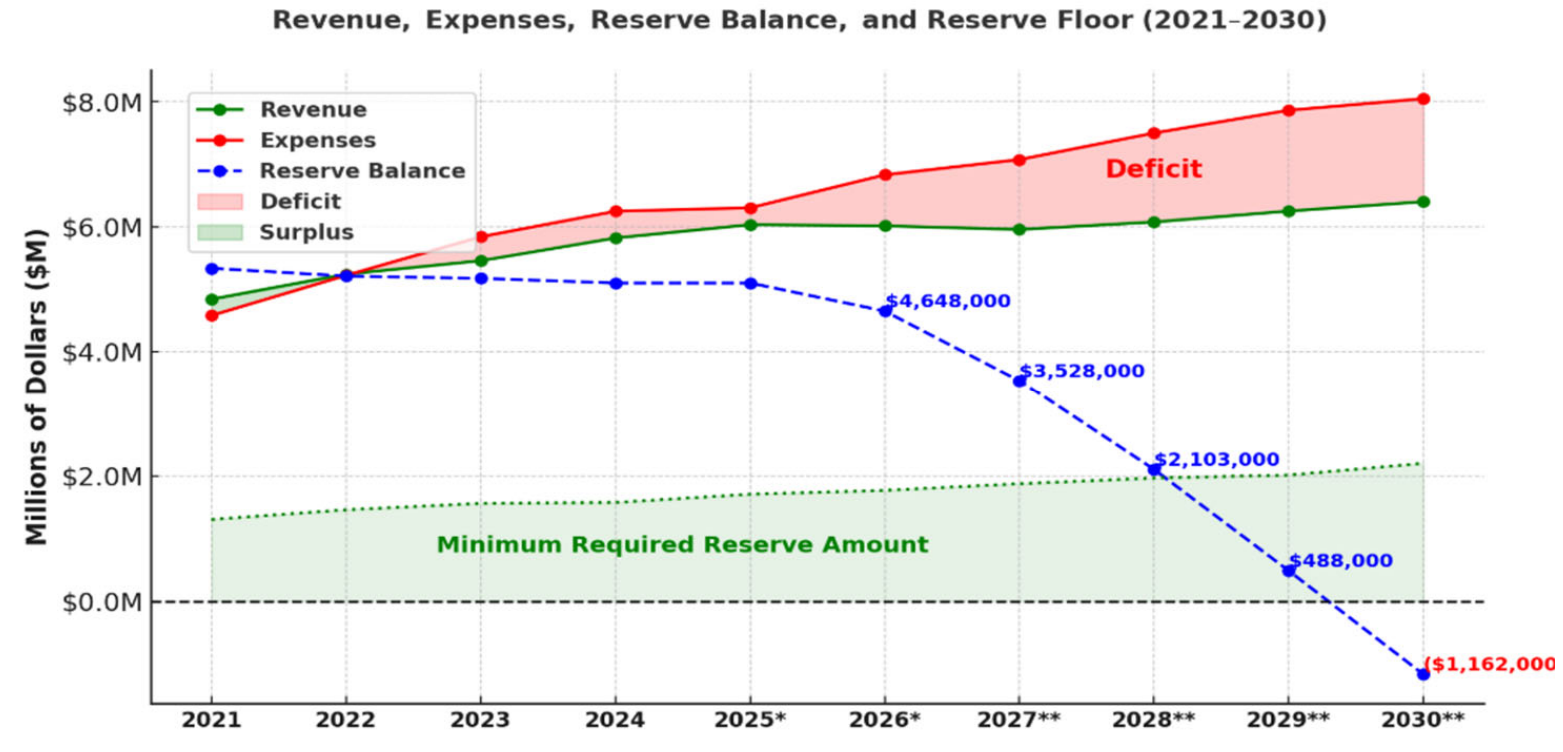
The recommendation to up the city's levy rate to $0.50 came from an independent Financial Sustainability Taskforce that the City Council established last year. Without taking some sort of major action, that taskforce's findings stated, the city would exhaust its reserves by 2030.
"Unless the city did something, it was going to go bankrupt or it was going to get absorbed by another city," taskforce member Wayne Burns told councilmembers Thursday. "In that case, taxes go up, and police services probably go down, and local control goes down."
Mayor Dean Hachamovitch, who was appointed last year following the resignation of former Mayor Steve Friedman, spent years chronicling the city's budget woes via a Substack newsletter.
"We got here by a process of denial and delay," Hachamovitch wrote in 2023, when a potential fix was still three years away. A few weeks earlier, Hachamovitch had written, "[t]he city administration has repeated different versions of 'further action is required' annually. There is no clear progress on a plan, or a plan for a plan."
Taking up just over a square mile of land, Clyde Hill incorporated in 1953, the day before its neighbor Bellevue made the same move. While Bellevue has swelled over the decades via annexation, going from 4.7 square miles to 36.5 today, Clyde Hill has stayed mostly trapped in amber. In 1970, the population of Clyde Hill recorded by the U.S. Census was 2,987 – just 113 people fewer than today.
In framing its decision to incorporate, Clyde Hill today cites a desire to "control land use development such as lot size and commercial zoning," with a 1953 report in the Seattle Post-Intelligencer describing lot-size restrictions as the "sole purpose" of becoming a city. Today there are just two commercial businesses in Clyde Hill – a gas station and a coffee shop, the Queen Bee.
After holding firm for decades, there are cracks starting to appear in the walls Clyde Hill has built to keep out change. The City is currently facing a legal challenge of its growth framework, brought by the land use advocacy non-profit Futurewise. The same type of appeal that forced Mercer Island to directly reckon with requirements to plan for affordable housing across different income levels and take steps to allow additional density, the challenge is set to prompt action in Clyde Hill later this year.
Clyde Hill has also been updating its land use code thanks to new state mandates, including a requirement to allow duplexes that came with 2023's House Bill 1110. Earlier this year, the city used an emergency ordinance to walk back allowances for cottage housing, severely limiting the types of housing that can actually be built under its new middle housing provisions.
These new state mandates are also being blamed for budget woes, with added consultant fees starting in 2023 cited as an extra expense that the city can't afford. It is worth noting, however, that the state Commerce department created a model housing code that was available for cities to utilize to reduce implementation costs – an avenue that Clyde Hill declined to take advantage of. Instead the city chose to create its own framework that gets much closer to the bare minimum required by law.
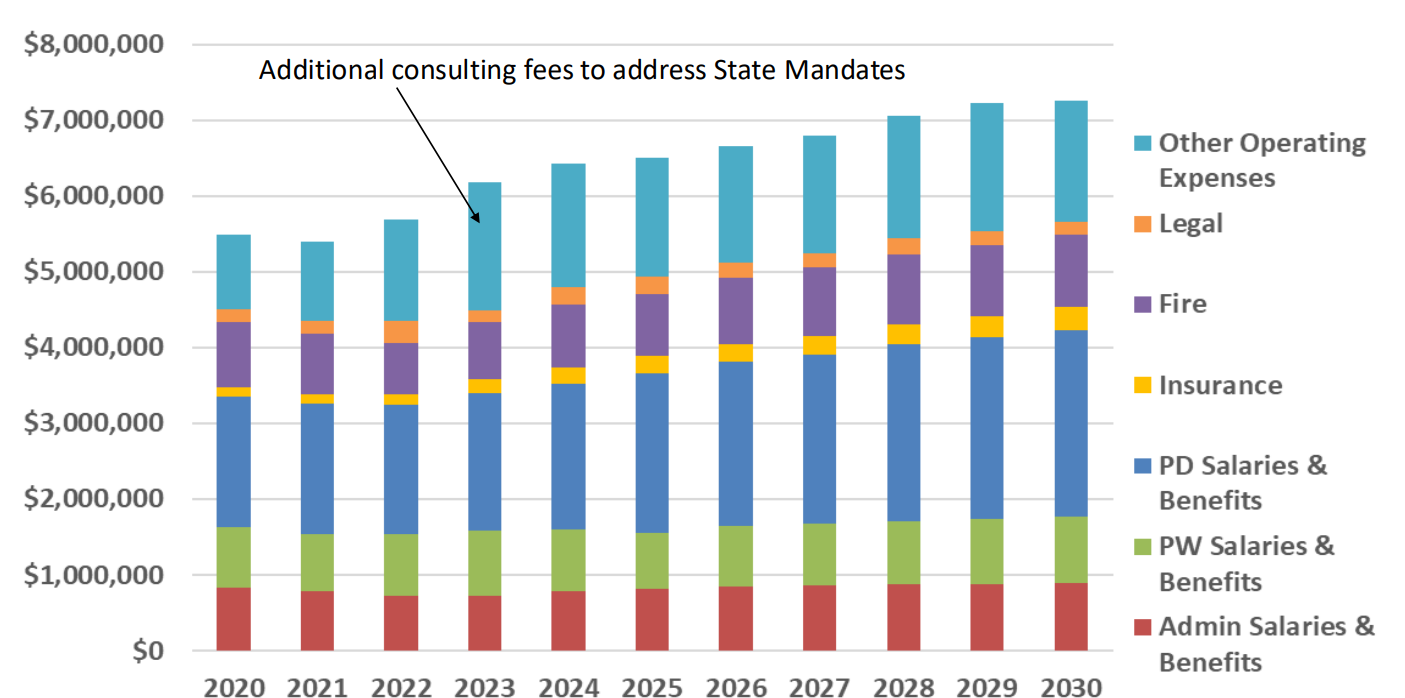
The line item that dominates spending in Clyde Hill is police and fire services, with 11 full-time employees compared to 3.75 in city administration, 3.25 in public works, and two in planning and development services. Of Clyde Hill's $6.7 million budget in 2026, $2.8 million is set to go to the city's police department, along with another $900,000 for contracted services with the Bellevue Fire Department – more than half of the city's annual budget. The $31,000 that the Clyde Hill Police Department has budgeted this year for uniforms is 77% of the salary of the employee tasked with working on the city's parks and recreation facilities.
But on top of maintaining control over land use issues, having a city-controlled police department is seen as a major reason for the city government to continue to exist.
"If you really wanted to solve the cash problem, you'd contract with King County [Sheriff's Department], and I would suggest calling the police the day before you need them," Burns said at a Council meeting this January. "If you do that, it's cheap, but you kind of get what you pay for in terms of responses."
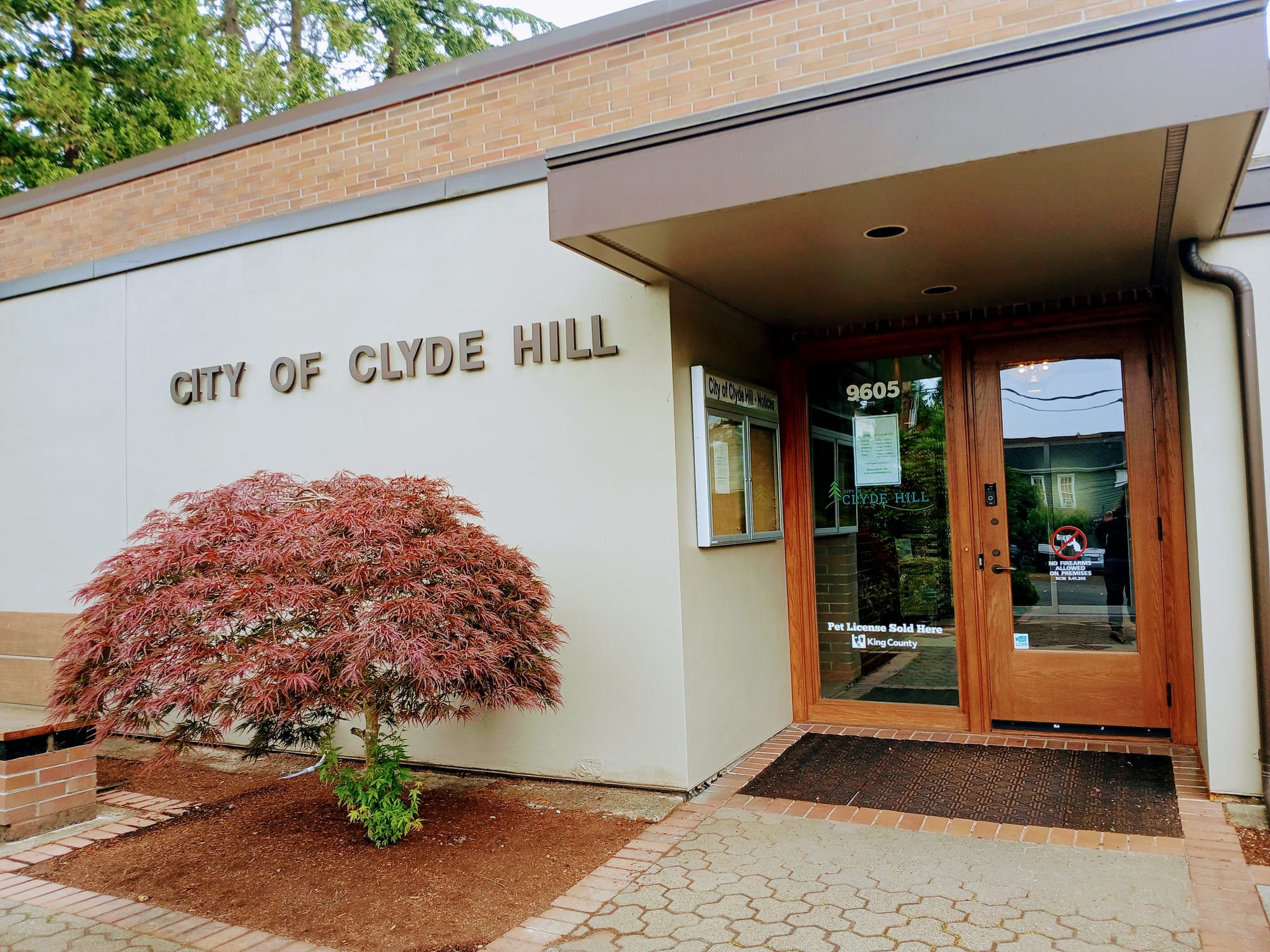
Over the years of grappling with a looming budget crisis, city officials did look at other available avenues to keep city tax rates low. Last year, the City Council hosted a meeting to discuss potentially asking voters to withdraw from the King County Library System (KCLS), creating an offset for any local tax increase. Hunts Point and Yarrow Point are currently the only jurisdictions in King County to have pulled out of KCLS, a fact that means residents there can't receive library services in King County or any other jurisdiction with a reciprocal agreement with King County.
That meeting saw library supporters turn up to voice strong opposition to the idea, with KCLS Executive Director Heidi Daniel laying out how many Clyde Hill residents currently engage with library services. While the idea hasn't resurfaced, it could at some future date.
"The City of Clyde Hill is at a crossroads," the members of the financial sustainability taskforce wrote to city residents in June. "In order to remain an independent city with local control of our own police department and land use, as well as fire and emergency medical services that we have all come to expect, the city needs to increase its property tax rate."
This November, Clyde Hill voters are poised to decide whether being an independent micro-city is worth the cost, or whether to force officials to consider a Plan B.
 Ryan Packer
 Ryan Packer