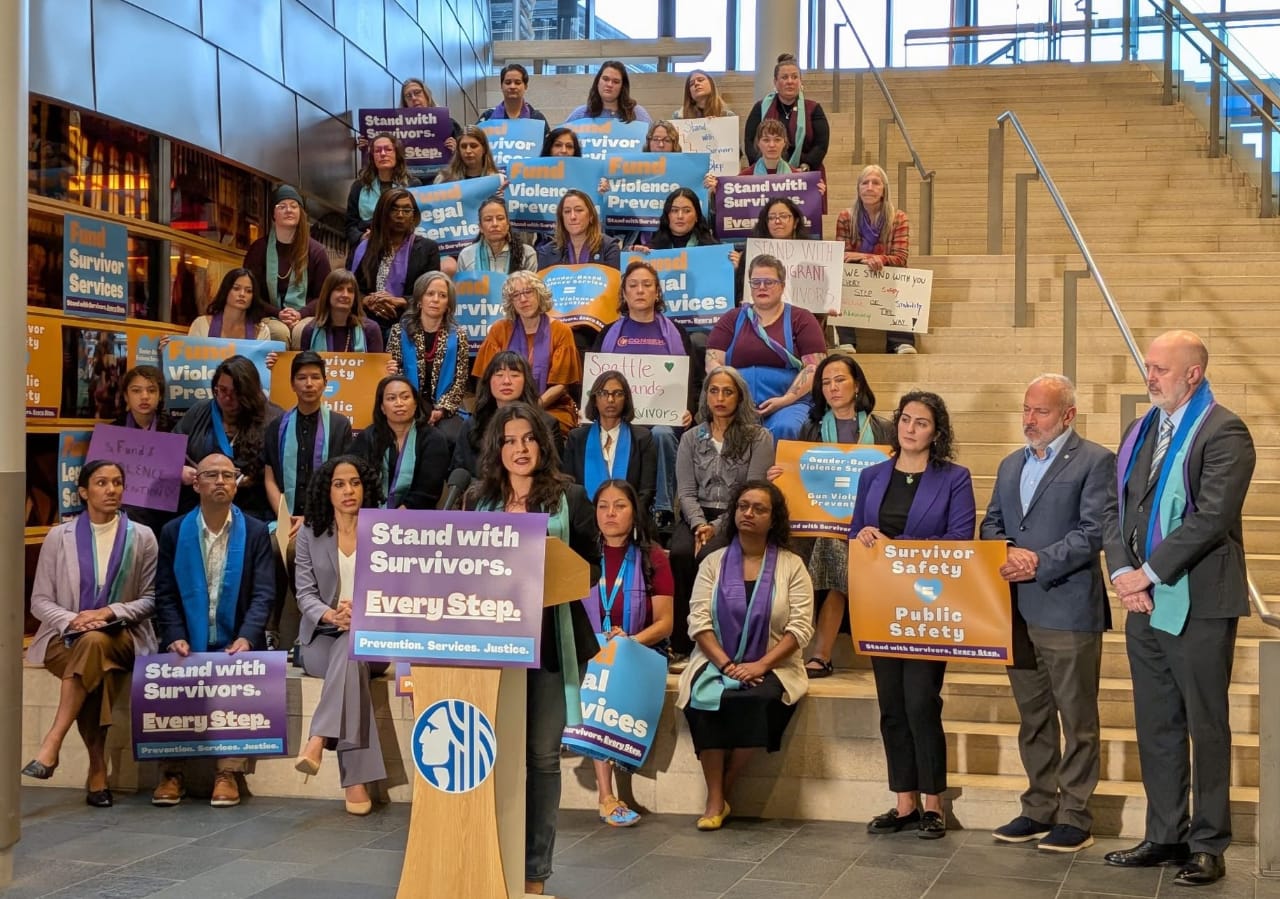
In the middle of a Seattle budget season marked by councilmember complaints and hyperbole, Councilmember Alexis Mercedes Rinck has stepped forward to announce her “Seattle Stands With Survivors, Every Step” campaign. While anti-survivor rhetoric continues to pervade the national news, the federal government under President Donald Trump is cutting key investments that have historically supported survivors of gender-based violence – and Rinck wants Seattle to step in to help fill the gaps.
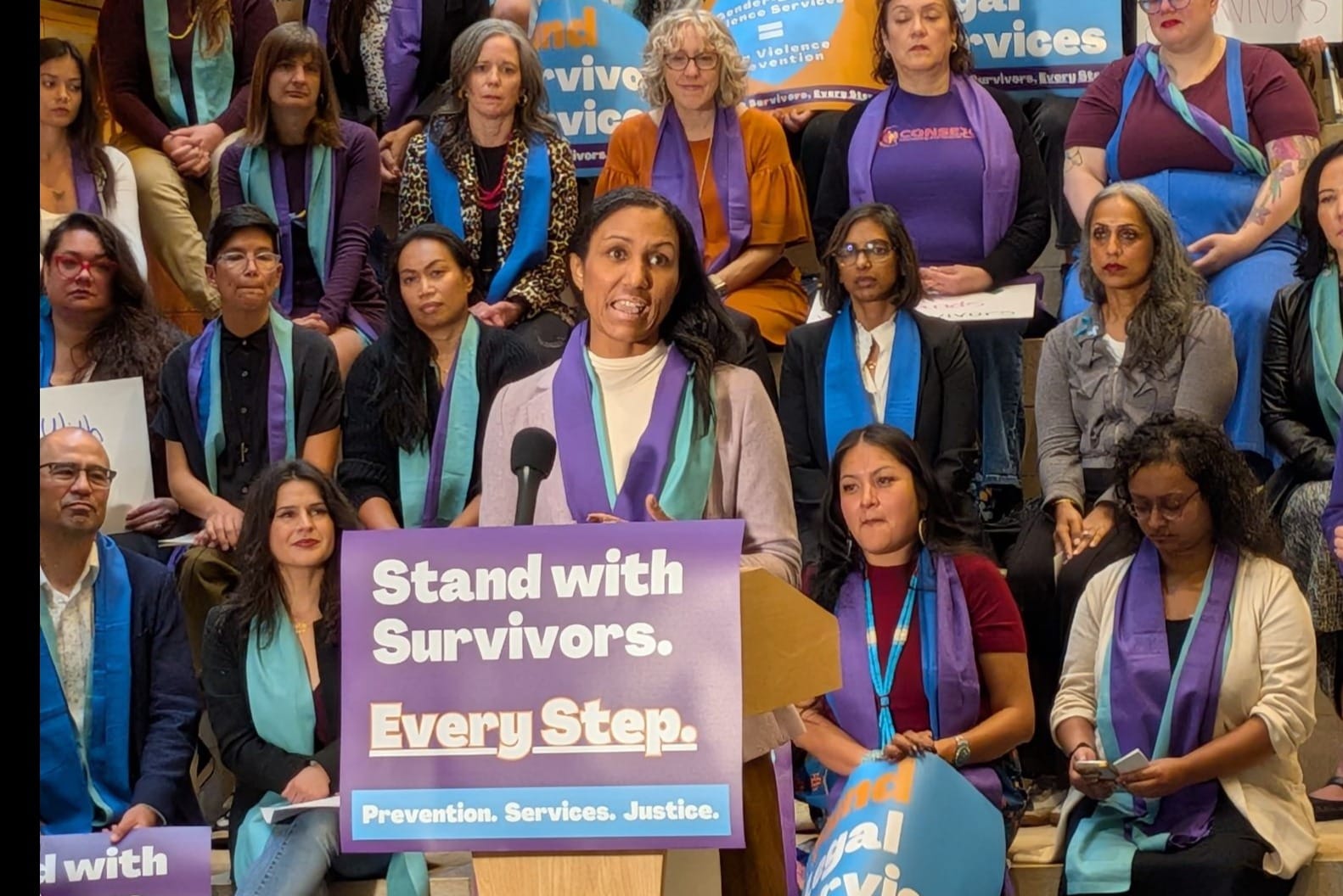
“Every two minutes, someone in this country is sexually assaulted,” Rinck said to kick off her press conference on Wednesday. “We cannot be serious about public safety in this city without also being serious about gender-based violence.”
“I stand here as your Seattle City Council member representing the Office of Position 8 and as a survivor myself,” Rinck continued. “I know what it costs to say those words out loud, but I know what it means when someone believes you and when someone is there to walk alongside of you. Every survivor in Seattle deserves that.”
Rinck wants to make $8 million in investments for survivors of gender-based violence in the 2027-2028 biennial budget to stabilize and scale up programs in three key areas: accountability for abusers and justice for survivors, direct survivor services, and prevention.
Rinck will also introduce a Statement of Legislative Intent (SLI) in order to help guide the work around funding and supporting these services in her Human Services, Labor, & Economic Development committee next year.
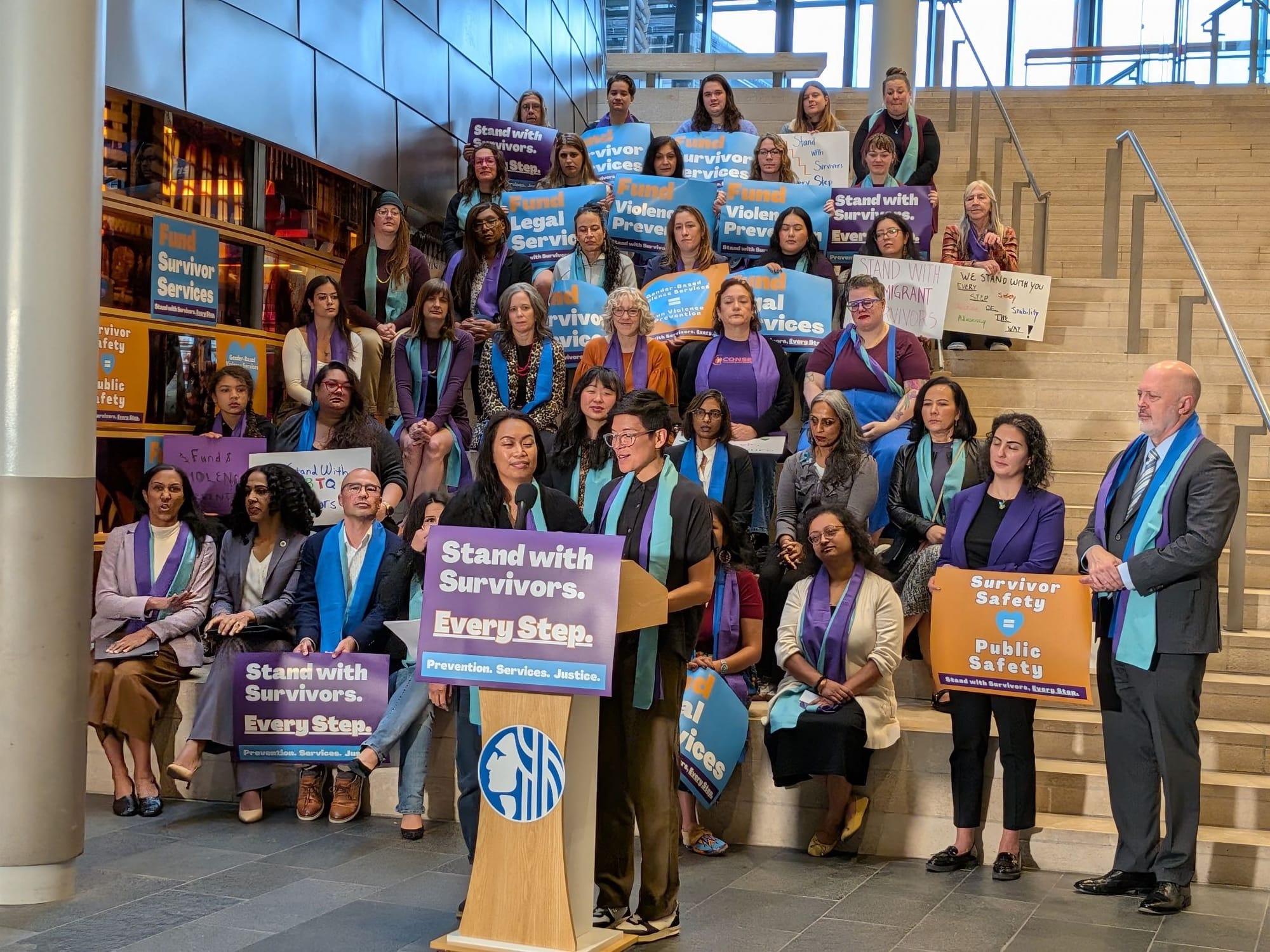
At her press conference, Rinck was flanked by fellow Councilmembers Dionne Foster, Eddie Lin, and Bob Kettle, as well as Seattle City Attorney Erika Evans, King County Councilmember Jorge Barón, State Representative Darya Farivar, and current LD-37 candidate for the State House Jaelynn Scott. Also present were many of the service providers with whom Rinck has been consulting to better understand the current needs in order to develop her campaign.
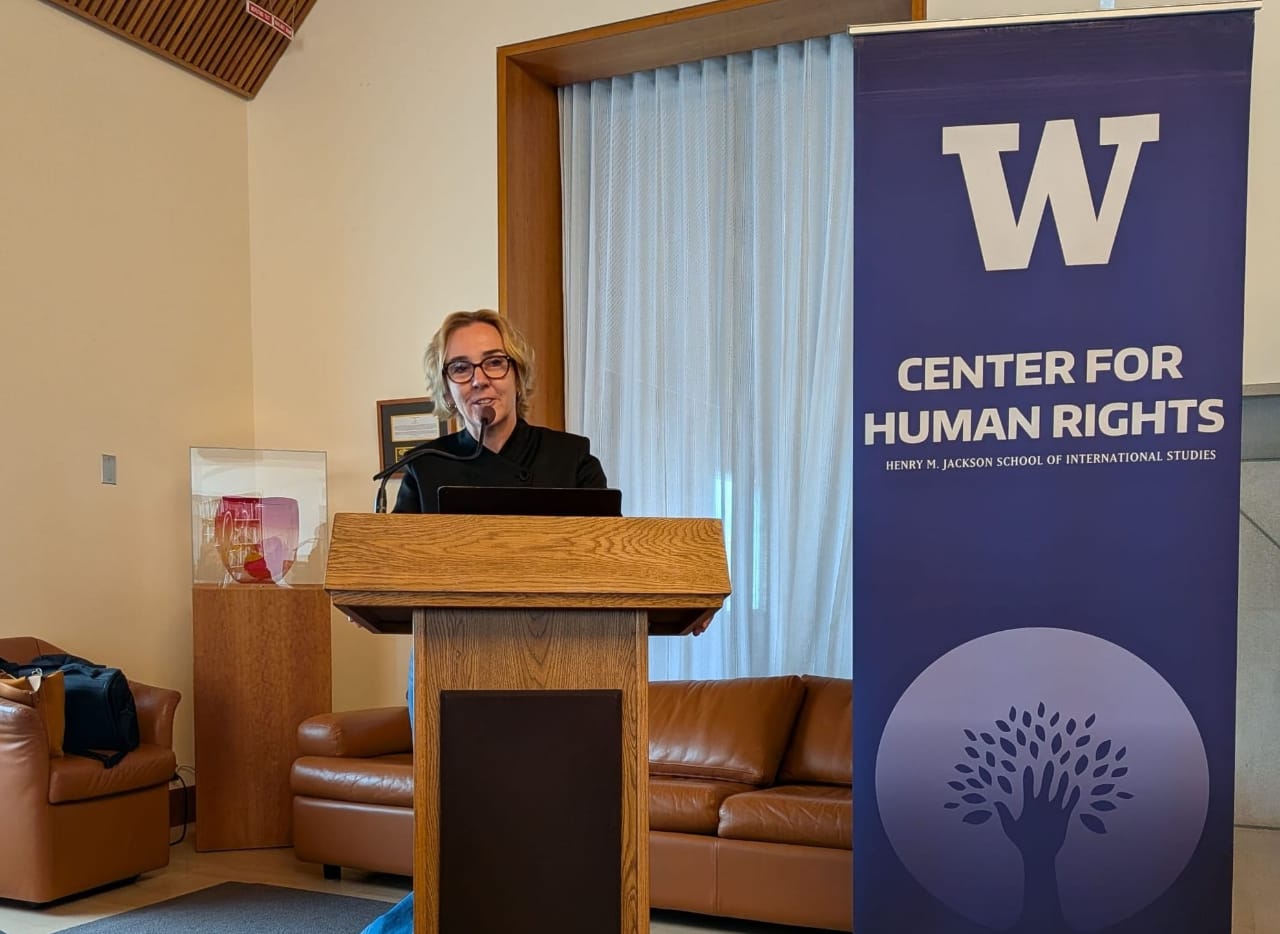
Riddhi Mukopadhyay, the executive director at the Sexual Violence Law Center (SVLC), said the average number of legal problems a Seattle resident who has survived domestic violence or sexual assault will experience is 19.7.
“Survivors cannot rely on the criminal system alone. Justice denied shows up costing more and hurting more,” Mukopadhyay said. “That's why community programs and legal services like ours matter. It's the collaborative network here that quietly keeps people housed, safe, employed, and in school. We don't make the headlines, but we do make the difference.”
Anti-survivor rhetoric becoming federal policy
Rinck spoke of the Jeffrey Epstein survivors who have spent years fighting to be heard, the case of the Cornell Seven gang rape, and the comedian opening Saturday Night Live by calling women who wear shorts in the gym “whores.”
“Three stories, one clear message to survivors,” Rinck said. “We don't believe you. It doesn't matter. Our fear and pain is just a joke.”
Rinck also mentioned the woman who was raped by a fraternity member at the University of Washington in 2022, who recently filed a suit against the university for failing to protect her from a known offender.
“I think that as we see the national news over the last several years, and we see the lack of accountability, the amount of corruption, and lack of consequence for this very significant and profound harm that survivors are experiencing, I think it's incredibly meaningful to have elected leaders and and local communities responding very unequivocally that this is not okay, and we need to actually make sure that survivors have resources and have support,” Amarinthia Torres, the co-executive director of the Coalition Ending Gender-Based Violence, told The Urbanist.
Feminist Soraya Chemaly linked the problem of pervasive campus rape directly to our society’s widespread patterns of impunity and lack of accountability.
“What I’m describing is [a] closed loop of institutional self-preservation, power, and elite freedom from accountability,” Chemaly wrote. “The mechanisms evident in cases of sexual violence — diffusing moral culpability and liability, protecting influential and powerful classes of people, forcing victims to absorb costs as individuals — are the same as those we see across corporate and political institutions that pervasively externalize the costs and violence required to maintain unaccountable power and a life with no limits for a few.”
In a period some people consider to be a backlash to the #MeToo movement, the news contains a litany of stories involving the Trump administration: the scandal of the Epstein files showing a web of power with a convicted child sex offender at its heart, the White House intervening on behalf of accused sex trafficker Andrew Tate, Russell Brand moderating a recent panel at a recent Make America Healthy Again (MAHA) summit right before going on trial for multiple allegations of rape and sexual assault, and Trump’s own civil liability for sexual abuse (a legal finding before he was elected to the presidency for the second time) as well as the scores of allegations of sexual misconduct.
Meanwhile, headlines decry the influence of the “manosphere” and its impact on violence rates against women and children.
Within this context, Trump’s administration has moved decisively in cutting financial support for survivors of gender-based violence, which is having impacts across the country and in Seattle specifically.
In addition to cutting social safety net programs like Medicaid and SNAP, which assist survivors in trying to rebuild their lives, H.R. 1 cut over $200 million from the Office on Violence Against Women as well as survivor-specific assistance within the U.S. Department of Housing and Urban Development (HUD). In the last two years, there have also been cuts to Centers for Disease Control and Prevention funding for violence prevention research, Department of Justice (DoJ) cuts to funding and training for child sex trafficking investigations and an attempt to cease grant-giving to organizations involved in Diversity, Equity, and Inclusion (DEI) work, and cuts to the Prison Rape Elimination Act.
In the wake of the Cornell gang rape investigation being re-opened, the Trump administration weakened the Title IX rules reverting to stricter guidelines for formal complaints and procedures and removing protections for LGBTQ+ students. Former President Joe Biden had strengthened these rules in 2024.
“It's important to note that many folks who disproportionately experience gender-based violence are marginalized and often erased people, and folks who are already under attack by other national policies right now,” Rinck told The Urbanist. “I'm thinking about immigrant women, women of color broadly, trans people, just to name a few.”
Rinck wanted to bring attention to the local impacts of the federal cuts, which include Aurora Commons reducing the service hours of its Safe, Healthy, Empowered (S.H.E.) Clinic, Salvation Army and New Beginnings anticipating major cuts to domestic violence transitional housing, and ReWA dealing with federal funding cuts to legal assistance and housing services for refugee and immigrant survivors. Some organizations are opting out of all DOJ grants due to the concern about possible restrictions around DEI values.
“We really see the root causes of gender-based violence being about rigid gender and gender inequity, so abuses of power and disparity,” Torres said. “And I think that those root causes are really important to name as we think about how we address harm when harm happens and when violence happens because the folks that are the most vulnerable, that are the most marginalized, that are the most objectified, that is when violence is occurring, is to those folks that are most on the margins and where we see dehumanization and objectification occurring.”
Organizations serving transgender people are seeing lessened philanthropic support, meaning fewer resources for transgender people who have survived gender-based violence. The ability for organizations to serve unaccompanied immigrant children who are often victims of gender-based violence has dramatically diminished. Immigrants who are survivors are afraid that if they share about their abuse or try to get help, they might be deported, Torres said.
Seattle Mayor Katie Wilson’s 2027 budget proposal ends some one-time investments in this space, including $500,000 for gender-based violence services and $400,000 for commercial sexual exploitation work, as well as a $285,000 cut to the Office of Civil Rights program providing funding for community-led domestic violence response and prevention programs. These are some of the investments Rinck is looking to restore.
Rinck told The Urbanist she’s also looking to restore federal cuts to help stabilize programs and to help programs improve their staffing ratios.
Separate from Rinck’s $8 million plan, Foster will be introducing an amendment for a one-time budget add of $1 million to help address the Seattle City Attorney’s Office’s backlog of domestic violence and other cases. Seattle City Attorney Erika Evans shared that of the 5,000 case backlog inherited from her predecessor Ann Davison, 1,700 of them are domestic violence cases, referencing a recent case that had taken almost two years to be filed.
Budget prospects
Seattle’s October revenue forecast, delivered last Friday, was not as rosy as some councilmembers might have hoped. From 2026-2028, the forecast predicted only $8.8 million in total additional revenues, meaning the city council will have very little wiggle room to fund their priorities in the current budget proposal without also implementing cuts.
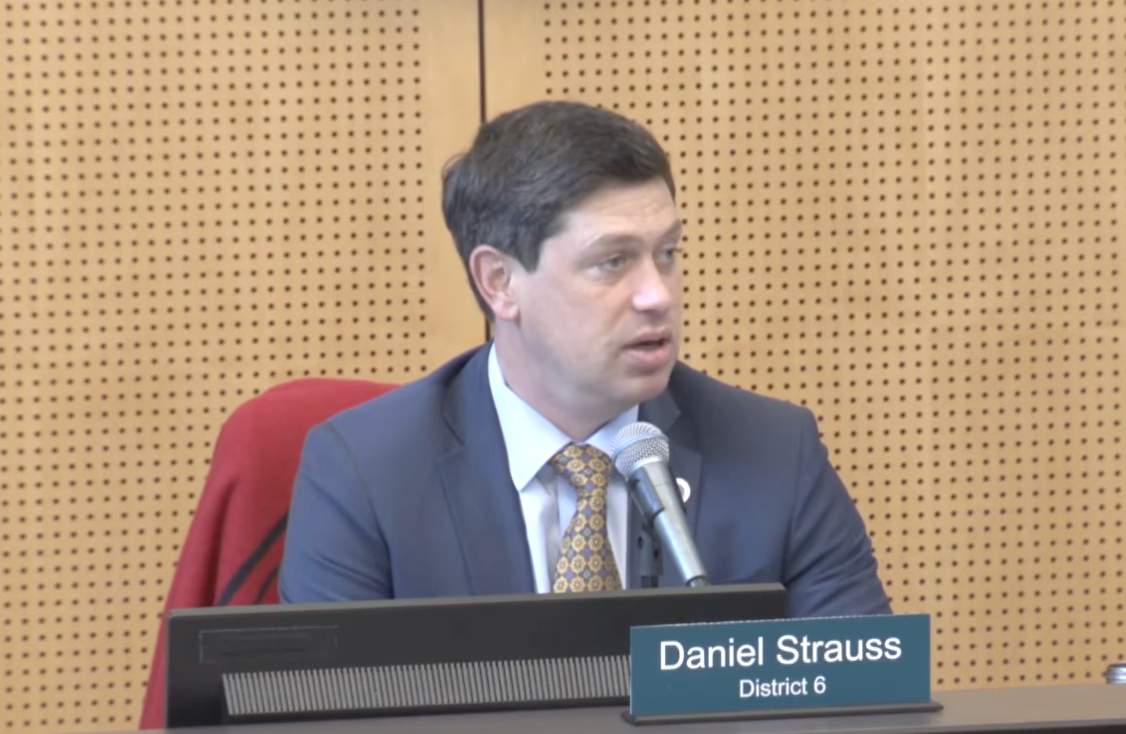
“I would consider this a bad forecast, even though it could be much worse. This is one of the smallest increases in the last several years,” Budget Chair Dan Strauss told The Urbanist. “We are being asked to do more with less. The federal government continues to try and defund basic services, from SNAP benefits to permanent supportive housing. While we received a very small revenue increase in this forecast, Seattle is also being forced to take on more financial responsibility for doing the federal government’s job.”
Councilmember Bob Kettle has been vocal in criticizing Wilson’s budget proposal, particularly as it pertains to public safety: primarily the Seattle Police Department (SPD) and the Seattle Fire Department (SFD). Kettle has expressed particular concern over the plateau – at 1,250 officers – in SPD staffing that would occur at the end of next year, given that he believes the City requires 1,400 officers or more.
Some councilmembers also expressed concern that more money wasn’t being invested in the Unified Care Team that performs sweeps of unhoused people around the City.
Given the budget crunch, it is unclear if Kettle would have the votes to further fund a police department that is already receiving a larger increase in investment than any other City department under Wilson’s proposal. There does seem to be a stronger consensus amongst councilmembers to try to reverse the $7.1 million cut to SFD’s overtime budget.
A spokesperson from SFD clarified to The Urbanist that the unit outages it experienced in 2025 were unplanned, as opposed to the planned outages that would be taking place under the overtime restriction in 2027.
“As a result of unplanned unit outages in 2025, the department reinvested some of that funding in areas that surpassed their planned budget, including workers compensation (as a result of personnel injuries), minor equipment costs (as a result of inflation), and fleet maintenance and repair,” the SFD spokesperson said.
Last week, Central Staff member Ann Gorman told the council the unplanned 2025 SFD unit outages didn’t appear to impact response times.
The almost-flat budget forecast might not bode well for Rinck to be able to garner enough support from her colleagues to add $8 million in funding over the next two years for gender-based violence programs. Rinck assured The Urbanist she intends to fight for the investment, but she sees the campaign as a multi-year effort that will also involve work within her committee.
“We're daylighting this issue because we need to talk about gender-based violence,” Rinck said. “Far too many of the messages that women in the U.S. have gotten in the past week – past two weeks, past year, if I'm being honest – have been that gender-based violence and forms of sexual violence attached to that: people who perpetuate that will not be held accountable, or that people don't care, or that this is just a joke. And I think it's tremendously important that people in positions of power right now send a different message that we're actually not going to tolerate that, and we are going to hold you accountable.”
“Everybody knows a survivor of gender-based violence,” Torres said.
 Amy Sundberg
 Amy Sundberg