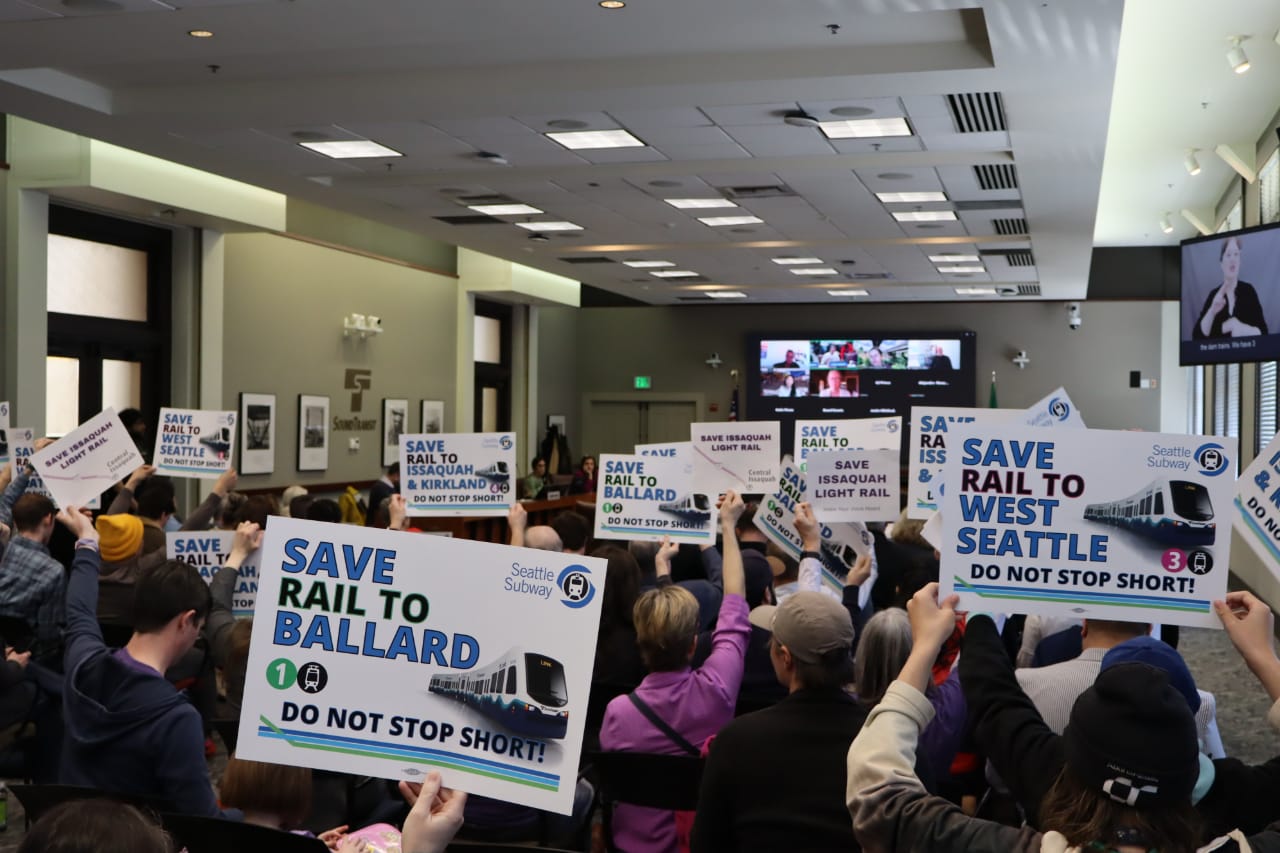
Members of the Sound Transit Board of Directors are facing a weighty decision over the next few weeks, ahead of a scheduled May 28 vote to rebalance expansion plans that have been on the books for years. On Thursday, the board's Executive Committee took its first stab at a proposal by Chair Dave Somers to keep some Sound Transit 3 (ST3) projects on track and indefinitely defer others, including nearly half of a light rail line between SoDo and Ballard and several long-promised infill stations on the existing 1 Line.
The agency is now referring to the Somers proposal as the "affordable ST3" plan. Thanks to cost-saving measures already unearthed by Sound Transit's capital team, and some revenue levers that the agency has been able to pull, the much-publicized $34.5 billion gap through 2046 has been reduced to a $13 billion gap in the capital program, with the horizon of the financial plan now stretching to 2052.
Even at reduced levels, the gap means Sound Transit can't provide a completion date for the full Ballard Line, on top of a new six-year delay to the future 4 line between South Kirkland and Issaquah, pushing it to 2050.

Though not all board members fully showed their cards Thursday, it became clear quickly that the Somers proposal is a pill that many will be able to swallow, and is viewed as a marked improvement over rebalancing options that the board looked at in March. Board Vice Chairs Girmay Zahilay and Ryan Mello did everything but directly add their stamp of approval to the plan, noting collaboration with Somers over the past few weeks.
Seattle Mayor Katie Wilson also provided a glass-half-full perspective when her turn came to frame the proposal.
"We do not have the luxury of wasting time or momentum, and my top priority in this process is that we maintain the momentum so that we can build that trust with the voters that we are going to deliver this whole package, come what may," Wilson said. "In my mind, we are certainly not canceling projects, and we are not delaying projects. We are not deferring projects. We are making the decision that we need to make right now so that we can move forward and we can do everything that it takes to deliver all of this as fast as we can."
Since Sound Transit will continue to advance design work on all of its rail projects, including the ones that no longer have a firm construction date, the hope is that refinements down the road will unlock additional dollars, on top of added support that may come from outside the agency – either future federal dollars or a golden parachute from the state legislature in the form of additional revenue tools.
With the Somers proposal, Sound Transit expects to get to 92% of the 650,000 additional daily transit riders that had been projected with the full ST3 buildout, but only serve 77% of the zero-vehicle households that would have seen a rail station built near them under ST3. That disparity seems to stem from the prioritization of the commuter-heavy "spine" of the system in the form of extensions to Tacoma Dome and Everett Station, as opposed to bringing rapid transit to places like Ballard and Graham Street.
Unsurprisingly, push back on Thursday came most strongly from board members who directly represent areas where projects would be put in limbo.
Tukwila Mayor Thomas McLeod pressed staff on criteria used to put a 1 Line infill station at Boeing Access Road on ice, despite being promised to voters in Sound Transit's first ballot measure in 1996. While Sound Transit uses a racial-equity toolkit (RET) to evaluate projects during their development stage, the framework to rebalance the entire system plan was not subjected to that toolkit, a fact that McLeod objected to given underrepresented communities in South King County that would be served by Boeing Access Road.
Seattle Councilmember Dan Strauss also came out swinging on behalf of Ballard Link, which would be truncated under Somers Plan. Rather than reaching Interbay and Ballard, construction would halt at Seattle Center, if Sound Transit is not able to unlock additional opportunities to advance further over the coming years.

"I appreciate that we have a better plan before us today, in just a few weeks, and that is simply because you put Ballard back on the table with 100% design to get to 15th and Market Street. That's no small feat in four weeks," Strauss said. "With that, we still do not have a date for Ballard. This is still a loss. Again, this is the only metropolitan regional center in the entire Sound Transit district that will not be connected by Link light rail on this planet. And that's a loss, without having a date – we had a date before [the] Enterprise Initiative. We do not have a date today. That is a problem. That is a loss."
Somers told The Urbanist in an interview following the meeting that the lack of a timeline to get to Downtown Ballard doesn't mean that Sound Transit won't get there – cold comfort for Ballard residents wondering how old they'll be when rapid transit finally reaches them.
"We're going to continue engineering and design for Ballard all the way to Market Street," Somers said. "We know we have to either find new financial capacity or resources to actually build it. So, it's pretty hard to estimate a time when those opportunities are unknown. So I understand the desire for a date, but it's very hard to estimate when we just don't have the money currently, but we're going to be looking for it."

With only six days between Thursday's meeting and the deadline to submit initial amendment proposals, the timeline is clearly tight. The reason for that fire under the board is being framed as West Seattle Link, currently next in the construction queue but in limbo as the agency considers its larger planning schedule. A Record of Decision issued by the U.S. Department of Transportation last year could be in jeopardy, according to Somers.
"The board last fall funded work on that project through June," Somers said. "And also the Federal Transit Administration has told us we need a plan, or they're not processing anything. So we've got to get the plan in place to continue working on, particularly, West Seattle because it's out in front, but all the other projects also."
Numerous board members framed their work as just beginning, with a strong push at the legislature in the 2027 session to advance new funding opportunities, including a 75-year-bond bill that fell short of the finish line earlier this year.
"I see this as a need to present a 'yes and' proposal," King County Councilmember Teresa Mosqueda said. "Yes, we hear you that the community and this board want the full Sound Transit 3, and we recognize, in order to accomplish that, you need to have additional financing tools. I think that message is going to really resonate with members of our state legislative delegation."
Potential amendments signaled by board members likely won't get entire projects restored, but look to strengthen accountability when it comes to the work ahead. If additional funds become available, how exactly projects in limbo should be prioritized currently remains opaque.
"I want more clarity around where we go from here," Zahilay said. "In other words, in the next couple of years, as additional financial capacity is uncovered through the design work, through additional partnerships, through financing tools, how will we make decisions, and how can the public be confident that their priorities are going be moved with urgency? So, I'm interested in including additional accountability measures, whether that is in the core proposal or through a companion resolution, especially with respect to the Ballard Link extension."
Transit advocates are pushing Sound Transit to get even more creative, to consider things like automation of the Ballard Line that would allow stations to be much smaller, shaving billions off the cost. But Sound Transit staff have been reluctant to pick those ideas up, citing the risk of process delays as a primary motivation on top of secondary concerns around station capacity. Ten years after voter approval, Sound Transit still hasn't been able to advance Ballard Link into a final design, but major changes could risk federal approval.
When it comes to project financing, Issaquah Mayor Mark Mullet has been garnering attention for advocating for Sound Transit to look at going to the voters to raise its statutory cap on debt capacity, getting projects built sooner. Washington state law restricts Sound Transit from issuing non-voted debt exceeding 1.5% of the assessed property value within its district, but voter-approved bonding would allow additional debt capacity.
At the same time, Mullet is pushing for design work to be accelerated, a bid to unearth more cost-saving measures that will make it clear that projects can be built sooner. Issaquah's leaders have already put forward a slew of ideas that could potentially save billions – a real possibility considering the 4 Line hasn't even entered project development yet.

"The estimates in this package have the Eastside line still at $8 billion and I think that number can drop by more than half," Mullet told The Urbanist. "And so if we can get some money to work with Sound Transit engineers on these concepts now and we show that we can reduce this line by more than half, then all of a sudden you get some flexibility on the debt capacity. And then it's a whole different ballgame."
Public sentiment is fairly unambiguous when it comes to completing the system, a fact that should give board members some wind in their sails. The public survey Sound Transit put out earlier this spring brought in nearly 18,000 responses – with 65% of respondents pushing Sound Transit to look for additional state or federal funding as a first or second-most important action to take. Meanwhile, 69% of respondents cited Link light rail projects as the most important for the agency to pursue.
On Thursday afternoon, the Executive Committee will hold another special meeting, to hear from members of the public after having to cut off comments last week in the interest of time. With the clock ticking down, it looks like the agency's course ahead is mostly set.
 Doug Trumm
 Ryan Packer