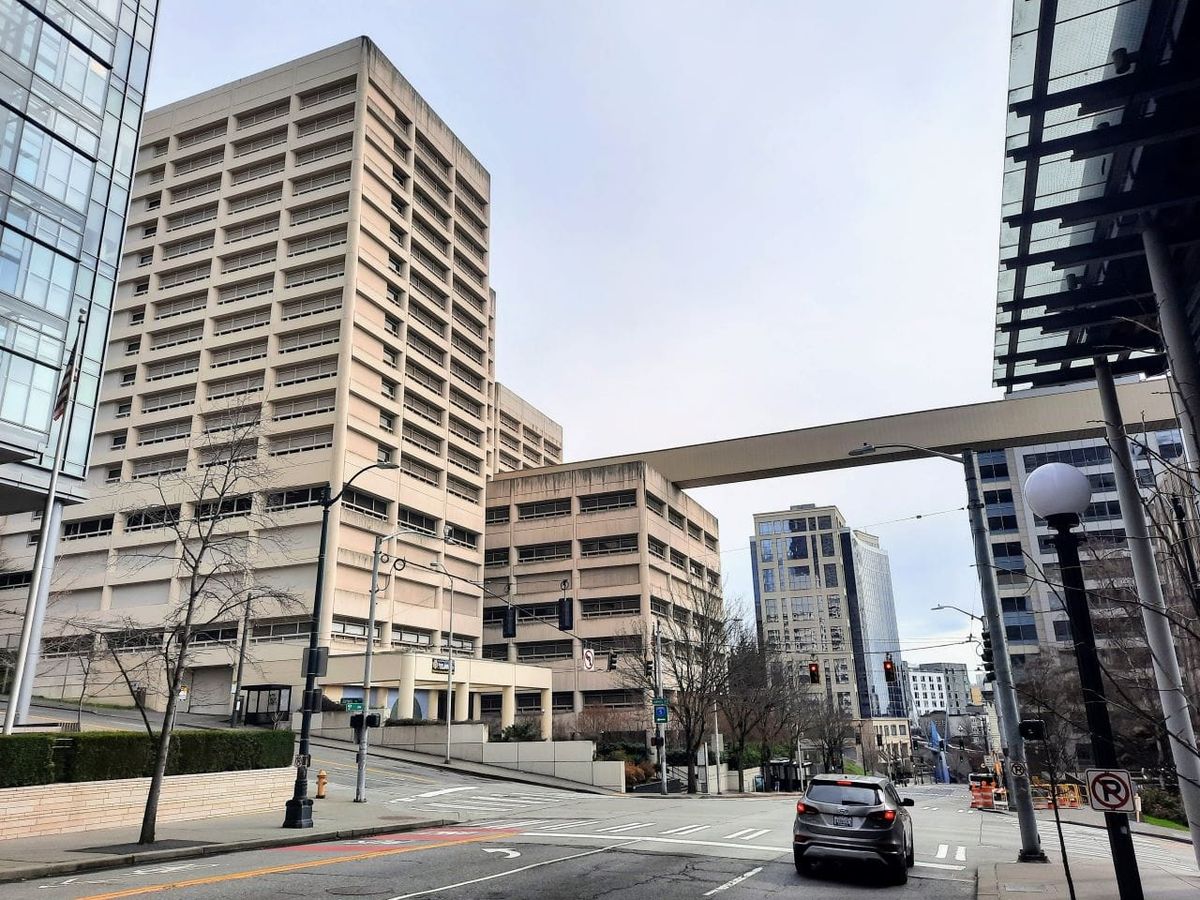
Amassing 12 inmate deaths since 2023, SCORE continues to face criticism.
The South Correctional Entity, known colloquially as the SCORE jail, released a new unexpected fatality report in April, as required under state law. SCORE’s Executive Director Devon Schrum and Operations Chief John DiCroce authored the report examining the death of Said Ali Abdulkadir, a 36-year-old Black man, in SCORE’s custody last March. The review hints at potential lapses in safety protocols, even as SCORE executives commended staff for their handling of the tragic event.
Abdulkadir died of a drug overdose of combined fentanyl, diazepam, and methamphetamine, according to the report, which was unable to ascertain how the drugs made it inside the jail.
Following an arrest on an outstanding warrant by the City of Tukwila Police Department, Abdulkadir was booked into SCORE the afternoon of March 21, 2025 and housed in the Medical unit at the Des Moines, Washington facility. After “completing medical protocols,” the report says Abdulkadir was transferred to a General Population unit on March 25 at 1:23pm.
About three hours later, at 4:17pm, security footage showed Abdulkadir inhaling something. At 4:57pm, security footage shows a cell mate appearing to give him aid. “This cellmate did not summon for help and appeared to move the decedent in a manner to make it appear the decedent was changing positions each time corrections staff passed by,” the report reads.
In fact, Abdulkadir wasn’t given medical aid from SCORE staff for almost four hours after the inhalation. At 8:09pm, the cell mate shared Abdulkadir’s condition with other cell mates, who informed facility staff. At that point, corrections staff, including two nurses, began rendering aid until a fire aid unit arrived at 8:21pm and took over, eventually transporting Abdulkadir to a hospital.
Later that night, at 2:20am and 4:41am, Des Moines Police Department logged calls for service from SCORE’s street address, both for reports of physical assault.
Abdulkadir died in the hospital on March 28. He had been incarcerated 13 times previously at SCORE.
An incident command debrief form for this event obtained by The Urbanist via a public record request said that after Abdulkadir’s departure, a “complete shakedown” of his unit occurred, which included universal strip searches. “As a result of this search, five (5) separate contraband incidents occurred and suspected drugs were secured in SCORE evidence lockers,” the debrief read.
In spite of the four-hour lag time between the overdose event and SCORE staff becoming aware of the issue, the debrief characterized the staff’s response to the incident as “great” and said they would be formally acknowledged in their performance logs.
According to the report, SCORE referred Abdulkadir’s cellmates for prosecution. The only additional recommendation that SCORE executives made was to obtain a narcotics detection dog.
SCORE’s history of deaths
SCORE jail is a public facility owned and operated by six south King County cities: Auburn, Burien, Des Moines (where the facility is located), Renton, SeaTac, and Tukwila. The first multi-jurisdictional jail in Washington state, SCORE operates through a series of interlocal agreements with local governments.
Many local cities contract with SCORE for jail space. The Port of Seattle, for example, which recently had its prices updated for 2026, pays $155.69 per day for its 15 guaranteed general population beds at SCORE, and $223.83 for any additional beds. Daily surcharges kick in for mental health residential beds and medical and mental health acute beds. The booking fee is $95. Cities that haven’t updated their prices since 2025, like Bellevue and Shoreline, pay slightly less.
Last year, PubliCola reported that 10 people died while in SCORE custody in the two years from 2023-2025. At least two additional people have died in SCORE custody since that reporting: Abdulkadir in March 2025 and Ronald Gunter in October 2025.
King County had a short-lived three-month contract with SCORE in 2023 that ended after the King County Department of Adult and Juvenile Detention (DAJD) determined that not enough people incarcerated at the King County Jail were eligible to be moved to the SCORE jail.
The City of Seattle also had a contract with SCORE that was approved by the city council in August 2024. Soon thereafter, the City negotiated a new contract with King County for expanded usage at the King County Jail that lessened its need for more jail space elsewhere. Councilmember Alexis Mercedes Rinck pushed to appropriate $300,000 in SCORE jail underspend in last August’s supplemental budget to pay for legal defense for unaccompanied children facing detention and deportation.

Concerns about detainee wellbeing have led some Seattle elected officials to completely avoid using the facility. During her campaign, Seattle City Attorney Erika Evans told The Urbanist she would not be sending anyone to the SCORE jail.
On the other hand, some councilmembers are eager to make use of the jail, given finite capacity at the King County Jail and campaign pledges to get tougher on crime. During a Public Safety Committee meeting in late May, Councilmember Bob Kettle criticized the City for not having a SCORE contract.
“We lack leadership that is sustained with an element of follow-through and follow-up. We lack the implementation by the executive branch over time, not just this administration, previous administration,” Kettle said. “Do we have a SCORE contract? South King County Regional Corrections facility? That would be helpful, and there’s other bills that have not been followed through.”

The Mayor's Office didn't respond to The Urbanist’s request for clarification on the current status of the City’s contract with the SCORE jail.
Responses to the fatality report
The week before Abdulkadir died, SCORE director Devon Schrum presented at a Renton City Council Committee of the Whole meeting, at which PubliCola reported her saying, “Our jail is safe and secure.”
Renton City Councilmember Carmen Rivera shared her concerns with The Urbanist about the death of Abdulkadir and subsequent report.
“I want to begin by expressing my deepest condolences to the family and loved ones of Mr. Said Ali Abdulkadir , who died in SCORE's custody on March 28, 2025,” Rivera wrote. “Mr. Abdulkadir was a human being, entitled to dignity and basic human rights. His death is a tragedy, and it is one that deserves honest, thorough accountability, not just another report.”
Rivera referenced the SCORE presentation to the Renton council that happened soon before Abdulkadir’s death.
“I am troubled by what the report confirms in context. SCORE was already aware of the problem,” Rivera wrote. “On March 17, 2025, four days before Mr. Abdulkadir was booked, SCORE briefed our Committee of the Whole and informed us of changes made due to a prior death in their custody: a K9 agreement for regular narcotic detection walkthroughs of the facility. Mr. Abdulkadir died one week after booking from drug intoxication; drugs that somehow made it into the jail. The fatality review confirms that a narcotics detection dog search occurred after his death, and that obtaining a detection dog is listed as a future recommendation. The Council was told of an agreement already in progress. That gap is unacceptable and the timeline matters.”
“SCORE has recently appointed a Canine Handler who is currently attending a Narcotic Detection Dog Academy,” a SCORE spokesperson told The Urbanist. “A dog will be assigned to the handler upon completion of the academy later this summer.”
The SeaTac City Council held a study session in September 2025 in which then-Councilmember Jake Simpson asked directly about Abdulkadir’s overdose (which had happened five and a half months previously) and whether there was any evidence showing how the contraband had entered the facility.
“No, I will say that those are both still being investigated, but we have not been able to find contraband entering the facility, and I will tell you that we have a body scanner, staff who do multiple searches,” Schrum said. “We will be adding, hopefully by the end of this year, a narcotics detection dog, and we're hopeful that that will also mitigate any drugs coming into the facility, but drugs are in all jails. It's not unique to SCORE. We do regular and random searching of the entire jail. We do what we can to find it and remove it.”
Not discussed was what safeguards are in place to prevent SCORE staff from bringing contraband into the jail to distribute to detainees.
Another Seatac councilmember asked Schrum how illicit substance use at SCORE compares to that in other local jails.
“Like I said, I do think it's in all the jails,” Schrum replied. “I think we have a lower rate, and a big part of that is we were built with and have excellent surveillance so that cuts down on a lot of the crime, if you will, inside a jail, whether that's an assault, a fight, or drug use because we're able to observe it. While we're not actively monitoring it, if it is observed, we can aggressively go after it – aggressively is not the right word – we can proactively address it much quicker than, say, other jails where that might come to you via an information or a confidential phone call or something a week later after use.”
On September 1, 2025, SCORE switched their medical provider from Wellpath to Mediko.
Gig Harbor Now reported that Schrum had difficulty finding any medical provider to hire, sending multiple inquiries to vendors without receiving any response before finally contracting with Mediko in a contract that cost $2 million more than SCORE’s previous contract.
“We are also pleased about our new partnership with MEDIKO, a proven leader in correctional healthcare,” a SCORE spokesperson told The Urbanist. “With three decades of experience, we believe MEDIKO stands apart through its unwavering focus on quality, accountability, and respecting human dignity. We chose MEDIKO because of their proven model of high-quality, compassionate healthcare, critical care, and the additional resources they bring to the table. Jails are not designed to be healthcare facilities, yet the people who come to SCORE are often already in crisis, frequently without insurance, support systems, or access to consistent care. Providing compassionate, high-quality healthcare is not just a priority for us, it is a responsibility we take seriously.”
According to Gig Harbor Now, most private insurance companies are unwilling to provide malpractice insurance to agencies working within jails and prisons, which means only larger companies that can afford to be self-insured can take on these jobs. In addition, there are no caps to damages from medical malpractice lawsuits and tort claims in Washington State, which can lead to high civil payouts that dissuade companies from operating here.
That being said, Mediko has been recently expanding within Washington State. The Spokane County Jail had a new contract approved with Mediko last December. Mediko also provides medical care for Cowlitz County Correctional and Nisqually Correctional.
In promotional materials, Mediko often touts its record of not having a single judgment against it – in spite of scores of lawsuits over its 30-year history.
This record doesn’t preclude Mediko from entering into settlements, however. One such settlement is documented between Mediko and Marcus Terrell Hicks. Hicks alleged that while he was in custody at the Richmond City Justice Center, he began to experience severe pain from a testicular torsion but wasn’t given appropriate care after reporting it. Hicks ended up in the emergency room two days later.
Hicks and Mediko agreed to a settlement.
A new lawsuit filed against Mediko in May by Nick Matthew Fuller alleges that while Fuller was in custody at the Roanoke City Adult Detention Center, he disclosed to Mediko that before his arrest, he had been walking barefoot in the Roanoke River and sustained a puncture wound on his big toe. Over the course of many days, according to his medical records, Fuller didn’t receive proper wound care, even after signs of infection. A nurse documented that the wound required surgical drainage, which wasn’t performed.
Two weeks later, Fuller’s toe had to be amputated at the hospital.
Fuller’s lawsuit is currently open.
Brian Nam-Sonenstein, senior editor and researcher at Prison Policy Initiative, wrote a report released in 2025 that explains why people who are incarcerated tend to receive poor healthcare.
“With prison healthcare, you regularly see that incarcerated people’s complaints get ignored, their requests for exams get denied, and their care gets slow-walked,” said Nam-Sonenstein. “That’s because prison healthcare systems are really more like liability management systems, and what’s bad for patient care can actually be good for limiting liability.”
SCORE does work with individuals to enroll in health coverage upon their release as needed, a SCORE spokesperson said. SCORE is also participating in the Medicaid Transformation Reentry Project, which provides incarcerated people who are eligible for Apple Health with a set of services up to 90 days before their release.
There has been one death at SCORE since Mediko took over its medical care. So far no deaths have been reported in 2026.
 Amy Sundberg