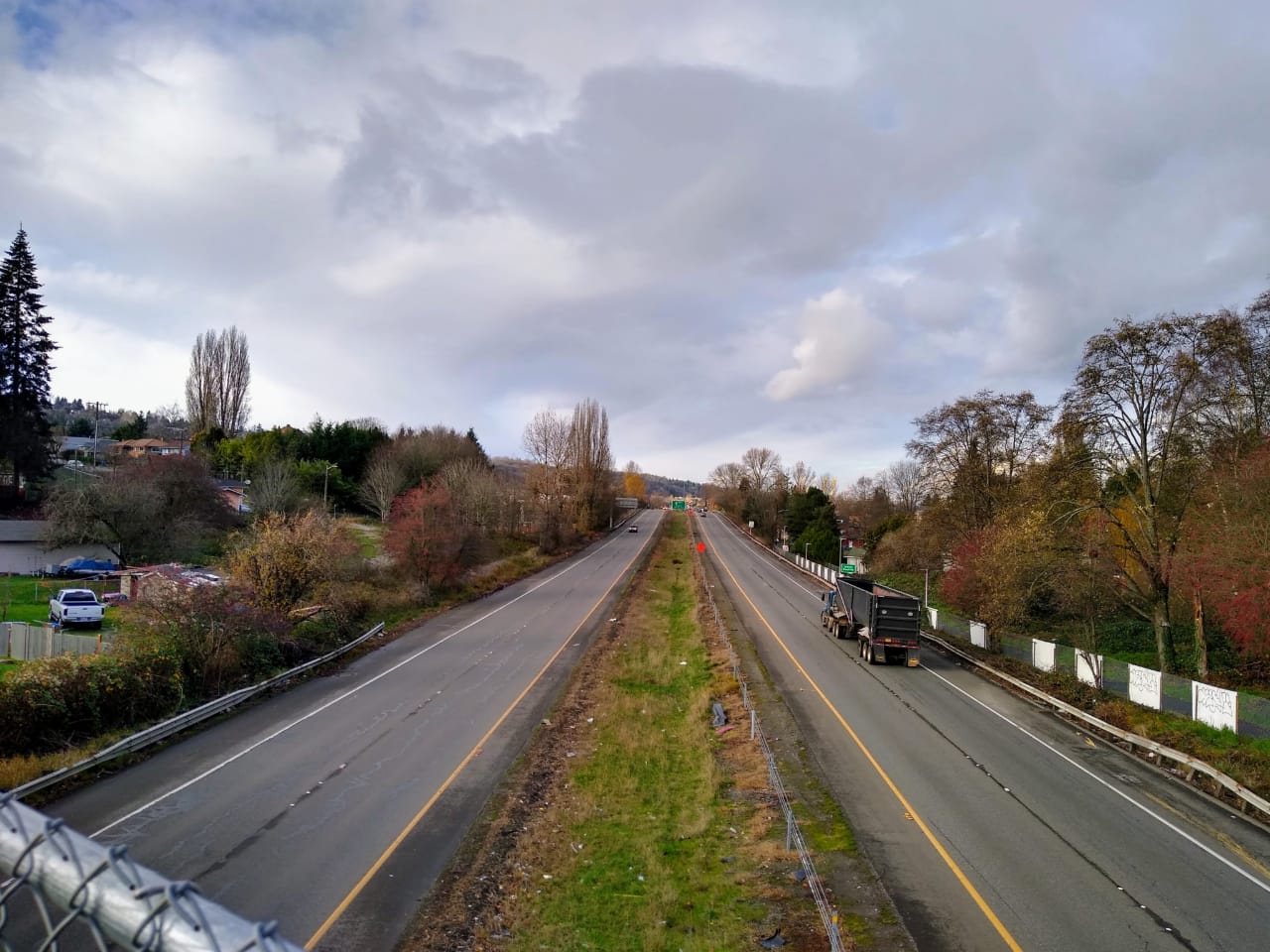
The momentum behind the idea of removing a redundant stretch of state highway that divides one of Seattle's most diverse neighborhoods got a big boost this week. A new report produced by Seattle's Office of Planning and Community Development (OPCD) looking at ways to transform State Route 99 through South Park outlines incredible upsides from scrubbing the highway off the map entirely, and very few negative impacts.
OPCD's newly released Potential Futures report, produced in conjunction with the Reconnect South Park Coalition, looks at four different ways to transition SR 99 out of its current state as an oversized highway that acts as a barrier between South Park's elementary school and its public library. Those options range the gamut from slimming down the roadway to simply adding more pedestrian bridges and trails.
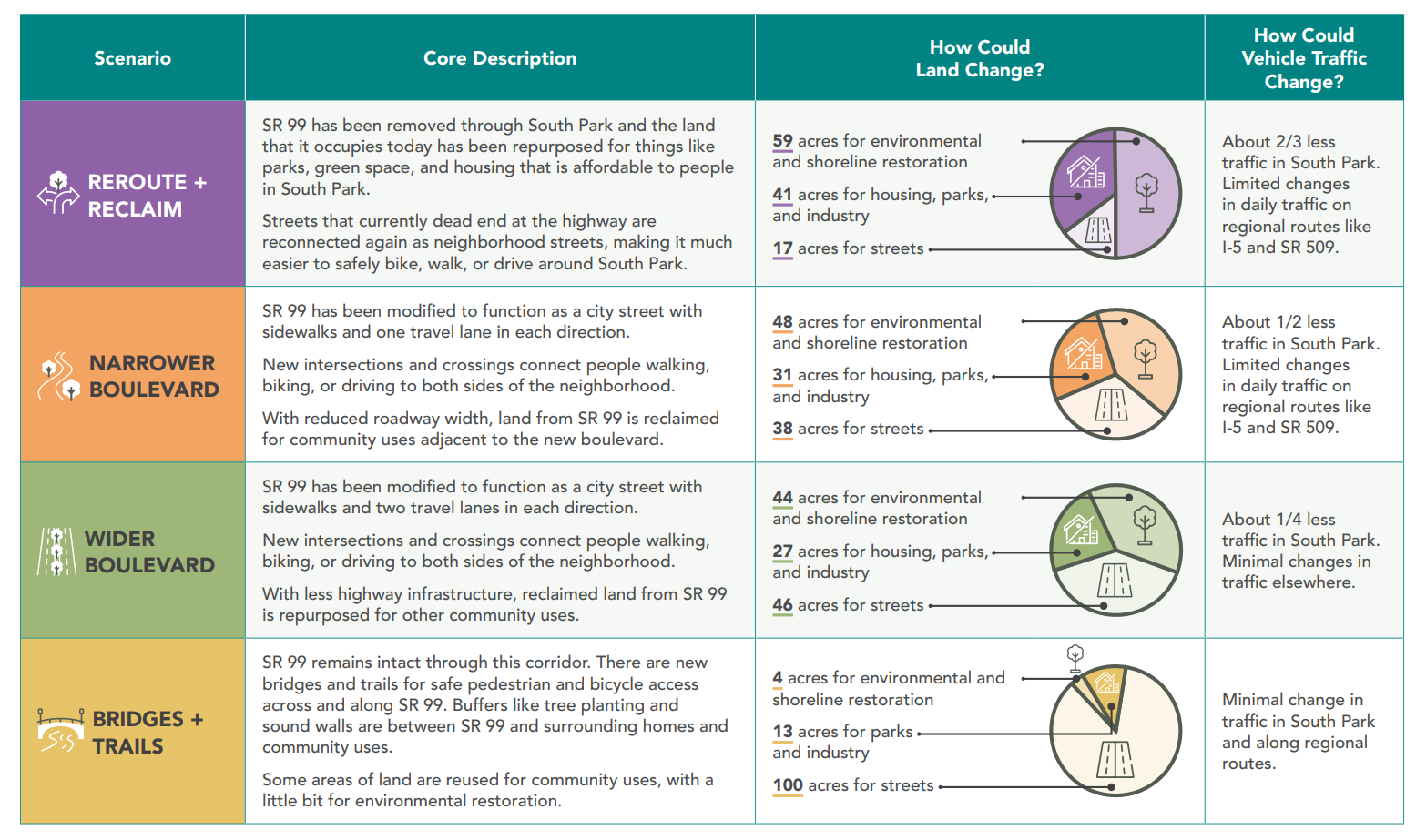
The agency projects that the most ambitious "reclaim + reroute" option would bring the most benefits: up to 100 acres of land opened up – and room for at least 400 units of housing – along with significant gains for the environment and public health. Removing this stretch of SR 99 would mean 64% less traffic diverted through South Park, and the amount of "pollution generating impervious surface" (PGIS) could be reduced by as much as 86%.
Aside from those clear benefits, a topline result from the report is that SR 99 through South Park is simply not a major workhorse for the regional transportation network, despite its daily impact on nearby residents. The analysis is fairly unequivocal that adjustments to the highway – up to removal and restoration of the street grid – would not have a major impact on mobility through the Duwamish Valley. SR 99 carries only around 4o,000 vehicles per day, compared to 70,000 to 80,000 that use nearby SR 509, to say nothing of I-5.
"Within one mile, four other major highways and arterials already provide continuous north south routes. This segment of SR 99 remains a limited-access highway occupying nearly 117 acres of public land, yet it carries traffic volumes similar to a busy city street," the report notes. "Under any of the scenarios that change SR 99, traffic would spread across multiple existing routes, and the daily change on each route would be small compared to what it already carries."
Removing the three miles of SR 99 that run through South Park is only expected to increase traffic on I-5 by 3%, and along SR 509 at S 100th Street by 8%. Meanwhile, traffic on the South Park bridge would decrease by 29%, illustrating the degree to which SR 99 traffic contributes to higher traffic levels within South Park despite the alternative routes that are available.
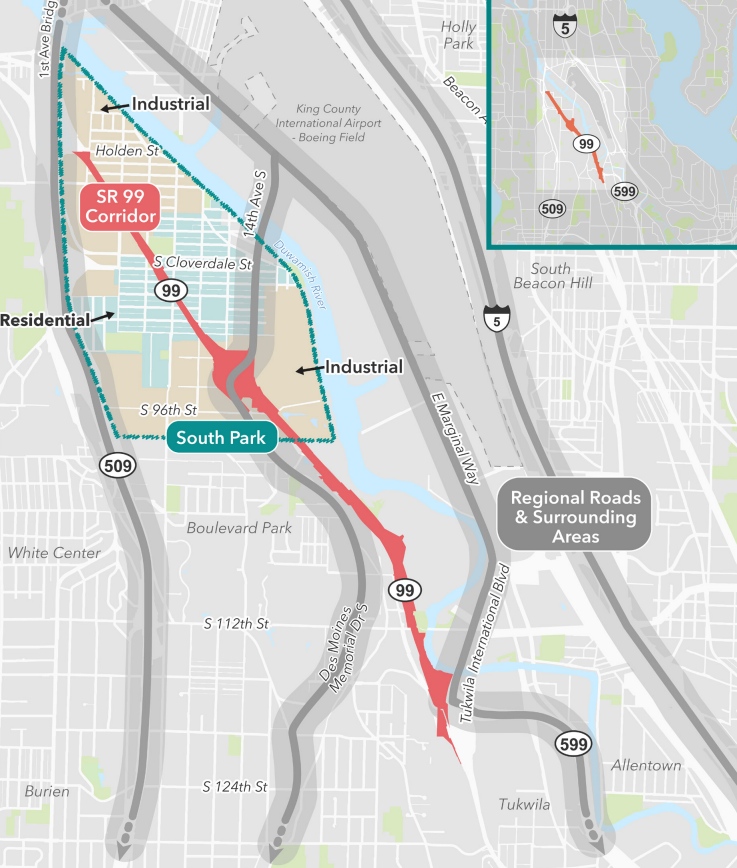
With SR 99 running directly along the Duwamish River south of South Park, reclaiming that land would open up significant opportunities for ecological restoration. Given recent civic conversations around how to reduce the impact of increased stormwater runoff as Seattle grows, this opportunity can't be discounted.
"Runoff from the highway drains straight into the river, which is an important habitat for salmon and other species," the report notes. Reclamation would "substantially reduce the deadly pollution from tire dust flowing into the river via smaller streams and creeks, and create transformational opportunities for habitat improvements on the shoreline."
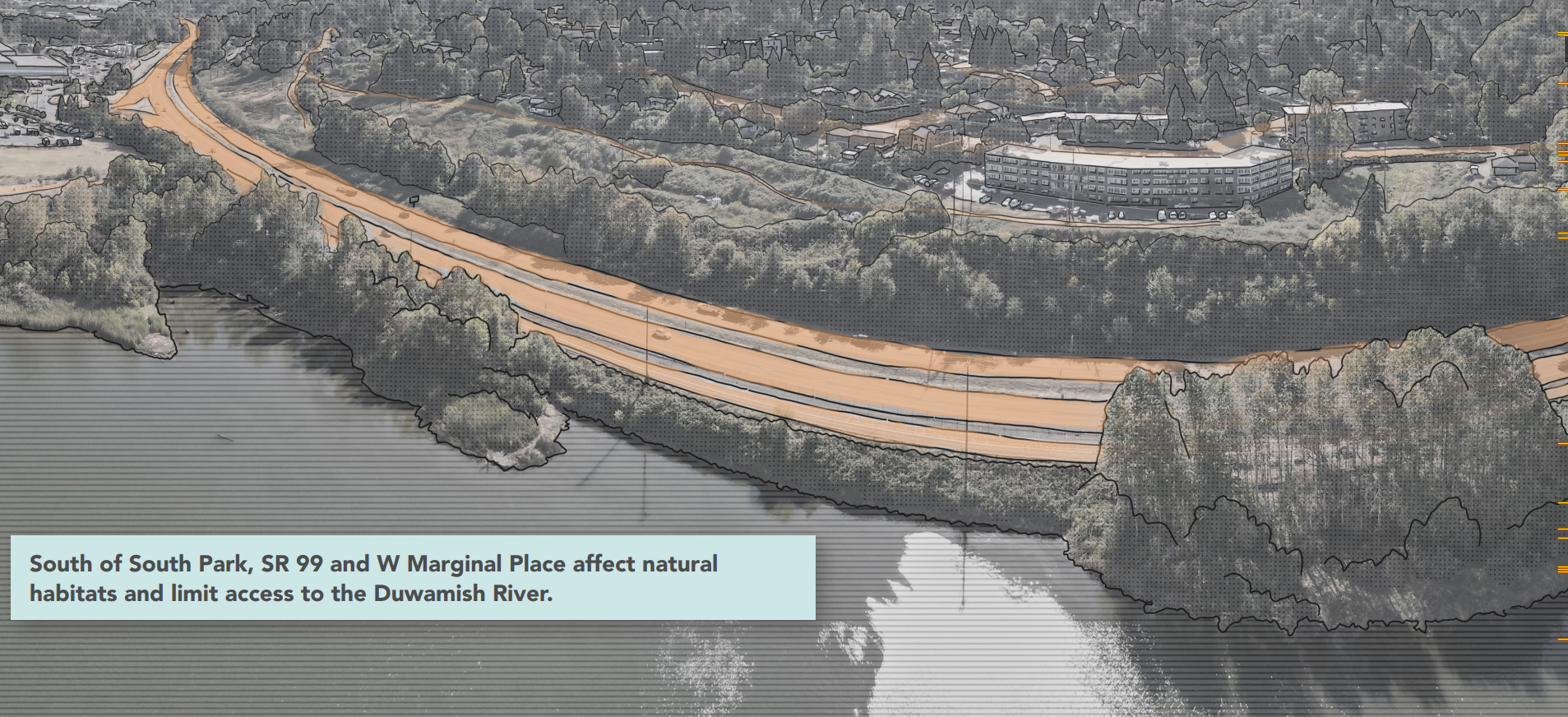
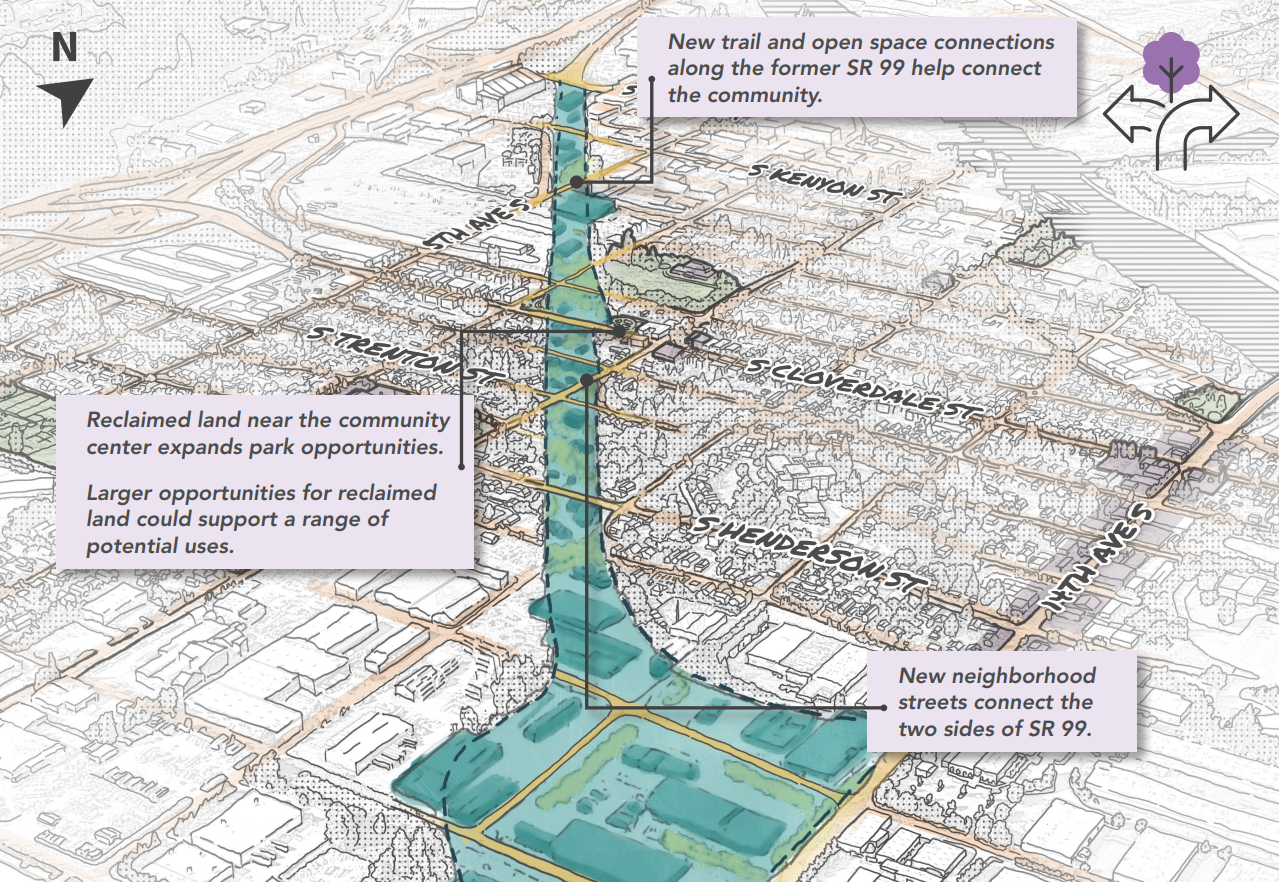
Through South Park itself, 41 acres could be unlocked for housing, open space, and business/industrial use after the street grid is reconnected through the neighborhood. Biking and walking connections would be vastly improved, with residents and visitors given alternatives to the current underpass at S Cloverdale or the pedestrian bridge referred to by neighborhood kids as the "scary trail."
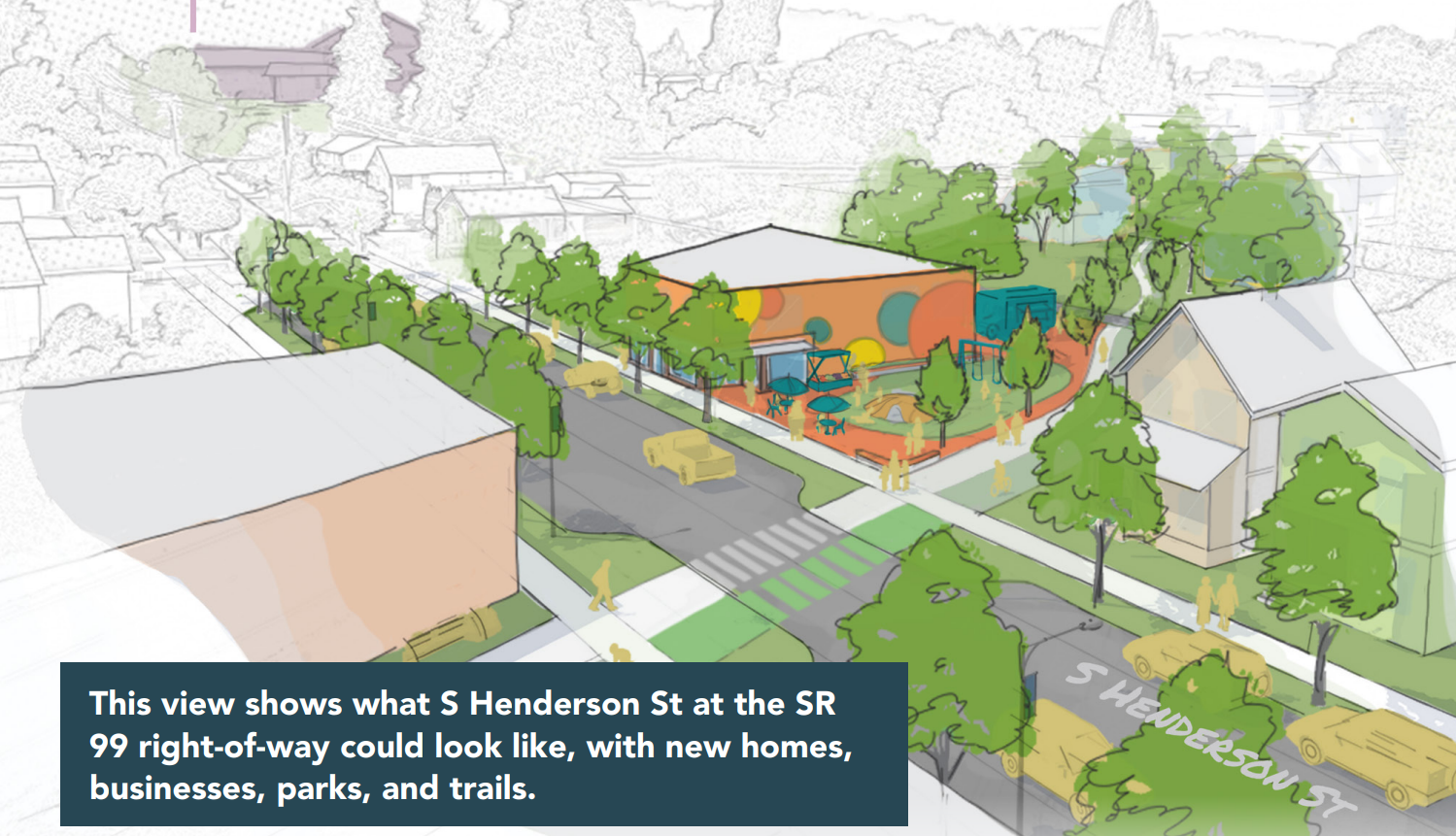
Seven of those acres are currently deemed "residential suitable" – with a modest projection of 400 homes spelled out thanks to an underlying assumption that the land would be rezoned to Low Rise 3 (LR3). With a more ambitious zoning designation, more units could be accommodated. Meanwhile 34 acres are seen as fitting in with adjacent industrial uses.
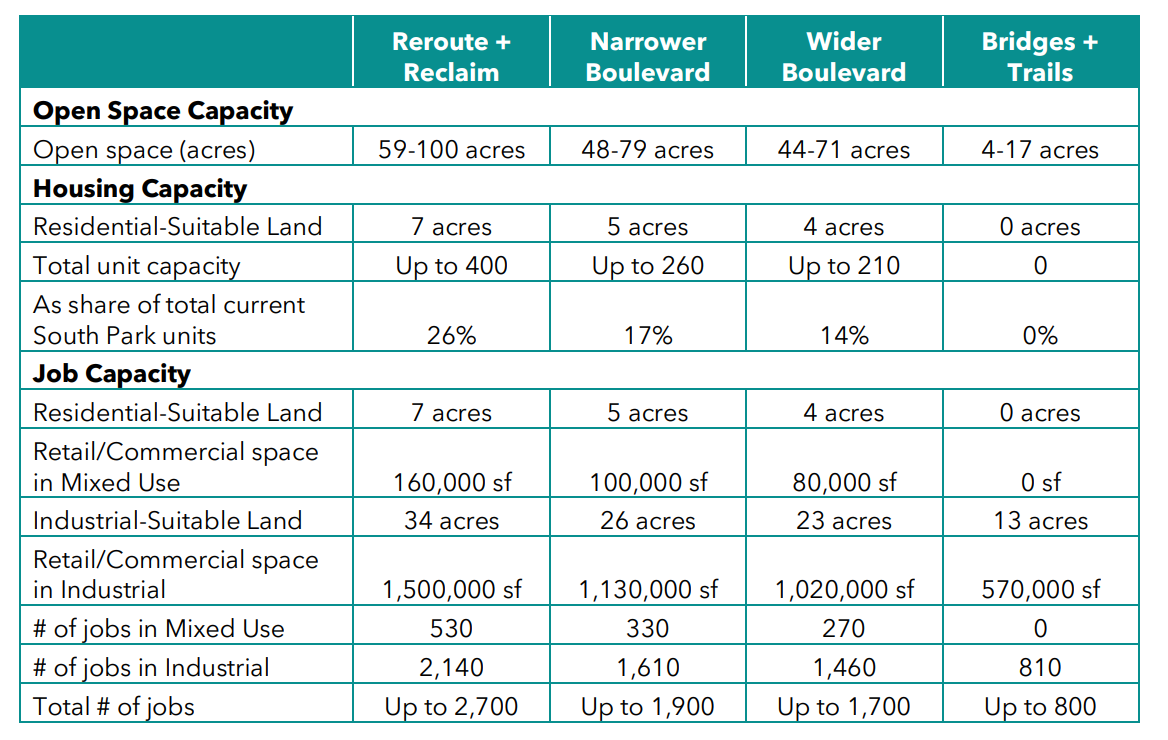
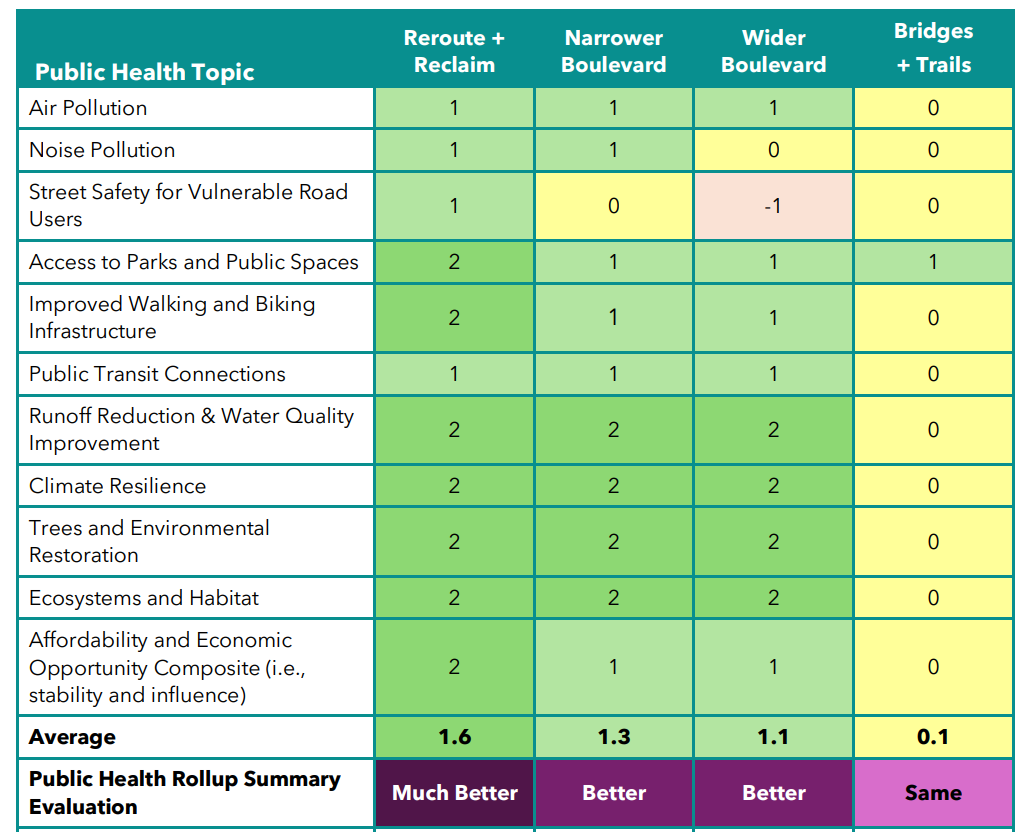
Looking at all of the potential benefits, the reroute + reclaim option scores best across the board, with the only downside recorded in the report the potential (limited) impacts on regional traffic. The physical act of removing the highway could also come with significant disruption during construction, though not as much as trying to slim down SR 99 while it stays open.
So what are the next steps for a transformative project of this scale? Per OPCD, it will be the creation of a Community Vision Plan and a Community Investment Plan, "focused on housing stability, small-business support, and long-term stewardship."
"Together, these efforts aim to modernize a mid-century corridor into a 21st-century public asset that advances health, safety, reliability, community well-being, and long-term regional value," the report's executive summary notes.
Easier said than done.
Funding such a major undertaking won't be easy to come by, either at the state or city level. Reconnecting South Park would have been a prime candidate for the Reconnecting Communities grant created by the 2021 Infrastructure Investment and Jobs Act (IIJA) – if that program had survived past the Biden administration.
Merged together with the neighborhood access and equity (NEA) grant program, the idea of setting aside federal dollars to restore areas impacted by transportation decisions of past generations will officially bite the dust if Congress adopts the "BUILD America 250 Act" that is currently advancing through the House. Endorsed by the ranking Democrat on the transportation and infrastructure committee, Rick Larsen (D-2nd District, Bellingham), the proposal would repeal the NEA grant program at the same time that it reduces funding for transit and rail projects.
Though it certainly could end up sitting on a shelf for a very long time, the Potential Futures report should be seen as a clarion call of the benefits that happen when cities take stock of the impacts of existing infrastructure – and the value that could be unlocked by thinking about that infrastructure in a different way. The return for a neighborhood like South Park would be seismic.
 Doug Trumm
 Ryan Packer