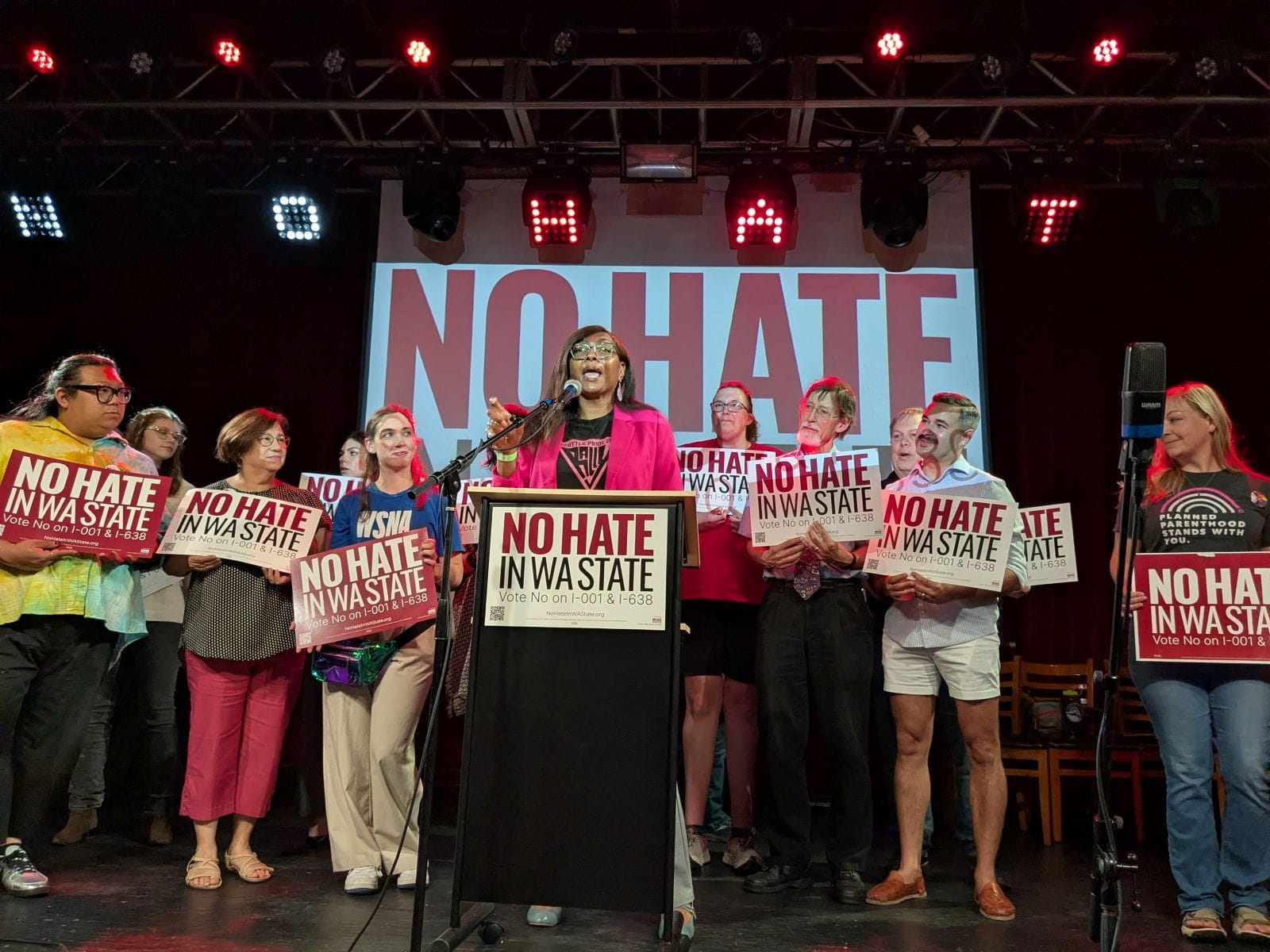
Rallying under the name No Hate in WA State, opponents to two conservative-backed initiatives attacking transgender rights launched their campaign last week.
Let’s Go Washington, Brian Heywood’s political action committee (PAC), is pushing for passage of the two initiatives on the Washington state ballot in November.
U.S. Rep. Pramila Jayapal (D - Seattle) spoke at the kick-off event to garner support against the initiatives, which was held at Neumos in Seattle’s Capitol Hill neighborhood.
“I want to be really, really clear about what these initiatives are. They are lies that are bankrolled by MAGA Trump donors,” Jayapal said. “One of these initiatives forces our schools to out LGBTQIA+ kids to the very families that might throw them out, and the other [...] literally forces these invasive, disgusting exams on every girl who wants to play a sport, just so that they can target a handful of trans kids.”

As of June 11, Brian Heywood himself has donated $1,975,000 to support passage of the two initiatives. In all, Let’s Go Washington has raised almost $5.5 million in support of their campaign.
In opposition to the initiatives, No Hate in WA State and another PAC, Defend Washington, have raised $1.1 million as of June 11, meaning Let’s Go Washington currently has a five-to-one fundraising advantage.
The Let’s Go Washington PAC is also supporting the initiative that would repeal the so-called ‘millionaires’ tax,’ a 9.9% tax on income over $1 million that was passed by the state legislature earlier this year, but isn’t set to go into effect until 2029.
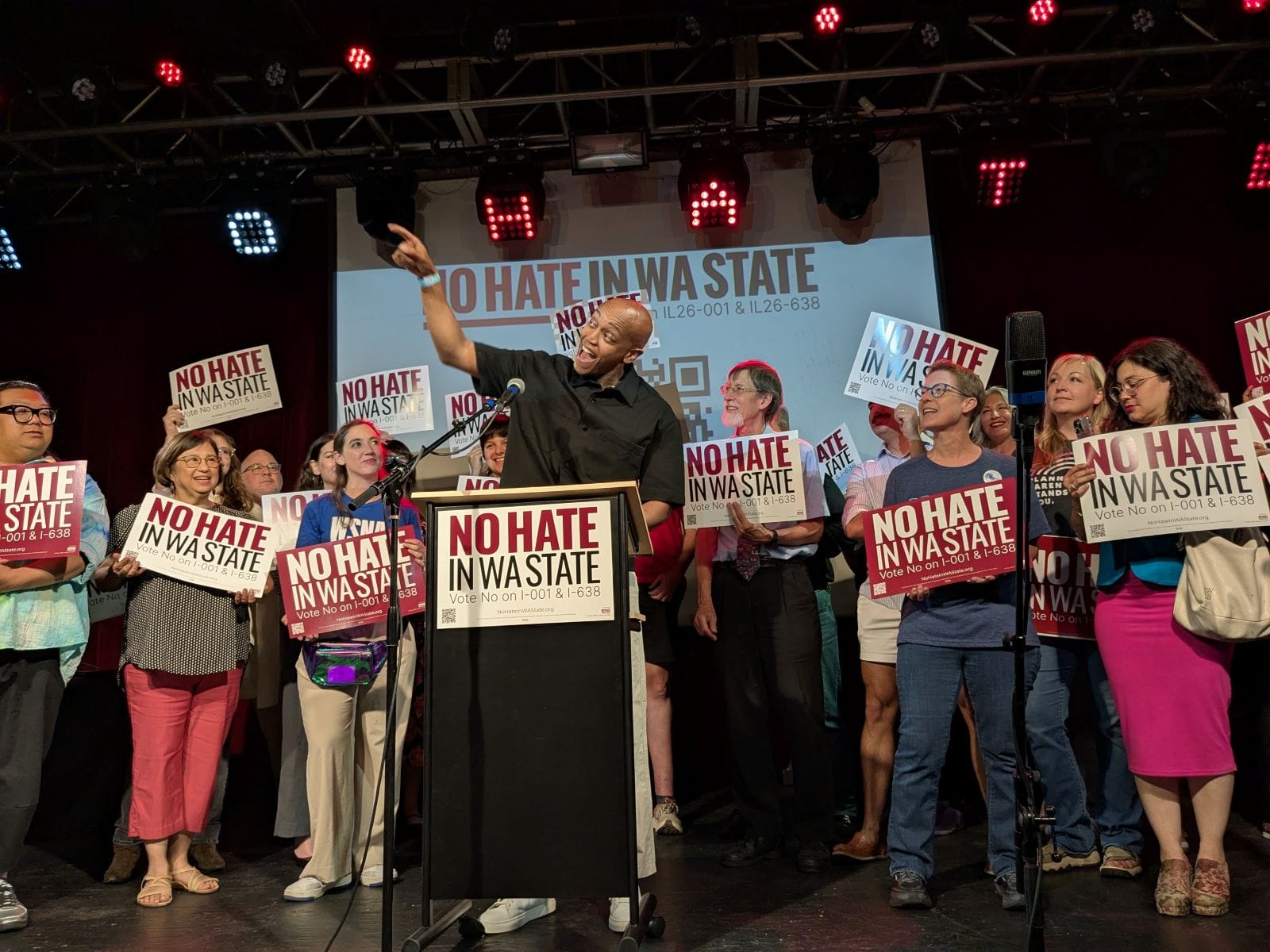
Lavender Rights Project’s executive director Jaelynn Scott, who is currently running for a state legislature seat in the 37th Legislative District, also spoke at No Hate in WA State’s event.
“This mega MAGA billionaire bigot funding anti-trans initiatives and trying to rob our state of the revenue to take care of basic services for all Washingtonians, that ain't just about transphobia,” Scott told the crowd. “I mean, it is about transphobia, but it's not just about transphobia. It's about money and politics, and the ability of one rich man and oligarchs to usurp our democracy.”
Let’s Go Washington is under the same umbrella as Full Court Press, a dark money group active in this year’s campaigns for state Supreme Court justices. With five justices running for election this year, the composition of the court could be shifted in a more conservative direction.
Were the initiatives to pass, they could face a legal challenge that might ultimately be decided by this same state Supreme Court.
The “parental rights” initiative
In 2024, Let’s Go Washington introduced an initiative enacting a “parental bill of rights” requiring schools to inform parents about educational and medical information. The measure also required affirmation that schools wouldn’t discriminate against students due to their religions and allowed students to opt out of activities related to their family’s beliefs, religion, and political affiliation.
The state legislature decided to pass the initiative as it was instead of sending it to the ballot. However, the next year, Rep. Monica Stonier (D-49th legislative district, Vancouver, WA), who is an educator herself, sponsored a “clean-up” bill, House Bill 1296. The bill removed parental access to medical records to remain consistent with other state law. The new bill also added several new anti-discrimination protections for students, including prohibiting discrimination due to immigration or citizenship status, homelessness, gender identity, and neurodivergence.
“I didn't think that that list [of parental rights] was inclusive enough of all parents, like immigrant parents or parents of LGBTQ students who are deserving of a safe school environment that doesn't demonize who they are or what their families look like,” Stonier told The Urbanist. “To me, that interest in protecting parental rights was overly narrowed to certain families and certain types of families.”
Stonier said that in addition to expanding the types of parents that received rights, she wanted to reclaim student rights – for students to be free from bullying, harassment, and intimidation – and educator rights – for educators to have the right to stand up for their students when necessary.
“This is a boogeyman argument about how schools are [...] trying to drive a wedge between parents and students when really educators know that students are more successful the more their parents are involved,” Stonier said. “There's not an interest in that wedge, there's an interest in partnering.”
The bill was passed into law and contained an emergency clause that made it go into effect immediately.
“Our policy was heavily informed by educators, school officials, school nurses, school counselors, parents who wanted a safe place for their kids to go, student experiences, and the ability for people to do their jobs in public school, so that kids can learn,” Stonier said.
A lawsuit seeking to block this law was rejected by a judge in May.
This year’s IL26-001 looks to undo some of the changes made by the law to the original initiative, most notably restoring parental access to medical and mental health records.
The initiative would also remove the following language: “To have their child receive a public education in a setting in which discrimination on the basis of sex, race, creed, religion, color, national origin, honorably discharged veteran or military status, sexual orientation, gender expression, gender identity, the presence of any sensory, mental, or physical disability, or the use of a trained dog guide or service animal by a person with a disability is prohibited.”
The initiative contains language that prohibits the legislature from altering it for two years after passage.
Advocates say allowing unfettered parental access to medical records would lead to the outing of LGBTQ+ kids who are looking to their teachers and counselors for support.
A survey conducted in 2011-2012 showed that 43% of homeless youth had been forced from their homes because of their sexual orientation or gender identity, illustrating the real life consequences of teenagers being outed against their wills.
Linden Jordan, an educator with PFLAG Washington State, said the initiative is not about good parents talking to their kids, but rather about kids having a right to privacy while they’re exploring their identities. Having a trusted adult at school – whether that be a counselor, nurse, teacher or coach – can be lifesaving for LGBTQ+ kids, Jordan said.
“These kids need safe places to go and to talk, and that is suicide prevention for a lot of these kids,” Jordan said. “These counselors help these kids hang in there. A lot of times they help these kids figure out how to talk to their parents. So attacking them and attacking this particular area, I think, is a really cruel aspect of this initiative, and they do it for a reason. They want to force school officials to have to out these kids, and if that's the end result, then a lot of these kids are going to end up in deep, deep trouble. These resources are vital for our kids.”
Advocates also have concerns that this initiative could endanger kids who are trying to seek help while surviving abusive situations at home.
Stonier said whether the attacks come in the form of library book bans or a conversation about whether or not kids can choose their own pronouns, they’re ultimately scare tactics.
“I think that is also motivated by an interest in dismantling our public school system,” Stonier said. “It is a hallmark of fascism. It is a hallmark of neo-Christianity nationalism.”
The girls’ sports initiative
The other initiative, IL26-638, would ban biologically male students from participating in sports for female students while imposing verification of biological sex by a health care provider in order for girls to participate in sports.

“What is misleading about the way the initiative is written is it is written under the guise of being a protection for girls and athletics, and really it's introducing the new physical exam requirements without really adding anything beneficial to girls’ athletics,” said Revelry Buchanan, a North Bend resident who is a trans non-binary athlete and parent of two teenaged girls.
According to the initiative, the three acceptable ways to verify biological sex would be through a student’s reproductive anatomy, their genetic makeup, or their “normal endogenously produced testosterone levels.” The initiative’s wording creates a gray area as to whether full pelvic examinations, rather than outer genital examinations, might be required.
Neither the genetic tests nor measurements of testosterone are reliable ways to verify biological sex, according to Jordan. And all of these tests present multiple barriers, including access to and costs of the tests and procedures and the deterrent of having to go through an unpleasant or embarrassing medical procedure just to play school sports.
“This would be humiliating, it would be traumatizing, and that is the right word,” Jordan said. “This would be traumatizing to kids to have their genitals looked at, and it would be chilling. Kids wouldn't play sports: not just trans kids, girls in general.”
Also at play is the issue of data privacy if girls who want to play school sports are forced to take genetic tests and share the results with the government.
Buchanan said there’s only about 10 athletes across Washington state who are openly transgender.
“You've got this disparity where every girl [...] is impacted by this going into place really to try to avoid having transgender athletes and specifically transgender girls be able to participate at that very, very low to almost nonexistent level,” Buchanan said. “Certainly for the transgender athletes themselves, it creates a lot of attention on them when really they just want to participate and be part of the athletic experience at their school and be able to fit in as girls.”
Buchanan emphasized the positive mental health aspects to participating in sports, while Jordan brought up the important aspects of teamwork and camaraderie, as well as the positive experience of working with a coach and giving girls with unstable or unsafe homes a supportive place to go. Exercise can also benefit physical health.
Girls already face social, economic, and institutional barriers to participating in sports. According to the National Federation of State High School Associations, 3.5 million girls participated in school sports in the 2024-2025 school year compared to 4.7 million boys. In Washington DC in 2022 and 2023, 53% of District girls participated in a sport compared to 70% of boys.
The wider dangers
“I know a lot of people don't get it: that for trans and intersex and non-binary kids right now, the tenor of all of these assaults on their very being is hitting the mark,” Jordan said. “I sit and listen to this stuff about how the goal is to eradicate trans people. Well, that is not lost on these kids.”

Jordan said what happens with these Washington state initiatives – running in a deeply Blue sanctuary state – can be seen as a kind of bellwether for transgender rights in the rest of the nation. Many Republican-run states have already enacted measures targeting transgender rights, while several other states are weighing similar initiatives also bankrolled by megawealthy conservative donors, as part of an apparent turnout-driving electioneering effort.
“There are currently more bills attacking trans youth’s right to play sports across the U.S. than there are trans youth in school sports,” the ACLU recently posted on Bluesky.
Jayapal said Republicans are staging these attacks in order to distract people from other harmful federal policies and decisions, including the war with Iran, the affordability crisis including the increasing costs of groceries and gas, the Epstein files, and federal policies reducing the number of Americans who can afford health insurance.
“In a culture where we valued differences, we would understand how devastating this is to kids that's being proposed here, and to me it's just an indication, if this passes in Washington State, it will be one of those moments where you say, where do I go now for these families and for these kids?” Jordan said. “Right now in this country, for trans kids and their families, there really is no safe place.”
Buchanan noted how many resources are being used because of these initiatives that could instead be used to uplift and support girls’ athletics.
“There does need to be more people, I think, being more vocal and standing up for the transgender inclusion in athletics or just in day-to-day life,” Buchanan said. “A lot of the proponents’ actions right now really are just trying to fight back against anti-trans litigation, but certainly there's a lot to be had of having a more stable and reliable sense of acceptance.”
Buchanan would like to see policy being discussed that focuses on inclusion and girls’ athletics, including trans girls as part of the conversation. They’d also like to see more research focused on girls’ and women’s athletics that includes non-binary and trans athletes.
“I think it's true that if an initiative like this passes here, it will be because we did not do a good enough job to make sure our neighbors and voters knew what they were doing because I don't think people want this,” Stonier said. “I think that the people who do are going about it in a dishonest and fear-mongering way, and I would be concerned if other states found that this was a winning strategy.”
Jayapal said a lot of organizing would be necessary to defeat the initiatives, which will involve both financial donations and volunteer time.
“It will be about turnout, and it will be about education. It will be about who came to somebody's door to talk to them about this, so they can understand what is actually happening,” Jayapal said.
Scott framed the resistance against the initiatives as a wider fight for democratic and inclusive values.
“It's about our ability as a collective to build a multiracial and diverse society that works for all people, especially the working poor, especially gender-diverse people,” Scott said. “Do not let them divide us. Let them know we will fight together.”
 Amy Sundberg
 Amy Sundberg