The largest expenses for Seattleites today are housing and transportation. As the city becomes more and more expensive for working families, our city government must lead in providing more affordable transportation options. Unfortunately, one of our cheapest transportation options, transit, isn't fast, frequent, or reliable enough to be competitive with driving.
Today, we have the chance to fix that. The Move All Seattle Sustainability (MASS) Coalition is calling on the Seattle City Council to approve Mayor Katie Wilson's proposed Seattle Transit Measure (STM) renewal to fund vastly more bus service and expand fare subsidies to the lowest income Seattleites.
Seattle sets goals. Now it's time to achieve them.
In 2015, 25% of Seattle had access to all-day transit service that came every 10 minutes or better. Thanks to the Seattle Transit Measure, by 2020, 72% of residents had access to 10-minute service.
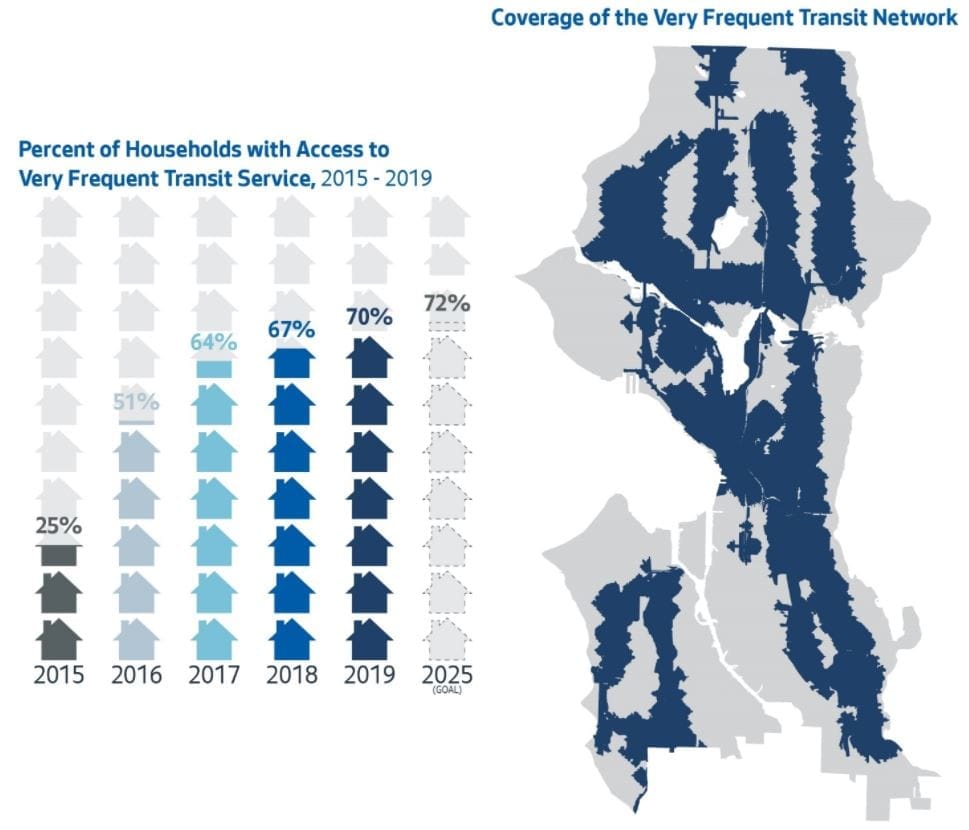
Unfortunately, the renewal measure that Seattle voters overwhelmingly approved in fall 2020 reduced funding and took a big step backwards on service frequency. Today, only 53% of Seattle lives within walking distance of transit that comes every 10 minutes all day.
Today, Seattle has a goal for 77% of the city to have access to every-ten-minute transit service. Seattle also has a 2030 goal to cut our climate emissions by 58% of 2008 levels (in 2022, we were just 10% below 2008 levels) and, in service to that goal, SDOT has pledged a 40% reduction in driving and a doubling of transit by 2030, now just four years away.
Sadly, we’re not on track to meet any of these goals. None of them are funded and in fact, we’re going backwards on all of them. Solo driving is trending upward for the first time in a decade and our traffic is back to being some of the worst in the country. We're calling on the City Council to fund the transit system we know we need to achieve these goals.
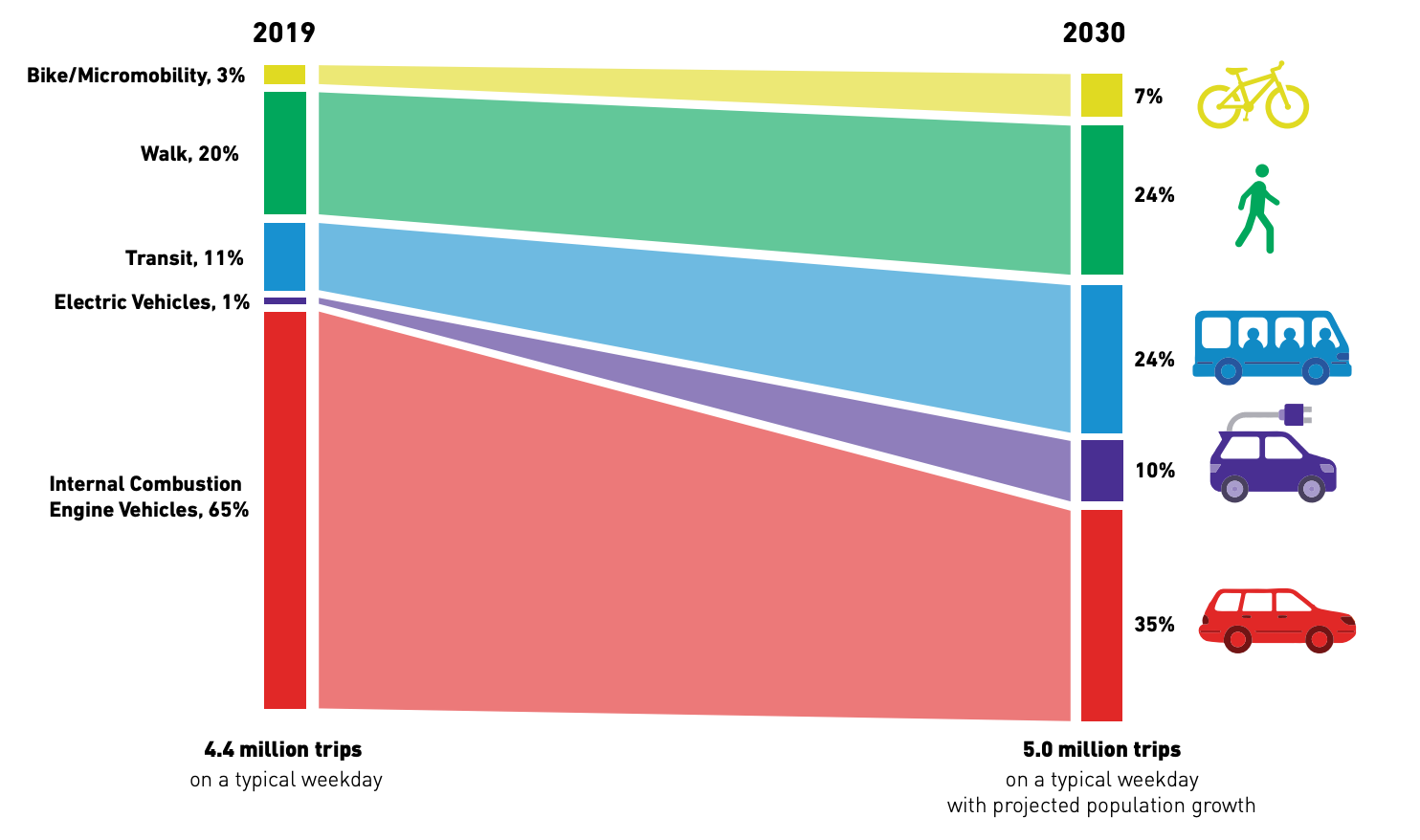
Frequency is freedom. Seattle deserves freedom from car dependence.
To achieve these goals, we need more transit.
We know that travel time is the strongest predictor of the choice to drive. Long waits make transit an infeasible option for would-be riders and long transfers make transit struggle to compete with driving. Crucially, 20% of all households in Seattle have zero cars. Additionally, many, like bar goers who’ve had one too many, shouldn’t be driving. Providing plentiful public transit is the best way to ensure that people of all ages and abilities are able to access the city.
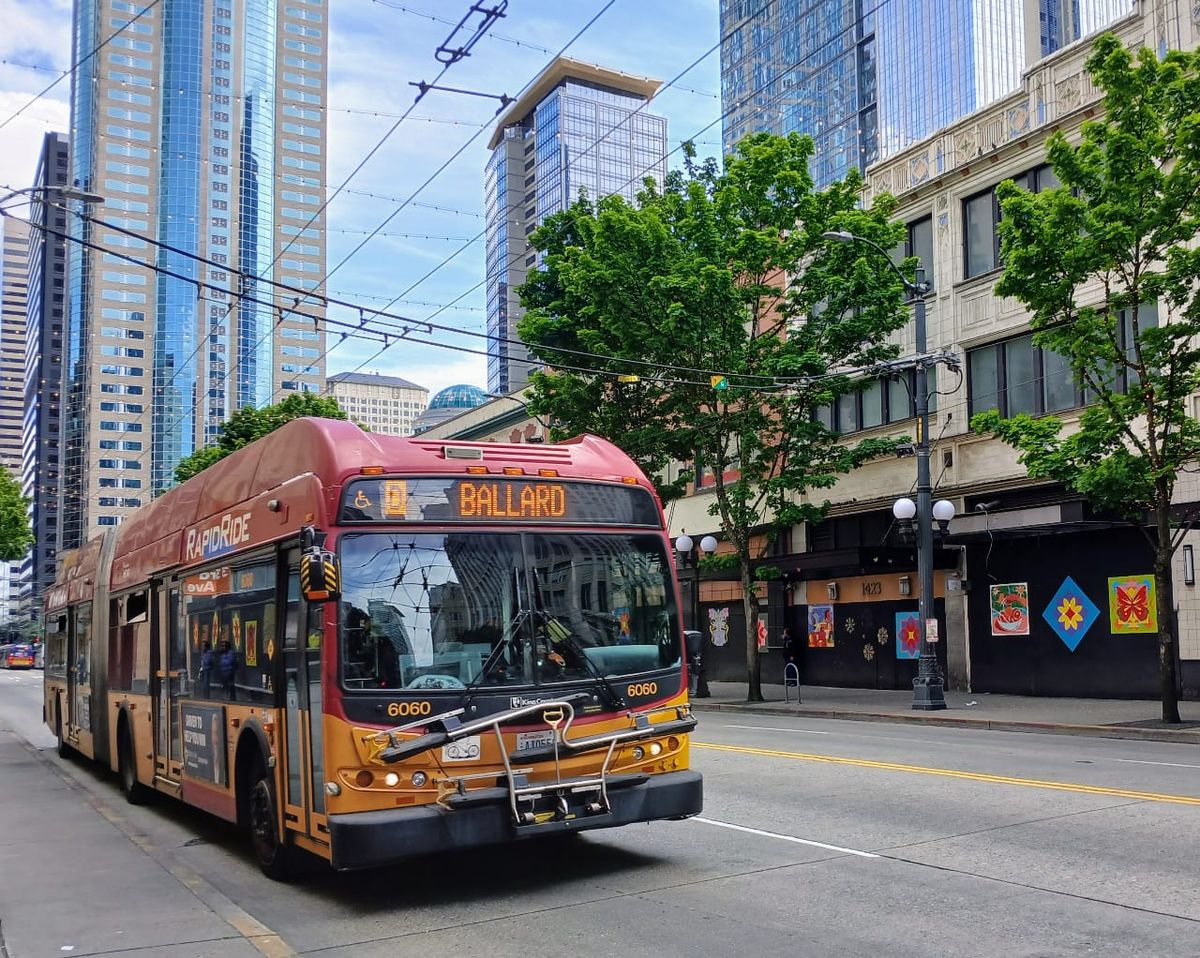
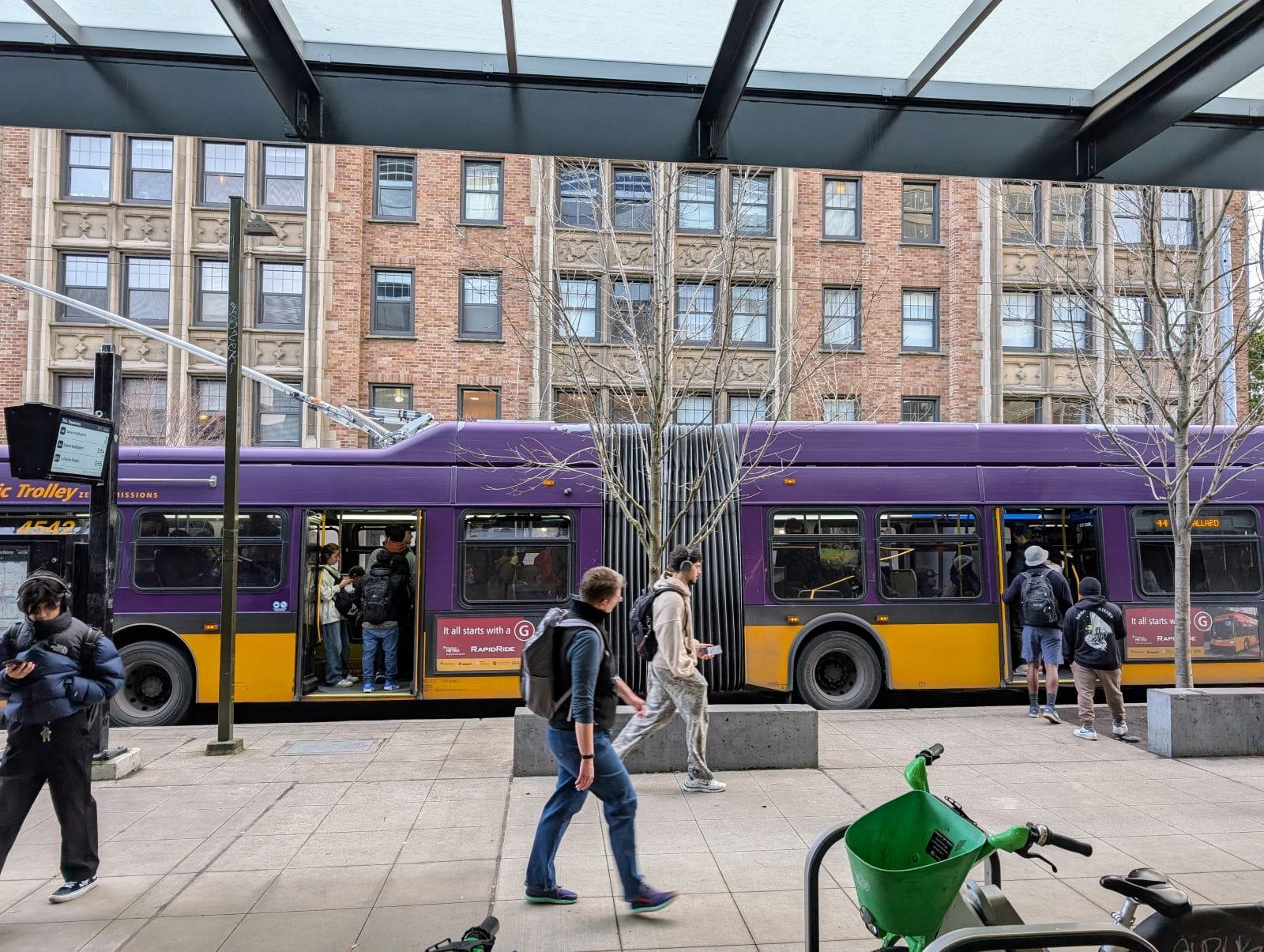
That's why we support this proposal which would nearly double the amount of bus service funded by the City of Seattle. Today, only nine routes in Seattle have every-10-minute service all day but SDOT's service goal, the Frequent Transit Network, calls for almost 30 routes covering almost the entire city. The proposal also reflects shifted post-pandemic travel patterns by directing more investment to nights, evenings, and weekend service.
Even with better frequency, transit riders know not all buses are faster than driving. That’s why this measure dedicates $3.5 million annually to transit capital improvements. That’s roughly enough to fund the Denny Way bus lane project every single year. These projects get buses out of slow and unreliable traffic and save the city money by not having to pay bus drivers to sit in traffic.
An affordable Seattle is transit oriented
As gas prices, insurance, and cars themselves skyrocket in cost, getting around Seattle is no easy feat. The total cost of car ownership in 2025 was almost $1,000 per month. With the highest Uber prices in the nation, unaffordable bikeshare prices, and buses stuck in traffic, getting around Seattle isn't cheap or easy for anyone.
The mayor's proposed Seattle Transit Measure will cost the median two-person household roughly $29 annually. But by expanding transit service, especially on nights and weekends, more of Seattle will be free from the expenses of driving. Less than half a tank of gas or just one evening of parking in Ballard, Capitol Hill, or Chinatown costs more than the expected annual cost of the STM.
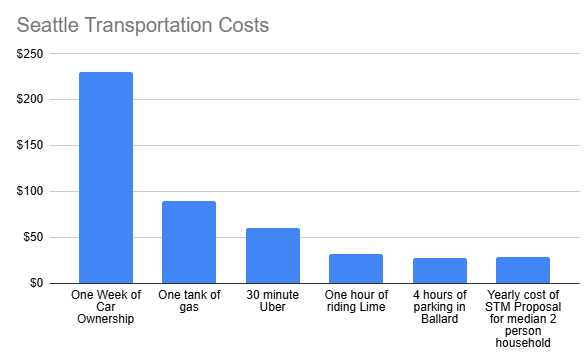
The proposal will also fund 22,000 unlimited ORCA cards for Seattle Housing Authority residents and voucher recipients. Bus service investments are also prioritized for routes and times when low-income riders with ORCA LIFT are riding. For the growing slice of Seattle that depends on transit, this measure ensures that the bus is there to get them around.
The sales tax is not a progressive funding mechanism, and we do not take that lightly.
But the state legislature restricts Seattle's options, and the others, like flat car tabs, are also regressive. We support the Mayor’s proposed measure because the alternative, a city where more people are forced into driving and car ownership, is a bigger strain on budgets up and down the income distribution.
Now is the time for change
We are the Move All Seattle Sustainably (MASS) Coalition, an alliance of 14 organizations working toward a safer, more accessible, and climate-aligned transportation system in Seattle. The mayor has provided a path to a better transit future. We are ready to vote for more bus service. We just need the City Council to let us vote for it. We're calling on councilmembers to pass a transportation measure that gives more people access to fast, frequent, and reliable public transit.
Join us at public comment June 18 and July 6 and testify at July 13th's Public Hearing. You can find the council schedule here.
Send a Letter to the City Council to Fund More Transit!
The Move All Seattle Sustainably (MASS) Coalition works to build a connected, walkable, and equitable Seattle by minimizing reliance on driving and achieving our Vision Zero and climate goals. Today, 14 organizations are members.
This letter is signed by 350 Seattle, America Walks, Cascade Bicycle Club, Fix the L8, The Nondrivers Alliance, Save Ballard Rail, Seattle Subway, The Seattle Transit Blog, The Transit Riders Union, Transportation Choices Coalition, and The Urbanist.
 Ryan Packer