The Eastside has yet to hit a high gear on ridership.
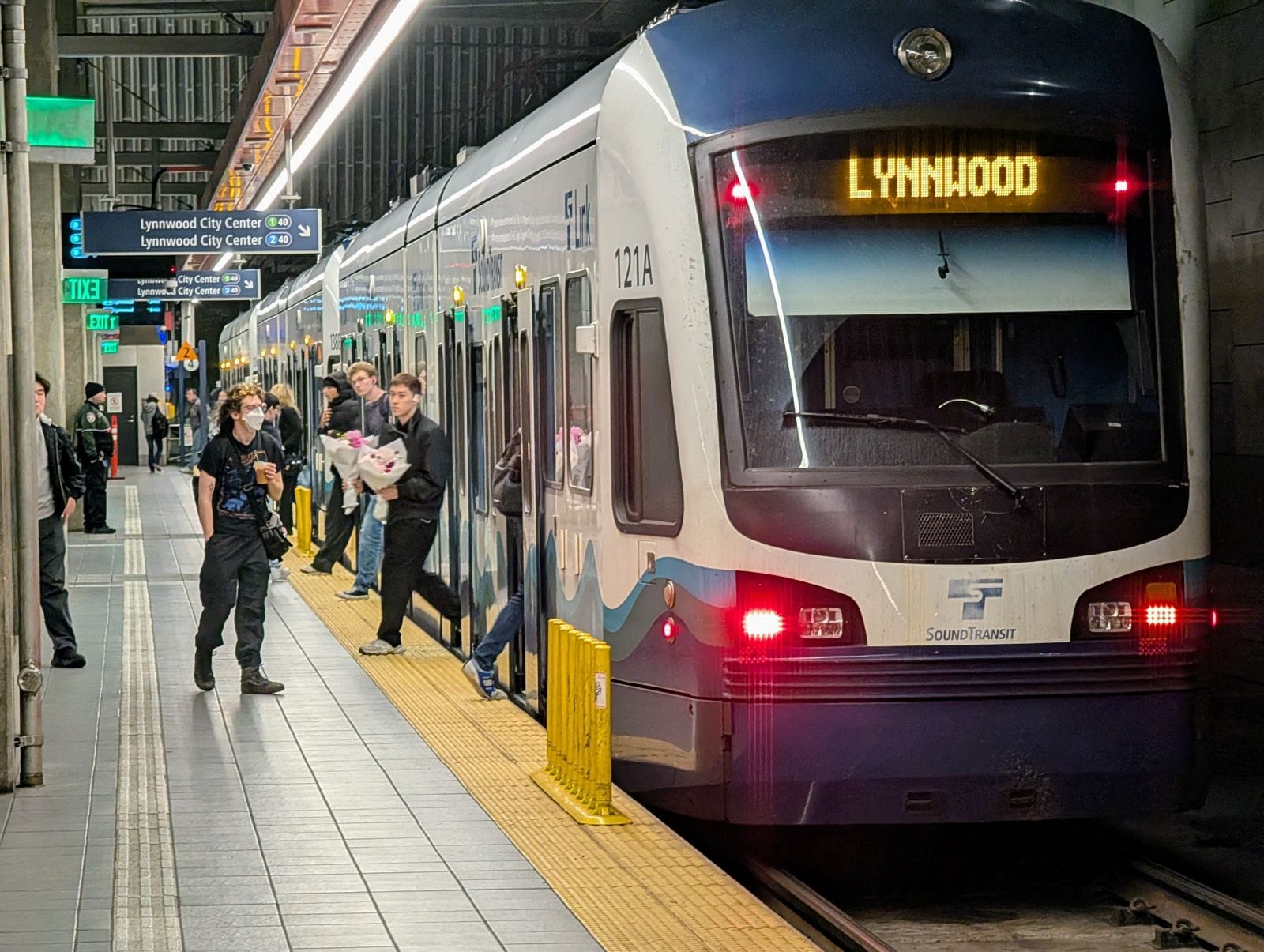
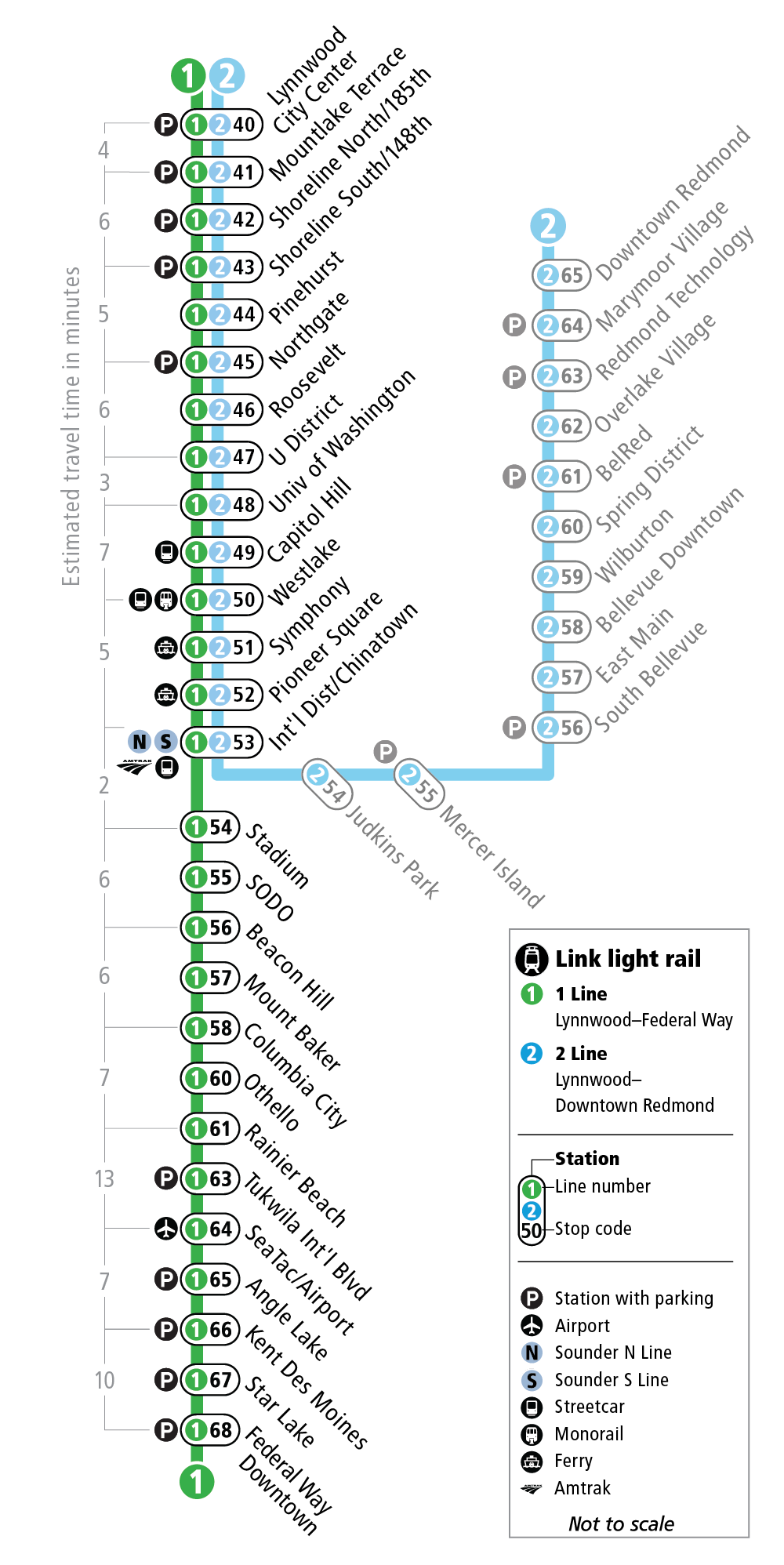
Light rail ridership has been surging in the wake of the expansion of the 2 Line across Lake Washington on March 28. The 1 Line now stretches from Federal Way to Lynnwood, with the 2 Line effectively doubling service from the Chinatown-International District to Lynnwood.
Four-minute peak frequencies in this overlapping segment are a major driver of ridership gains. Daily boardings remain above 160,000 even as the busy summer season has cooled. Gains in the Eastside portion of the light rail network have been less dramatic.
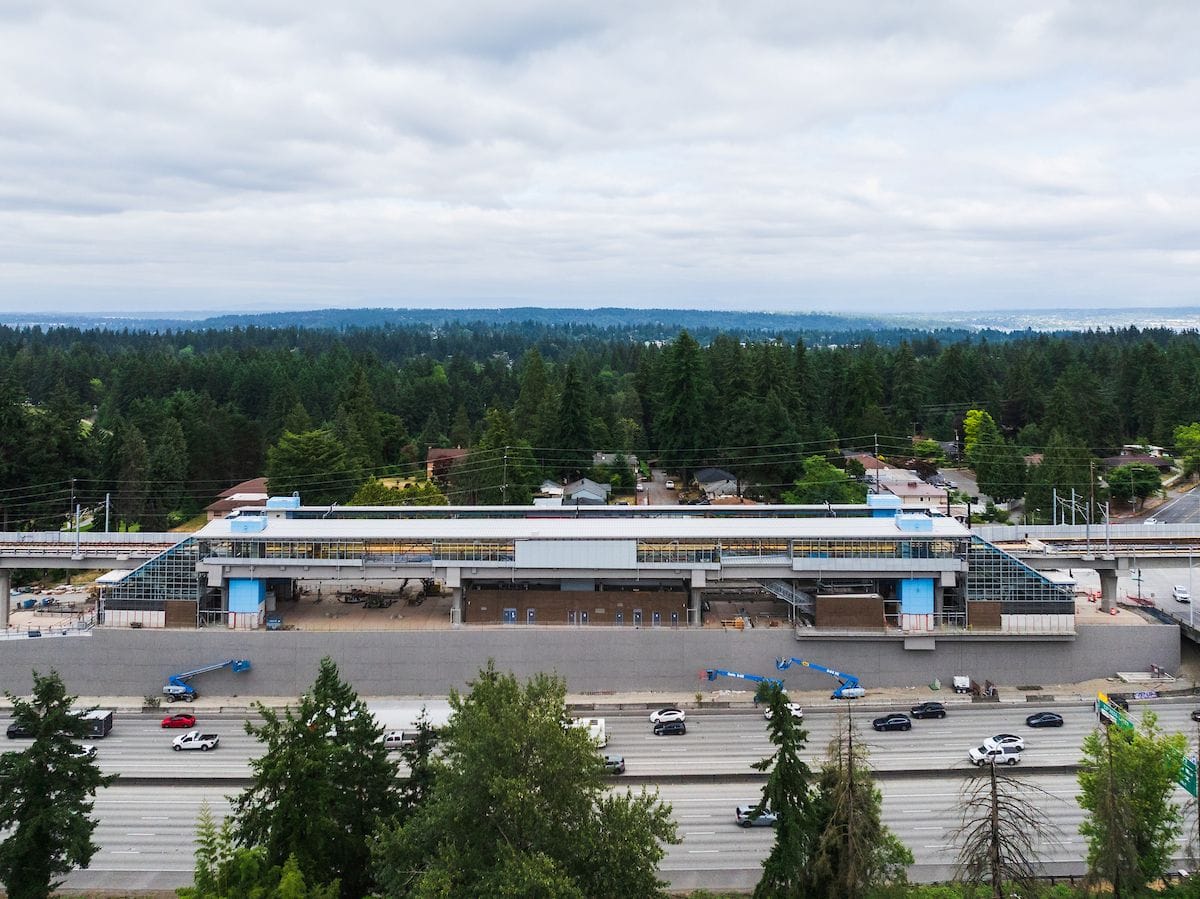
Due to construction defects and delays on the floating bridge portion of the 2 Line route, Sound Transit altered its plan and opened an Eastside-only "starter line" segment in 2024. That line extended to Downtown Redmond in spring 2025 and peaked just shy of 11,000 daily riders that summer, before fading over the fall and winter.
The extension of the 2 Line across the lake this spring has swelled ridership up to their summer 2025 peaks once more, but not significantly higher. The South Bellevue to Downtown Redmond segment averaged about 14,000 daily boardings in June, for example, but 11,330 in August after the World Cup ridership bump had subsided.
The 2 Line is almost assuredly garnering most of its ridership in its westside portion, from Seattle to Lynnwood. The caveat being we don't know for certain since Sound Transit told The Urbanist that it does not yet have the capability of separating 2 Line ridership from 1 Line ridership at the stations where both lines stop.
"Per our stats team, we do not currently have the ability to separate out 1 and 2 Line ridership in the core, but it is something the team is actively working on," Sound Transit spokesperson Henry Bendon said in an email. "We do not yet have a two 2 Line only whole system daily ridership number."
For the stations serving only the 2 Line, Sound Transit's ridership dashboard shows that Downtown Bellevue is leading the way, with South Bellevue in second. Downtown Bellevue averaged 2,541 daily boardings in August, while South Bellevue tallied 1,924, driven by its 1,500-stall parking garage.
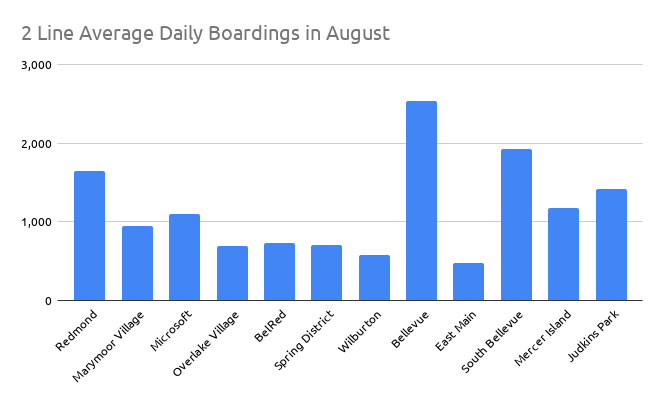
Downtown Redmond is in third with just over 1,600 daily boardings, while Judkins Park (in Seattle) and Mercer Island fill out the top five. The 2 Line station struggling most for ridership is East Main, which managed just 480 daily riders in August.
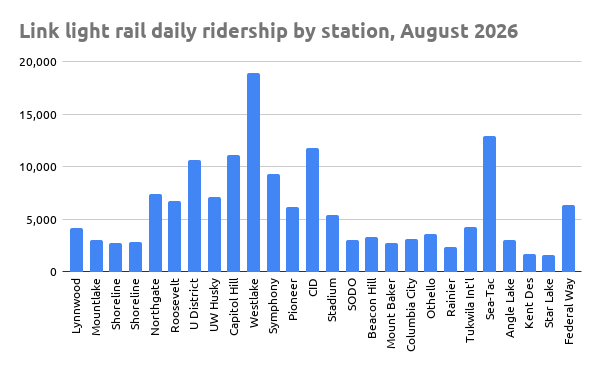
Nearly every station west of Lake Washington is pulling in more ridership than even the busiest Eastside station. The exception is Rainier Beach, Kent Des Moines, and Star Lake, which are each below 2,500 daily boardings.
Westlake Station amassed 19,458 daily boardings in August, garnering more ridership than the entire East Link – the 12 stations served only by the 2 Line rather than both lines.
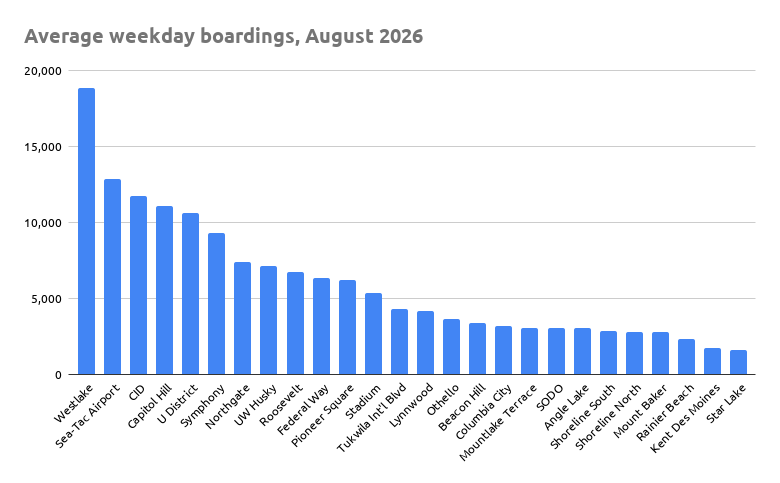
Eight of the top 10 stations for ridership are in Seattle. SeaTac's airport station (the second most-ridden) and Federal Way Downtown (in tenth) join the top 10 list. Seattle's top nine most-ridden stations all benefited from 2 Line expansion, which roughly doubled train frequencies, enticing more riders.
Since 1 Line and 2 Line ridership is currently lumped together in agency data (at least in overlapping stations) we don't know exactly how much of the load that the 2 Line is carrying at those stations.
The 1 Line is operating with a mix of four-car and three-car trains, while the 2 Line is typically two-car trains; so, the capacity of the 1 Line is greater. But riders traveling within the overlapping segment are likely to take whichever train comes first, which is effectively a coinflip when both are at eight-minute headways.
The lack of line-specific ridership data at Sound Transit could hinder the agency's ability to optimize its service patterns. However, a spokesperson did frame a solution to track the ridership by line, rather than in the aggregate only, as imminent.
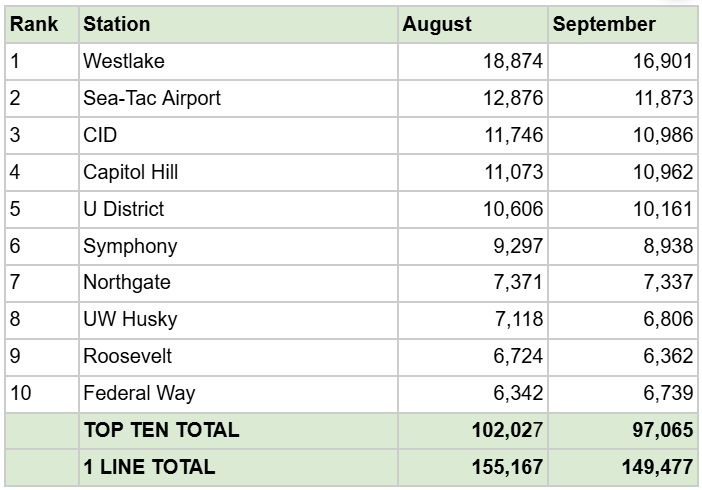
The data shows a massive share of the agency's ridership passes through its top 10 busiest stations. The pattern has been fairly consistent in recent months, with about 65% of ridership happening in the top 10, versus just 35% in the remaining 16 stations in the corridor.
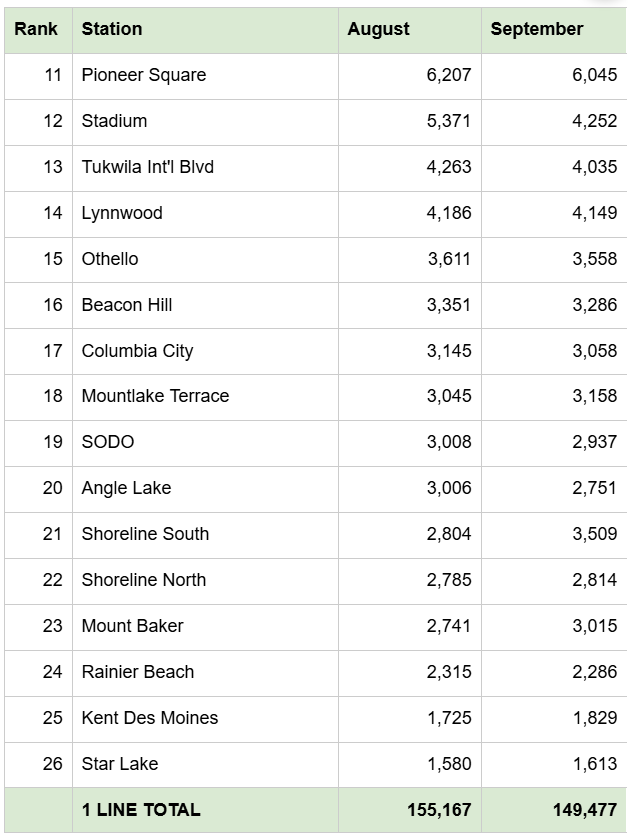
The largest ridership jump from August to September was at Shoreline South, which saw a 25% increase from just over 2,800 to just over 3,500 daily riders. This is likely the fall bus service change at work, and the increasing opportunity for bus-rail transfers after it – Route 522 now heads to Shoreline South instead of continuing along SR 522 to the University of Washington's Seattle campus, which means 522 riders headed to and from campus now hop a train in Shoreline. Another boost could be tied to the leasing up of new apartment buildings added near the station.
Federal Way was also a gainer in September, adding about 400 daily boardings and leapfrogging Roosevelt to become the ninth-busiest station for the month.
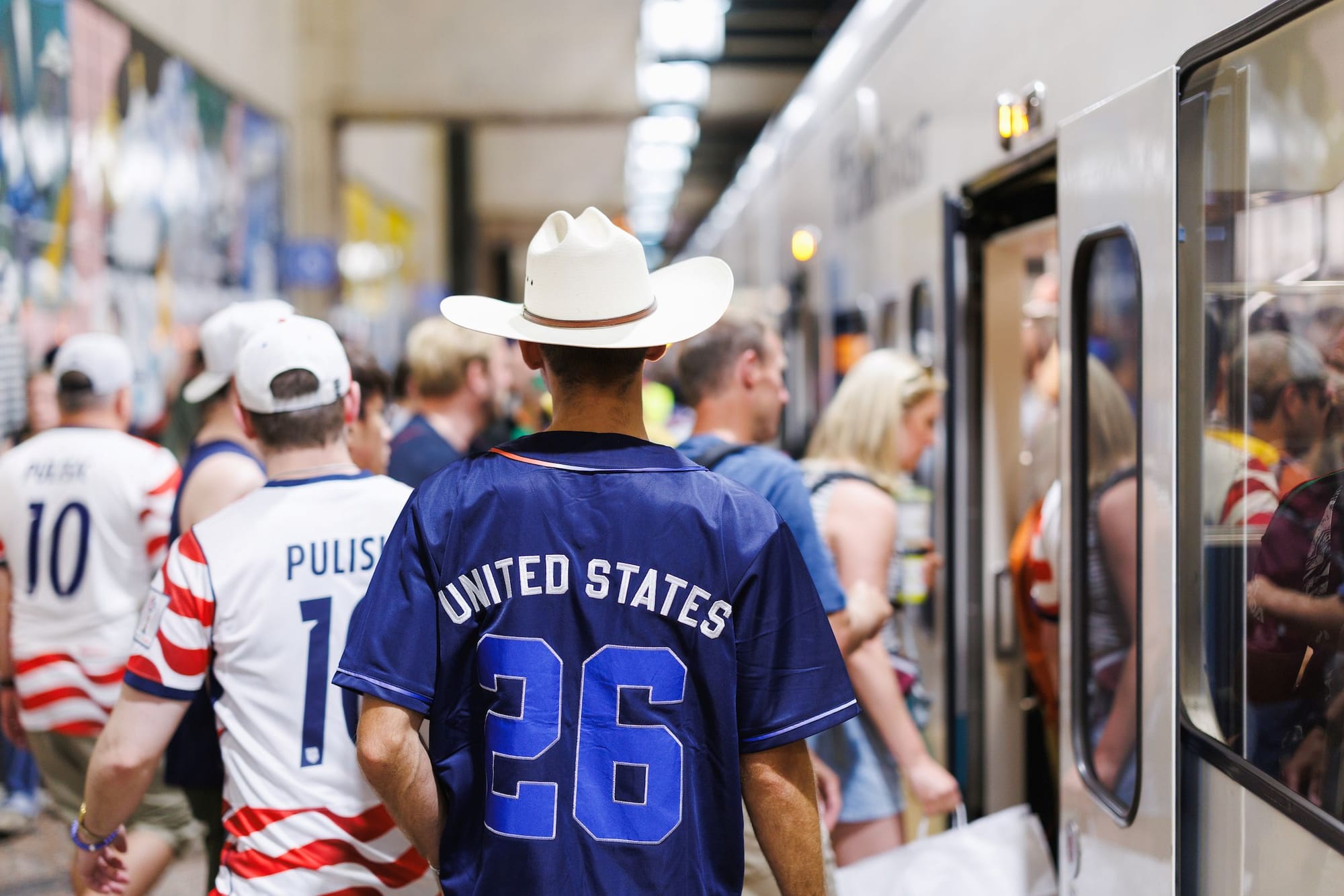
Meanwhile, the biggest ridership drops from August to September were at Stadium and Westlake. Stadium is yoked to the whims of sports fans and event schedules, and waning interest in the Seattle Mariners baseball team as their playoff odds evaporated must have hurt ridership totals. The drop of nearly 2,000 daily boardings at Westlake is more mysterious, but perhaps tied to a slowing of the tourism season. Sea-Tac Airport also saw a drop of roughly 1,000 daily boardings, in alignment with this hypothesis.
Overall, Sound Transit is largely sustaining ridership from its June peak during the height of World Cup fervor. In September, the 1 Line corridor came in just shy of 150,000 daily boardings, while the 2 Line hit nearly hitting 15,000 daily boardings in its exclusive segment.
Systemwide, September's ridership total is indeed down, but only moderately from the 178,264 daily boardings highwater park in June.
What the trend will be in months ahead is an interesting question.
Sound Transit does not have any big light rail openings planned for nearly a decade, with West Seattle Link and Tacoma Dome Link extensions expected to come online in 2035, barring further delays. The Graham Street infill station could be a small boost around 2031.
And given the lack of housing development near the station, the recently inaugurated Pinehurst infill station isn't likely to move the needle much on systemwide ridership, at least in the near term. Starting in 2028, the rollout of Sound Transit's Stride bus rapid transit system could add a boost via bus-to-rail transfers, but impact will likely be modest.
Since Sound Transit torrid pace of light rail expansion is hitting a lull, light rail ridership growth will need to be organic – likely built on adding homes and jobs near existing stations and attracting more riders through consistent service quality.
Part of the decline from the June peak could be attributed to the agency's going from a month of nearly flawless execution to a period with several major service disruption and hiccups. Who can blame would-be riders for hopping on a bike or scooter or hailing a cab on days when significant disruptions occur?
The good news is that cities up and down the line are generally aiming to add housing near their stations – albeit to varying results. Sound Transit has also pledged improvements to maintenance and how it handles disruptions, hoping to lessen the sting and keep riders trusting light rail is a reliable way to get where they need go.
Even without major expansions in the near-term horizon, Sound Transit ridership appears to be trending in the upward direction all the same.
 Doug Trumm