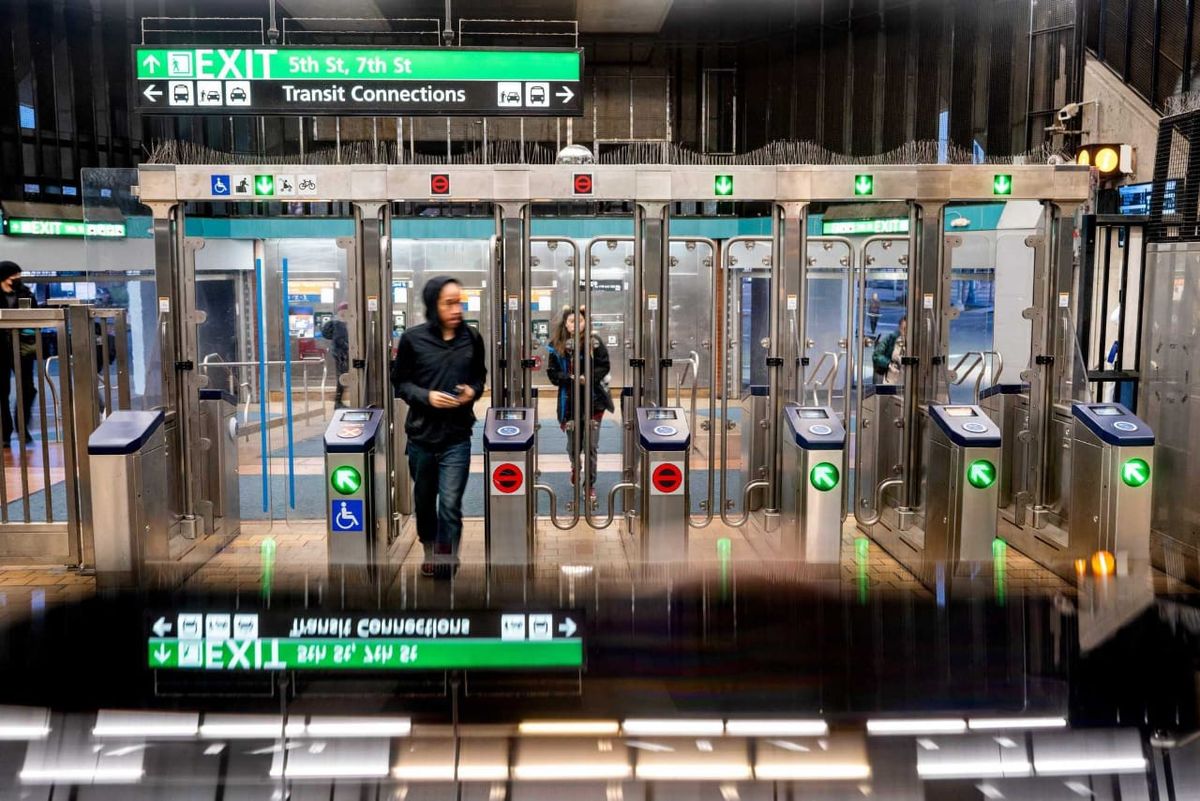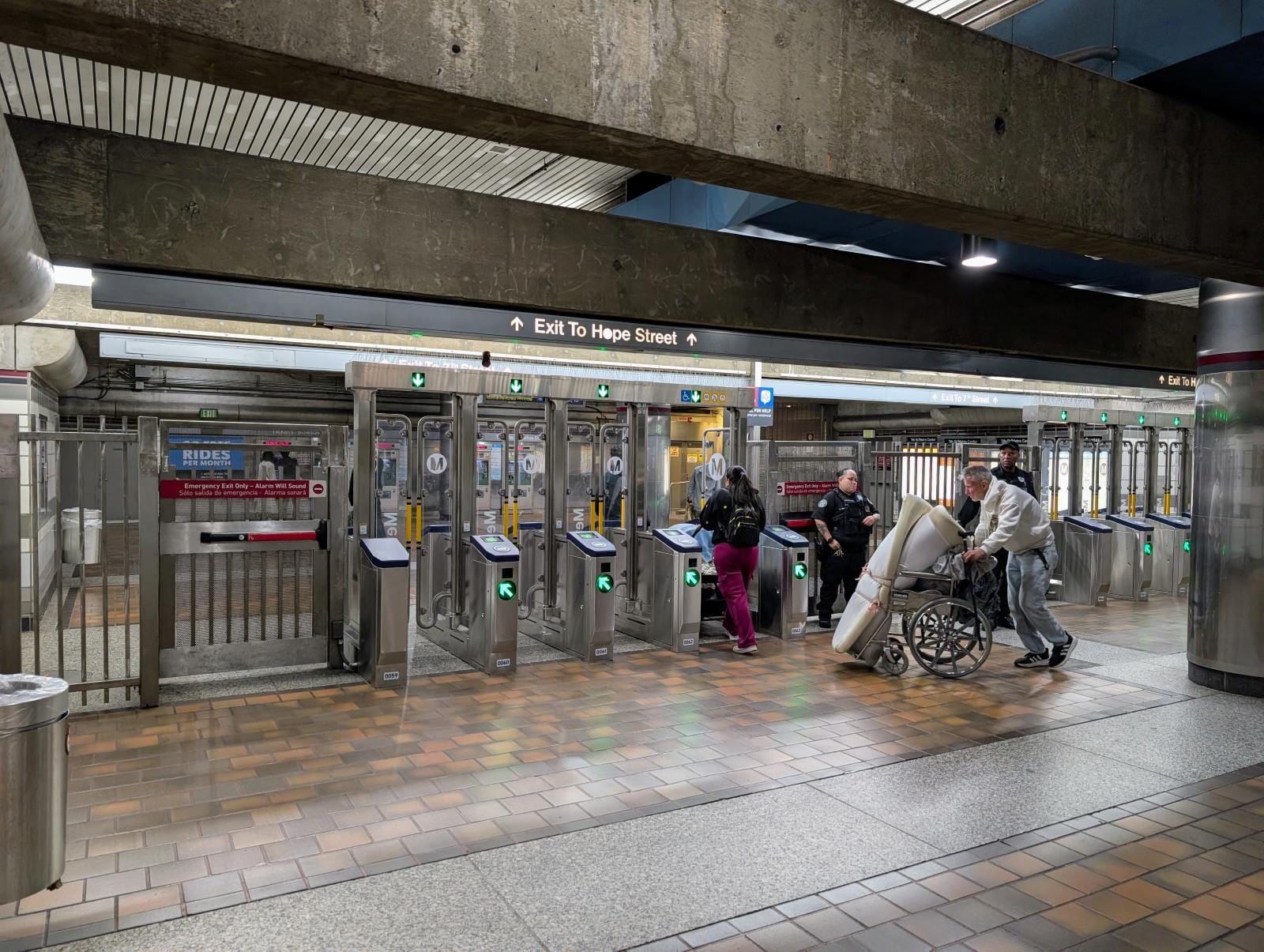
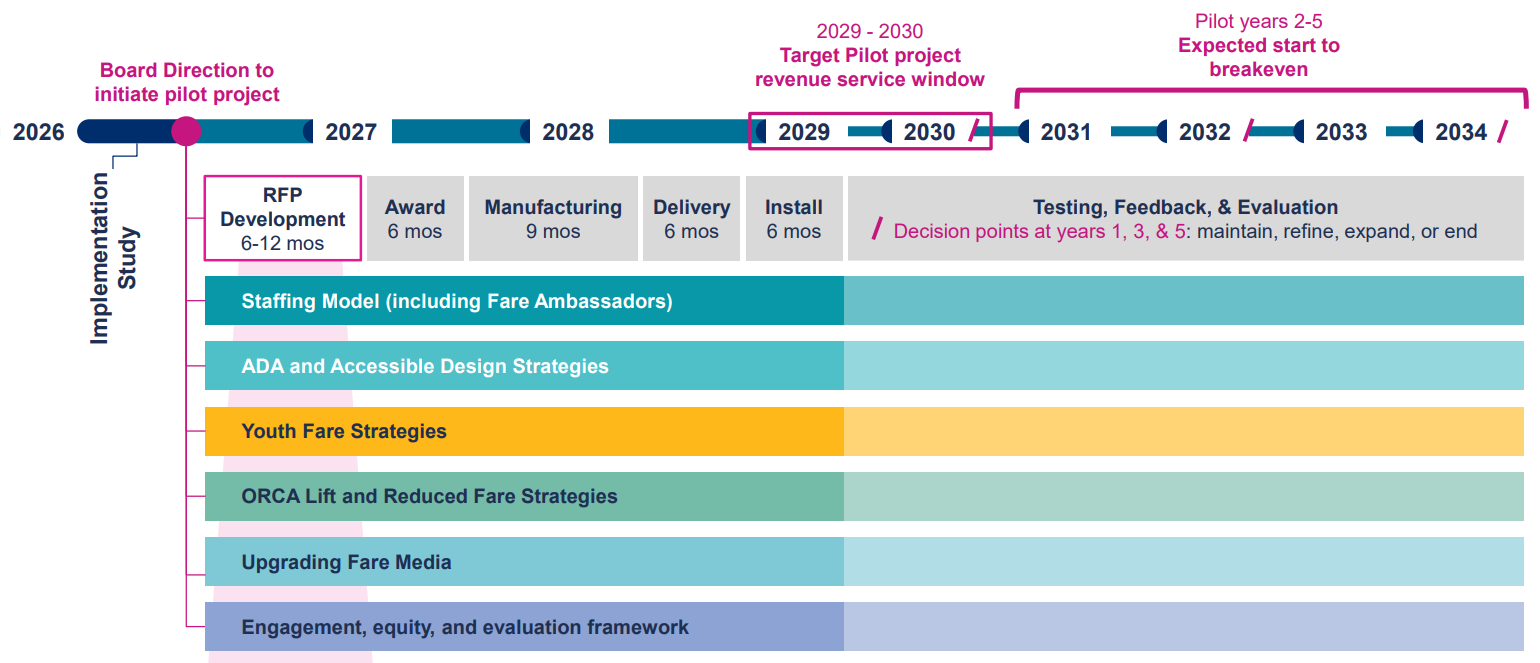
On Thursday, the Sound Transit Board of Directors approved the creation of a fare gate retrofit program set to use $6 million that has been queued up to design a gate pilot at 14 high-ridership Link stations. Those design and planning funds are expected to ultimately turn into an $87 million program that will get gates installed by 2029 or 2030.
Once implemented, the pilot program is expected to recoup costs through higher fare compliance rates within two to three years, according to agency projections.
At last estimate, Sound Transit puts its current light rail fare compliance rate at 63%, based on automatic counters on trains compared to fares paid. The caveat: that figure includes youth under 19, who are not required to pay fares under the state's free youth fare program. Adjusting for free-ride youth would put the compliance rate closer to 70%.
Additionally, Sound Transit's fare ambassador program, which is based on staff members actually checking fares on trains, has measured the fare compliance rate at 85% in 2025, with a further 7.5% of fare-less riders checked being exempt youth. This discrepancy has led some transit advocates to argue the agency is overestimating fare evasion and the potential uptick in fare revenue that gates could prompt.
Sound Transit's financial modeling is based on achieving 95% fare compliance at stations where gates are installed, which staff noted is less that the 98% peer agencies have reported at gated stations. The need to include accessible entry points for people in wheelchairs or with strollers or bikes means the opportunity for fare gate jumping will exist to some extent, although other U.S. transit agencies have estimated that problem as a relatively minor one.
Sound Transit's initial proposal would put bi-directional fare gates at the high-ridership stations in the core of Seattle, Bellevue downtown, and at the ends of lines. Since the gates would be bidirectional and require riders to tap on to enter and tap off to exit stations, staff expect compliance rates to increase systemwide, not just at the gated stations. This is because so many trips end at the stations set to receive gates. With bi-directional gates at key stations, retrofitting all of the system's other stations down the line will likely prove much less lucrative.
"It's important to highlight that while we are showing only boardings at gated and non-gated stations, we're going to need to measure system-wide compliance given the bidirectional nature of the gates, where compliance will be driven both by boardings and alightings," said Brian de Place, Sound Transit's Security and Fare Engagement Executive Director. "And since the vast majority of our riders come in and out of the gated stations, we expect to see compliance levels change at the non-gated stations as well as the gated ones."
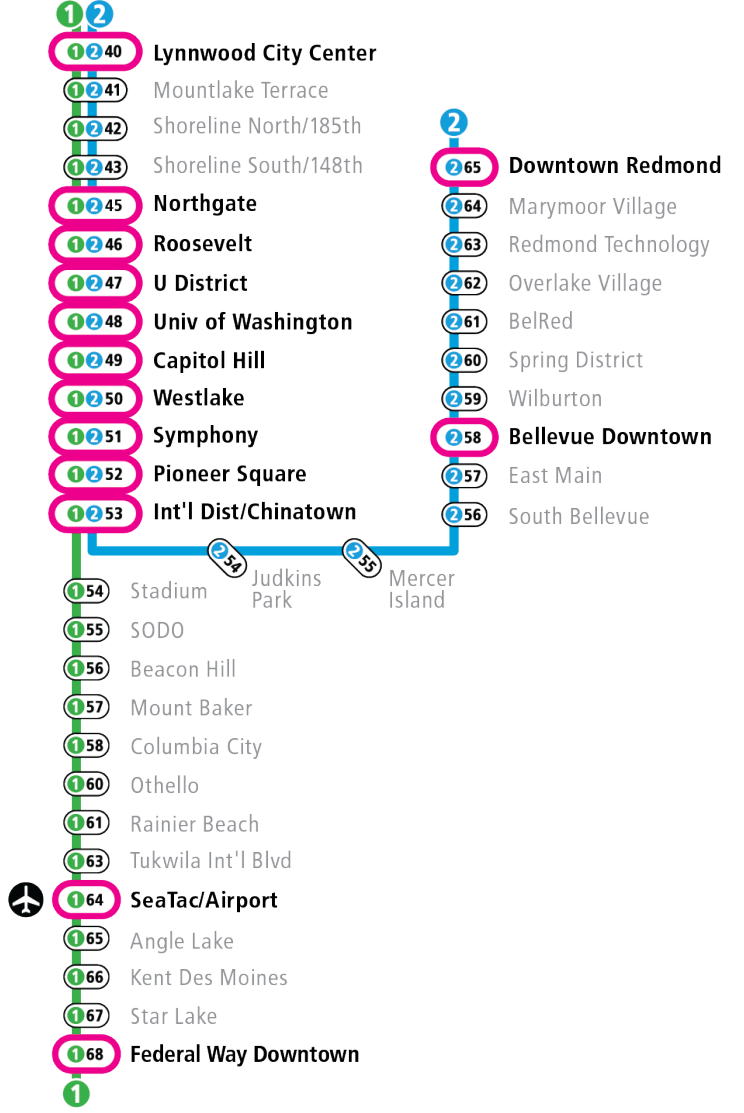
About 85% of Sound Transit light rail ridership starts or ends at one of the 14 gates to be targeted for gates, officials said. That traffic has grown rapidly with the extension of the 2 Line across the lake, reaching 160,000 daily riders even before the World Cup came to town.
De Place noted that the agency also opted against trying to quantify the fare compliance benefits at non-gated stations nor the side benefits they hope to achieve – such as lower maintenance costs due to less vandalism – in their financial calculations, although peer agencies, like BART, have reported such benefits after implementing fare gates. If such benefits do come to pass, the financial boost from fare gates could be even larger, he said.
Without factoring in those potential benefits, the agency estimates gates would still boost fare revenue by at least $30 million annually, an increase of more than 30% compared to today's fare revenue across the entire Sound Transit system.
While a nice little boost, that level of revenue is not likely to be large enough to be a major factor in solving the agency's multi-billion-dollar budget gap through 2046. Once estimated at $34.5 billion, the board reduced its long-term budget gap to about $10 billion in May by delaying or tabling a number of expansion projects – and planning to sunset the Sounder N Line commuter rail service. Every little bit helps, though, fare gate supporters have posited.
The fare gate pilot program received a recommendation from the Rider Experience and Operations Committee earlier this month, generating a more in-depth policy discussion at that juncture. King County Councilmember Claudia Balducci noted the agency would need to set its metrics of success for the program, which she painted as a bit squishy so far.
Some boardmembers also raised equity concerns, about potentially making it harder for low-income residents to access the light rail system. King County Executive Girmay Zahilay highlighted those concerns on Thursday, with de Place noting staff was hoping to ramp up participation in the Orca LIFT reduced fare program.
"Brian, just to clarify, you're saying that between now and when fare gates are installed in the next couple of years, we have a specific plan to set up structures or staffing where people can enroll on site for free and reduced fare cards," Zahilay said. "Is that right?"
De Place said yes, with board authorization.
As it stands, staff said about 91,000 people are enrolled in a reduced fare program. Given the Seattle metropolitan area has a population around 4 million, that suggests a fraction of the people eligible are actually enrolled in ORCA Lift or other reduced fare card programs.
In his report to the board on Thursday, Sound Transit CEO Dow Constantine pledged efforts to increase rider awareness as the roll out of the fare gate program approaches.
"Staff have heard loud and clear the emphasis on a thorough and equitable engagement strategy that ensures appropriate fare media and rider awareness materials are available to all passengers once the program is implemented," Constantine said. "Should the board adopt the pilot today, we look forward to keeping you apprised of our progress in tandem with standard design and construction updates you should expect."
After King County Councilmember Teresa Mosqueda raised a question about access for people with disabilities or with bikes in tow, Sound Transit staff assured the board the agency's Request for Proposal would factor in those needs, and that solutions existed.
"As we move into preparing the RFP and actually coming up with the design of these gates, we'll be working really closely with both the ADA community and the bike community in order to understand the specific needs of those communities vis-a-vis gates," said Meg Cederoth, who is deputy chief planning officer at Sound Transit. "And there are multiple systems in the U.S. where the ADA question has been resolved quite comfortably. We'll be making sure we're engaging with our local communities to understand any unique needs here, and then the bike community as well will be working with them to understand that the gates are wide enough."
Another aspect still to be determined is if the fare gates will be rolled out simultaneously at all 14 proposed stations, or on a rolling basis to test the program more incrementally. The board will still need to greenlight the construction funding before the pilot can fully advance.
 Ryan Packer