State officials are trying to keep the dream alive of high speed rail connecting the Cascadia region and linking Seattle, Portland, and Vancouver. The Washington State Department of Transportation (WSDOT) has a public survey open through November 13.
The survey will refine high speed rail options while also shaping the I-5 master plan the agency is putting together at the same time. Yoking together the planning for the region's primary freeway and its most promising HSR route was a conscious decision on WSDOT's part, aiming to underscore the crash course the region is on toward transportation gridlock – at least without significant intervention.
"The Cascadia megaregion is expected to grow by 3.4 million more people by 2050. This growth is equivalent to adding a city almost the size of Los Angeles to the megaregion," WSDOT noted on its project page. "The increase in population will be matched by economic growth across industries like technology, aerospace, healthcare and logistics. Recent studies show that the strain on our existing transportation system will be significant by 2050."
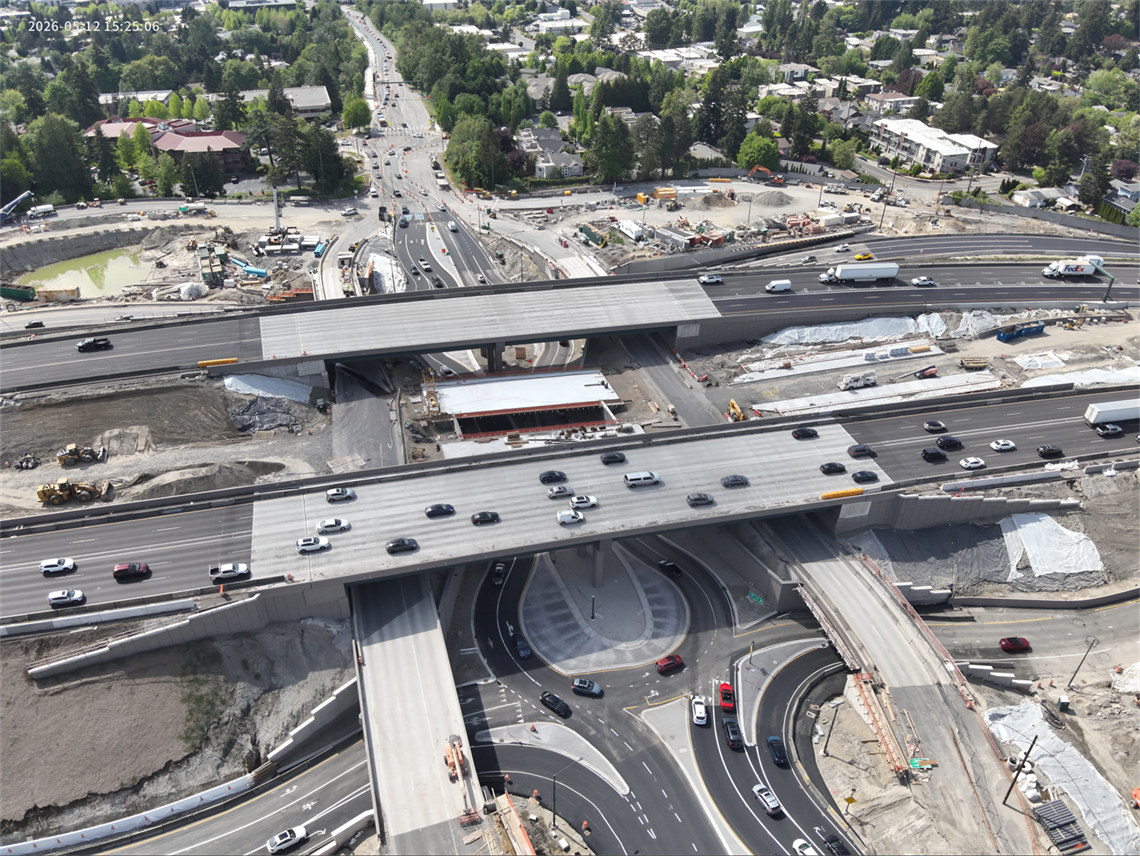
The state transportation department lays out the need for upgrades in the I-5 corridor. (WSDOT)
The survey does not provide much new information for folks who have already been engaged in this high speed rail process, which WSDOT has long been exploring – going back to a 2017 feasibility study, a 2019 business case study, and a 2020 framework study outlining a path to cross-border governmental collaboration.
WSDOT did share a project definition that sets a goal of achieving top speeds of at least 160 miles per hour.
"The purpose of the Cascadia High-Speed Rail project is to provide reliable high-speed rail service at speeds greater than 160 mph or 260 kph that is competitive with other transportation modes and improves mobility between the Cascadia megaregion’s metropolitan areas. The project purpose includes optimizing the safe and efficient movement of people in the growing Cascadia megaregion and facilitating economic development."
According to a presentation from September at the Washington Transportation Commission, the high speed rail program is spending the next year identifying "potentially feasible" route options, before spending another year refining those options.
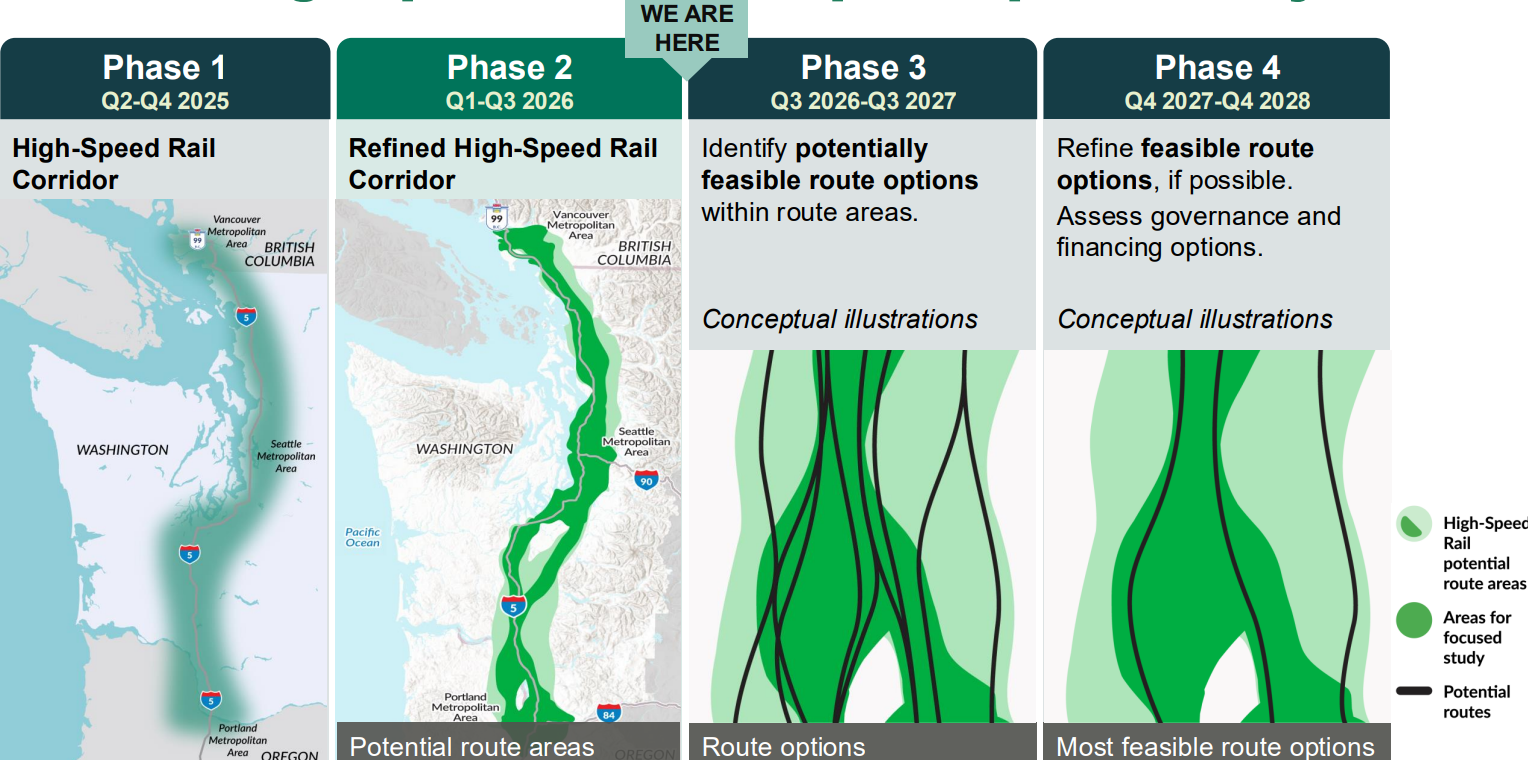
"The Service Development Plan will be an analysis of potential routes where high speed rail could operate, an analysis of conceptual service options like the number of train trips and the number of stops that a high speed service may have," Ben Tripousis, WSDOT's Cascadia High-Speed Rail and I-5 Program Administrator told the commission. "We'll look at financing and governance as a component of the service development plan development. What the service development plan will not determine is a preferred route option or specific station locations at this time. That will be accomplished in future analysis."
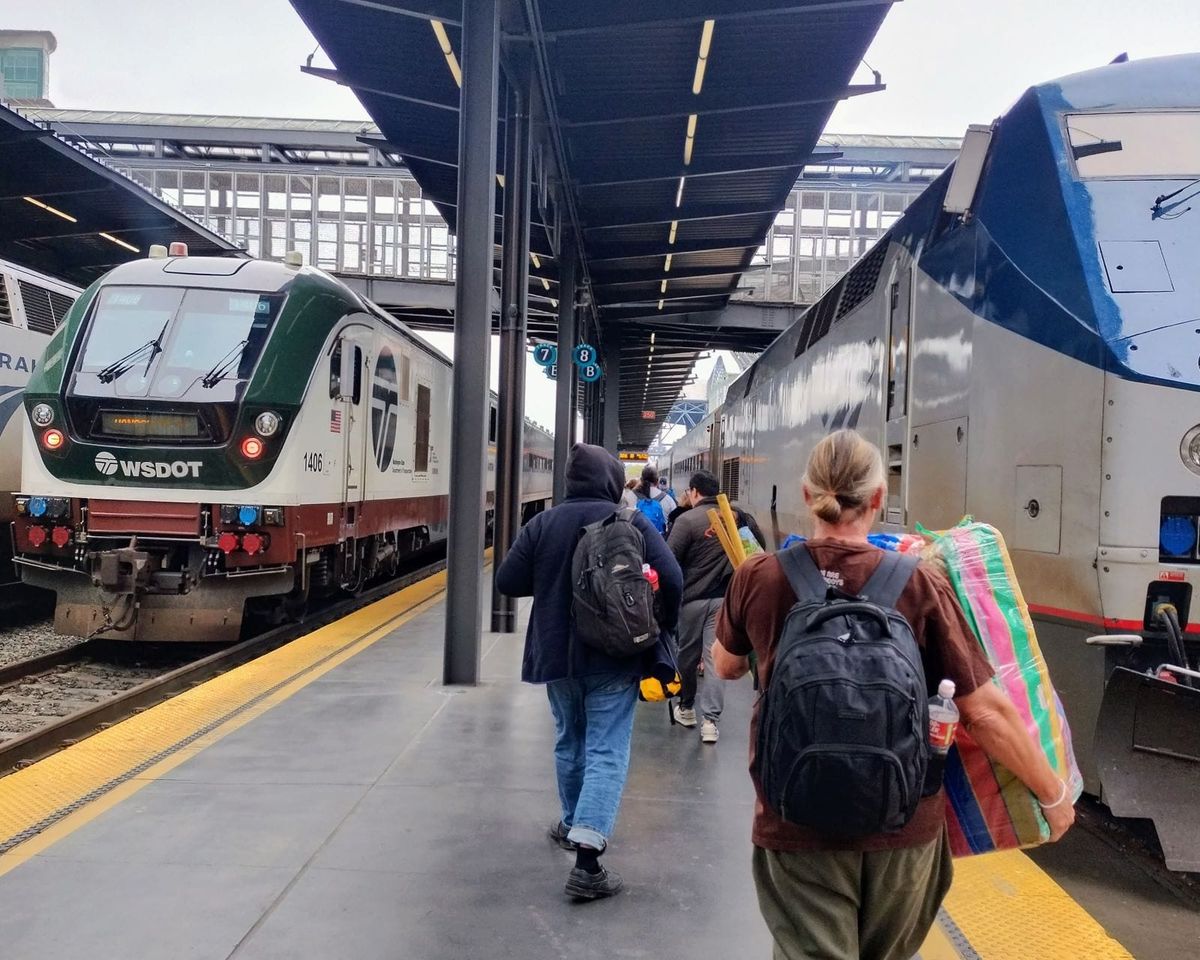
WSDOT clarified that HSR would be a complement rather than a replacement for existing Amtrak Cascades service: "Cascadia High-Speed Rail would complement the existing Amtrak Cascades passenger rail service. High-speed rail would make fewer stops and travel at greater speeds than conventional rail services, likely running on new, dedicated tracks. Think of high-speed rail as the express train, while Amtrak Cascades would be the local route."
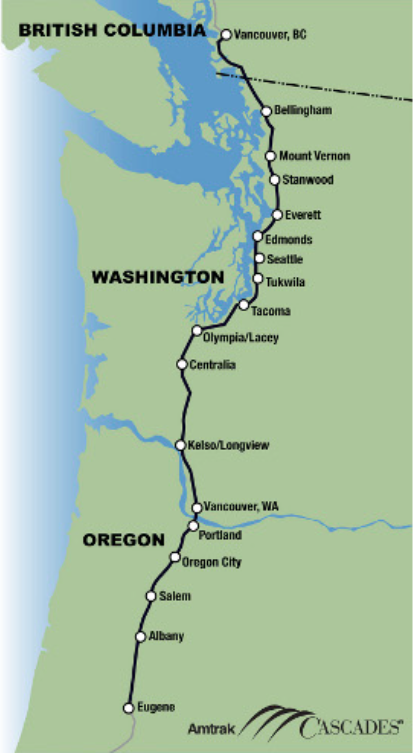
WSDOT is leading on the planning effort because 277 of the 315 miles between Portland and Vancouver, B.C. are in Washington state. That stretch could be spanned in as little as two hours with high speed rail, depending on the number of stops and the maximum speeds achieved.
In the final days of the Biden Administration, WSDOT secured a $49.7 million federal grant to fund the creation a service development plan for Cascadia high-speed rail.
WSDOT will likely be facing pressure from some quarters to widen I-5 in its master plan process. Former WSDOT secretary Roger Millar warned that widening I-5 would be prohibitively expansive and ineffective, since car traffic would swell to clog the wider artery.
High speed rail would be pricey in its own right, but with much better ability to scale up and solve the underlying problem. Unlike adding another freeway lane on I-5, high-speed rail can boost frequency to meet increased demand, rather than quickly succumbing to congestion issues and getting trapped in a cycle of induced demand.
Whether freeway expansions or light rail, large infrastructure projects are facing massive increases in construction costs, which is sure to impact high-speed rail projects as well. These cost increases are tied to a period of high inflation and sky-high costs on construction materials (linked to Trump tariffs) and fuel (tied to Trump's war in Iran). In its 2017 study, WSDOT estimated Cascadia “ultra-high speed rail” would cost between $24 billion and $42 billion — and that was before the era of high construction cost escalation hit.
A higher price tag is running headlong into a period of retreating public investment in passenger rail.
Republicans have also been pushing to overhaul grant programs funded in Biden's Infrastructure and Jobs Act to punish transit projects. Now that Democrats have retaken control of Congress, gutting transit investment seemingly should be off the agenda – although some Democrats like Washington's own Rep. Rick Larsen (who is the frontrunner to secure the coveted position of House transportation committee chair) had signed on the Republican-led legislation, which has an Orwellian name: the BUILD America 250 Act.
Meanwhile, some rail advocates have argued high speed rail has boondoggle potential – pointing to the over budget and very behind schedule California high speed rail project – as they push the state should prioritize more incremental improvements to Amtrak Cascades service that could be achieved sooner. Studies have shown high demand for conventional rail that could easily support doubling Cascades frequencies to 16 daily trips – which state lawmakers affirmed as a goal without yet allocating funding to make it happen.
Since the state is envisioning high speed rail as an express service serving fewer stops, more frequent "local" Cascades service would serve a valuable purpose once the bullet train arrives, feeding the high speed hub stations and keeping the in-between cities connected. And in the interim, it would build up a base of ridership so high speed rail can hit the ground running.
State officials are aiming to complete the high speed rail service development plan by 2028. That may put the region in position to win federal funding from a new federal administration more friendly to transit than Trump has been.
Since high speed rail will likely take more than a decade to build, its success may also require a period of political stability and continued federal commitment to infrastructure investment that the United States has not seen over the last decade. But the 2026 midterm could potentially portend a larger political shift – at least if that momentum can be sustained and cultivated.
Complete WSDOT's survey by Friday, November 13.
 Doug Trumm