Today is the due date for engineering firms to submit cost-saving ideas for the Ballard Link light rail extension, but some transit advocates are criticizing Sound Transit's process and questioning whether the agency is actually open to new ideas and innovative approaches.
Many Sound Transit 3 (ST3) expansion projects are facing headwinds, but Ballard Link in particular faces considerable uncertainty, with a 2042 opening date for the whole line the best case scenario, which would require closing a huge budget gap of around $8 billion. The less-rosy scenario would be opening only the portion through Downtown Seattle in the 2040s and delaying the Interbay and Ballard section to the 2060s, allowing more time for funding to accrue in Sound Transit's coffers. West Seattle Link, meanwhile, has slipped to 2035 – five years later than initially envisioned.
When the Sound Transit Board of Directors overhauled project schedules on May 28, it established a Request for Information (RFI) process to solicit cost-effective design ideas for Ballard Link from outside firms. However that RFI didn't actually go out the door until last month. Sound Transit issued the RFI on September 2, with responses due October 5.
Advocates with the Save Ballard Rail coalition pushed for the RFI and hoped that it would open the door to much more cost-effective approaches that allow Sound Transit to deliver light rail to Ballard closer to its original timeline in the 2030s.
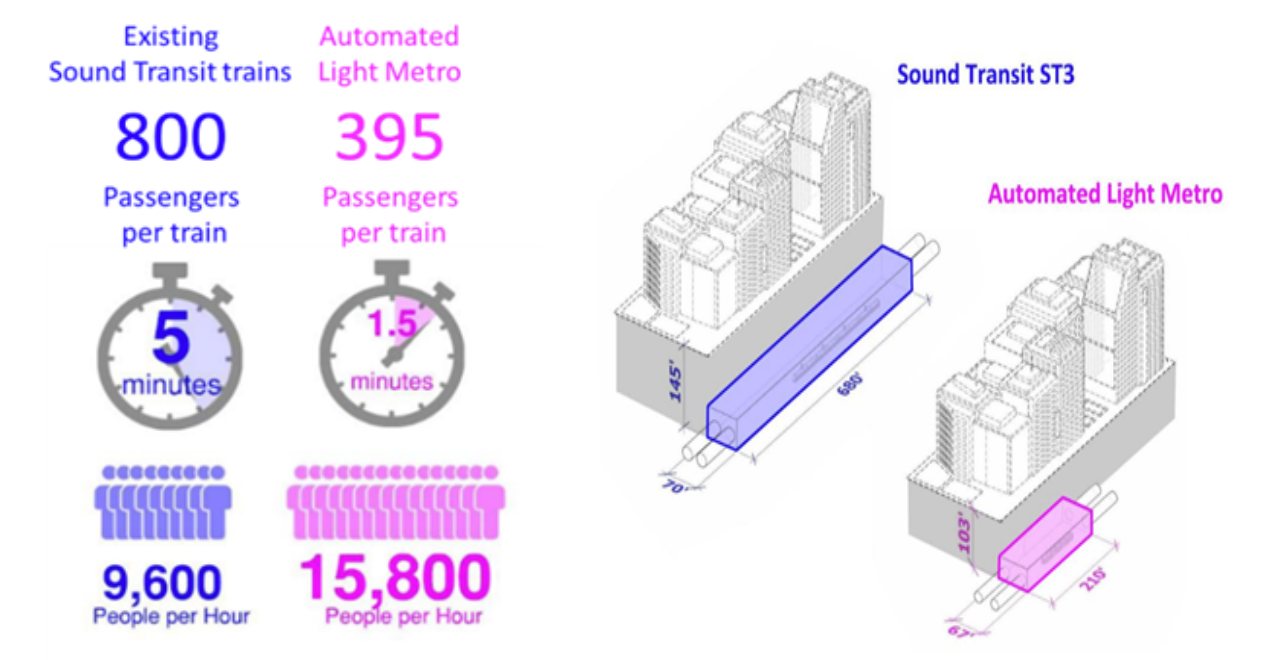
One of those cost-slashing ideas was converting Ballard Link to an automated light rail (ALR) system with shorter trains and stations, as proposed in a white paper by former Seattle Department of Transportation director Scott Kubly and transportation planner Trevor Reed, and popularized in an Urbanist op-ed. Copenhagen used this technology to overcome their own financial crisis and deliver a highly successful metro system, providing a proof of concept, but the authors do not think Sound Transit is taking their idea seriously.
"They have structured an RFI process that is almost guaranteed to validate their current approach," Kubly and Reed told The Urbanist in a joint written response. "They did no industry outreach ahead of time, they barely publicized the RFI, and they gave an extremely abbreviated response period. This is not the approach of a competent agency or an agency that wants serious responses. This is a clear example of a bureaucratic following the letter but not the spirit of a board request."
Another idea that has garnered interest from Save Ballard Rail and other transit groups is exploring elevated rail as a means to avoid incurring huge costs digging a deep tunnel and cavernous stations in downtown Seattle. Civil engineer Travis Henderson pitched the idea in a white paper he sent to Sound Transit this spring and finetuned in an op-ed in The Urbanist last month. Several transit groups endorsed studying the idea, including Seattle Subway and Transit Equity for All.
"Against a 34-year wait until 2060 for the full line, two or three years of further study is not the risk. The current plan is," Henderson wrote. "Declining to study an alternative with $10 billion in potential savings because the analysis may cost tens of millions is not sound process management. It is institutional inertia, a sunk-cost fallacy that completes the paperwork for a tunnel Sound Transit cannot afford to build, while blocking the alternatives most likely to reach Ballard."
Henderson pointed out the parameters of the RFI precluded firms from putting forward elevated rail as a replacement for planned tunnel sections downtown. The RFI instructs respondents that they "must be mindful of the existing project definition and eschew strategies that could further jeopardize the project timeline." Since Sound Transit has never formally studied elevated rail for the downtown section, it does not fit the project definition.
In a series of Bluesky posts, Kubly criticized how quietly Sound Transit was conducting the RFI process.
"Thursday before Labor Day they issue [the RFI], wait 1.5 weeks to publicize, give 30 days to respond," Kubly wrote. "It’s almost as if they don’t want serious responses. Their staff wrote a memo in April reviewing our proposal. Tips their hand that they aren’t receptive to new ideas."
Kubly also questioned whether agency staff had given automated light rail proposal a fair shot. Sound Transit's deputy executive director for enterprise planning, Alex Krieg, quietly issued an internal memo responding to Kubly and Reed's proposal in April, but the agency didn't send it to the authors or the outside world until June 12 – after the board had voted on the financial plan.
The memo poo-poos the savings possible with shorter choo choos, claiming Kubly and Reed overestimated how large planned stations are likely to be. Additionally, Krieg argued Seattle costs are uniquely driven up by high seismic risk and the earthquake-proofing requirements that brings related to liquefaction risk and unfavorable soil conditions (composed of loose glacial till and artificial fill in some trouble spots) and routing obstacles that would still be in play with shorter stations.
"While having shorter station platforms would make station-siting easier, tunnel and station depths on Ballard Link are driven primarily by the need to route around and below existing building foundations, construction tiebacks, and major utilities – not by station size," Krieg wrote in the memo. "The depth of Westlake Station, for example, is set by the need to tunnel under the foundation caissons of the Motif Hotel. These constraints exist regardless of vehicle technology or station size."
It's interesting that the agency is considering a hotel built in 1973 an immutable obstacle. Motif last sold for $145 million in February 2018 – although the 19-story tower did see a renovation in 2023, according to Puget Sound Business Journal. It's possible the agency could save more buying the property and demolishing it than routing a $20 billion-plus project around it, which would force the future Westlake Station to one of the agency's deepest ever at around 135 feet.
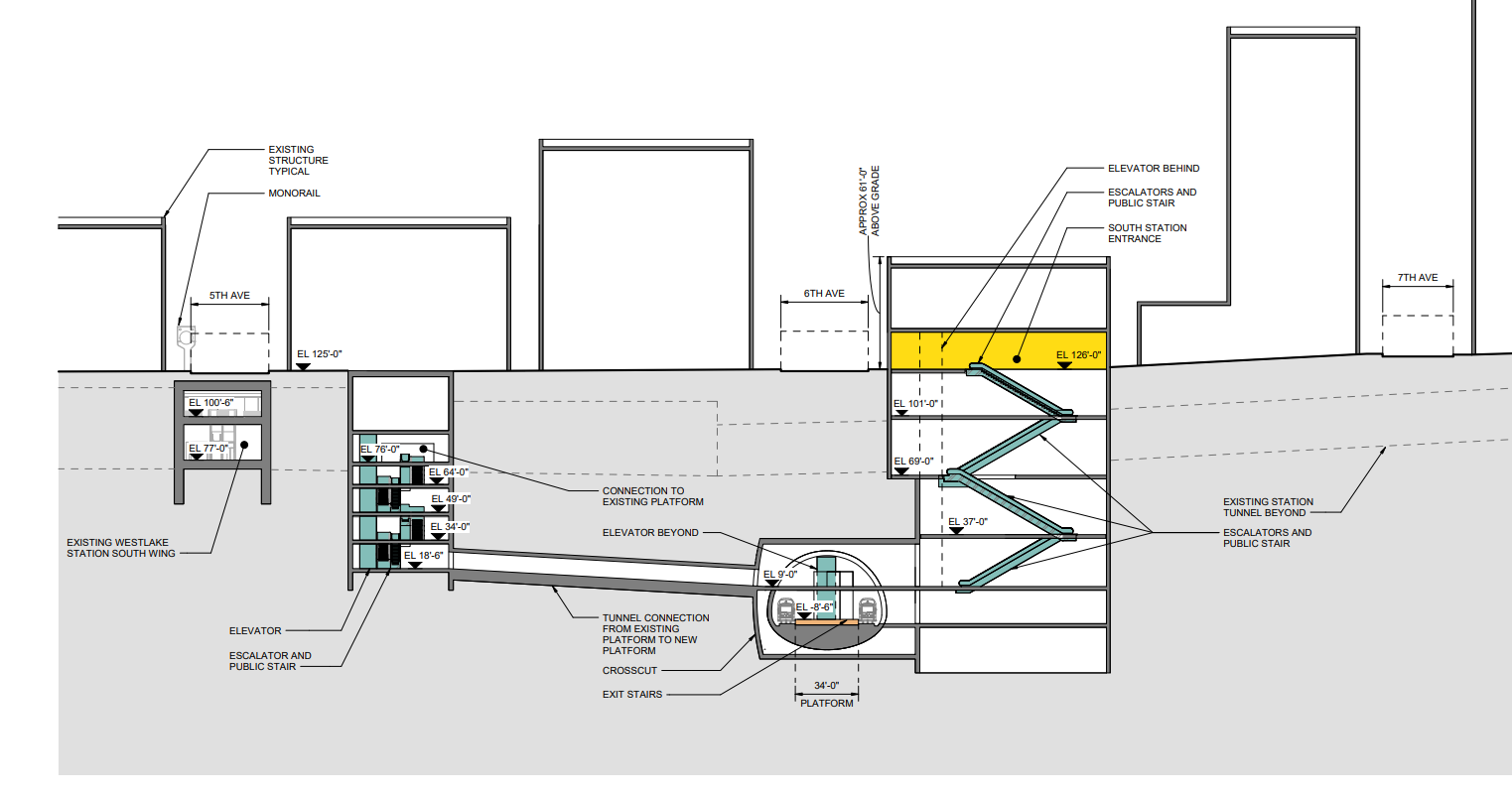
While on the surface Krieg's memo appeared dismissive of the idea to switching to shorter automated stations, Kubly and Reed said the agency conceded some of their key points, and framed project risk all wrong, overlooking the shortcomings of its current approach.
Sound Transit concedes that its costs are globally anomalous and validates the central thesis of our white paper: smaller stations and more frequent, automated trains save money. It does not argue that the agency’s current plan is cost effective or that our proposal lacks merit. They argue changing course creates risk. That framing only works if their current plan is low-risk.
The memo treats the current plan as safe and ALR as risky. That is the wrong framing. The current plan has already produced unaffordable costs, delayed delivery, public distrust, and a system plan that fails to deliver on the voter-approved ST3 plan. That is not risk. That is certainty.
The memo falls back on familiar Sound Transit tropes, everything is uniquely hard here, any alternative is fraught with risk, and every constraint is fixed unless it supports the preferred plan.
-Kubly and Reed
Kubly and Reed said they didn't consider elevated rail in their white paper because they determined it would be too large of a change to reuse the existing environmental impact statement (EIS) documentation without significant additional work. They hoped ALR would largely repurpose the existing draft EIS since it was still in a tunnel with the same tunnel locations.
The draft EIS for Ballard Link was supposed to be released this year, but has been repeatedly delayed, with foot dragging from the Trump administration likely contributing.
The delays could be an opportunity to rethink approaches, but there's no sign that's the route the agency is going. Elevated rail could offer cost savings in West Seattle, or at least expose that the agency is not reasonably estimating the cost differential between tunneling and elevating lines.
West Seattle's Junction originally was envisioned as an elevated station, but Sound Transit converted it to an underground station under the excuse that it might actually be cheaper, while reducing neighborhood opposition related to aesthetic concerns and construction detours. Shortly thereafter, the agency revealed its preferred route has ballooned in cost by $1.6 billion.
"There's no universe that elevating should cost more than tunneling in West Seattle based on the current land use and extensive [City-owned right-of way or ROW]. Refusing to take any of the Fauntleroy ROW is an assumption that would be contested in any objective process," Kubly and Reed told The Urbanist. "But it was a red line for the electeds/local stakeholders actually negotiating. An elevated option in downtown could be a part of the solution. We think the better approach is not to prejudge an approach, but put them in competition, through the RFI.
Across the board, the agency is largely doubling down on existing approaches to keep ST3 projects moving, even as financial headwinds grow. That approach may end up working on some lines, but advocates are worried it's failing Ballard.
The board has prioritized building out the light rail spine to Tacoma and Everett – a corridor stretching more than 60 miles. Relatedly, those project face smaller delays. Sound Transit is expecting to open Tacoma Dome Link in 2035 – three years later than first planned. The agency is hoping to launch the first leg of the Everett Link extension (as far as Paine Field) in 2037. That's only one year later than promised during the ST3 campaign. The section from Paine Field to Everett Station would wait until 2041 under the phased opening plan.
Or as Kubly opined: "Don’t be surprised to read that the results from their RFI validate their current approach."

 Ryan Packer
 Scott Kubly
 Travis Henderson