Elevated light rail would be much cheaper and have better outcomes than a deep-bore tunnel in Downtown Seattle.
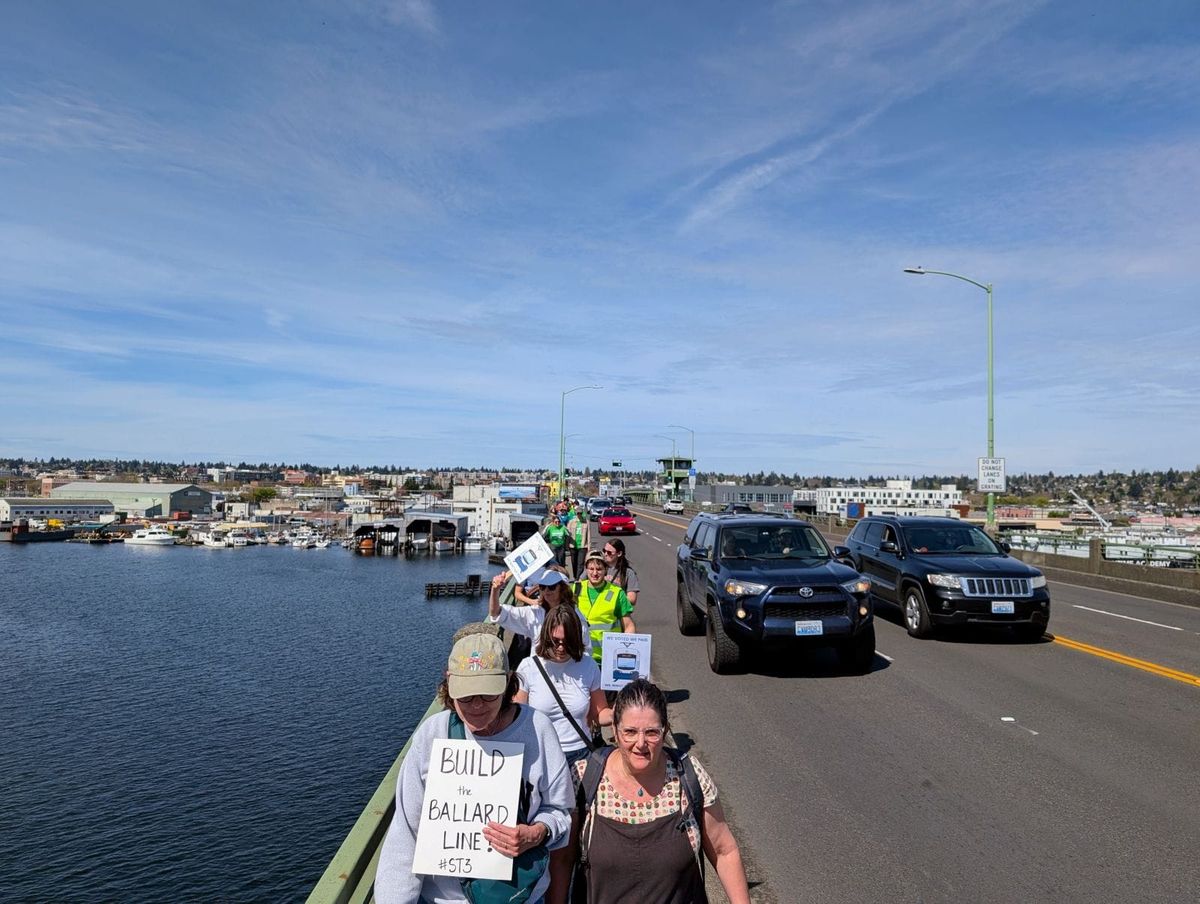
On May 28, the Sound Transit Board of Directors voted 16-2 to designate the final segment of light rail to Ballard, from Seattle Center to Market Street, as “not currently affordable.” The funding gap is pegged at $7 to $9 billion, with stations at Smith Cove, Interbay, and Ballard left unfunded. The agency now projects an official opening as late as 2060, 44 years after voters approved the line as part of the Sound Transit 3 (ST3) ballot measure in 2016.
In the same vote, the board fully funded the second light rail tunnel through downtown Seattle, the most expensive and complex component of the Ballard Link Extension. They saved the tunnel by sacrificing service to one of Seattle’s largest and fastest-growing neighborhoods, which now faces decades more without rail.
With suburban boardmembers refusing to discuss a regionwide ST4 funding measure until trains run in their communities, Seattle faces the growing likelihood of funding Ballard Link on its own. The immense cost of the downtown tunnel now determines whether Ballard gets light rail at all.
Despite huge hurdles before them, Sound Transit has never asked one important question: Can Ballard Link run elevated through Downtown Seattle, and if so, how much would it save?
The answer could erase the entire Ballard funding gap in a single design decision while delivering major advantages the tunnel could never match.
Sound Transit should study an elevated guideway through downtown Seattle.
This proposal has been endorsed by: Downtown Seattle Streets for All, Eastside Urbanism, Move Redmond, Save Ballard Rail, Seattle Subway, Transit Equity for All, and West Seattle Urbanism.
The Alternative That Was Never Studied
Despite more than a decade of studies, environmental review, and public engagement on Ballard Link, Sound Transit has never formally evaluated an elevated alignment through Seattle’s downtown core. Even its foundational 2014 corridor study ran elevated guideway through Interbay but defaulted to tunnel once it reached Uptown.
Yet on other projects, the agency has studied far more unusual ideas, including a 2022 feasibility report on replacing West Seattle Link with an aerial gondola.
The Urbanist's Fall Member Drive is in full swing! Support our work, read ad-free, and help us hit our goal for the member drive!
Every alternative, from the 2018 screenings to the 2022 Draft Environmental Impact Statement (DEIS) and beyond, routes the 1 Line through twin deep-bore tunnels with stations reaching as deep as 190 feet below street level.
This is a remarkable omission.
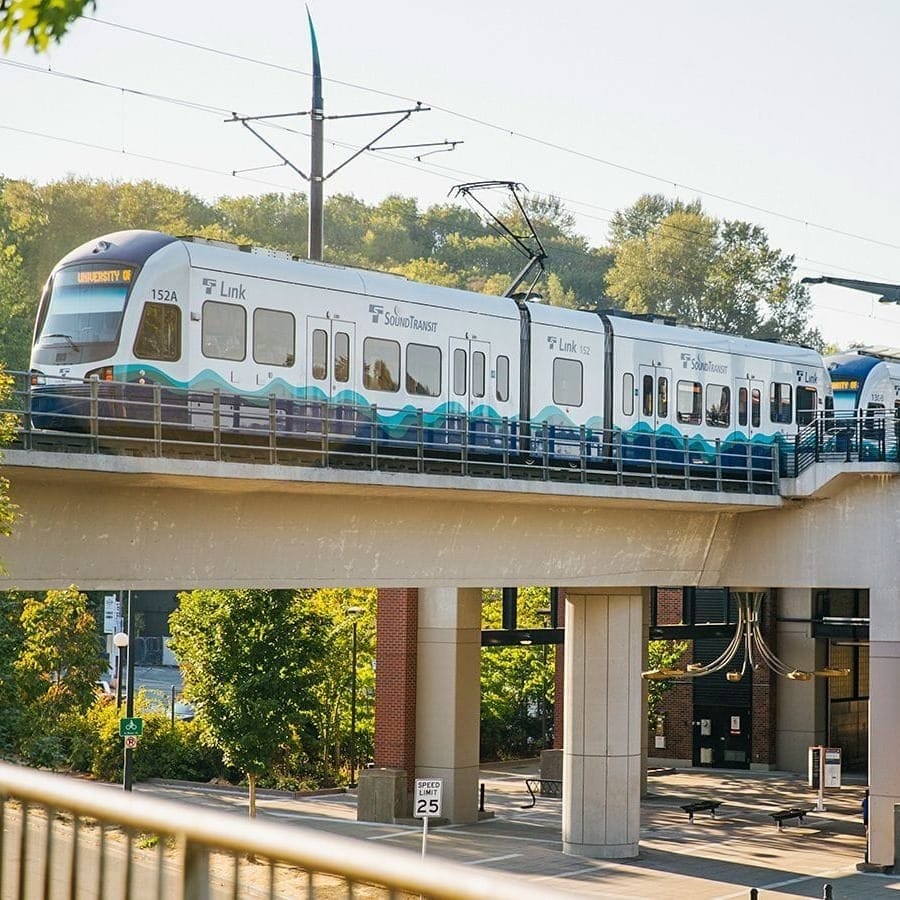
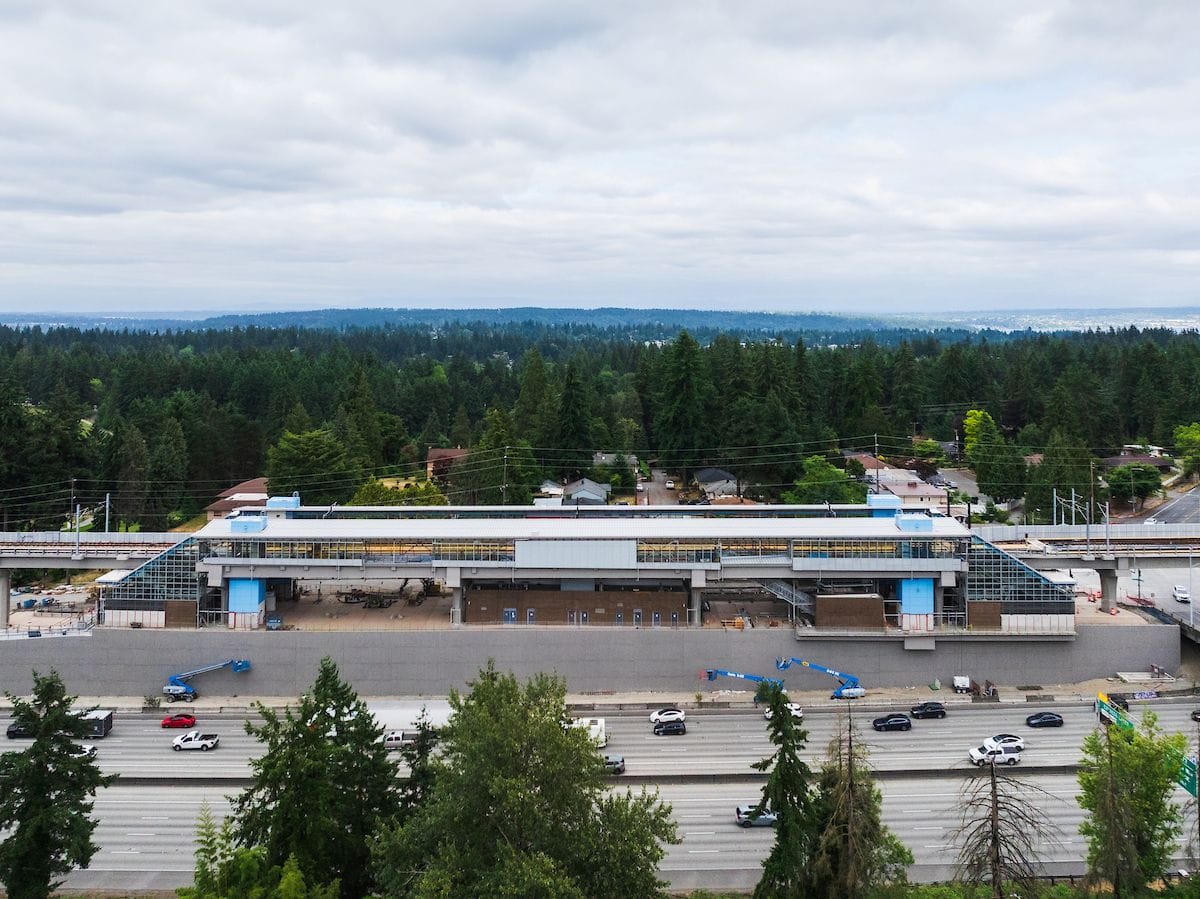
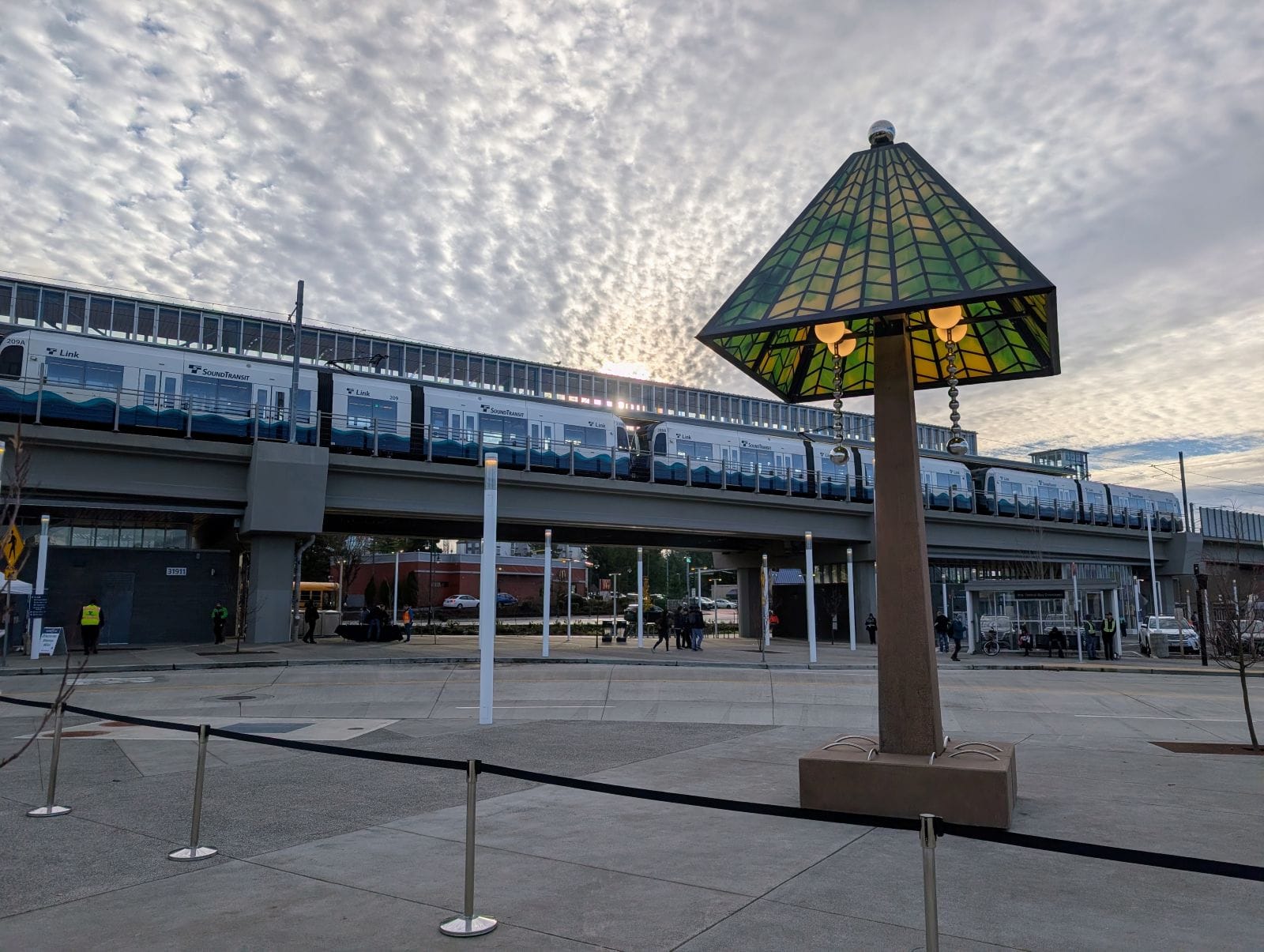
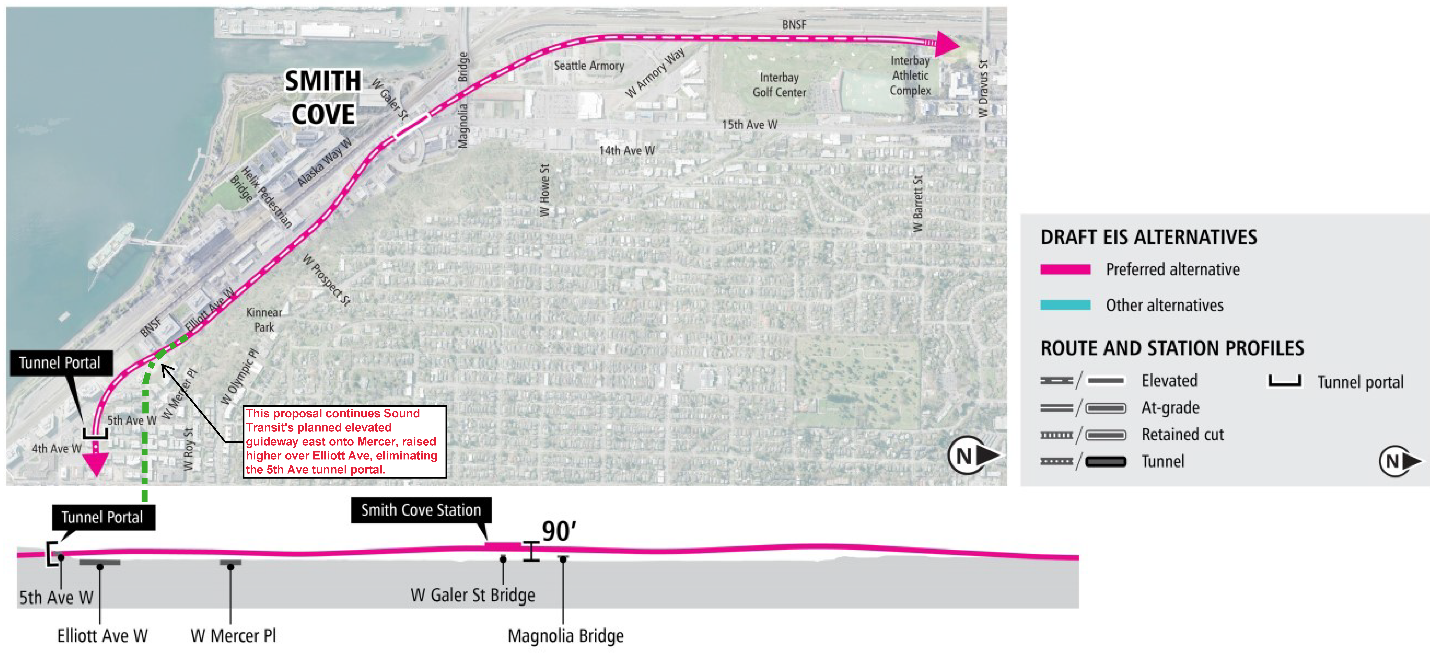
Elevated rail is nothing new for Sound Transit. The existing 63-mile Link system includes extensive stretches of elevated guideway across nearly every corridor, with deep-bore tunneling as the exception. The agency’s own plans for Ballard Link run elevated from the Uptown portal north to Interbay, with a 90-foot-tall station at Smith Cove.
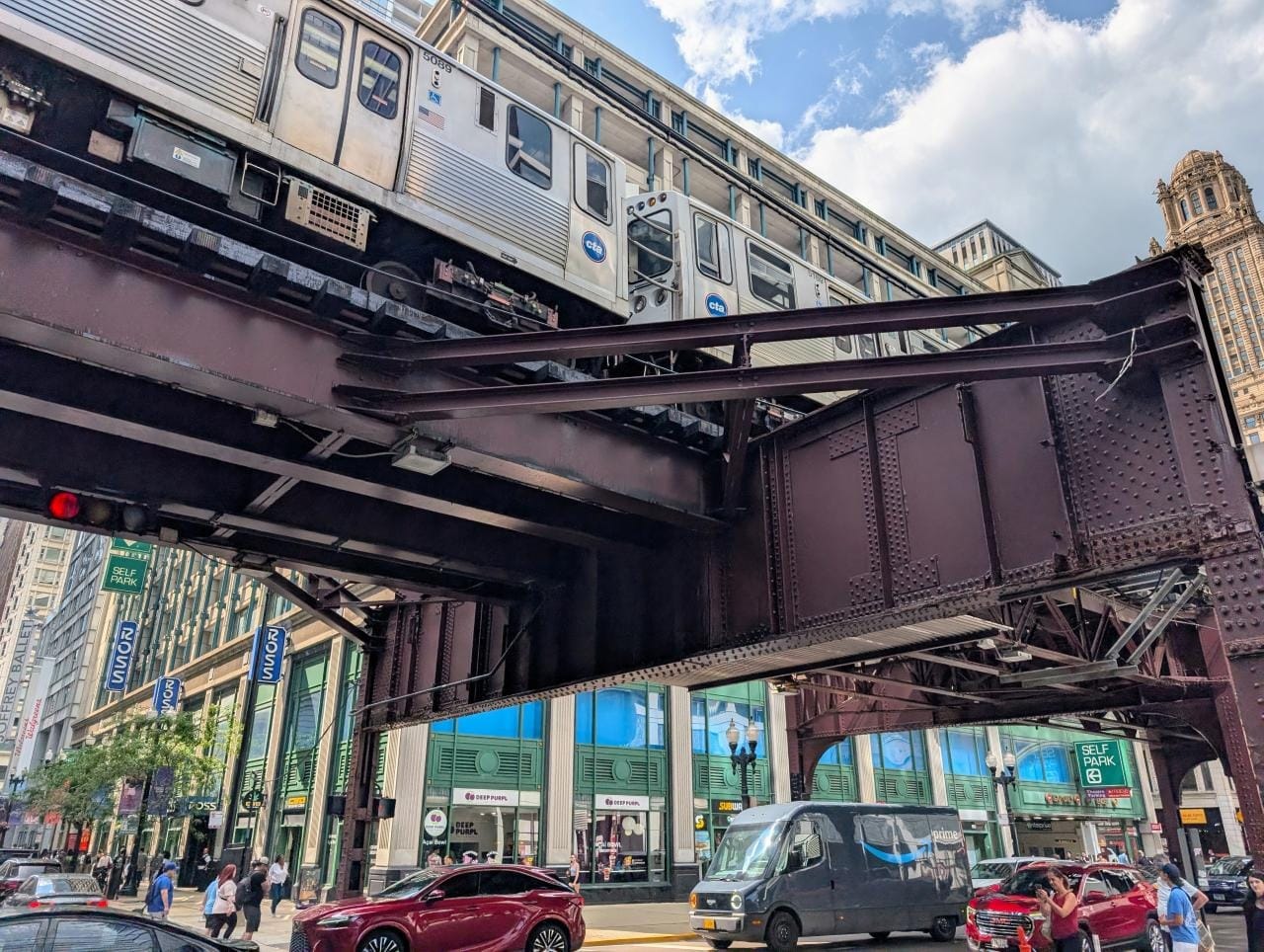
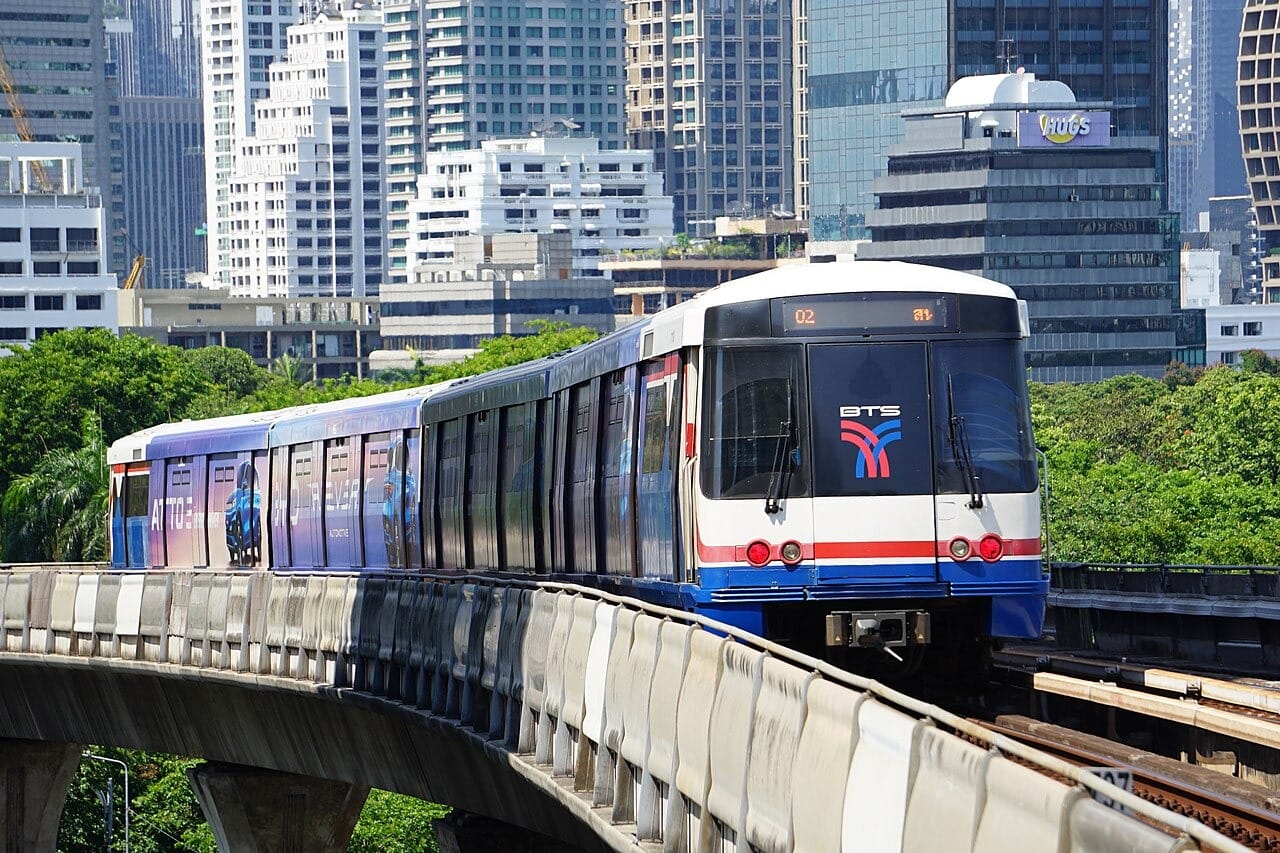
Elevated urban rail is one of the most widely used forms of grade-separated transit, from Vancouver’s SkyTrain running primarily elevated through dense neighborhoods, to Chicago’s L running above its downtown for over a century. In New York, Bangkok, and Kuala Lumpur, elevated systems deliver high-capacity service with broad public acceptance.
In fairness, tunneled metros have a long, successful history. But spending billions to bury a line up to 190 feet underground without ever evaluating a proven, dramatically cheaper alternative is not due diligence.
It is an institutional blind spot.
Every study that shaped ST3 asked the same two questions: whether the existing downtown tunnel could absorb a third line, and, if not, where the new tunnel should go. None asked whether it needed to be a tunnel at all. Once a tunnel was written into the ST3 plan, it became untouchable.
Yet that same plan directs the board, when facing budget gaps, to fund projects that best achieve the plan’s goal of connecting urban centers. The board invoked that authority on May 28: deleting West Seattle’s Avalon Station and designating the promised segment to Ballard as unaffordable. If the plan can be altered to cut service, it can be altered to deliver it more effectively.
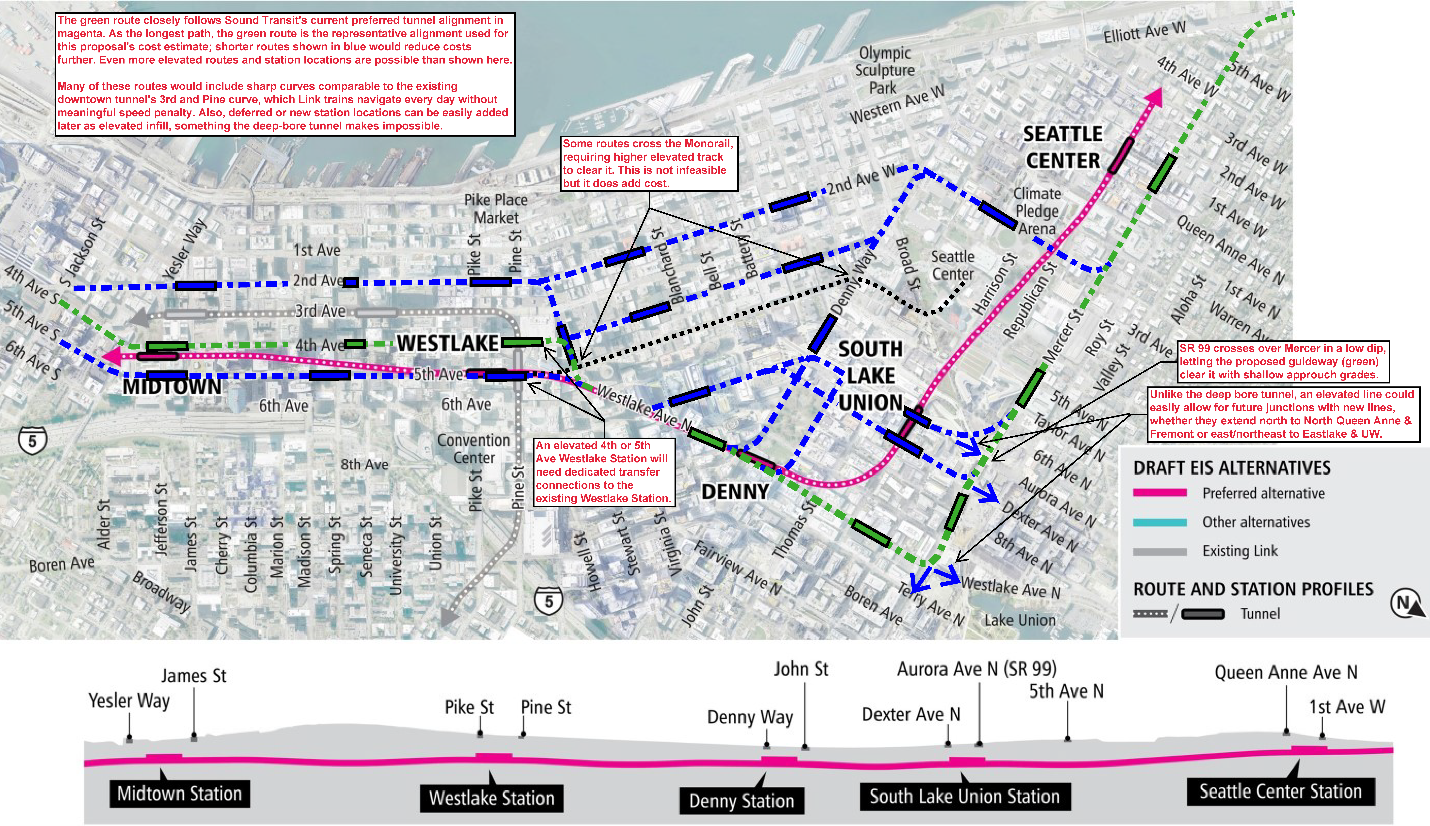
Sound Transit has never stated its reasons for not considering elevated rail through Downtown Seattle. No technical finding against it appears in the agency's alternatives screening documents.
Likely objections to elevated rail are political, ranging from concerns about aesthetics to streets being temporarily torn up during construction to the potential of permanently losing a car or parking lane to support columns. The line would also pass through historic districts and near landmarked structures, adding complexity and risk, all real challenges addressed in more detail below.
Closing Ballard’s Funding Gap
The financial argument for elevated rail is staggering, even under conservative assumptions.
Sound Transit’s December 2025 feasibility assessment provides the foundation, pricing the full Ballard Link at $21.4 billion and the SoDo-to-Westlake tunnel segment at $8.4 billion, all in 2025 dollars. That segment alone, roughly two miles with three underground stations, averages $4.2 billion per mile. This approaches New York’s Second Avenue Subway Phase 2, which at roughly $4.7 billion per mile is the most expensive subway project ever undertaken.
The December assessment also prices that same segment at $7.2 billion without the Westlake station. The difference implies Sound Transit prices the Westlake interchange at roughly $1.2 billion. By excluding Westlake, that two-mile segment reduces to $3.6 billion per mile.
At this lower rate, the remaining 1.9 miles of tunnel from Westlake north to the Uptown portal would cost $6.8 billion. Using this reduced rate is appropriate given the north section contains no comparable interchange, and Sound Transit has published no cost estimate for it.
The agency has since identified up to $470 million in further design savings at Seattle Center station, credited below. The financial plan also consolidates the South Lake Union (SLU) station at Harrison Street into a shifted Denny station, though the resulting savings have not been published.
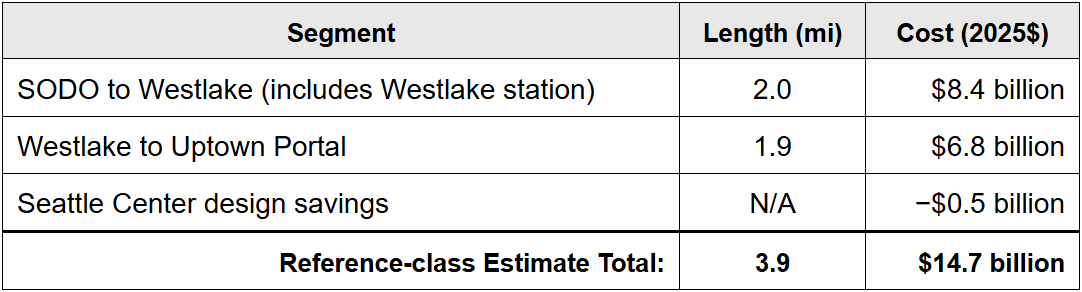
Every cost input is derived from Sound Transit's own figures.
In the May vote, Sound Transit programmed $18.1 billion in year-of-expenditure (YOE) dollars for Ballard Link, funding construction from SoDo to Seattle Center plus $300 million to complete design to Market Street. That stops the tunnel short of the Uptown portal. Because of inflation, the $14.7 billion estimate above would be higher on a YOE basis. Sound Transit has told The Urbanist it does not have a figure in 2025 dollars for the updated Ballard financial plan.
On the other hand, a 4.4-mile representative elevated rail alignment serving the same corridor, shown as dashed green in the figures, offers a far more economical alternative. The route would connect six stations: the Chinatown-International District (CID), Midtown, Westlake, Denny, SLU, and Seattle Center / Uptown, thus preserving the SLU stop the current financial plan omits.
Four recent projects show what elevated rail can cost:
- Federal Way Link: 7.8 miles, mostly elevated, roughly $320 million per mile (total project cost as delivered, contracted 2019, opened 2025)
- Surrey-Langley SkyTrain: 10 miles, fully elevated along a suburban arterial, roughly $440 million per mile (total project cost, contracted 2024, converted from C$6 billion)
- Honolulu's Skyline, City Center segment: 3 miles of elevated guideway and stations through a dense urban core, roughly $550 million per mile (design-build contract, awarded 2024)
- Chicago's Red Line Extension: 5.5 miles, largely elevated, roughly $1 billion per mile (total project cost under a signed federal grant agreement, 2025)
Three of the four come in under $1 billion per mile, including Sound Transit's own Federal Way extension, which opened under budget. Chicago is the outlier, but its figure includes a new railyard, maintenance shop, and 78 new rail cars, none of which Ballard Link needs.
This proposal uses Chicago's rate, the highest of the four, despite those extra items. Downtown Seattle is a more complex environment than most of these corridors, so using the largest figure leaves little room to argue the comparison is optimistic.
At $1 billion per mile, a 4.4-mile elevated alignment costs $4.4 billion.

Thus, a single design decision does more than eliminate the deficit that put ST3's highest-ridership project on the unaffordable list. It exceeds Ballard Link’s entire $7 to $9 billion funding gap by more than $1 billion.
The real margin could be billions larger. Sound Transit states that gap in YOE dollars, and Chicago's rate is YOE as well, while the tunnel estimate above is in 2025 dollars. Both mismatches understate the case for elevated rail.
Those savings would also cover Sound Transit's entire $9 to $11 billion (YOE) systemwide shortfall across all remaining deferred ST3 projects, Ballard Link included.
Shrinking the largest capital project of the late 2030s by roughly 70% relieves the agency's most binding constraint: the cash flow and debt capacity limiting delivery schedules. Within the North King County subarea, where local tax revenue funds projects benefiting that subarea, this could restore other deferred projects, accelerate timelines, or fund MLK Way improvements that speed up the 1 Line.
These are reference-class comparisons, not formal engineering estimates, and they carry uncertainty. But even if the savings estimate is off by 30%, roughly $7 billion in savings remains, larger than any single cost-saving measure the agency has identified to date.
The scale of the cost difference between elevated and deep-bore construction is simply too large for reasonable uncertainty to erase.
Three Advantages the Tunnel Can Never Match
While this cost-saving potential alone justifies formal study, an elevated alignment also unlocks three transformative capabilities that are physically impossible for any tunnel alternative.
A Rider Experience Worth the Investment
Under the agency’s proposed tunnel plan, the new Westlake station would sit up to 140 feet below street level, with the other new downtown stations ranging from roughly 85 to 120 feet deep. Sound Transit’s own estimate for Westlake puts the escalator rides alone at four to six minutes just to reach the surface.
These are not stations.
They are vertical commutes.
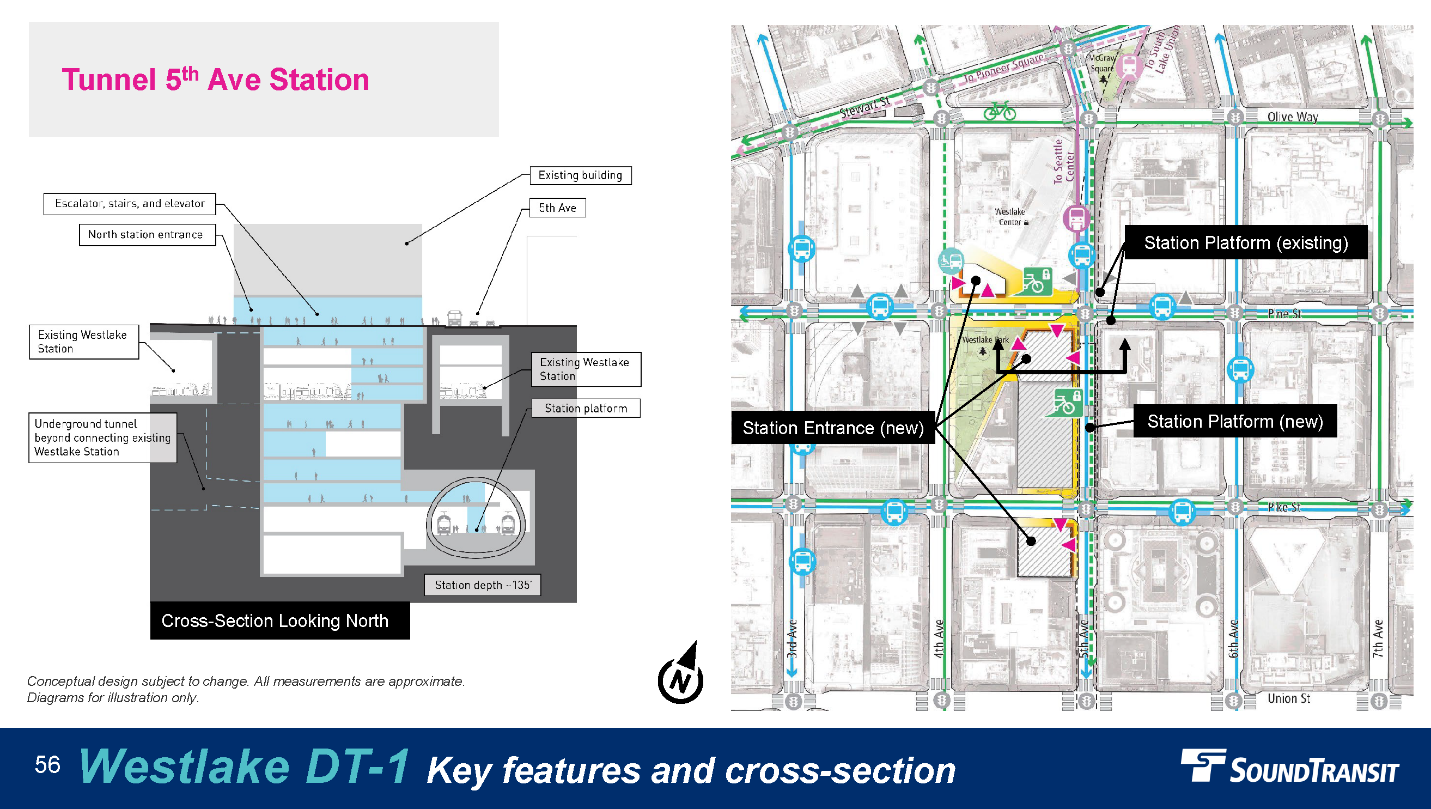
For a transit system meant to save people time, burying riders that deep underground undermines the main purpose.
Unlike a deep-bore tunnel, most elevated stations would sit only 20 to 35 feet above ground, placing riders on the street in under a minute. Instead of staring at dark tunnel walls, passengers see the city they are traveling through, with natural light and uninterrupted cell service. The guideway becomes a visual landmark, guiding pedestrians to the nearest stop, while straightforward emergency evacuations occur in open air rather than a confined tunnel.
The result is a far safer, more welcoming, and dramatically more accessible system for all riders, including those with mobility challenges.
A Line You Can Actually Expand
Sound Transit’s recently updated financial plan omits the South Lake Union (SLU) station, shifting the Denny station to partially cover the gap in station access. As Councilmember Dan Strauss noted at a recent rally, “These are subterranean stations that cannot infill.”
He’s right. Mining a new infill station box down to an active deep-bore tunnel is financially prohibitive and operationally disruptive.
Once a subterranean station is eliminated, it is gone for good.
Elevated guideway changes this calculus, as adding a new station to it is a well-understood process, so long as the line is level enough to host a station platform. Pinehurst, Sound Transit’s first elevated infill station, opens this year at a cost of $144 million, with its anticipated savings redirected to help fund the Graham Street infill station.
That works, whether recovering a deferred stop or adding a new one in fast-growing areas like SLU or Uptown. If budget constraints force the agency to defer a downtown stop today, that neighborhood can still get its station in five, 10, or 20 years.
This can even restore a Stadium station on the 1 Line, which will be lost when the line shifts into the new tunnel. An elevated alignment along 4th Avenue would allow a future infill station immediately adjacent to the stadiums, closer than the existing one, serving the 1 Line and a new Eastside-to-South Sound line discussed further below.
None of these options exist 100-plus feet underground.
This flexibility extends beyond stations. An elevated guideway through SLU creates natural branching points for future lines. A branch north to Fremont and Green Lake, or northeast to Eastlake and the University District, only needs a simple elevated junction, while an existing deep-bore tunnel cannot be feasibly branched. Advocates have already pushed for elevated rail on Aurora Avenue, an obvious expansion corridor given its density and the region's highest-ridership bus route.
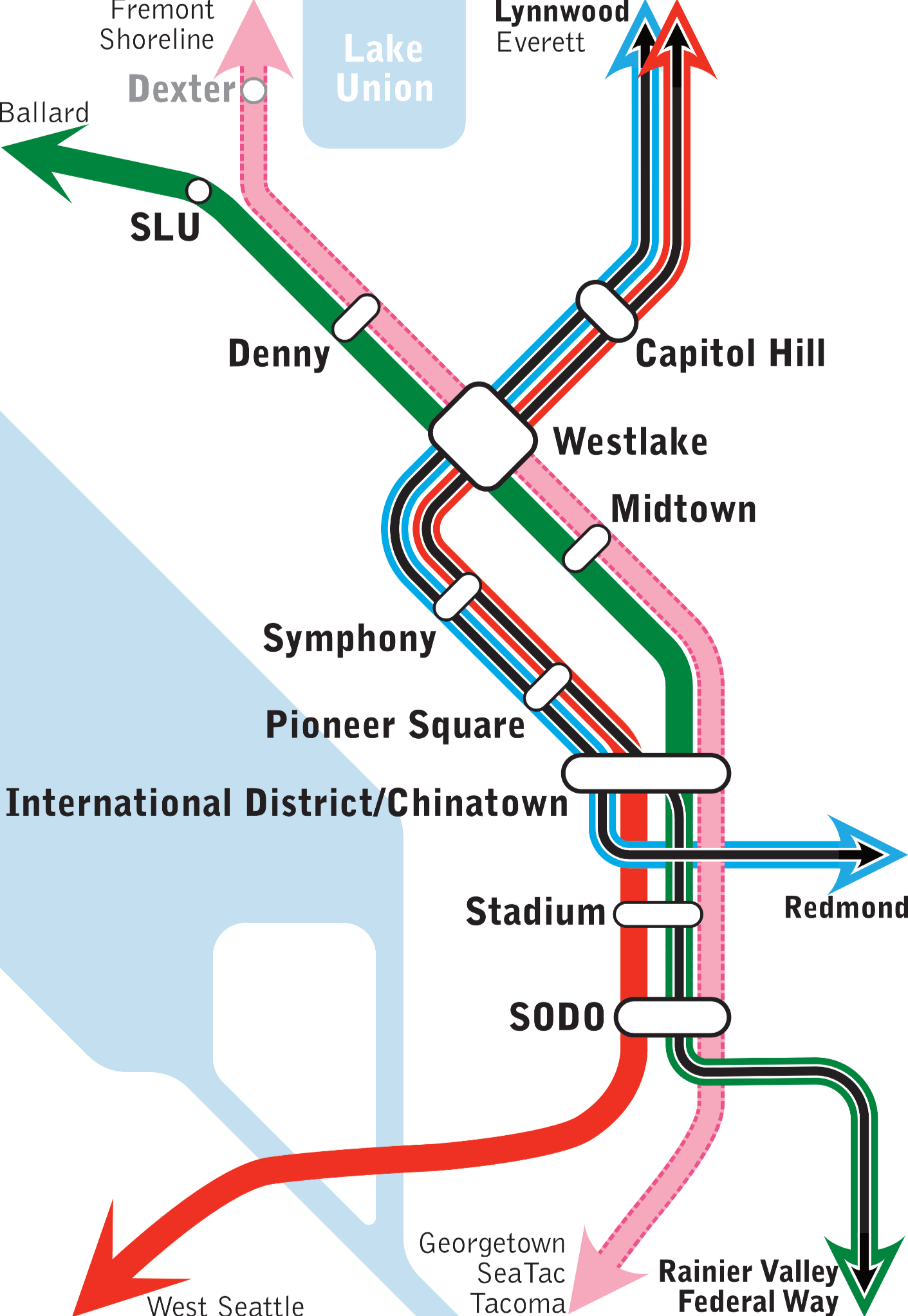
The twin deep-bore tunnels offer no such future. The board’s plan terminates the tunnel at Seattle Center, short of the west portal. Extending it later means new tunnel boring machines, new launch boxes, and excavating beside an active station, adding hundreds of millions in remobilization costs. Elevated guideways, meanwhile, can be extended span-by-span without these penalties.
This matters for a project already split into funded and unfunded halves. An elevated alignment can be built to whatever point funding allows, then easily resumed later without paying extra, turning any future funding issue into a pause rather than a permanent endpoint.
A Direct Eastside-to-South Sound Connection
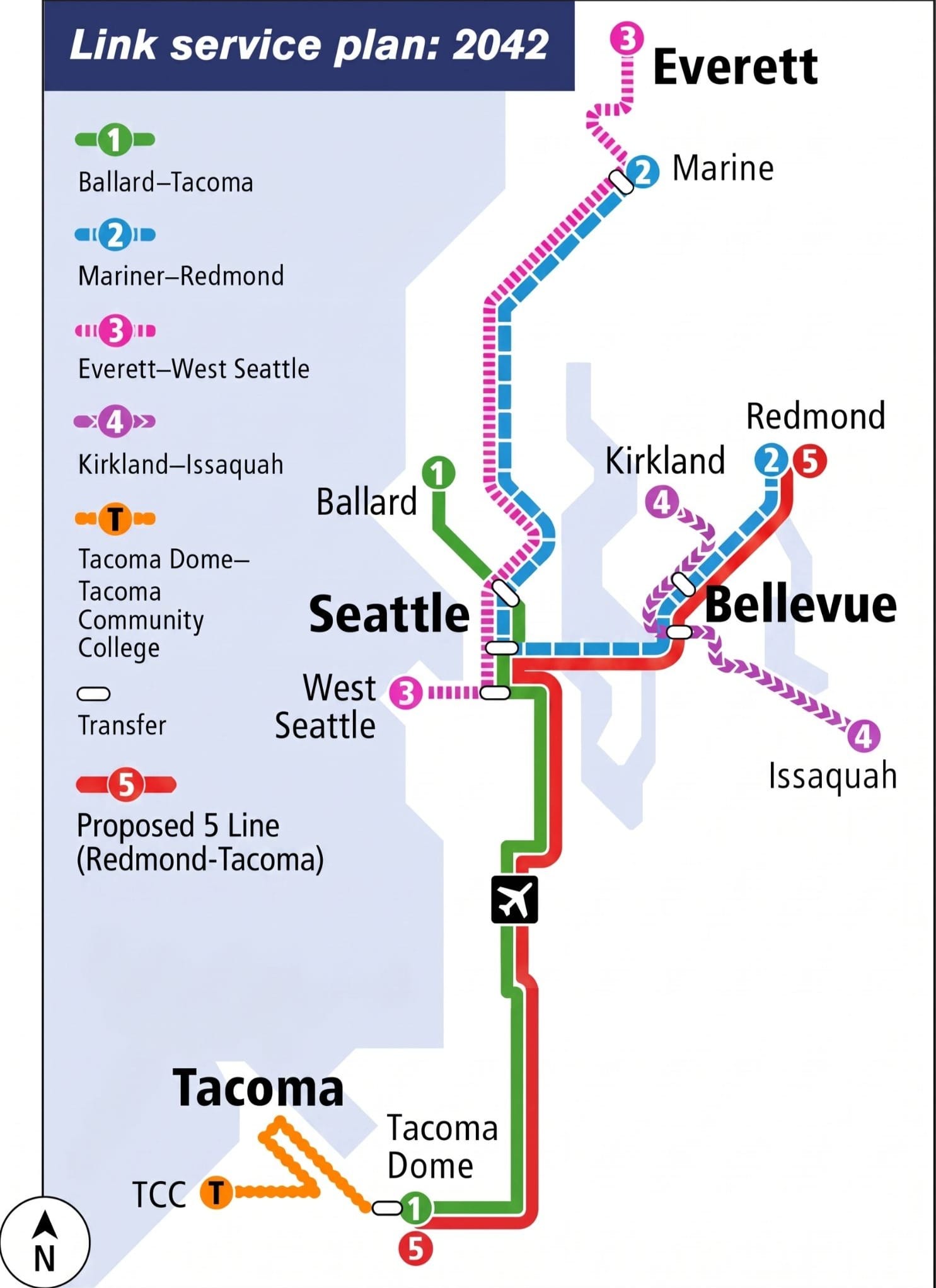
In SoDo, an elevated 1 Line could run above 4th Avenue S and cross over the I-90 / I-5 interchange ramps at roughly the same height as the existing 2 Line guideway to the east. This shared geometry enables a short, relatively simple elevated junction, shown in dashed orange below, to directly connect the two lines.
This junction enables something no tunnel alternative can offer: a new 5 Line running from the Eastside directly to SeaTac Airport and Federal Way. Today, that trip requires a transfer within the CID station, up and over the tracks between platforms. Under the tunnel plan it would become a transfer between two separate stations, more than a block apart.
By eliminating that transfer, the junction would allow the new 5 Line to run one-seat rides at frequencies up to the system’s current operating capacity.
One day, trains could run from Redmond straight through to Tacoma.
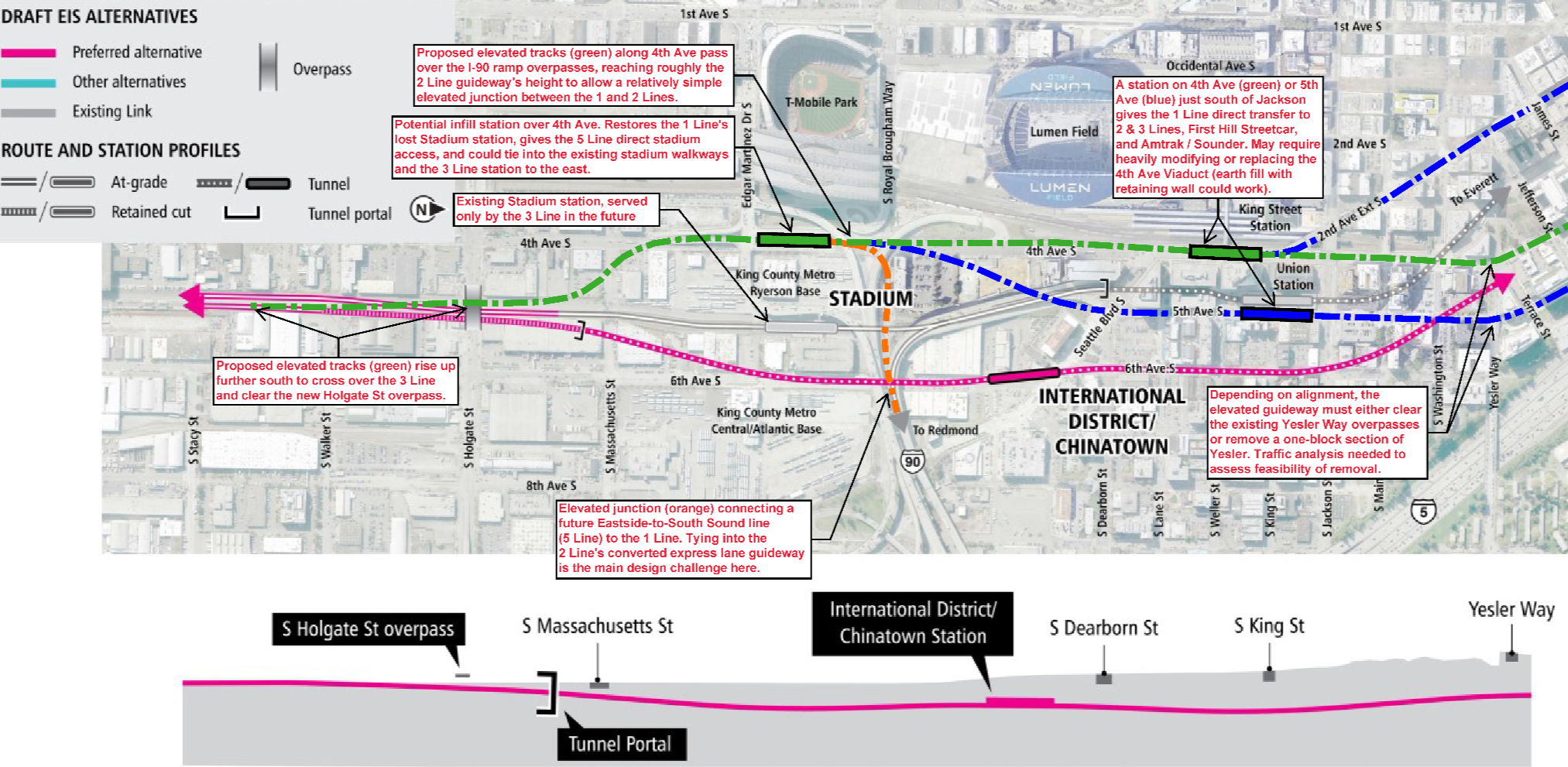
The junction would need careful design, as it ties into a superelevated curve on the existing 2 Line guideway (converted former I-90 reversible express lanes). That would require guideway modification, be it deck widening to shift the track divergence east of the curve, reworking the curve to flatten the superelevation, using a more complex junction alignment, or another approach entirely.
The 2 Line crosslake connection triggered a 44% ridership surge in a single month, making Link the most-ridden light rail system in the United States. Adding the 5 Line as a direct Eastside-to-South Sound route would represent a network upgrade of comparable magnitude.
By interlining with the 2 Line east of the junction and the 1 Line south of it, the new 5 Line would further strengthen the case for the region's longest-sought operational fix: grade-separating the Rainier Valley to unlock full frequency doubling across both interlined segments.
This would transform Ballard Link from a local Seattle dispute into a regional priority, with multiple subareas holding a concrete stake in the elevated alternative.
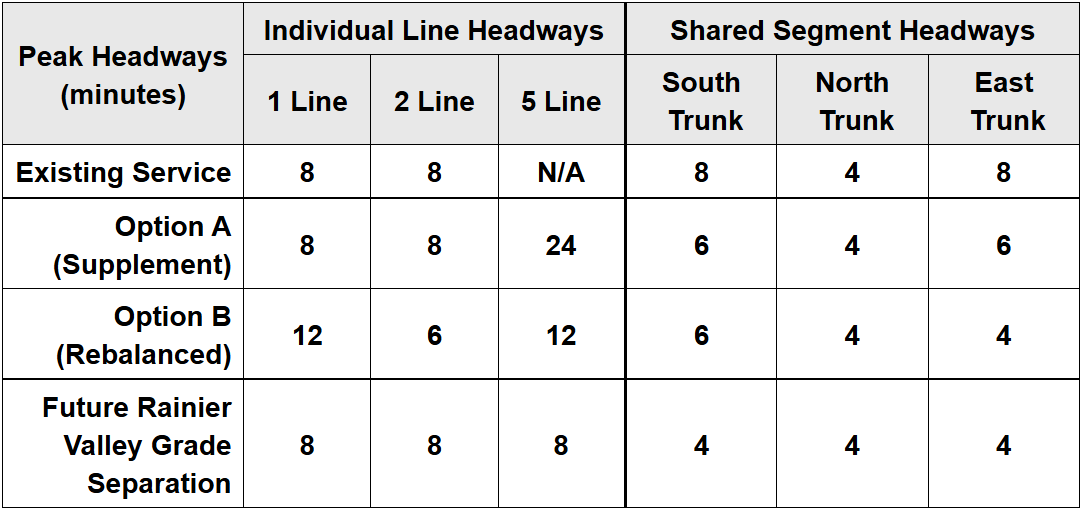
Option A adds 5 Line service without changing existing frequencies. Option B rebalances all three lines for four-minute Eastside service, at the cost of longer 1 Line headways for riders continuing north. Future grade separation of Rainier Valley puts every line at eight minutes and every trunk at four.
An elevated alignment also delivers the same spine segmentation and operational redundancy the proposed tunnel would. The 5 Line adds another layer: because it bypasses downtown entirely, a tunnel closure would leave two of four lines running intact rather than one of three. Blocked northbound 2 Line trains could continue south as 5 Line trains rather than turning back at Judkins Park. The August 1 derailment, which cut downtown service for 14 hours, showed why this flexibility matters.
While the three key advantages discussed in the sections above are most crucial, elevated rail offers even more: lower geotechnical risk, fewer property impacts, faster design and construction, reduced long-term neighborhood disruptions, and far less concrete. Maintenance is also simplified, with no complex tunnel ventilation, dewatering, or fire suppression systems to design or maintain.
Elevated guideway not only costs less to build. It costs less to operate, expand, and maintain for decades to come.
Real Challenges with Established Solutions
Seattle’s history with the Alaskan Way Viaduct and failed Seattle Monorail Project will inevitably color the political conversation. Yet neither precedent applies.
The Alaskan Way Viaduct was a massive, six-lane double-decker highway, fundamentally different from a light rail guideway in width, height, noise, and function. Meanwhile, the Seattle Monorail Project was similar in scale to modern elevated light rail; voters approved it four times before a catastrophic financing scandal killed it. It died on financing, not engineering, and the legacy Monorail still operates from Seattle Center to Westlake Center with broad public support.
Beyond politics, can downtown streets even accommodate elevated guideway? They can.
Multiple north-south corridors have rights-of-way wide enough for dual-track guideway with side-platform stations; prevailing grades meet light rail design parameters; and east-west routes through SLU and Uptown are similarly feasible.
Elevated guideway fits, but real engineering and construction challenges remain. None are novel, and every one has proven solutions drawn from elevated systems worldwide.
Utilities and existing structures
Unlike a tunnel, elevated guideway support columns can be flexibly located around utilities, driveways, and existing structures, with span lengths varying as needed. A tunnel must shift a long section of alignment to clear even a single subsurface obstacle. Likewise, crossings over the Yesler Way overpass and the Monorail guideway are feasible, though both would need further study to determine the best design.
Shadow and noise
Modern light rail's compact size casts a fraction of the shadow the Viaduct imposed, and modern concrete guideways sound nothing like the elevated steel structures of the last century. Sound Transit has already engineered light rail to pass silently below the University of Washington's electron microscopes, a far harder problem than quieting a guideway above a busy street. Resilient fasteners, rail dampers, and continuous welded rail hold train noise at or below ambient traffic levels.
The Chinatown-International District (CID)
For years the CID community has opposed the major neighborhood disruptions an underground station would bring. This proposal's elevated station above 4th Avenue west of Union Station would keep construction to the district's edge. It would require replacing the viaduct beneath it, either in kind or with an earthen embankment and retaining wall, while avoiding the deep excavation and property acquisition a station box demands.
Seattle Subway independently reached the same conclusion, proposing a similar elevated CID concept endorsed by Transit Equity for All, a leading CID advocacy group. Seattle Subway also calls for a state highway designation on 4th Avenue to help fund the viaduct replacement.
Sound Transit decided against a 4th Avenue tunnel route as work below and adjacent to BNSF's tracks was found "not reasonably constructible." That constraint does not apply to an elevated guideway, which can be built high enough to account for any raised profile from the adjacent Jackson Street and 2nd Avenue bridges if or when they are rebuilt to meet BNSF requirements.
Elevated rail offers the CID a faster and less disruptive path to better mass transit while delivering the Union Station multimodal hub the current tunnel alternative forgoes.
The Westlake transfer
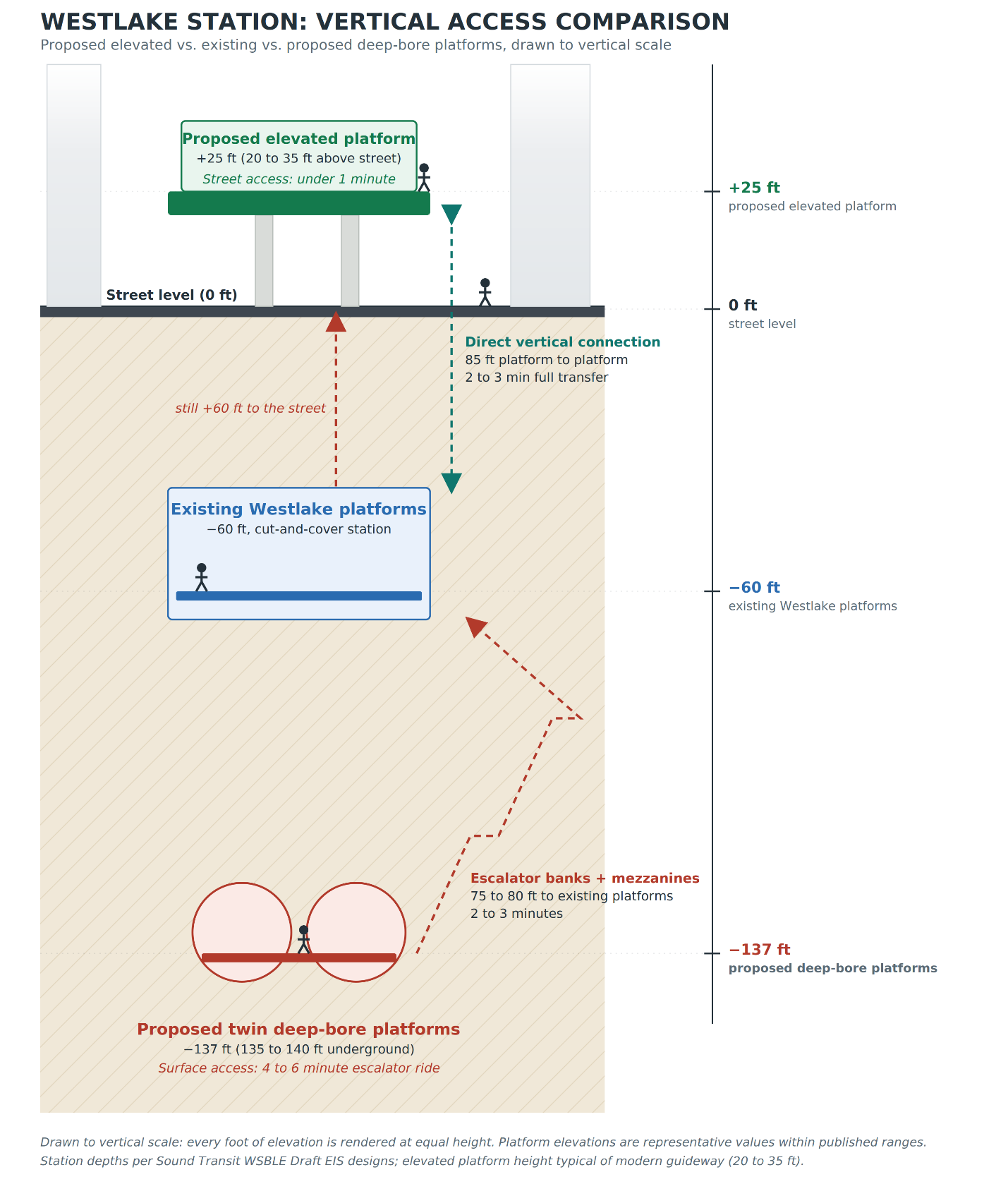
As one of the most complex challenges, the Westlake transfer must connect to existing platforms roughly 60 feet below street level, making the difference between deep-bore tunnel and elevated stations stark:
Elevated 1 Line Station:
- 20 to 35 feet above the street
- 80 to 95 feet down to Westlake's existing underground platforms via a direct transfer connection
- Riders: less than a minute to reach street level; two to three minutes for the full transfer
Deep-bore 1 Line Station:
- 135 to 140 feet below the street
- 75 to 80 feet up to Westlake's existing underground platforms via multiple escalator banks and mezzanine levels, then another 60 feet to reach street level
- Riders: two to three minutes to transfer to the existing platforms; four to six minutes total to reach the surface
While transfer times are comparable, only the deep-bore option turns a trip to the surface into a vertical commute.
Visual impact
Elevated rail has long been criticized for being ugly and visually disruptive, historically the most common flashpoints for community opposition. Those critiques deserve serious design attention, while answering them presents a civic opportunity.
Modern guideways need not be brutalist concrete monoliths. From the rich cultural heritage of the CID to the tech-focused aesthetic of SLU, support columns and station structures can reflect each neighborhood’s character by using architectural cladding, precast finishes, and integrated lighting. The Los Angeles Metro has published an entire design guide for integrating elevated transit into neighborhoods, and turns its own guideways into canvases for public art.
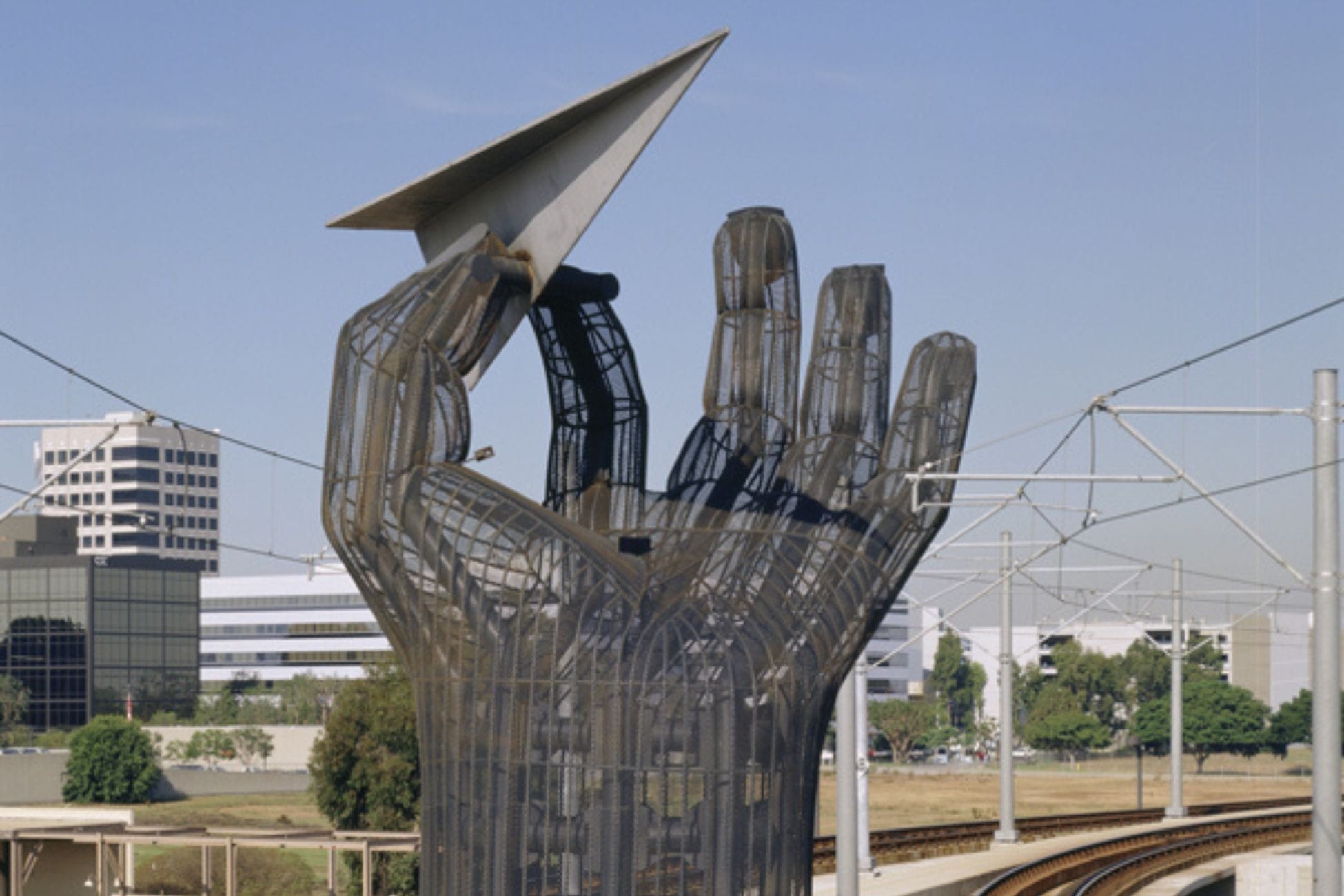
Instead of hiding a generational investment 100-plus feet underground, a well-designed elevated alignment becomes a visible, permanent enhancement to Seattle’s urban fabric.
The challenges above are real but solvable. Yet they pale in comparison to the engineering, financial, and schedule risks of digging nearly four miles of twin deep-bore tunnel and approach, some of the most complex construction Sound Transit has ever attempted.
A Process That Excludes Alternatives
On April 5, I submitted a proposal with maps to the Sound Transit Board, Seattle City Council, and Mayor’s office requesting formal study of this elevated alternative. On April 21, the Ballard Link project team confirmed it would be included in the Enterprise Initiative engagement summary for the board.
A self-imposed constraint
On May 28, the board established a Request for Information (RFI) process to solicit cost-effective designs from outside firms. This was a welcome step. Sound Transit issued the RFI on September 2, with responses due October 5.
The board's resolution limited the RFI to proposals that "should complement the existing environmental review process and avoid additional disruption or delay." The RFI carries that forward, instructing respondents that they "must be mindful of the existing project definition and eschew strategies that could further jeopardize the project timeline."
Elevated guideway appears once, in an appendix asking how to reduce the cost of the already-planned elevated section. It never appears as a substitute for the tunnel, leaving billions in potential cost reductions unexamined.
The same appendix asks what Sound Transit could do "to avoid environmental process delays associated with potential changes to project definition." The RFI's mandatory section warns respondents away from what its appendix asks about.
Agency leadership often cites environmental review timeline disruptions to reject new alternatives. But disrupting what timeline, exactly? The Ballard Link DEIS has sat at the Federal Transit Administration for months, its release now pushed to the end of 2026. The funded segment’s opening slipped from 2039 to 2042, while the rest was unfunded and pushed to around 2060, roughly 25 years later than the 2035 opening pledged in the ST3 plan. No new alternative caused that delay; the current tunnel plan did.
The schedule cost of elevated
An elevated alignment would take real time to design, evaluate alternatives, and run through supplemental environmental review. That is realistically two to three years even moving with urgency.
Fortunately, it would not start from scratch. Survey, utility locates, geotechnical borings, building foundation depths, right-of-way records, and ridership modeling carry over to varying degrees, as does the DEIS's existing conditions analysis, which describes the corridor regardless of mode. Only the impact analysis would change.
Even so, an elevated line is simpler to design and faster and less risky to build. Surface conditions can be measured directly; subsurface conditions can often only be approximated. There are no massive launch or station boxes to excavate and no tunnel boring machines to procure, which can take more than a year to deliver.
The main schedule cost of elevated occurs during street redesign in coordination with the Seattle Department of Transportation, which a tunneled alignment largely avoids.
By Sound Transit's own reckoning, the West Seattle cost-savings effort added two to three years of delay, a trade it stands behind for over $2 billion in savings. An elevated Ballard Link could return nearly four times the savings while expediting rather than delaying the schedule.
Other regions have refused to wait. Utah found the money to accelerate five rail lines from a 2030 plan and delivered all 70 miles by 2013, two years early and $300 million under budget. Ballard Link doesn't need new money, just a cheaper design.
Against a 34-year wait until 2060 for the full line, two or three years of further study is not the risk. The current plan is.
Refusing to look
Declining to study an alternative with $10 billion in potential savings because the analysis may cost tens of millions is not sound process management. It is institutional inertia, a sunk-cost fallacy that completes the paperwork for a tunnel Sound Transit cannot afford to build, while blocking the alternatives most likely to reach Ballard.
This blocks more than the elevated proposal. An automated light rail proposal faces similar barriers, and the two approaches are largely compatible. Combining them could push savings even further, though with operational tradeoffs such as precluding the new 5 Line.
Study of these proposals cannot occur if Sound Transit rejects anything that challenges the tunnel, whether replacing it entirely or upgrading the technology within.
By the agency’s own accounting, the difference between opening the Ballard station in 2042 and waiting until 2060 is money. This elevated proposal finds it.
Sound Transit’s CEO has called for cost savings to close the gap. Boardmember Teresa Mosqueda, pointing to West Seattle’s billions in savings, says the agency “must apply the same approach to Ballard.” Councilmember Strauss wants “important revisions to how much concrete we’re using.” Outside the agency, Seattle Subway has publicly asked for a cost comparison of an entirely elevated alignment.
This proposal answers every one of these calls.
The Ask
Seattle should not have to choose between funding Ballard Link on its own and waiting decades more simply because procedural caution forecloses the agency’s most promising options to get it back on track.
- Sound Transit should commission a formal engineering study and cost comparison of elevated and automated alternatives through downtown Seattle, ideally by an independent firm.
- The agency should work with its partners to expedite the study and permitting of those alternatives.
The RFI cannot serve this purpose. It explicitly creates no obligation to evaluate or act on anything submitted.
The potential savings are too significant, the rider experience benefits too substantial, the expansion potential too great, and the added regional connections too valuable to dismiss without formal agency study.
Ten billion dollars is too much money to leave on the table because nobody thought to look up!
A growing list of advocacy groups have endorsed this proposal, including Downtown Seattle Streets for All, Eastside Urbanism, Move Redmond, Save Ballard Rail, Seattle Subway, Transit Equity for All, and West Seattle Urbanism.
David Scott, board president of Seattle Subway, and Doug Trumm, publisher of The Urbanist, have both thoroughly reviewed and edited this piece.
Editor's note: Travis Henderson is a pseudonym, which The Urbanist agreed to use due to potential workplace repercussions. The author does not have a conflict of interest, or stand to financially benefit from Sound Transit contracts.
 Ryan Packer