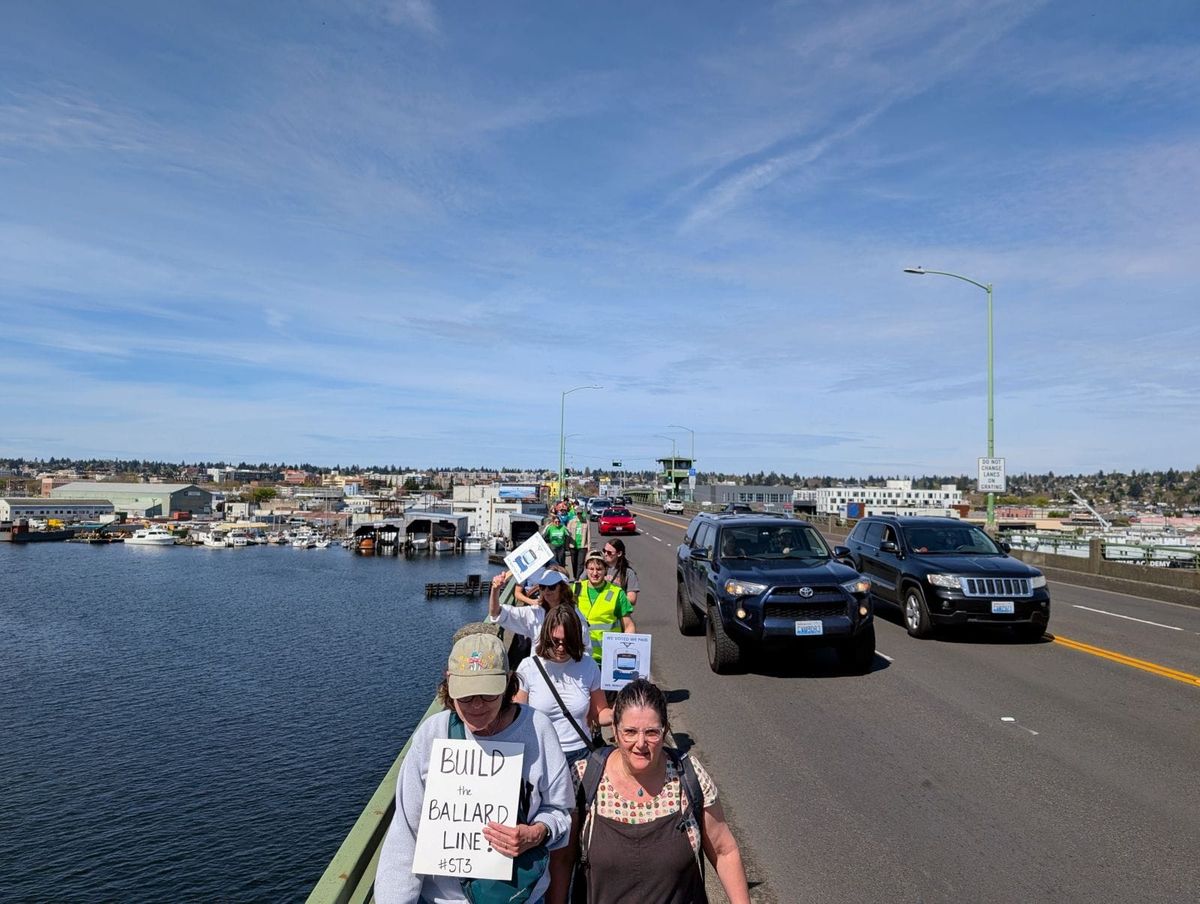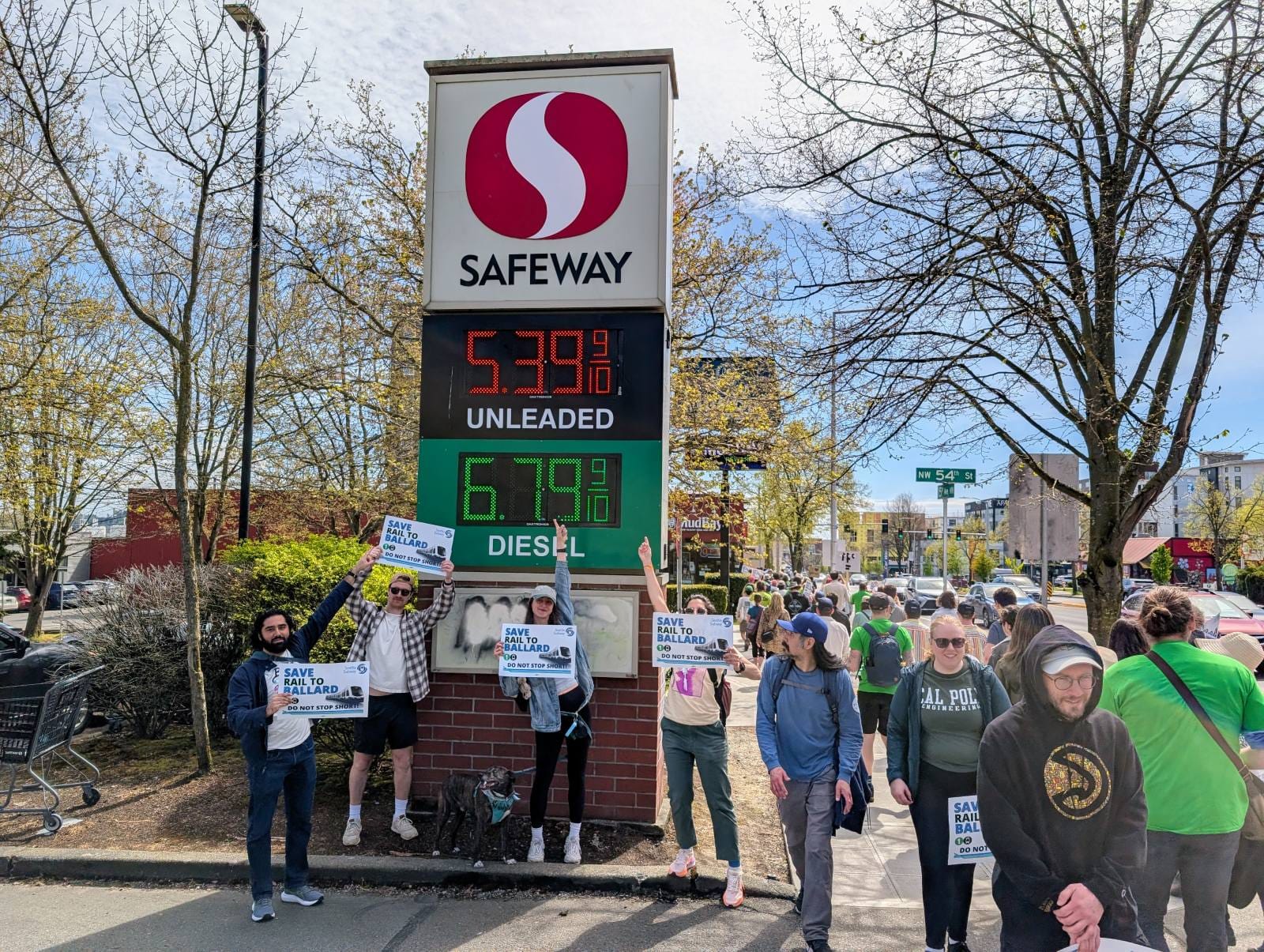
Seattle Subway was founded in 2011 to fight for the entire Sound Transit 3 (ST3) plan to open before 2040. Today, we’re joined by the Save Ballard Rail coalition in the fight to deliver light rail to Ballard in the 2030s. Our first request was transparency: together with the community, we called on Sound Transit's Board to give the public a status-quo date for Ballard rail based on current finances and cost estimates. We’re grateful the Board heard us and directed the agency to do just that.
Last Friday, Sound Transit told the public that under the status quo, rail won't reach Ballard until "around 2060." While this dire timeline does not surprise us, it is wildly unacceptable.
That said, we are also grateful that Sound Transit heard our demand for a concrete plan of action to bring Ballard Link’s opening back to the originally-promised 2035 date. In Friday’s release, the agency proposes five broad efforts and claims that if all those efforts succeed and all the stars align, then Ballard Link will open in 2042.
Even in Sound Transit’s perfect world, this is seven years later than voters were promised. Simply, 2042 still isn’t good enough. Not only that, but the broad efforts Sound Transit describes are not actionable in their current vague form. The public deserves to understand the detailed steps the agency is going to take and how each one is expected to impact construction timelines. The goal must be a Ballard station at Market Street opening by 2035, as voters approved.
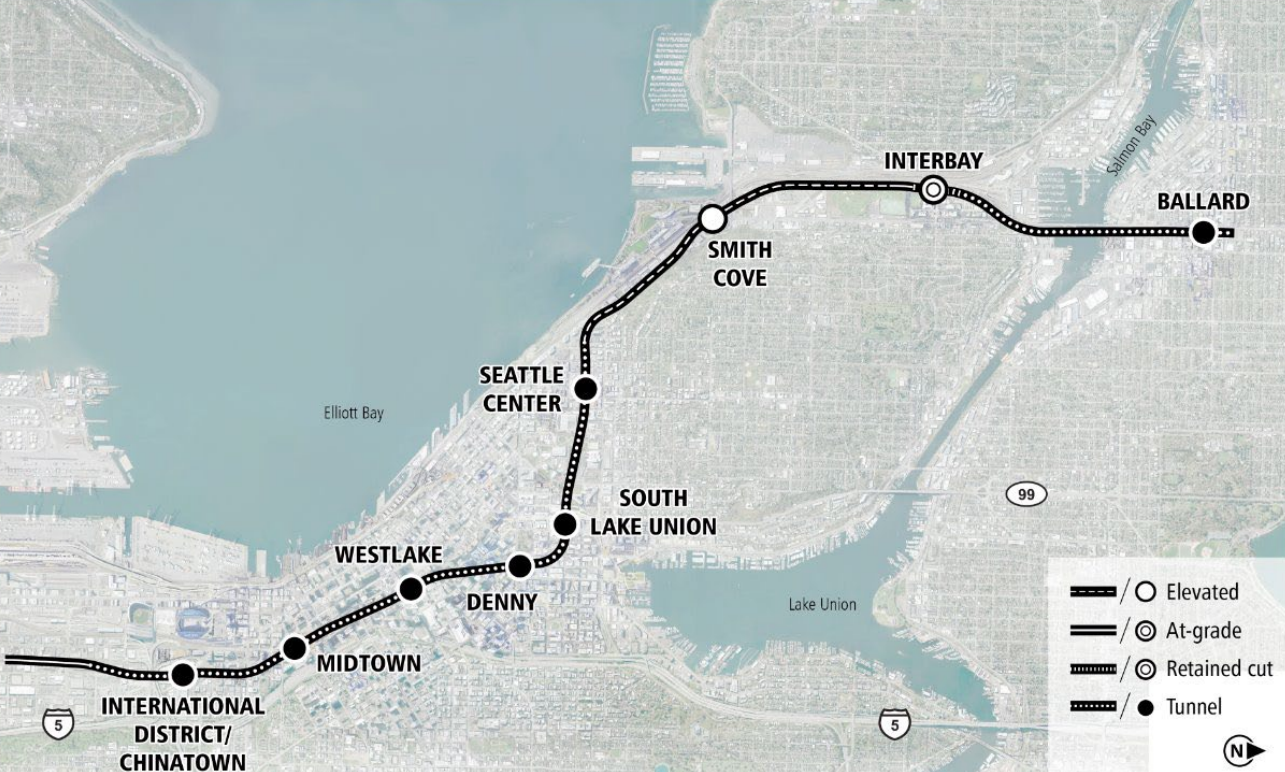
There is no reason ST3 should end up as the most expensive urban rail project in U.S. history on a cost-per-mile basis. Meeting the voter-approved 2035 opening will take more than the funding mechanisms Sound Transit has already identified.
It's past time for the agency to seriously engage with the Transit Costs Project and the Transit Abundance Playbook. Experts all over the country have been trying to tackle our excessive costs of building transit and we need to heed their advice. Specifically, we're asking Sound Transit to:
- Reexamine the design: expensive tunnel construction and oversized and overly deep stations.
- Bring more expertise in-house to control exorbitant consulting costs.
- Reexamine unnecessarily large and inconsistent contingency assumptions.
- Become an agency that's easier for construction contractors to work with, in part by holistically revisiting its approach to risk management.
- Release a cost comparison of (1) an entirely elevated alignment and (2) a shallow cut-and-cover tunnel through Downtown Seattle, both using standardized, compact stations enabled by shorter, more frequent automated trains. Vancouver, British Columbia has already shown how to do this well; we'll even buy the train tickets for Sound Transit staff to go see it firsthand.
- Work with the City of Seattle to secure a state highway designation for the Fourth Avenue Viaduct south of Washington Street, and pursue state funds to cover the roadway replacement cost. It will be a project that's necessary for the regional economy with or without light rail on 4th Avenue, so why not do it all at once?
Sound Transit must also bring a concrete, data-backed plan to the state legislature to help secure tools like 75-year bonds and a higher debt ceiling, the kind of solutions that could get us back to the voter-approved 2035 date and deliver all of ST3 by 2040.
By naming the 2060 status-quo openly, Sound Transit is finally acknowledging how dire the situation is rather than pretending otherwise. Even their optimistic 2042 scenario requires every solution to be in place by 2033. There's no time to waste.
Friday's release was a good first step, and one the whole community worked hard to achieve. We're all very grateful to the Sound Transit Board for acting. But the lack of detail leaves real questions that Sound Transit should answer publicly and immediately:
- What are the current opening-date estimates for West Seattle, Everett, and Tacoma Dome Link extensions? Sound Transit indicated Link to Seattle Center has slipped by 3 years since May to 2042. Have the other ST3 projects also slipped?
- What are Sound Transit’s federal funding assumptions (as a percentage of total budgeted project costs) for each ST3 project?
- Any assumption greater than 0% appears unrealistic until at least January of 2029, given the current transit-averse administration. Any assumption greater than 25% of total budgeted project cost would be challenging to achieve for any ST3 project, besides possibly Tacoma Dome. Any assumption greater than 48% of total budgeted project cost would be historically unprecedented.
- What exactly are the funding gaps?
- There is currently no detail beyond $35 billion in total for all of ST3. Sound Transit provided potentially-outdated information previously, including up to $12 billion worth of ST3 unfunded, up to $9 billion of Ballard Link Extension unfunded (construction from Seattle Center to Market Street), but what are the current figures for each segment that add up to $35 billion? What is the current cost of the new tunnel to Seattle Center in isolation? What is the current cost of the project from Seattle Center to Market Street and what is the current gap?
- The roadmap says “$1B is needed by 2030, more needed by 2033”. Is any funding for Ballard Link Extension beyond Seattle Center currently secured, i.e. before 2033?
- What about the DuPont Sounder extension and Boeing Access Road infill station on the 1 Line?
- How exactly can the budget gap be closed by 2033? How much additional cash flow is expected from each of the financial levers individually, and how much savings is expected from each cost-saving mechanism?
- 75-year bonds?
- Increasing the debt capacity from 1.5% to 2.5% of total assessed property value?
- Revising Seattle’s fire code to be in-line with the rest of King County?
- Self-permitting authority for Sound Transit?
- Tax-increment financing, both as currently authorized and if expanded?
- Expanded authority to capture value from surplus land?
- Why would we ever count on third party or private sector funding, as the agency has hinted at? What is the historic precedent to support this lever? How much is needed from the private sector, and can we actually count on that? What is possible without this?
- Every month of delay costs tens of millions of “year-of-expenditure dollars” so what are the concrete steps to successfully achieve these financial levers and cost-saving mechanisms long before 2030? That’s still 42 months away.
Answering these questions will allow Sound Transit to build momentum and restore trust with riders anxiously awaiting expansion. This agency’s goal must be delivering on promises made to voters, including service to Market Street in Ballard by 2035. Failing that, we need to revisit every assumption to begin service far sooner than 2042. Rail to Ballard within our lifetimes is still within reach with the right approach.
 Ryan Packer