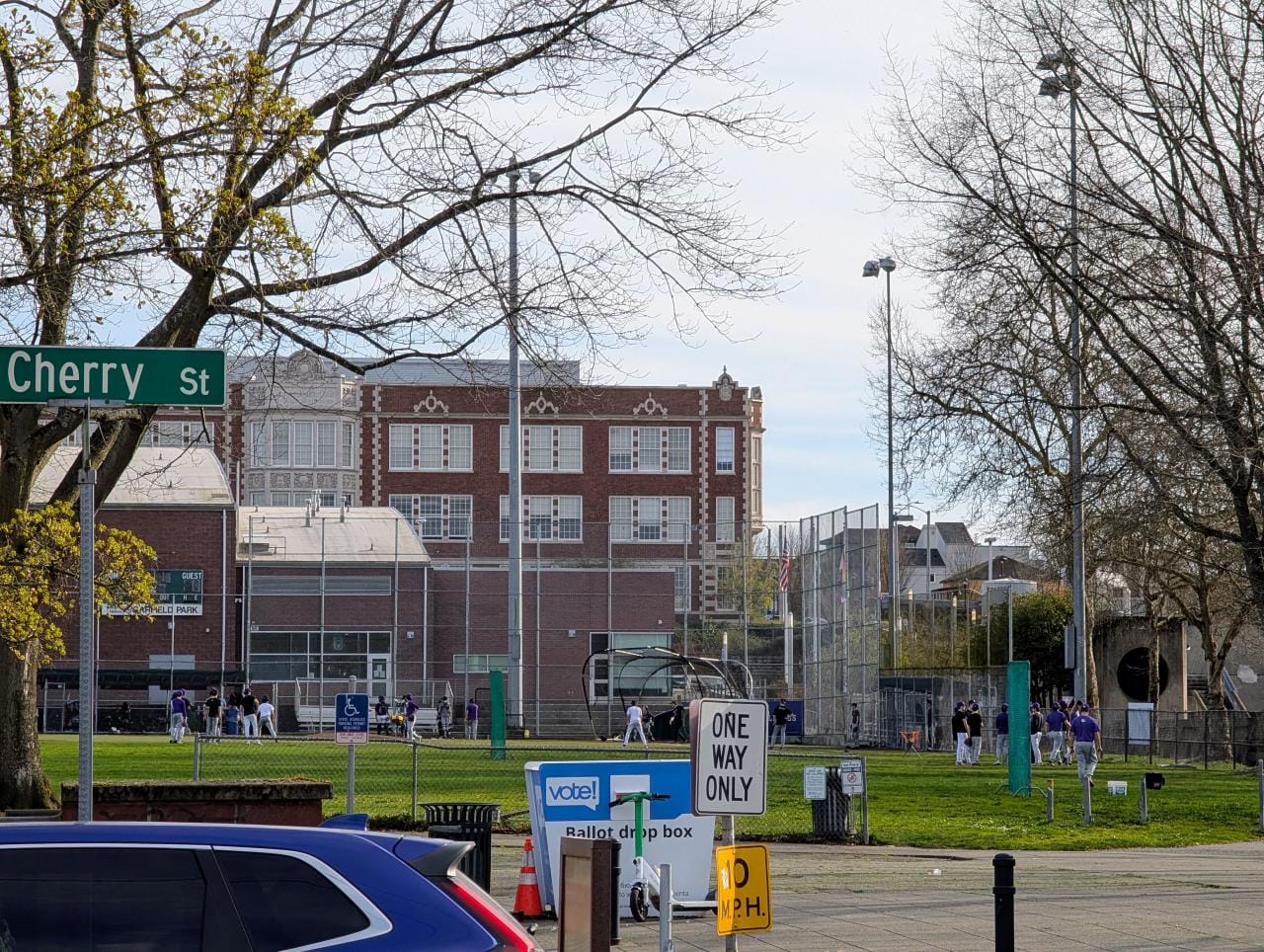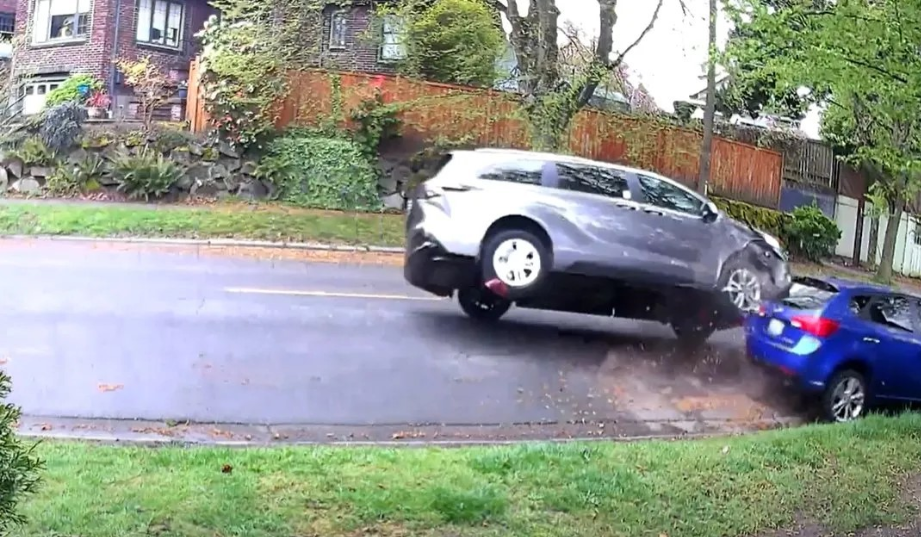
A car gained its wings at a Seattle bus stop this April. My partner watched it live. I watched the security footage after. The driver lost control, went airborne, and destroyed a parked car. School buses load and unload in front of my house every morning. Coe Elementary is three blocks away.
This street is maintained by Seattle Parks as part of the landmarked Queen Anne Boulevard. The Seattle Transportation Plan flags it for bike-friendly infrastructure. SDOT's map marks it a “Safe Route to School” for Coe. Three labels, but the street operates like none of these lofty concepts. Built as a scenic parkway, now also a walking route to school, it gets driven like a speedway.
Appalled by a crash at a bus stop, I emailed my councilmember. No response yet. I wrote the Seattle Department of Transportation (SDOT) and got a form letter suggesting a flag or a "slow the flock down" sign, citing the City’s Vision Zero program, which has overseen 18 pedestrian deaths in the past year, the highest count since 2006. An old email shows I asked for a safe crosswalk on this same block in 2023 and got the same form letter from the same office.
I should say I rarely bike. I mostly walk, take the bus, and rent a car when a trip needs one. This is not a cyclist's complaint. It is a pedestrian's.
I share this not because my block is special. It is emphatically not.
The missing constituency for people streets
Over decades, Seattle has built strong constituencies for transit and bikes. Another for housing has emerged more recently, delivering missing-middle reform and a mayor elected partly on affordability. What it has yet to build is a constituency for confronting car dominance.
The people who would join it already live here, in numbers far larger than anyone counts. One in five Seattle households is car-free. Many more would happily drive less if alternatives worked. A friend who loves biking drives across the city every day for work, because the buses are slow and the bike routes aren't safe. The demand is here. Seattle hasn’t built the city that would meet it.
Seattle added 80,000 residents between 2017 and 2023, yet gained almost no cars. These car-free or car-lite citizens see a car-default in our city that others may not.
There’s the friendly neighbor whose car blocks the crosswalk while they wave you into traffic. The mother pushing her stroller faster as a hefty SUV slows, but never quite stops. The kids who learn to ride bikes on a patio because the route to school is unsafe and the sidewalk is inches from 40 mph traffic. The cars parked in the planting strip along a greenway, because speeding drivers mean residents would rather lose greenery than park on the wide road.
None of these people are villains. They are simply recognizing for whom this city was designed.
There's a quieter cost. The houses on my block have, over decades, turned their backs to our noisy, tree-lined boulevard. Kids don't cross the boulevard on Halloween. We never meet the parents, see the costumes, share the joy. The car-default city is not just dangerous and polluting. It is lonely.
Things are shifting
Mayor Katie Wilson’s first executive order earlier this year was bus lanes on Denny Way. Political will plus paint. A KIRO radio host attacked Wilson for not owning a car, as if a non-resident's joyride should outrank the residents and visitors who live, walk, and bus along Denny. The thing protected in every city decision is car infrastructure. The other side of the table is empty too often.
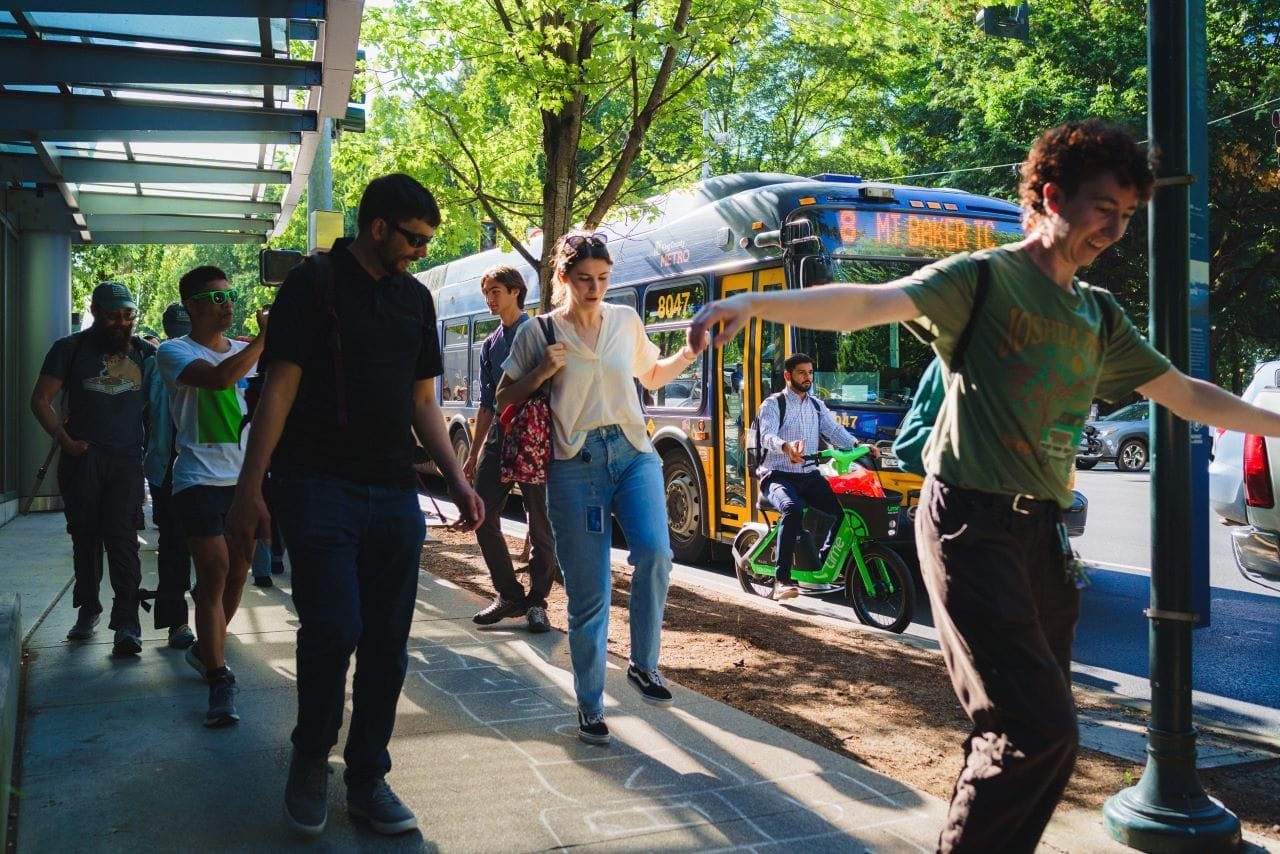
Denny Way matters for another reason. We chose to build thousands of new homes along it, as we have along Aurora, Rainier, MLK, and Lake City Way. Growth pushed onto streets full of cars and narrow sidewalks. Tens of thousands of new neighbors, asked to build community across six lanes of traffic. The Denny bus lanes are not just a transit fix. They are a first step toward a city that works for all.
Wilson's SDOT has begun the broader work too. A new People Streets and Public Spaces program is up and running. Four neighborhoods (Lake City, Capitol Hill, Georgetown, and South Park) are getting "low-pollution" pilots backed by $9.2 million in levy funds.
The legal tools to do this work now exist. The state passed a shared streets law in 2025, and Seattle's enabling ordinance passed this year. Both were shaped by Mark Ostrow, my co-chair at Queen Anne Streets Alliance. Until now, "shared" streets have mostly been car-first: Stay Healthy Streets and Greenways masked real safety with cheap signage. The new law allows the actual thing: public space reserved for people, with cars accommodated last. Let's build them.
And the fight is on. Recently, U District organizers planned to close one block of The Ave to cars for two Saturdays as a test of what a quieter street might feel like. The city canceled the permit mere days out, citing a petition opposed to the event. Several businesses on that petition told the Seattle Times they hadn't agreed to oppose it, and some hadn't signed at all. The pilot died not from public opposition but from the appearance of it.
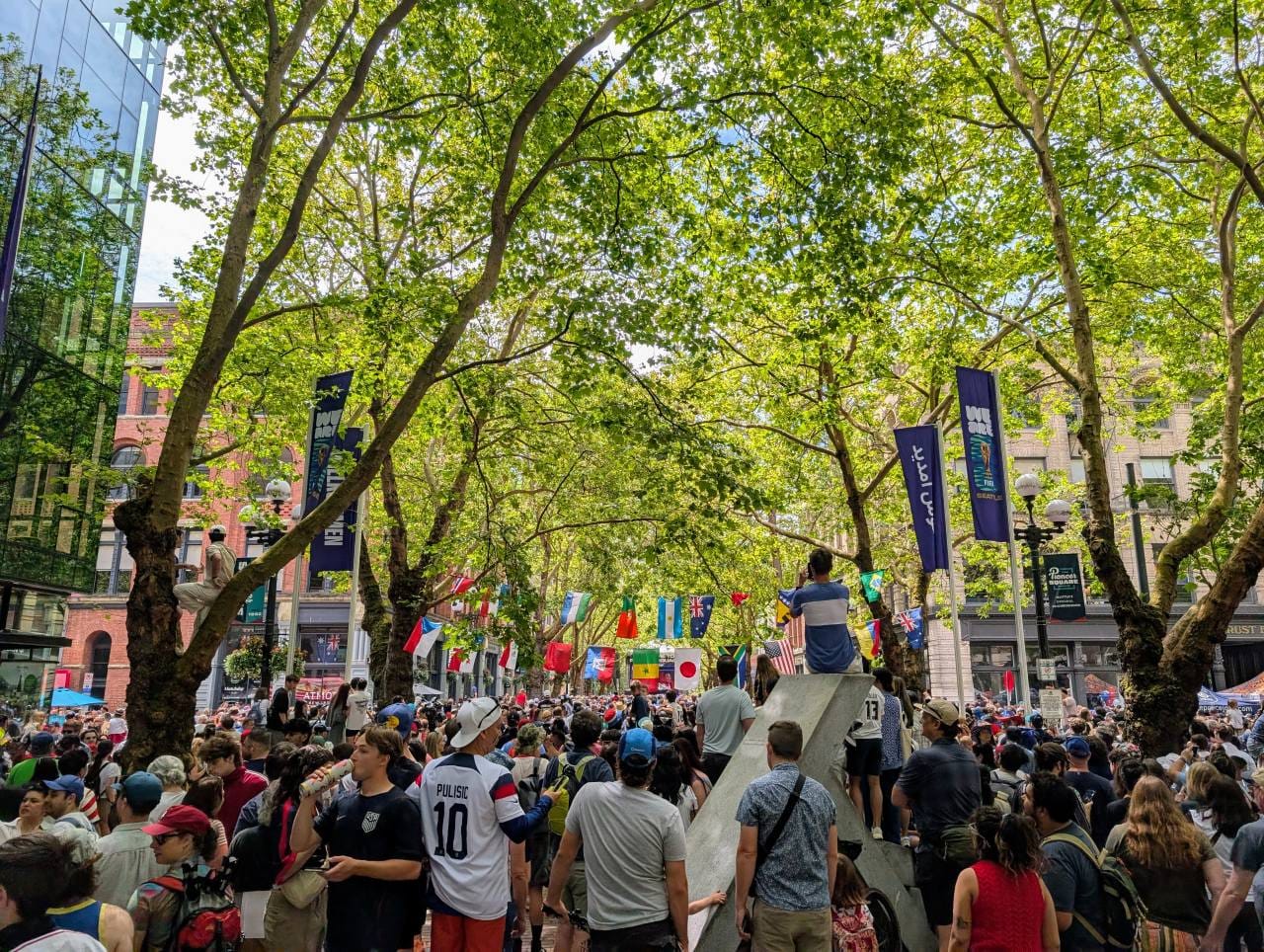
The same logic killed a community-safety plan in Pioneer Square. SDOT proposed 21 bike-parking corrals at intersections where parking is already illegal (and unsafe). The Alliance for Pioneer Square and the neighborhood’s historic commission opposed them. SDOT cut the plan from 21 to three, and moved the rest onto sidewalks, taking space from pedestrians instead of illegal parking. Meanwhile, for the FIFA World Cup, the city has pedestrianized all of Pioneer Square on match days. It can be done when the city decides to do it.
Our city could not even hold the line when the law was already on its side. This is the political logic the shared-space constituency exists to break.
The case for shared space
The idea is simple: streets, sidewalks, plazas, and curbs that work for the kid walking to school, the rider on the L8, the blind pedestrian, the elder on a bench, and yes, the contractor parking his rig, the Lyft pickup, the driver getting to a hospital. Not the end of cars. Not bikes versus drivers. Shared space is not ‘no cars.’ It is cars last, community first.
Some 27% of space in Seattle is already roads, parking, sidewalks and alleys. That quarter of the city should serve the greatest good, look to the future, build community, enable safe transit, support commerce. Today it is storage for private vehicles. In some cases, this serves the public good. In many others, it certainly doesn’t. Why is a cafe charged more for tables set up in a single parking spot than a single car, left there unused for weeks?
I grew up in the mountains behind Sequim. I dreamed of a car as a child, and the freedom it would bring in the rural hinterlands. Then a high schooler was killed near my house, biking where I’d biked, on a road with no shoulder, at night, because there was no other way to get home. The driver had no other way home either. Nobody was a villain. But the verdict, spoken and unspoken, was that the kid shouldn't have been on the road. That is how we talk about these deaths. We even call these incidents "car versus pedestrian," as if the car did it on its own.
The car-default is not freedom. It falls hardest on those with the least: too young to drive, too old, priced out entirely. AAA puts the cost of car ownership at around $12,000 a year. Cities, with ample connection and proximity, should be easiest for those without cars. We make them unsafe.
When SDOT surveyed the Rainier Valley about Lake Washington Boulevard, a majority of the ZIP code most affected backed opening it to people. The neighborhoods handed the worst streets are not asking to keep them. The boulevard is one of the clearest cases in the city: a scenic Olmsted parkway, 100 crashes from 2015 to 2022, used as a cut-through by drivers who have other routes and choose this one. Mayor Wilson just expanded its car-free weekends.
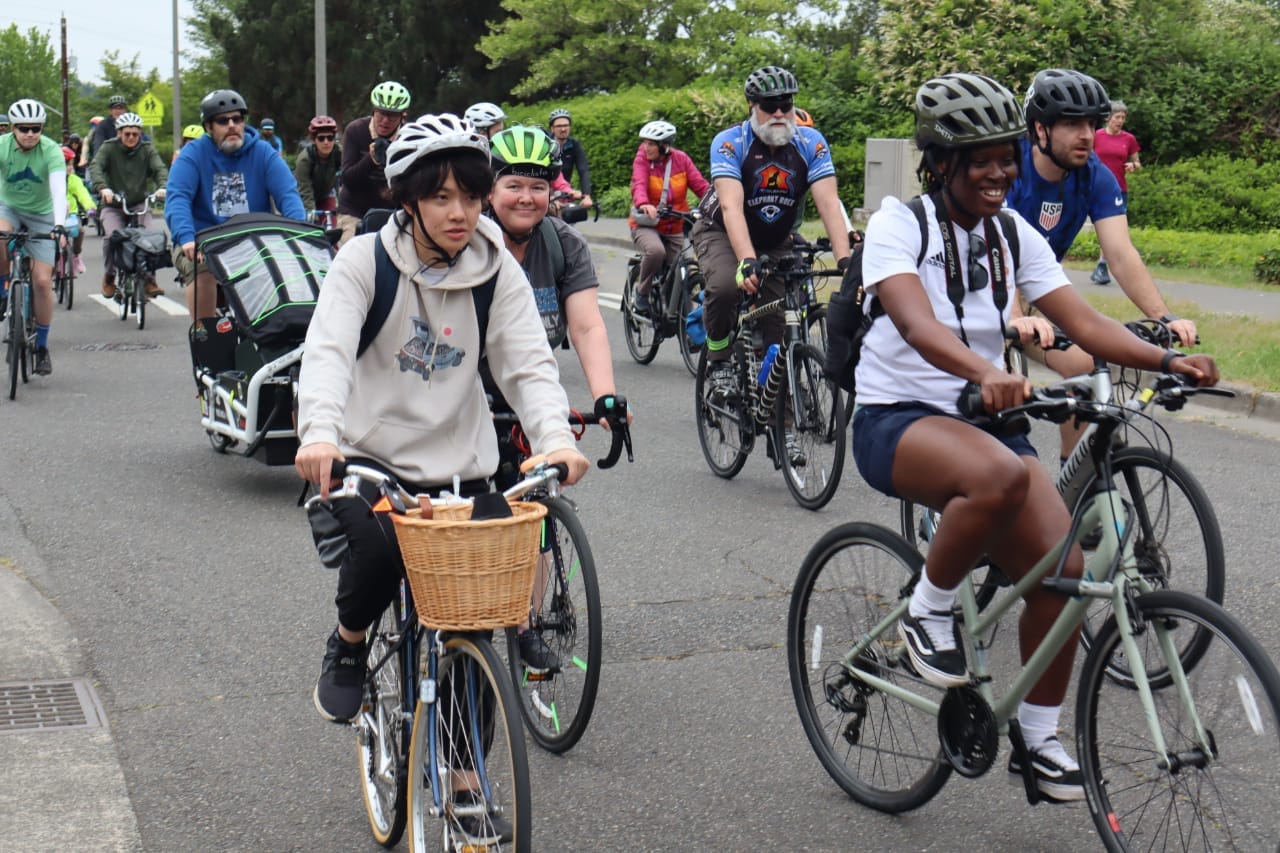
The Seattle Times editorial board, hardly a band of radicals, went further last month: close more neighborhood streets to cars, they argued, and rotate them across the city. They're right.
What to push for
Unapologetically removing cars from public space is transformative in a way you cannot imagine until you see it. Vancouver. Portland. Mexico City. Even Calgary. Each started with one block returned to the people. Here is what the shared-space constituency should push for in Seattle in the next 18 months:
Make Safe Routes to School and greenways actually safe. These streets carry the label. The city marks them on maps, paints curb ramps, posts signs, then accepts cars speeding past schools. Painted crosswalks are the floor. The ceiling - what we must demand - is treating a designated route to school as a street where a kid, not a car, is the design standard. Daylit corners, raised crossings, diverters, and, on some streets, no through traffic at all.
Use the new shared streets law on streets that need it. Not just signage on residential blocks. Start with paint, then real reengineering: bollards, planters, raised crosswalks, lane reductions. A sign that says "10 mph" on a street where cars go 35 will not protect a child. Traffic diverters will.
Require SDOT to commit that every repaving project incorporates safety improvements at initial design. Elliott Avenue is the live example. The Interbay segment has documented crashes and SDOT is still not adding more than car infrastructure. If the easier portion is not fixed now, the bigger portions never will be.
Transportation is 58% of Seattle's climate pollution. Not big oil, not a data center, but our own transportation choices in aggregate, particularly the daily car trips a better city would let us make another way. And hundreds of thousands more people will live here in the coming decades. Every climate fight is upstream of the same problem.
Paint is cheap. Bollards are cheap. Speed cushions are a rounding error against the 2024 Seattle Transportation Levy. The reason these things have not happened is not money. The people who would benefit don’t yet identify as a constituency. Car dominance has won by default.
The car in front of my house thankfully did not hit a child this time. The next one might.
Denny got its bus lane in four months because someone decided it could. The shared streets law exists because someone wrote it. The deaths will not stop because Councilmember Rob Saka called for another audit of the failing Vision Zero program that SDOT just audited. They will stop when the people already here, the walkers and riders, the elders and parents, and even the drivers who'd rather not be, act like the bloc they already are.
Jesse Swingle is co-chair of Queen Anne Streets Alliance and on the board of The Urbanist. If this piece described a bloc you want to be part of, join our emerging alliance on Signal here.
 Move All Seattle Sustainably (MASS) Coalition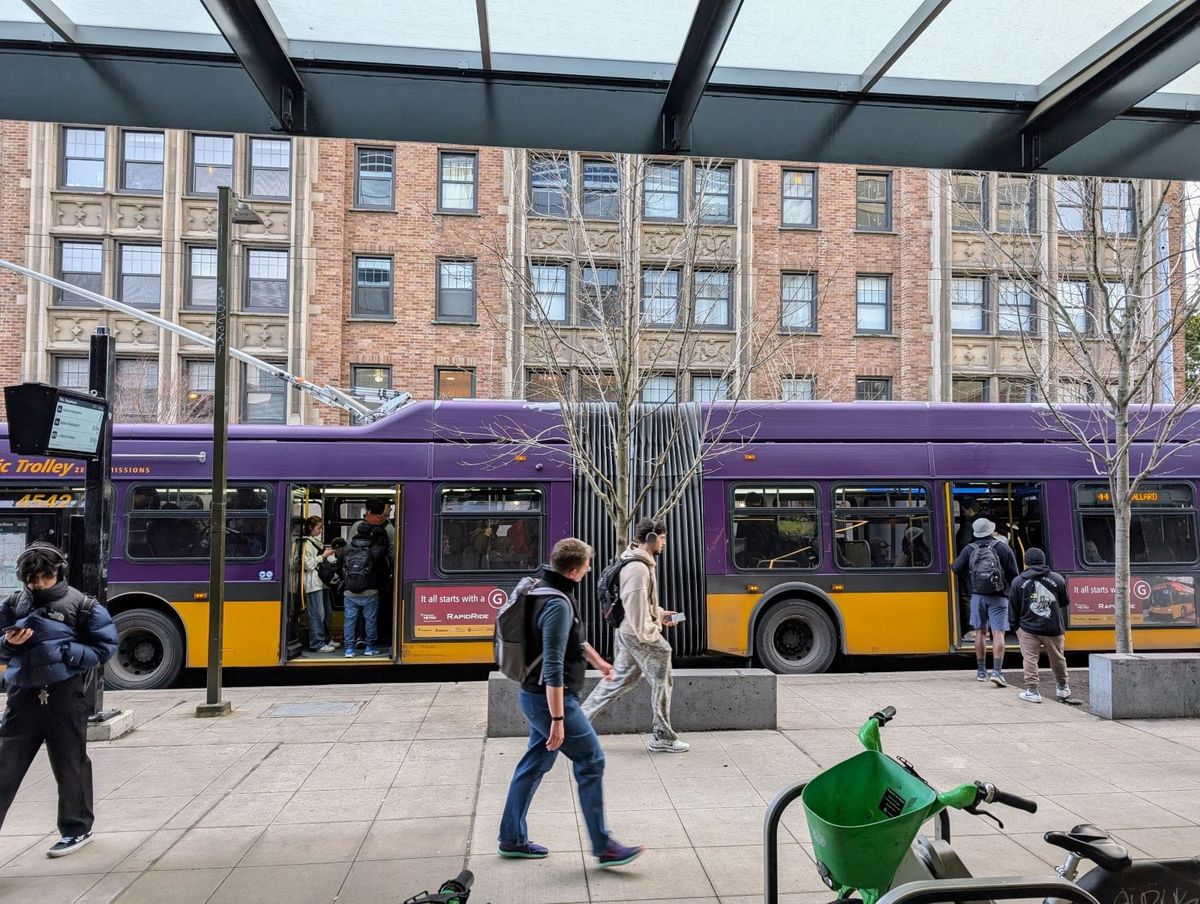
 Ryan Packer
 Doug Trumm